Isle of Man
Ellan Vannin: a self-governing Crown Dependency in the middle of the Irish Sea, about 85,000 people, not part of the United Kingdom and never part of the European Union. It has its own parliament, Tynwald, which still promulgates its laws outdoors on a mound at St John's every July, and whose surviving record begins in 1417 rather than in the 979 that gets quoted. It has its own Celtic language, Gaelg, which was written down using a spelling system borrowed from Elizabethan English, was declared dead by UNESCO in 2009 while hundreds of people spoke it, and is now taught to children at the Bunscoill Ghaelgagh. Norse kings ruled here for centuries and left runic crosses instead of portraits. The island gave some women the vote in 1881, and the restriction on that came from the unelected chamber, not the elected one. It held twenty thousand civilians behind barbed wire at Knockaloe in one war and interned Jewish refugees as enemy aliens in the next. It has the oldest motorcycle race in the world and a mountain course that has killed more people than anyone officially counts. And it has a wheel, a herring fleet, an electric railway, a tailless cat and a folklore in which you greet the fairies on the way past.
A chronological documentary of 1,174 moments spanning 1830–2026 on Loreline.
Curated by Olivier · last updated 2026-09-03
Eras
- Tynwald, The parliament and the ceremony. Tynwald claims to be the oldest continuous parliament in the world, and that claim survives only on the word continuous: Iceland's Althing is older, founded in 930, but was disbanded in 1800 and restored in 1845. The traditional date of 979 has no documentary support and appears to have been chosen so that a millennium could be celebrated in 1979; the earliest surviving House of Keys record is 1417. What is not in doubt is the practice: laws are still promulgated outdoors in Manx and English on Tynwald Hill at St John's every July. Also the Revestment of 1765, the Lord of Mann, the deemsters, and the 1881 Act that gave some women the vote, where the elected House of Keys wanted to go further than the appointed Legislative Council allowed.
- Stones, What the deep past actually left: megalithic tombs like Cashtal yn Ard and King Orry's Grave, the Meayll stone circle, the keeills that are early Christian chapels, and above all the Manx runic crosses and cross slabs, which carry Norse names and Norse myth cut into Christian monuments. This is where the Viking centuries live, because no contemporary image of any king of Mann exists and no honest archive can invent one. Also Castle Rushen and Peel Castle, Rushen Abbey, and the excavations that produced the Viking burials and the silver hoards.
- Land, Inland and agricultural: the glens, Snaefell and North Barrule, the curraghs, sod hedges and stone walls, the upland and the farms. The Manx Loaghtan, the native four-horned sheep, and Cregneash, the crofting village kept as a working museum. Also the Manx cat, which is a genuine and documented mutation of the Brachyury gene rather than a tourist invention, but which carries Manx syndrome, a real spinal welfare problem that an honest archive shows alongside the charm.
- The Season, From the 1870s the island sold itself to industrial Lancashire and Yorkshire as a holiday, and for a century that was the economy. Steam Packet paddle steamers into Douglas, boarding houses along the promenade, the Gaiety Theatre, the Villa Marina, Derby Castle, wakes weeks, deckchairs and the camera obscura. Then the collapse when cheap flights to Spain arrived, and what the island became instead. The Summerland fire of 2 August 1973, in which fifty people died at the Douglas leisure complex, belongs to this segment and is handled soberly.
- Folklore, Labelled as folklore throughout, never as fact. Manannan mac Lir, the sea god who shrouds the island in mist and may or may not have given it its name. The Moddey Dhoo, the black dog of Peel Castle, first written down in the 1700s. The Buggane, the Phynnodderee, and the Fairy Bridge at Ballalonna where you greet the Little People as you pass. The taboo words, including the one for rat. Hop tu Naa with its turnip lanterns rather than pumpkins, Yn Chruinnaght, the Manx Folk Awards, and the traditional music and dance that came back with the language.
- Racing, The Isle of Man TT and the Manx Grand Prix. The race began in 1907 on the St John's Short Course and moved to the 37 and three quarter mile Snaefell Mountain Course in 1911, which is a public road closed for the occasion and has never been a purpose-built circuit. Held to roughly a tenth of this archive on purpose, because the island is not a racetrack. On the deaths, which are real and heavily quoted: the large published figure covers the entire Mountain Course including the Manx Grand Prix and the Clubman TT rather than the TT alone, the lists separate competitors from officials, marshals and spectators, and no organisation maintains an authoritative count. This archive states scope rather than a bare number, and carries the memorials rather than the crashes.
- Internment, Twice in the twentieth century Britain interned civilians on this island. Knockaloe near Peel held on the order of twenty thousand men in the First World War and was effectively a town. In the Second World War the camps were requisitioned boarding houses with wire around them: Rushen at Port Erin and Port St Mary, which was the women's camp and unlike anything else in the system; Hutchinson in Douglas, which became known as the artists' camp and held Kurt Schwitters and Hellmuth Weissenborn among others; and Mooragh, Central Promenade and Peveril. Many of those interned as enemy aliens were Jewish refugees who had fled Nazism, which is the fact the whole subject turns on. The Arandora Star, carrying internees for deportation, was torpedoed in July 1940. Treated here as documentary record, never as spectacle.
- Gaelg, The Manx language, the largest segment in this archive because it is the island's most distinctive thing and because Manx speakers have put a great deal of it online themselves. Gaelg is a Goidelic language, sister to Irish and Scottish Gaelic, written with a spelling system based on Elizabethan English rather than classical Gaelic orthography, which is why it looks so unlike its relatives on the page. Ned Maddrell, the last native speaker from a Manx-speaking community, died on 27 December 1974. In 2009 UNESCO classified the language as extinct while hundreds of people spoke it, the linguist Jennifer Kewley Draskau objected publicly, and the classification was later revised to critically endangered. Around 2,223 people reported conversational ability in 2021, and the Bunscoill Ghaelgagh at St John's teaches children through the medium of Manx.
- Railways, An unusual survival: the island kept its Victorian transport when everywhere else scrapped it. The Isle of Man Steam Railway still runs steam to Port Erin, the Manx Electric Railway has been working since the 1890s with original tramcars, the Snaefell Mountain Railway climbs to the summit, and the Douglas horse tramway still runs along the promenade. Also the Groudle Glen Railway, the stations and sheds, and the rolling stock that would be in a museum anywhere else and is in daily service here.
- Mining, Lead, zinc, silver and copper, and the engineering that drained the workings. The Great Laxey Wheel, Lady Isabella, built in 1854 to pump water from the Laxey mines and still the largest working waterwheel in the world. Foxdale, the Snaefell mine, the adits and engine houses and washing floors, the mine railway, and the spoil that is still in the landscape. For a few decades in the nineteenth century this small island was a serious producer of zinc ore.
- Coast, The sea on every side, and the wildlife that comes with it. The Calf of Man and its bird observatory, Manx shearwaters, choughs, razorbills and kittiwakes, basking sharks in summer, seals, the Sound, Langness, the Point of Ayre, Spanish Head and the Chicken Rock lighthouse. The whole island is a UNESCO Biosphere Reserve, the only entire jurisdiction to hold that status. Also Raad ny Foillan, the coastal path that goes all the way round, and the herring fishery that the island lived on before it lived on visitors.
- Music, Added after the first build, because music had been scattered through folklore and language and deserved a home. Manx traditional song and tune, much of it sung in Gaelg: Arrane Oie Vie and the carvals, the island's own carol tradition. The dance sides Perree Bane and Ny Fennee, and Yn Chruinnaght, the inter-Celtic festival where the island meets Ireland, Scotland, Wales, Cornwall and Brittany. Fiddle, harp and the Manx bagpipe revival, sessions in pubs, the choirs and the Manx Music Festival that everyone calls the Guild, and the Manx Folk Awards where the children compete. Then the living end of it: Ruth Keggin singing in Manx, and Davy Knowles from Port St Mary playing blues. Culture Vannin has put more of this online than anyone, which is why so much of this segment comes from them.
- - Tynwald berthed at the Coffee Palace Berth, Douglas, Isle of Man.. The Steam Packet vessel Tynwald berthed at the Coffee Palace Berth, Douglas. The Isle of Man Steam Packet Company was founded in 1830 and describes itself as the oldest continuously operating passenger shipping company in the world.
- - Archaeological Journal, Volume 3, 0065. An engraving of the Cathedral of St German at Peel from the Archaeological Journal, volume 3, 1846. Antiquarian recording of this kind is how the island's monuments entered the scholarly record.
- - Snaefell pictured at Douglas.. The Steam Packet vessel Snaefell of 1863 at Douglas. The company named a succession of ships Snaefell after the island's highest point, Manx Sniaull, from the Old Norse for snow mountain.
- - Isle of Man Steam Packet Company packet steamer, Fenella. The Steam Packet's iron twin-screw steamer SS Fenella, No. 76303, built 1881. The company's Victorian fleet was built for a passenger trade that ran to hundreds of thousands of arrivals a season.
- - Tim mylrea and the buggane. ', an illustration from 'The Phynodderee, and other legends of the Isle of Man', 1882. The Buggane is a malicious shape-shifting giant of Manx legend; the best known one is said to have torn the roof off St Trinian's Church each time builders finished it, which is offered as the reason the chapel stands roofless.
- - Flaxney Stowell (1846-1916) - Castletown Harbour - 1955-0345 - Manx Museum. 'Castletown Harbour' by Flaxney Stowell (1846 to 1916), 1884, in the Manx Museum collection. Castletown was the island's capital until Tynwald moved to Douglas in 1874, ten years before this was painted.
- - John Miller Nicholson (1840-1913) - A Summer Afternoon, Douglas Promenade - 1954-2501-050 - Manx Museum. 'A Summer Afternoon, Douglas Promenade' by John Miller Nicholson (1840 to 1913), painted in 1888. Nicholson is the island's principal Victorian painter and recorded Douglas at the height of its resort trade.
- - Douglas Head, Isle of Man. 781 (NBY 419249). An Oilette postcard of Douglas Head and the harbour, published around 1905. The postcard trade is itself evidence of the resort boom: the island was being sold as an image to a mass market that arrived by steamer.
- - Norton TT 1907 01. The Norton with a Peugeot engine on which Rem Fowler won the twin-cylinder class of the first Tourist Trophy in 1907. Charlie Collier won the single-cylinder class and the race overall on a Matchless, covering ten laps of the St John's Short Course in 4 hours 8 minutes 8 seconds at an average of 38.21 miles per hour.
- - Snaefell leaving Ramsey. The Steam Packet vessel Snaefell of 1910 leaving Ramsey (Rhumsaa). Ramsey is the island's second port and the northern terminus of the Manx Electric Railway.
- - Box, souvenir (AM 2006.92.6-11). A souvenir box made by a German internee signing himself F.P.C. at the Douglas Aliens Detention Camp during the First World War. Fine handwork in bone, wood and straw is the best documented material category to come out of Manx internment, made by men with time and almost nothing else.
- - Box, souvenir (AM 2006.92.6-3). One of a set of souvenir boxes made by the internee F.P.C. at the Douglas Aliens Detention Camp in the First World War. The Douglas camp, in a former Cunningham holiday camp, opened before Knockaloe and was the island's first.
- - Box, souvenir (AM 2006.92.6-18). Another souvenir box by the internee F.P.C., Douglas Aliens Detention Camp, First World War. Craft work of this kind was sold, traded and sent home, and it is one of the few ways interned men entered the record in their own hand.
- - Box, souvenir (AM 2006.92.6-6). A carved souvenir box from the Douglas Aliens Detention Camp, made by a German civilian interned on the island during the First World War. The maker is known only by the initials F.P.C.
- - Eerste Wereldoorlog, propaganda, ansichtkaarten, prentbriefkaarten, SFA018000848. An orchestra of German prisoners at the Douglas camp, First World War, reproduced on a propaganda postcard. Organised music, theatre and teaching recur through the whole century of Manx internment, in the WWI camps and again in the WWII camps at Douglas and Onchan.
- - Box, souvenir (AM 2006.92.6-8). A souvenir box from the Douglas Aliens Detention Camp made by the internee F.P.C. during the First World War. Objects like these travelled: this one is now in the Auckland Museum collection.
- - Box, souvenir (AM 2006.92.6-7). Souvenir box carved by the German internee F.P.C. at Douglas during the First World War. Bone, wood and straw work of this kind is strongly attested in Manx museum collections.
- - Box, souvenir (AM 2006.92.6-12). A souvenir box made at the Douglas Aliens Detention Camp by the German internee F.P.C., First World War.
- - Box, souvenir (AM 2006.92.6-14). Another of the F.P.C. souvenir boxes from Douglas Aliens Detention Camp. The Douglas camp was set up in a requisitioned holiday camp and preceded Knockaloe, which opened in November 1914.
- - Box, souvenir (AM 2006.92.6-16). A souvenir box carved by the German internee F.P.C. at Douglas Aliens Detention Camp during the First World War, now in the Auckland Museum.
- - Waiting For Dinner in the Huts Art.IWMART17056. 'Waiting For Dinner in the Huts', painted inside a Manx internment camp in 1916, with bunks along the walls and clothing hung from hooks. Knockaloe was built of wooden huts, unlike the requisitioned boarding houses used in the Second World War.
- - Overnight Snowfall Melting Into Slush Art.IWMART17057. 'Overnight Snowfall Melting Into Slush', a camp yard between wooden huts, painted by an internee in 1917. Knockaloe held around 23,000 men, making it effectively one of the largest settlements in the Irish Sea.
- - View of a Pow Camp, Isle of Man, 1915-1919 Art.IWMART17053. A view down into a First World War prisoner camp on the island, painted by an internee between 1915 and 1919. WWI Knockaloe material is by far the better documented and more freely available seam of Manx internment imagery.
- - George Kenner and brother Benno washing salt herrings on the Isle of Man PoW Camp 10.9.1918. George Kenner and his brother Benno washing salt herrings at Knockaloe in 1918. Kenner was a German civilian interned for the duration, and the paintings and drawings he made inside the camp are among the fullest visual records of it that exist.
- - Storm and Rainbow, Symbol for Near End of War 1918 Art.IWMART17055. 'Storm and Rainbow, Symbol for Near End of War', painted in a Manx internment camp in 1918. The painter was one of the German civilians held at Knockaloe under Britain's enemy alien policy.
- - Last Supper Before Returning Feb. 1919 Art.IWMART17054. 'Last Supper Before Returning', February 1919, painted inside a Manx internment camp as men prepared to leave. Knockaloe operated until 1919, four months after the armistice.
- - Manx Gaelic recording - Ned Maddrell (Last native Manx Speaker). Archive audio of Ned Maddrell speaking Manx Gaelic. Maddrell, a fisherman from Cregneash (Creneash), was the last native speaker from a Manx-speaking community and died on 27 December 1974. He learned Gaelg from his great-aunt Margaret Taubman, who had no English.
- - [SA 0042] Ellyn yn ny Geal concert in Douglas. A concert recording held in the Manx sound archive. Audio of this kind survives because recording equipment was sent to the island in 1948 at the direction of Eamon de Valera, then Taoiseach, to capture the last native speakers.
- - [SA 0041] Interview with John Thomas Kaighen speaking Manx Gaelic and a choir rehearsal. An archival recording of a native Manx speaker. Recording equipment was sent to the island in 1948 at the direction of Eamon de Valera, then Taoiseach, specifically to capture the last native speakers, which is why audio of them exists at all. Choral singing is long established on the island, and the Manx Music Festival, known locally as the Guild, has been its main competitive stage.
- - Manx language and dialect archive recordings: Skeealyn Vannin, Disk 2 Track 7iii. An archive recording from Skeealyn Vannin, Manx National Heritage's published collection of Manx language and dialect recordings made of the island's last native speakers.
- - Manx language and dialect archive recordings: Skeealyn Vannin, Disk 2 Track 7ii. A Skeealyn Vannin archive track. Recording equipment was sent to the island in 1948 at the direction of Eamon de Valera, then Taoiseach, specifically to capture the last native speakers of Manx Gaelic before the generation was gone.
- - Manx language and dialect archive recordings: Skeealyn Vannin, Disk 2 Track 6ii. An archive recording of spoken Manx from the Skeealyn Vannin collection held by Manx National Heritage. Actual audio of native Gaelg speakers survives because the Irish state intervened in 1948.
- - Isle of Man TT 1950. Footage of the 1950 Isle of Man TT. By this date the race had been running over the 37.73-mile Mountain Course since 1911; the first TT of 1907 was held on the shorter St John's Short Course on the west of the island.
- - Geoff Duke Isle of Man TT 1951. Geoff Duke at the 1951 Isle of Man TT. Duke won the Senior and Junior TTs that year and went on to six world championships, and he later settled on the island.
- - Manx Electric Railway, Laxey - 1963. The Manx Electric Railway at Laxey in 1963. The MER passed through several changes of ownership and near-closure in the twentieth century before the Manx government took it on.
- - Snaefell Mountain Railway - 1963. The Snaefell Mountain Railway in 1963. The line has been carrying passengers to the island's highest point since 1895 without interruption of its route.
- - Tynwald, Isle of Man. Tynwald Hill at St John's, photographed in December 1966. The mound is stepped in four tiers, and the ceremony held on it is the reason Tynwald describes itself as the oldest parliament in continuous existence; Iceland's Althing was founded earlier, in 930, but was suspended between 1800 and 1845.
- - Kirk Michael Station, IOM. Kirk Michael station in 1970. The line through Kirk Michael on the west coast closed in the 1960s, and its trackbed is now a walking route.
- - 1970: MANX ALIVE! Life on the Isle of Man | Man Alive | Voice of the People | BBC Archive. The BBC's 'Man Alive' filmed island life in 1970. The island's population at the 2021 census was 84,069, of whom just under half were born on the island and 38.2 per cent in the United Kingdom.
- - Fishing boats at Peel, Isle of Man. Fishing boats at Peel in 1972. The island's herring fleet had already collapsed by then: from over 300 nickeys based on the island in 1879 to just 25 boats in 1922, and the modern Manx fishery is scallop and queen scallop.
- - Summerland, Douglas, Isle of Man, & the tragic 1973 fire, by band members Mike & Linda Fletcher. A song by band members on the Summerland fire of 2 August 1973 at Douglas (Doolish), in which fifty people died. It remains the island's deadliest peacetime disaster.
- - Manx Electric Railway train approaching Cornaa 1973. Manx Electric Railway winter saloon 21 with trailer 41 approaching Cornaa in 1973, on the way to Ramsey. The northern half of the line runs through the glens of the east coast and was under threat of closure through much of this period.
- - Isle of Man Holiday 1970s. Amateur film of an Isle of Man holiday in the 1970s. The mass market for the island was Lancashire and Yorkshire mill workers travelling on Wakes Weeks, a trade that declined sharply as cheap air travel to the Mediterranean spread.
- - View from the Laxey Wheel. Laxey village seen from the top of Lady Isabella in 1979. The wheel stands over 22 metres in diameter and visitors climb the stair around its rim.
- - Ferry on the Mersey. An Isle of Man ferry on the Mersey in 1979. The heyday of holiday traffic had passed by then, but the boats were still packed at peak times.
- - 05882 (858) 30-06-1982 of the Isle of Man Railways steam tank locomotive No 11 "Maitland" at Douglas, Isle.... Isle of Man Railway steam tank locomotive No. 11, photographed on 30 June 1982. The line's locomotives are Beyer, Peacock two-foot-six-inch gauge engines, some over a century old and still working.
- - Laxey Wheel, 1980s - Film 7211. Film archive footage of the Laxey Wheel in the 1980s. The wheel had ceased industrial work with the mines and was already a visitor attraction, restored and maintained as a monument.
- - 1986 Isle of Man TT 80th Anniversary Documentary. A documentary made for the 80th anniversary of the TT in 1986. Counting from the first race of 28 May 1907, organised by the Auto-Cycle Club over ten laps of the St John's Short Course with 25 entrants.
- - The train now departing - Steam on the Isle of Man - 1988. Steam on the Isle of Man in 1988. The Steam Railway was reduced to the Douglas to Port Erin line in the 1960s and 1970s after the rest of the network closed, and has run continuously since.
- - JoeyDunlopTT1992Gooseneck125ccm. Joey Dunlop at the Gooseneck on his 125cc machine at the 1992 Isle of Man TT. Dunlop was Northern Irish rather than Manx, took 26 TT wins and was killed in a road race in Estonia in 2000.
- - Isle of Man TT Races RC30. Nick Jefferies on a Honda RC30 at Creg-ny-Baa during the 1992 Isle of Man TT. Creg-ny-Baa is the right-hander at the bottom of the mountain descent and one of the best known spectator points on the course.
- - Isle of Man Steam Railway with footplate (cab) ride June 1992. A footplate ride on the Isle of Man Steam Railway in June 1992. The three foot gauge line has run from Douglas to Port Erin since the nineteenth century and is publicly owned.
- - RobertDunlopTT92Start. Robert Dunlop at the start of the 1992 Isle of Man TT. Robert was Joey Dunlop's brother, and the family's association with the island's road racing spans four decades.
- - The Laxey Wheel as seen from Mines Road, Laxey. The Laxey Wheel from Mines Road, 1993. The wheel was designed by Robert Casement and named for Lady Isabella Hope, wife of Lieutenant Governor Charles Hope.
- - IOM Manx Electric Railway Centenary 1893-1993. The centenary of the Manx Electric Railway, marked in 1993. The line opened in 1893 and cars 1 and 2 of that first year are still in service, which is the basis of its claim to be the oldest electric tram line running its original stock.
- - Perree Bane: Manx dancing at Yn Chruinnaght 1995. Perree Bane is one of the island's dance sides, formed to perform the Manx dance repertoire. Yn Chruinnaght is the island's inter-Celtic festival, where Mann meets Ireland, Scotland, Wales, Cornwall and Brittany.
- - Groudle Glen Railway Centenary 1996. The centenary of the Groudle Glen Railway in 1996. The two foot gauge line opened in 1896 to carry Victorian holidaymakers from Groudle Glen out to a headland zoo, and was restored by volunteers.
- - Songs of Praise - Peel Castle, Isle of Man, 1997 (Part 1). Songs of Praise recorded at Peel Castle in 1997. The castle on St Patrick's Isle was originally built by the Norse in the eleventh century and later held the cathedral of the diocese of Sodor and Man.
- - Isle of Man Sea Terminal. The Isle of Man Sea Terminal at Douglas. The terminal is the island's principal point of arrival and sits at the head of the harbour that made Douglas the capital.
- - Race Commentary - 1998 Senior TT. Manx Radio's original race commentary on the 1998 Senior TT, the blue riband race of the meeting. The Senior is run over six laps of the 37.73-mile Mountain Course.
- - Niarbyl - Thatched fisherman's cottage at Niarbyl Bay. A thatched fisherman's cottage at Niarbyl Bay on the west coast. Niarbyl means 'the tail' in Manx, from the reef running out from the shore, and the cottages sit directly on the beach where boats were worked.
- - Douglas - Marine Drive (A37) - Coastal scenery. Coastal scenery from Marine Drive, the A37 south of Douglas. The road was cut as a Victorian scenic route along the cliffs and is now partly closed to traffic by rockfall.
- - Douglas - Marine Drive (A37) - Coastline. The coastline from Marine Drive, the A37 south of Douglas. Marine Drive was built as a Victorian toll road for carriages and trams along the cliff edge.
- - Cregneash - View of village from south. Cregneash (Creneash) seen from the south. The village is run as a living museum by Manx National Heritage and presents traditional croft life alongside Loaghtan sheep.
- - Cregneash - Folk Museum tearoom interior. The tearoom interior at Cregneash Folk Museum. By 1848 J. G. Cumming already observed that few islanders, and perhaps none of the young, spoke no English at all.
- - Douglas - Central Promenade along Douglas Bay. Central Promenade along Douglas Bay. The unbroken run of Victorian and Edwardian frontage is the physical record of the mass tourism boom; the same terraces were sealed behind wire as an internment camp in 1940.
- - Niarbyl - Horse back rider and thatched cottage. A rider and a thatched cottage at Niarbyl on the west coast, filed under racing. Niarbyl is a fishing hamlet on the coast road and is not part of the Mountain Course.
- - Douglas - Central Promenade - Sunrise to the east. Central Promenade, Douglas (Doolish), at sunrise. Central Promenade Camp opened here in June 1940 and held over 2,000 internees by the end of that month, predominantly Italian; it closed after about ten months and became an RAF base.
- - TT Archive: 2000 Lightweight TT - Full Commentary. Archive commentary on the 2000 Lightweight TT. Joey Dunlop won the Ultra Lightweight race at this meeting, his 26th and final TT victory; he was killed in a road race in Estonia a few weeks later.
- - TT Archive: 2000 Formula One - Full Commentary. Archive commentary on the 2000 Formula One TT. This was Joey Dunlop's final TT meeting, at which he took the last of his 26 wins.
- - The cliffs of Spanish Head. 's southern end. The name is attached to a legend of a wrecked Spanish galleon, for which no evidence has been found; the same Armada story is also told to explain the tailless Manx cat, and is folklore in both cases.
- - Laxey - The Mines Trail - T-Rocker. The T-rocker on the Laxey Mines Trail, which converted the horizontal motion of the pump rod into vertical motion at the shaft. The Great Laxey Wheel was a pump, not a mill: it lifted floodwater from the Glen Mooar workings up to the Main Adit.
- - Douglas - Marine Drive - Road closure at SW end. The road closure at the south-west end of Marine Drive. The cliff route has been progressively abandoned to landslip since the Victorian period.
- - Laxey - The Mines Trail - InsideThe Old Adit. Inside the Old Adit on the Laxey Mines Trail. The Main Adit drained the workings out to the Laxey river and the sea, and it is the drainage system the great wheel existed to serve.
- - Laxey Wheel - View to southwest. The Laxey Wheel under repair and repainting in 2003, in preparation for the 150th anniversary of Lady Isabella. Manx National Heritage, which operates the site, describes it as the largest working waterwheel in the world.
- - Laxey - Mines Trail - Machine House, Engine House. The Machine House of 1856 and the Engine House on the Laxey Mines Trail. The surface buildings survive where the underground workings are long since sealed.
- - Cregneash Village - Village Sign. The village sign at Cregneash (Creneash), the folk village run by Manx National Heritage. This was Ned Maddrell's village; he was born here in 1877 and is described as the last speaker who grew up in a Manx-speaking community.
- - Douglas - Harris Promenade - Sefton Hotel. The Sefton Hotel on Harris Promenade, Douglas. The Sefton was among the buildings requisitioned in the Second World War, when the island's empty boarding houses were turned into internment camps.
- - Laxey - Cart used to haul ore from Laxey Mine. A cart used to haul ore from Laxey Mine. The Great Laxey Mine Railway, a narrow gauge line serving the workings, has been partly restored.
- - Cregneash - Village lane past The Weaver's House. A village lane at Cregneash past the Weaver's House. Culture Vannin, the trading name of the Manx Heritage Foundation, was established by the Isle of Man Government in 1982 and employs a Manx Language Development Officer.
- - Douglas - 'Stabit' on display near Loch Promenade. 'Stabit' on display near Loch Promenade, Douglas. The name comes from the island's motto, 'Quocunque Jeceris Stabit', whichever way you throw it it will stand, which is Latin and dates from the 17th century, later than the triskelion itself.
- - Cregneash Village - Lane, thatched cottage, Museum. A thatched cottage and lane at Cregneash Village. Thatch, whitewash and low stone walls are the surviving fabric of Manx crofting, preserved here as a working museum rather than a reconstruction.
- - Douglas - Duke Street - Feegan's Lounge. Feegan's Lounge on Duke Street, Douglas, in 2003. The pubs and lounges behind the promenade served a resident trade year round rather than the summer visitors.
- - Cregneash Village - Village lane off A31. A village lane off the A31 at Cregneash, used as a funeral procession route in the film 'Waking Ned Devine'. The village's unaltered fabric is what makes it filmable, and it is the reason Manx National Heritage keeps it in working condition.
- - Isle of Man Steam Operated Railways 2003. Steam operation on the island's railways in 2003. The Isle of Man Steam Railway has run since the 1870s and its surviving locomotives include Loch and Maitland, both built by Beyer Peacock.
- - Cregneash Village - The Smithy taking a break. The smithy at Cregneash Village taking a break. Every current speaker of Manx is what scholars call a new speaker, having acquired the language other than by transmission in the home.
- - SnaefellMtnRly1-NrLaxey-CIMG0402. Snaefell Mountain Railway train No. 1 descending towards Laxey. The mountain cars have run this line since 1895 and use a bow collector on the overhead.
- - Derby Castle, Manx Electric Railway. Derby Castle, the Douglas terminus of the Manx Electric Railway. The depot and workshops here maintain cars that are over a century old.
- - Skyhill farm, Isle of Man. Skyhill farm above the Glen Auldyn valley, with views to North Barrule. Skyhill was the site of Godred Crovan's decisive battle in 1079, after which he took Mann and founded the Crovan dynasty.
- - View of Ballaterson Manor from the Crossroads. Ballaterson Manor seen from the crossroads, a modern house rather than a medieval one. Manx farm names beginning Balla, from balley, a farm or homestead, are among the most common place-name elements on the island.
- - Sulby Glen - Isle of Man. The young Sulby river running over rocks in Sulby Glen. The glen is the largest on the island and cuts back into the central massif below Snaefell.
- - The Beach at Glen Maye, Isle of Man. The beach at the bottom of Glen Maye gorge on the west coast. The island's glens are wooded ravines running down to the sea and are a distinct Manx landscape category.
- - Ewan Hamilton. A rider on the Snaefell Mountain Course, 31 August 2005. 2005 was the deadliest year in the course's history with eleven deaths across the whole season, most of them at the August and September Manx Grand Prix rather than the June TT.
- - TYN06 DW-1. Tynwald Hill at St John's, 2006. Laws promulgated here are read in both Manx and English, which makes Gaelg a working language of the constitution rather than only a heritage one.
- - Manx Flag. A Manx flag hanging with others from the ceiling of a bar in Key West, Florida. The triskelion is one of the most travelled Manx exports, carried by a heavy nineteenth and early twentieth century emigration, particularly to the United States and Australia.
- - TYN06 DW-4. Tynwald Hill and its processional way at St John's, 2006. Tynwald is Tinvaal in Manx, and the High Court of Tynwald is Ard-whaiyl Tinvaal.
- - Footpath at Aldrick, Isle of Man. The coastal footpath at Aldrick between Port Erin and the Sound. The Raad ny Foillan, the Road of the Gull, is the waymarked path that encircles the whole island.
- - Man sheep.. A Manx Loaghtan sheep. The breed's name comes from the Manx lugh dhoan, mouse brown; by the 1950s only 43 animals survived, and the Rare Breeds Survival Trust raised it to priority status in 2025 because numbers are falling again, with fewer than 1,500 registered breeding females.
- - Lighthouses, foghorn & tholtan (derelict building), Calf of Man. The lighthouses, foghorn and a tholtan, a derelict building, on the Calf of Man. The lights are now unoccupied following automation, though the central foghorn is still in use.
- - MER 9, Groudle Glen, 2006 (01). Manx Electric Railway car No. 9 at Groudle Glen station. The MER opened in stages from 1893 and reached Ramsey in 1899.
- - Little Isabella, Groudle Glen, 2006 (01). Little Isabella at Groudle Glen. The Groudle Glen Railway is a two-foot gauge line built to carry visitors to a coastal zoo, and it is now preserved and running again.
- - Isle of Man Steam Railway - train in Colby station. An Isle of Man Steam Railway train at Colby station. The southern line runs from Douglas through Ballasalla, Castletown, Colby and Port St Mary to Port Erin.
- - Castletown. Castle Rushen at Castletown (Balley Chashtal). The castle was the seat of the Lords of Mann and the island's centre of government, and the Revestment Act was read publicly here on 11 July 1765.
- - Part of the Meayll Circle. 18 metre circle, a plan not found elsewhere in the British Isles in this form.
- - Peel general view of castle Isle of Man England. A photochrome print of Peel Castle. The castle's red sandstone curtain wall encloses the whole of St Patrick's Isle.
- - Cows alongside Side Burn. Cattle grazing beside a burn. Agriculture accounts for a small share of the island's economy today, but it shaped the field pattern and the sod hedges that define the lowland landscape.
- - Emeraude france douglas. The ferry Emeraude France in Douglas Harbour. The island's sea links run mainly to Liverpool and Heysham, with seasonal routes to Ireland.
- - Crossroads on the A14 Sulby to Sandygate Road. The crossroads on the A14 between Sulby and Sandygate, signposted to Ballaugh Curraghs. The Curragh is the island's largest wetland and holds a nationally important winter roost.
…994 further moments continue the chronology here. Full text archive: /loreline-text/isle-of-man.md
- - Cormorant1. A cormorant on the Manx coast. Shags and cormorants breed on the cliffs alongside kittiwakes, razorbills and the Manx shearwater.
- - Niarble view to the South - panoramio. Niarbyl looking south along the west coast. The bay's thatched cottages and reef make it one of the most photographed points on the island.
- - Calf of Man. The Calf of Man (Yn Cholloo). The Manx shearwater, Puffinus puffinus, takes its scientific and common name from the island; the Calf colony was devastated by rats historically and has been the subject of restoration work.
- - Groudle Glen Hotel and tram station Isle of Man England. A photochrome print of the Groudle Glen hotel and tram station with Manx Electric Railway tram No. 5. Groudle Glen was one of the pleasure grounds built along the electric line to give the trams somewhere to carry people to.
- - Mooragh Park Lake Ramsey BW. Mooragh Park at Ramsey (Rhumsaa). Mooragh Camp opened on 27 May 1940 with a first intake of 823 internees and ran until September 1945. Like every Manx WWII camp it was made of requisitioned boarding houses enclosed in barbed wire rather than purpose-built compounds, and it held Nazi sympathisers and Jewish men together.
- - Liverpool scene from Pier Head landing stage. Liverpool's Pier Head landing stage, the former berth for the Isle of Man ferry. The service now runs from the Isle of Man Ferry Terminal on Triskelion Way, named for the island's three legs.
- - Bee Gees - Ellan Vannin (unofficial anthem of Isle of Man ). Ellan Vannin is the Manx name for the island, and the song of that name is treated as an unofficial anthem. The national anthem is Arrane Ashoonagh Vannin.
- - Queen's Promenade, Douglas. (Doolish), looking north. Tynwald moved from Castletown to Douglas in 1874, following the population and the money to the resort capital.
- - View to Castletown seafront from Irish Quay. Castletown (Balley Chashtal) seafront from Irish Quay, with the tower of King William's College behind. Castletown was the island's capital and the seat of the House of Keys until 1874.
- - Castle Rushen. 's courts, prison and administration for centuries.
- - Watch Tower. A tower at Peel Castle on St Patrick's Isle. The castle was originally built by the Norse in the 11th century and stands on the islet joined to Peel by a causeway.
- - Douglas Bay Isle Of Man Panorama Source1. Douglas Bay. The town became the island's resort capital on the back of the steamer trade, with a promenade of boarding houses built to receive Lancashire and Yorkshire mill workers on their Wakes Weeks.
- - Bunscoill Gaelgagh. An early report on the Bunscoill Ghaelgagh. The school opened at St John's in September 2001 and moved into the island's mainstream education structure in 2020.
- - Snaefell,Isle of Man Steam Packet. The Steam Packet fast craft Snaefell at Douglas. The company was founded in 1830 because crossings before then were irregular and unreliable and the island could be cut off for weeks, which makes the Steam Packet a self-determination story as much as a transport one.
- - Learn Manx Gaelic with Adrian Cain. Learning Manx with Adrian Cain, the island's Manx Language Development Officer. The post is employed by Culture Vannin, established by the Isle of Man Government in 1982 as the Manx Heritage Foundation.
- - Spanish Head from Black Head. Spanish Head seen from Black Head, with the Chicken Rock lighthouse in the distance. Chicken Rock stands off the Calf of Man and was for decades one of the loneliest keepers' postings in the British Isles before automation.
- - Isle-of-Man--Douglas--Jubilee-clock-2. The Jubilee clock in Douglas, also known as the Victoria Clock. It was erected for Queen Victoria's jubilee, in the decades when the resort trade was at its height.
- - Isle-of-Man--Douglas--The-Henry-Bloom-Noble-Library-1. The Henry Bloom Noble Library in Douglas. Noble was a Manx philanthropist whose bequests funded much of the town's public provision in the resort era.
- - Tram at Derby Castle terminus of Manx Electric Railway. A tram at the Derby Castle terminus of the Manx Electric Railway. Derby Castle is where the horse tramway along Douglas promenade meets the electric line north, so a passenger can cross the island on Victorian traction alone.
- - Arandora Star Part 4 of 4. Part four of a documentary series on the Arandora Star. The ship was carrying more than 1,600 men although designed for about 500; the sinking on 2 July 1940 changed British public opinion on internment and releases followed from later that year.
- - House-of-Manannan vikinger Peel-Man 03. A display at the House of Manannan in Peel (Purt ny hInshey) showing a longship being put ashore. Manannan mac Lir is the island's tutelary sea god of legend, said to shroud Ellan Vannin in mist to hide it from invaders; the museum named for him interprets the Norse-Gaelic period through objects and reconstruction because no contemporary image of any king of Mann exists.
- - Manannan Douglas. HSC Manannan in Douglas Harbour. The Steam Packet fast craft is named for the legendary sea god Manannan mac Lir, whose cloak of mist is the island's living idiom for its sea fog.
- - Funny song Manx Kipper Song. A comic song about the Manx kipper. Smoked herring remains the island's best-known food export.
- - House-of-Manannan Peel-Man 01. Part of the House of Manannan at Peel, with sculptures of Vikings dragging a longship through the window display. Museum reconstruction of this kind is interpretation and should not be read as a picture of the Norse-Gaelic kingdom.
- - Old House Of Keys, Castletown, Isle Of Man.. The Old House of Keys at Castletown (Balley Chashtal), seat of the Manx parliament until it moved to Douglas in 1874. The House of Keys was self-electing until the House of Keys Election Act 1866, a closed body that filled its own vacancies; the first popular elections were held in April 1867.
- - Manx Tradition: Arrane Ghelbee (Dalby Song). A traditional Manx Gaelic song from the island's collected repertoire.
- - House-of-Manannan vikinger Peel-Man 04. Viking figures on display at the House of Manannan, Peel. The Norse-Gaelic kingdom that ruled here was a hybrid society, and its real material evidence is the runic crosses that cut Scandinavian myth alongside Christian imagery.
- - Peel Harbour
- - Great Laxey Wheel, mineral mine hitech from 18th century. The Great Laxey Wheel. It is a pumping engine, not a mill: the wheel drove rods along a viaduct to lift water from the mine workings up to the Main Adit, which drained to the Laxey River and the sea.
- - Waterwheel Viaduct, Laxey, Isle Of Man.. The waterwheel viaduct at Laxey. The wheel is water-powered because the island has no coal supply but an abundance of water, and the whole system was built around that constraint.
- - May Landry 1. A kitten described by its shelter as a Manx mix. Taillessness in the Manx cat is caused by a dominant mutation in the T gene, Brachyury, and the same mutation causes Manx syndrome, a spinal and spinal-cord malformation with real welfare costs.
- - Ramsey War Memorial, Isle Of Man.. The war memorial at Ramsey (Rhumsaa). The island's war memorials date mainly from after 1918, the year the Knockaloe internment camp was still operating a few miles away.
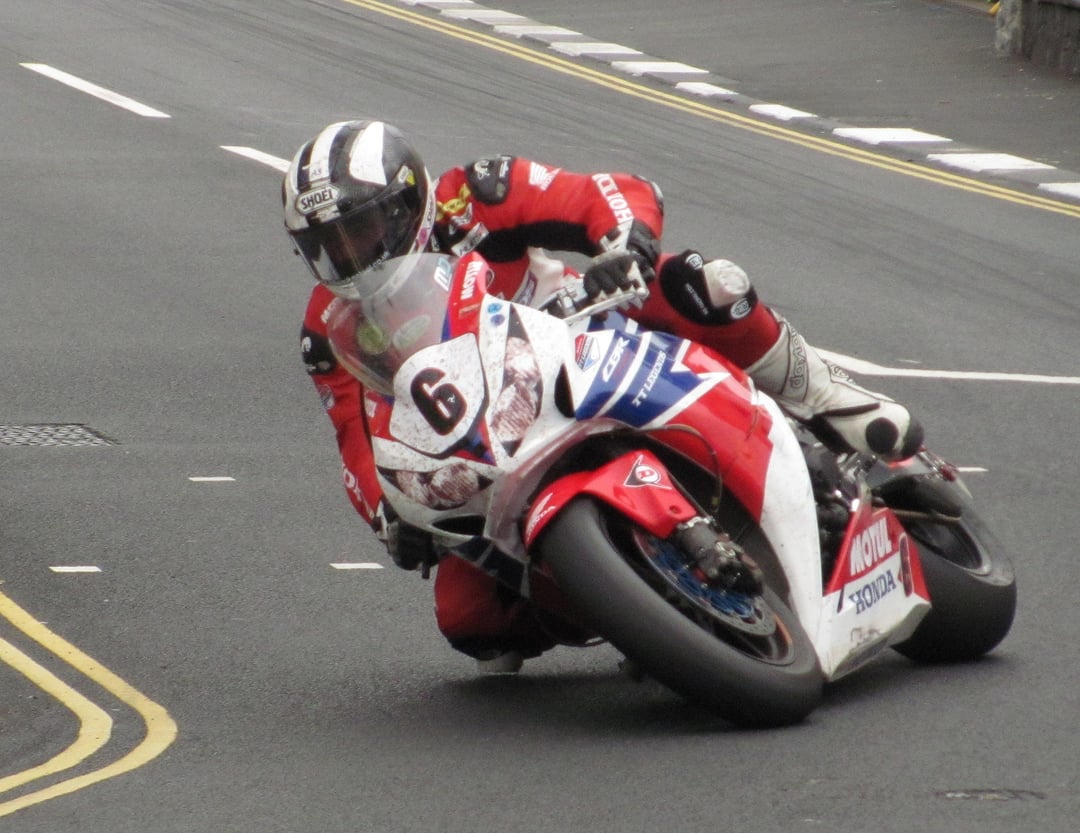
- - 2009 Kate's Cottage Michael Dunlop. Michael Dunlop at Kate's Cottage in 2009, a left-hand bend where the course starts its run down off the Snaefell mountain section. The descent from the mountain to Creg-ny-Baa is one of the fastest stretches of the circuit.
- - Bwaane-Ned-Beg-Hom-Ruy. The cottage of Ned Beg Hom Ruy, the poet and Manx-language writer Edward Faragher, at Cregneash. Faragher was one of the last people to write literature in Manx from within a Manx-speaking community.
- - Norton Rotary RC588 Duckhams. Ian Simpson's 1994 rotary-engined Crighton Norton displayed at Nobles Park, Douglas, behind the TT grandstand, in 2009. The rotary Nortons won the Senior TT in 1992 and are among the most unusual machines to have taken the race.
- - 2008 October - Port Erin Bay in the Isle of Man on a stormy day. Port Erin bay on a stormy October day. Port Erin, Purt Chiarn in Manx, was half of the Rushen internment camp in 1940, when the wire enclosed the whole town.
- - Loch Promenade - Douglas - Isle of Man - kingsley - 20-APR-09. The southern end of Loch Promenade in Douglas, with Manx flags on the flagpoles. Loch Promenade was reclaimed and built in the Victorian resort boom and is the front line of the town's boarding house trade.
- - Isle of Rum Manx shearwaters. Manx shearwaters filmed at their colony on the Isle of Rum in Scotland. The species is named for the Isle of Man, where the Calf of Man colony was historically devastated by rats, a bird whose Manx name is avoided at sea in favour of longtail.
- - The Calf Of Man, Calf Sound, Isle Of Man.. The Calf of Man and Calf Sound. The Calf covers almost one square mile and is separated from the mainland by the Sound, and it is a bird observatory as well as a nature reserve.
- - I.O.M. Fisheries Protection vessel at Douglas. The Isle of Man fisheries protection vessel Barrule entering Douglas Harbour. The island runs its own fisheries protection because it is a self-governing Crown Dependency with its own territorial sea, which is also the sea included in its UNESCO Biosphere designation.
- - Douglas Port, Isle of Man. Douglas Port. The harbour is the island's main freight and passenger gateway, and the reason the capital moved here from Castletown.
- - My Island Folk Music - The Ellan Vannin Tragedy.. Ellan Vannin is the Manx name for the island, and the song of that name is treated as an unofficial anthem. The national anthem is Arrane Ashoonagh Vannin.
- - St Johns Church at Night - panoramio. The Royal Chapel of St John the Baptist at St John's (Balley Keeill Eoin), at night. The chapel stands beside Tynwald Hill, and the ceremony on Tynwald Day moves between the two along a processional way.
- - Steam Heritage Trail on the Isle of Man (56). A pub at St John's on the island's Steam Heritage Trail. St John's sits at the crossing of the island's main west road and was served by the Manx Northern Railway.
- - Intro to Manx Music & Dance DVD. An introduction to the Manx music and dance tradition, made to put the repertoire in front of players and dancers.
- - The Witches Mill at Castletown. (Balley Chashtal). The island's witchcraft associations are folklore and later revival rather than documented history, and the building's fame rests on twentieth century occult interest.
- - House-of-Manannan Minneplate2002. A memorial plate for King Harald V and Queen Sonja of Norway, set into the wall of the House of Manannan at Peel in 2002. The island's Norse inheritance is real and institutional, but the Kingdom of Mann and the Isles was a Norse-Gaelic sea kingdom spanning Mann and the Hebrides, not a Norwegian outpost.
- - Caarjyn Cooidjagh
- - Beside Peel Castle at Dusk - panoramio. Peel Castle at dusk. The castle stands on St Patrick's Isle, which carried a Christian community before the Norse arrived and a garrison long after they left.
- - Rushen Abbey. 's principal monastery and is associated with the compilation of the Chronicles of Mann, a 13th to 14th century source now held at the British Library.
- - Isle of Man hydrofoil leaving the floating landing stage, Pier Head, Liverpool. The Isle of Man fast craft Manannan leaving the floating landing stage at Pier Head, Liverpool. The vessel carries the name of the island's legendary sea god.
- - Caarjyn Cooidjagh
- - The Great Laxey Wheel - Isle of Man. The Great Laxey Wheel. Manx National Heritage, which runs the site, describes it as the largest working waterwheel in the world; it opened on 27 September 1854.
- - Orrin Aged 4 Singing Ellan Vannin in Manx Gaelic. Bunscoill Ghaelgagh at St John's opened in September 2001 and teaches all subjects through Manx, the only school in the world to do so. Ellan Vannin is the Manx name for the island, and the song of that name is treated as an unofficial anthem. The national anthem is Arrane Ashoonagh Vannin.
- - IOM Peel German Cathedral by Malost. The Cathedral of St German at Peel Castle. The cathedral stands inside the castle walls on St Patrick's Isle and gave the island's diocese, Sodor and Man, half its name; Sodor comes from Old Norse Sudreyjar, the Southern Isles.
- - IMG 5188. The Lady Evelyn wheel and the Snaefell wheel site at Laxey. The Snaefell wheel is the lesser-known second wheel of the Laxey area, sometimes called the other Laxey wheel.
- - Bofors gun Ronaldsway. A Bofors gun at the Manx Aviation and Military Museum beside Ronaldsway airport. Ronaldsway was an RAF and Fleet Air Arm station in the Second World War, at the same time as the island's boarding houses were serving as internment camps.
- - Millennium Way, north of Ballasalla. The Millennium Way north of Ballasalla. The long-distance path runs the length of the island from Castletown to Ramsey along an old royal highway route.
- - Cashtal yn Ard
- - Hooded Crow. A hooded crow, Corvus cornix, on the island. The bird is a common resident and shares the Manx uplands and mining spoil with ravens and choughs.
- - Entrance to Peel Castle. The entrance to Peel Castle on St Patrick's Isle. The gatehouse controls the causeway that is the only land approach to the island.
- - View of derelict swimming pool Bradda Glen. The derelict swimming pool at Bradda Glen, Port Erin. Open-air pools like this served the island's resort trade and were abandoned when mass holiday traffic collapsed.
- - Race paddock IMG 0249. The race paddock at the 2010 Isle of Man TT. The paddock sits at Nobles Park behind the grandstand on Glencrutchery Road, which has been the start and finish since the Mountain Course was adopted in 1911.
- - Douglas Road Corner IMG 0003. Douglas Road Corner on the Snaefell Mountain Course. The circuit runs through towns, villages and farmland on ordinary roads, with stone walls, kerbs and houses at the edge of the racing line.
- - Isle of Man Coastal Path. The Isle of Man coastal path. The Raad ny Foillan, the Road of the Gull, runs around the whole island and links its beaches, cliffs and harbours.
- - THE RUDGE MOTORCYCLE. UK.. A Rudge motorcycle. Rudge-Whitworth machines raced at the island's early TTs; the course's first fatality, Victor Surridge, was riding a Rudge-Whitworth in practice at Glen Helen on 27 June 1911.
- - New railway bridge over the A6 at Kewaigue. A railway bridge over the A6 at Kewaigue. The Isle of Man Steam Railway runs narrow gauge steam from Douglas to Port Erin and is the surviving southern section of a network that once reached Peel and Ramsey.
- - Swirling currents off Kitterland. Currents swirling off Kitterland, the islet in Calf Sound. The Sound runs between the mainland and the Calf of Man and the tide through it is fast enough to be dangerous.
- - David Smith 2010 Manx GP. David Smith riding a 246cc Yamaha in the Lightweight Classic at the 2010 Manx Grand Prix, finishing second in 1:40:41. The Manx Grand Prix is a separate meeting from the TT and accounts for a substantial share of the Mountain Course's fatalities.
- - The stands at the TT Start-Finish line. The stands at the TT start and finish line on Glencrutchery Road, Douglas, 2010. Riders leave at ten second intervals against the clock rather than in a mass start, which is the fundamental difference between the TT and circuit racing.
- - Irish Quay Lighthouse Castletown - geograph.org.uk - 1701562 (cropped). The Irish Quay lighthouse at Castletown (Balley Chashtal). The harbour lights mark the entrance at the mouth of the Silverburn.
- - Castletown Station - panoramio. Castletown station on the Isle of Man Railway. Castletown was the island's capital until 1874 and the line to Port Erin still calls there.
Full text archive: /loreline-text/isle-of-man.md