Saint Michael
He is named four times in the Bible and has been painted more often than almost anyone in it. Michael arrives in the Book of Daniel as the prince who stands guard over Israel, turns up in Jude arguing with the devil over the body of Moses, and in Revelation leads the armies of heaven against the dragon, and from those few verses, and a much larger body of writing that never made it into the canon, grew a figure who ended up on mountaintops across Europe, on the coat of arms of Kyiv, on the patches of paratroopers and police, and in the monthly calendar of the Coptic Church. His name is a question rather than a statement: Mi-ka-el, who is like God. Around the year 490 a bull is said to have led a man to a cave on the Gargano, and around 708 a bishop of Avranches said the archangel appeared to him and pressed a finger into his skull; the shrines founded on those accounts are still standing and still receiving pilgrims. He is an angel of Islam, a guardian in Jewish tradition, and one of the most venerated figures in Ethiopian and Egyptian Christianity. This archive follows all of it: the texts, the images, the mountains, the reported visions, the feast days, the soldiers, the other faiths, and what the archangel has become since.
A chronological documentary of 660 moments spanning 200 BC–150 BC on Loreline.
Curated by Olivier · last updated 2026-08-22
Eras
- Scripture, Where he actually appears. Daniel's prince who stands guard, the dispute over the body of Moses in Jude, and the war in heaven in Revelation 12, four short passages that generated everything else. Plus the Dead Sea Scrolls, the Book of Enoch and the apocrypha that filled in the rest.
- Angels, The wider order he belongs to. Angels in Judaism and the merkabah tradition, Mika'il in the Qur'an as the angel of provision and rain, the hierarchies of Pseudo-Dionysius, and the Persian, Ottoman and Iraqi miniatures that painted them.
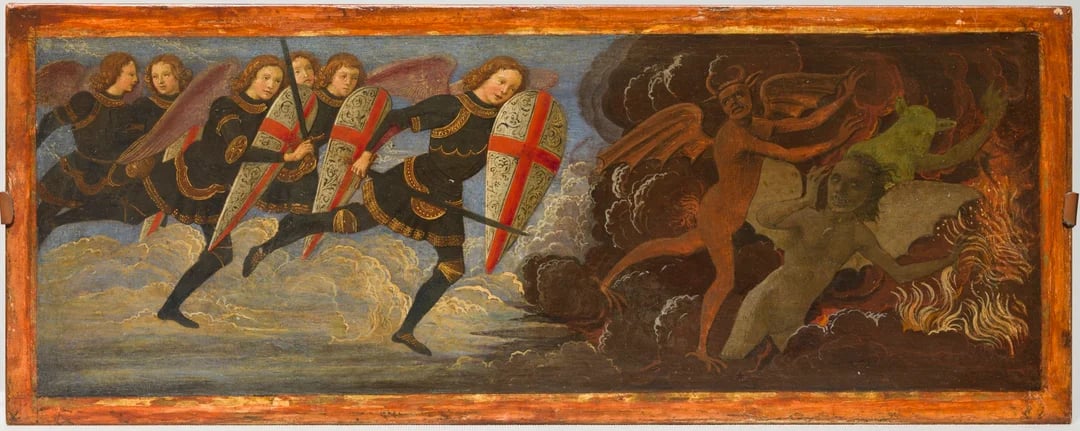
- Dragon & Devil, The fight. Michael spearing, trampling and expelling, Raphael's small panel, Guido Reni's Roman altarpiece that Satanists and popes have both used, Rubens and Bruegel's falls of the rebel angels, Bermejo's jewelled armour, and the moment repeated in ten thousand images.
- Paintings, The single standing figure, in armour or a dalmatic, with sword and scales. Byzantine, Gothic, Renaissance and Baroque painting of the archangel across Europe, and the galleries and museums that now hold it.
- Icons, The Eastern image. Painted panels and wall paintings from Byzantium, Greece, Russia, Serbia, Georgia and Bulgaria, Boyana, Lesnovo, Staro Nagoričane, plus the workshop practice, the egg tempera and gilding, and the icon painters still doing it.
- Altarpieces, The multi-panel object above the altar. Polyptychs and retablos, Spanish and Italian trittici, the Madonna-and-saints groupings where Michael stands to one side, and the Wilton Diptych, pieces built to be seen by a congregation, not a curator.
- Mosaics & Glass, The archangel in tesserae and lead. Ravenna and Sicily, Venetian and Byzantine mosaic, stained glass from the great cathedrals to Victorian parish windows, and the light-dependent images that only work in the building they were made for.
- Sculpture, Michael in stone, wood and bronze. Church portals and tympana, the spire figure and the weathervane, Epstein's bronze at Coventry, processional statues, and the carved altarpiece figures of Germany and Spain.
- Manuscripts, Michael on the page. Books of hours, psalters and apocalypse cycles, the Très Riches Heures and the Beatus manuscripts, plus the Egyptian Book of the Dead and the Hunefer papyrus, where the weighing of souls was already being painted three thousand years earlier.
- Mont-Saint-Michel, The abbey on the tidal rock in Normandy. Built and rebuilt from the eighth century, a fortress the English never took, a prison after the Revolution, and now one of the most visited places in France, plus the tides, the causeway and the restoration work.
- Skellig Michael, A monastery on a pillar of rock eleven kilometres into the Atlantic. Beehive huts, six hundred steps, the monks who lived there from the sixth century, the puffins and the lighthouse keepers, and what filming Star Wars there did to it.
- Sacra di San Michele, The abbey on Monte Pirchiriano above the Susa valley in Piedmont, on the line of Michael sites running from Ireland to Apulia. The Staircase of the Dead, the Zodiac Door, and the building that gave Eco the setting for The Name of the Rose.
- Gargano, Monte Sant'Angelo in Apulia, the cave where the cult began around 490 and the oldest Michael shrine in western Europe. The Lombard patronage, the Via Sacra Langobardorum, the pilgrim graffiti cut into the walls, and the UNESCO listing.
- Shrines, Everywhere else he is venerated. St Michael's Mount in Cornwall, Bamberg and Hildesheim, the Hamburg Michel, Brussels, Mantamados on Lesbos, and the Mexican and Filipino shrines where the feast still fills a town.
- Apparitions, The visions that founded the sites. The Gargano bull and the sandal left behind, Aubert of Avranches and the hole burned in his skull in 708, the sheathed sword over Castel Sant'Angelo during the plague, and the later apparitions and their feasts.
- Soldiers, Patron of soldiers, police and paratroopers. Michael on regimental badges and unit patches, the patron of Kyiv on the city's coat of arms and its golden-domed monastery, requiems for the fallen, and the wartime uses of an armed archangel.
- Coptic Church, Egyptian Christianity, where Michael has twelve feast days a year. Coptic icons and their distinct faces, the monasteries of Wadi el-Natrun, the Nile-flood blessing on 12 Paoni, hymns and vespers, and a devotion older than most of the European material.
- Ethiopian Church, Ethiopian Orthodox Tewahedo practice, where Mikael is everywhere. The rock-hewn churches of Lalibela, painted church interiors, magic scrolls, the tabot and the processions, and the monthly commemoration on the twelfth of every month.
- Orthodoxy, The Byzantine and Slavic churches. The Synaxis of the Archangels on 8 November, the taxiarch, monastery and cathedral dedications from Athos to Kyiv, liturgical chant, and the theology of the bodiless powers.
- Devotion, How people actually pray to him. The Leonine prayer of 1886 and its removal in 1964, the chaplet, medals and holy cards, exorcism and the Church's actual position on it, novenas, and the parish groups keeping it going.
- Michaelmas, 29 September and what grew around it. Quarter day, rents and hiring fairs, the Michaelmas goose and the blackberry folklore, the term that still bears the name at Oxford and Cambridge, and the modern afterlife, the tattoo, the surname, the station tile.
…and 660 more moments. Full text archive: /loreline-text/saint-michael.md