Hip-Hop & R&B
Hip-hop, rap, R&B, soul, neo-soul, urban music videos.
Part of RAD Archive
1,700 moments in this segment.
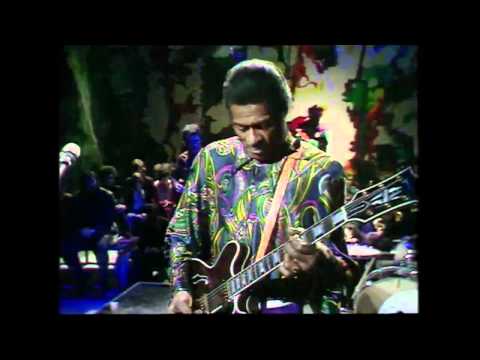
- - Chuck Berry Memphis Tennessee - Chuck Berry Memphis Tennessee. (1972) Era: Early Rock & Roll Television Era (1972) - BBC studio broadcast of a foundational rock and roll pioneer performing a Chess Records classic, captured in the low-light, single-camera format typical of early 1970s British public television production. This footage represents a rare single-take broadcast document of one of rock and roll's most important composers and performers delivering a canonical song in a controlled BBC studio environment. The unedited, single-camera format, confirmed by the extreme quantitative metrics, preserves an unmediated record of Berry's live performance grammar. Its value as a primary cultural artefact is amplified by Berry's status as an inaugural Rock and Roll Hall of Fame inductee and one of Rolling Stone's top five greatest artists of all time. The warm-toned, low-light visual signature is itself a historically specific aesthetic marker of early British colour television. Context: Chuck Berry recorded 'Memphis Tennessee' in September 1958 for Chess Records in St. Louis, a song that went unreleased as a US single yet became one of the most covered compositions in rock history, with over 200 recorded versions. By 1972, Berry was an established transatlantic touring artist and a firm favourite of British rock audiences shaped by the 1960s British Invasion, whose architects, including The Beatles, had learned directly from his catalogue. The BBC Television Theatre performance captures Berry in a mature live context, translating his Chess studio language into the restrained visual grammar of public-service British television. The song's deceptive narrative structure, appearing to be a romantic longing but revealed in the final verse to be a father seeking his six-year-old daughter, made it a touchstone of early rock storytelling sophistication. Director notes: Multiple sources confirm Chuck Berry performed 'Memphis Tennessee' at the BBC Television Theatre, London, on Wednesday 29 March 1972. The performance is documented on the DVD release 'Chuck Berry: The Lost Broadcasts,' which draws from a session that took place in March 1972 and included Memphis Tennessee among several titles. The extreme quantitative metrics, a single scene change across the full 275-second duration, near-zero motion score (5.44), very low brightness (23.93/255), and strongly warm colour temperature (2.02), are fully consistent with a static BBC studio camera locked on the stage under tungsten flood lighting. No post-production director credit has been found in any publicly indexed source.
- - Bee Gees - Jive Talkin'. ' (1975) Era: Pre-Disco Funk Crossover Era (1975) - The year the Bee Gees pivoted from baroque pop to R&B/funk, marking the commercial birth of their disco-era identity with a #1 Billboard Hot 100 comeback single. A foundational artifact of the disco era's prehistory, this promo clip captures the Bee Gees at the precise moment of their commercial and artistic reinvention. Its austere, performance-focused production, typical of 1975 RSO Records promos, contrasts sharply with the song's seismic cultural impact, making it a compelling study in the disconnect between modest visual production values and landmark musical significance. Essential for any archive documenting the transition from early-70s pop to mid-70s funk and disco. Context: Released in May 1975 on RSO Records, 'Jive Talkin'' marked a dramatic stylistic reinvention for the Bee Gees, who had been commercially dormant since 1971. Recorded at Criteria Studios in Miami under producer Arif Mardin, the track fused R&B, funk, and proto-disco elements that were percolating in American urban nightlife. The song's infectious rhythm was famously inspired by the sound of the brothers' car crossing the Julia Tuttle Causeway each day. To circumvent radio programmers' preconceptions, RSO released the single in plain white packaging with no artist identification, a strategy that proved successful in landing the track on playlists. It reached #1 on the Billboard Hot 100 in August 1975 and became the launchpad for the Bee Gees' dominant late-1970s run, eventually leading to the Saturday Night Fever phenomenon. Director notes: The promotional clip was produced in 1975 to support the single release on RSO Records. It features a performance-based format consistent with low-budget promo clips of the era. No production company, director, or cinematographer credit has been found in publicly available records including IMDB, Wikipedia, or RSO Records documentation.
- - DONNA SUMMER - LAST DANCE. (1978) Era: Peak Disco Era (1978) - Height of the American discotheque cultural explosion, coinciding with the release of the Thank God It's Friday film soundtrack on Casablanca Records; the song became both an Oscar-winning cultural artifact and a defining closing anthem of the disco era. Exceptionally high. This is a primary audiovisual document of one of the most decorated songs in disco history, capturing Donna Summer's live performance of an Oscar-, Grammy-, and Golden Globe-winning track at the peak of her commercial power. The video's warm-toned, slow-paced film aesthetic is a near-perfect visual correlate of the era's nightclub culture. As one of the earliest film-derived music promotional clips, it holds significant value for tracing the lineage between theatrical musical performance and the formalized music video format that would crystallize on MTV in 1981. Context: Released in 1978 at the absolute commercial zenith of the American disco movement, 'Last Dance' served a dual role as both a film performance number and a standalone Casablanca Records single. The song pioneered the ballad-to-uptempo structural hybrid within disco, a format that became a template for Summer's subsequent hits. It was the first of eight consecutive top-five singles for Summer on the Billboard Hot 100. The song won the Academy Award for Best Original Song, a Grammy for Best Female R&B Vocal Performance, and a Golden Globe, an unprecedented awards sweep for a disco track, simultaneously cementing Summer's status as the 'Queen of Disco' and legitimizing the genre in mainstream awards culture at the precise moment disco was approaching its cultural peak before the 1979–1980 backlash. Director notes: The ~299-second duration of the file corresponds closely to the extended disco version of the track. IMDB lists two distinct 1978 music video entries: a 'Disco Version' (runtime ~6m, tt7682192) and a 'Studio Version' (runtime ~3m, tt7682186). The file's duration of 299.88s (~5 min) is consistent with an edited-down form of the disco version or a standalone promotional clip derived from the Thank God It's Friday film footage. The film's performance sequence was shot at a real Los Angeles nightclub location (333 S. La Cienega Boulevard). No dedicated music video director credit has been found in any publicly available source including IMDB full credits, Wikipedia, Discogs, or music reference databases.
- - The Jacksons - Blame It On the Boogie. (1978) Director: Peter Conn Era: Disco Era / Early Promotional Video Age (1978) - Pre-MTV promotional clip produced at the dawn of the music video form, embodying late-1970s disco and funk aesthetics with pioneering analogue and early digital visual effects technology. This is a Tier 1 archival document representing the intersection of a canonical pop-cultural moment (the Jacksons at peak disco-era prominence), a historically documented technological milestone (Scanimate + Quantel DFS 3000 deployment at Image West), and one of the earliest surviving examples of a purpose-built pop promotional video using computer-assisted post-production. It is cited as Michael Jackson's music video debut, granting it singular biographical and historiographical significance within both Jackson-family and broader pop-music-video canons. Context: Released in September 1978 as the lead single from the Jacksons' Destiny album on Epic Records, 'Blame It on the Boogie' arrived at the apex of the global disco era and at the very inception of the promotional music video as an art form. The track represented the group's reassertion of creative independence following their departure from Motown, and introduced a tighter funk-band aesthetic. The simultaneous UK release of a competing version by unrelated English singer-songwriter Mick Jackson generated a widely-covered 'Battle of the Boogie' in the British press, amplifying the Jacksons' international profile. The video itself, one of the earliest examples of electronic visual effects applied to a pop performance clip, positioned the group at the frontier of both music video culture and computer-assisted post-production, produced at a moment when the format had no established grammar or industry infrastructure. Director notes: The 1978 promotional video for 'Blame It on the Boogie' features the group dancing on a plain black background, with the defining visual conceit being heavy use of electronic trail effects created at Image West, Ltd. The production employed two then-cutting-edge technologies: the Scanimate analog computer system and a Quantel DFS 3000 digital framestore. The Scanimate system allowed real-time analog manipulation of video imagery to produce the characteristic motion-smear and trailing silhouette effects visible throughout. The Quantel DFS 3000 was a pioneering digital framestore that enabled frame-accurate digital image storage and compositing, essentially one of the first pieces of digital post-production hardware used in a pop music promotional context. The video has been cited as Michael Jackson's music video debut. It was later included on the bonus disc of the DVD box set 'Michael Jackson's Vision' (2010) and was released on the Jacksons' official YouTube channel.
- - Bee Gees - Too Much Heaven. (1979) Director: Martin Pitts Era: Late Disco / Soft-Soul Transition Era (1978–1979), Peak Bee Gees commercial dominance; a deliberate pivot from Saturday Night Fever-era uptempo disco toward lush R&B balladry, coinciding with the band's historic UNICEF charity campaign and six consecutive US #1 singles streak. High curatorial value as a primary visual document of the Bee Gees at their commercial and cultural apex, capturing a deliberate aesthetic and genre pivot in a single artifact. The video's near-meditative pacing, only 5 scene changes in 299 seconds, makes it an exceptional example of late-1970s performance promo minimalism, and its UNICEF-tied release context gives it additional historical and humanitarian significance beyond its chart achievements. Essential reference for archives documenting the late disco era and the emergence of adult contemporary as a dominant 1980s format. Context: Released in late 1978 and charting at #1 in the US and Canada in early January 1979, 'Too Much Heaven' occupies a singular cultural moment: the Bee Gees were at the zenith of their commercial power following the Saturday Night Fever phenomenon, yet deliberately steered away from uptempo disco toward a lush, harmony-driven ballad. The song was pledged entirely to UNICEF's Music for UNICEF Concert (January 9, 1979), earning over $7 million in publishing royalties, and the Gibb brothers were subsequently received at the White House by President Jimmy Carter. The video's dark, warm, contemplative aesthetic, low brightness (46.25/255), slow motion (5.70), and near-static editing (59.83s avg. shot length), mirrors the song's introspective departure from the dancefloor, situating it as a transitional cultural artifact at the precise hinge point between disco's commercial peak and its imminent backlash. Director notes: The video is listed on IMDb (tt8598860) as a 1979 music video production directed by Martin Pitts, featuring Barry Gibb, Maurice Gibb, and Robin Gibb performing the song. It is catalogued on IMVDb with a 1979 release date. The promo was produced to support the single released in late autumn 1978, which became a #1 hit in the US and Canada in early January 1979, and was the band's official contribution to the Music for UNICEF fund. The extremely low scene-change count (5 cuts in ~299 seconds) and long average shot length (~59.8 seconds) are consistent with the static, single-location performance format typical of promos produced for UK and European television broadcast at this time.
- - RUN DMC - Sucker MC's. (1983) Era: Old School Hip-Hop Golden Dawn (1983–1984) - Pre-commercial rap era defined by street-level aesthetics, minimal production budgets, and the emergence of Hollis, Queens as a locus of hip-hop identity formation. Exceptionally high. 'Sucker MC's' is a primary document of hip-hop at the precise moment of its transition from street performance to recorded commercial artifact. The video's raw, unmediated visual style is a direct analogue to the sonic philosophy of the track itself. As an archival object it preserves not only a performance but an entire set of cultural codes, fashion, posture, spatial use, address to camera, that defined the genre's visual identity for the decade that followed. Tier 1 preservation priority. Context: Released in 1983 on Profile Records, 'Sucker MC's' is widely regarded as one of the foundational texts of recorded hip-hop, pioneering the use of a bare drum machine (the Roland TR-808) with no melodic sampling, a deliberate rejection of the funk-interpolation model dominant in early rap. The video's aesthetic directly embodies this anti-excess ideology: no dancers, no elaborate sets, no narrative conceit. RUN DMC's visual self-presentation, matching Adidas gear, fedoras, gold chains, sneakers without laces, codified what would become the dominant visual grammar of mid-1980s hip-hop, influencing fashion, music video production norms, and hip-hop's crossover into mainstream American youth culture. The Hollis, Queens geography underpinning the group's identity positioned hip-hop as a multi-borough cultural force extending beyond the South Bronx origin myth. Director notes: The video for 'Sucker MC's' is one of the earliest documented promotional clips for RUN DMC, recorded in association with their debut single on Profile Records (1983). The stripped aesthetic, bare room, performance-only, minimal crew, is consistent with the era's DIY promotional video format, often produced as performance documentation rather than narrative art. No production company credit is widely documented in accessible databases for this specific clip.
- - New Edition - Mr. Telephone Man. (1984) Director: Jay Dubin Era: Early MTV Era (1984) - Mid-decade R&B/pop crossover moment; pre-New Jack Swing, peak of teen vocal group television exposure and music video as promotional standard on MTV and BET. This video is a Tier 1 preservation priority as a confirmed 1984 artifact directed by one of the era's most significant music video directors, featuring New Edition at the apex of their classic lineup. It serves as a primary visual document of mid-decade teen R&B aesthetics, group performance staging, and early music video production craft, and is directly linked to a charted No. 1 R&B single with broad cultural resonance. Context: Released in late 1984, 'Mr. Telephone Man' arrived at a pivotal moment for Black teen pop in America. New Edition, five young men from Boston's Roxbury neighborhood, had already proven themselves with 'Candy Girl' and 'Cool It Now,' and this single cemented their position as standard-bearers for a youthful, melodic R&B crossover sound. The song reached No. 1 on the Black Singles chart and No. 12 on the Billboard Hot 100, demonstrating the group's appeal across racial demographics at a time when MTV was still navigating its fraught early relationship with Black artists. Written and produced by Ray Parker Jr., the track blended pop-soul accessibility with teenage relatability, making the music video an essential vehicle for the group's image on both MTV and BET. The video's warm, theatrical presentation helped reinforce the group's wholesome, coordinated identity, a deliberate contrast to the harder edges emerging elsewhere in contemporary R&B and hip-hop. Director notes: Dubin directed the 1984 promotional clip for New Edition's 'Mr. Telephone Man,' the second single from their self-titled MCA Records album. The video was produced alongside a period in which Dubin was among the busiest music video directors in the industry, with concurrent credits including major Billy Joel and Hall & Oates videos. He also directed the follow-up New Edition video 'Count Me Out' (1985), suggesting an ongoing working relationship with the group and their label.
- - Sade - The Sweetest Taboo - Official - 1985. (1985) Director: Brian Ward Era: Mid-80s Sophisti-Pop / Quiet Storm Era (1985) - Peak MTV rotation period for cinematic, mood-driven adult contemporary soul; Sade's second album cycle establishing a new standard for understated visual elegance in pop music video. High-tier preservation priority. This video is a confirmed, officially released artifact from a pivotal album cycle by one of the defining acts of 1980s sophisti-pop, directed by a formally trained NFTS graduate. It represents a sophisticated fusion of cinematic narrative, dual-location production, and warm analogue aesthetics that distinguished Sade's visual brand. Its role as the first chapter in a documented three-video narrative trilogy across Promise elevates its archival significance beyond standalone viewing. The video's restrained visual language offers a significant counterpoint to the period's dominant MTV aesthetic and remains a primary research document for the intersection of Quiet Storm culture, cosmopolitan British pop identity, and mid-80s music video craft. Context: Released in October 1985 as the lead single from Sade's second album Promise, 'The Sweetest Taboo' arrived at the height of the Quiet Storm radio format's cultural influence and MTV's expansion into adult contemporary programming. The song reached number five on the Billboard Hot 100 and became Sade's second consecutive number-one on the Adult Contemporary chart, following 'Smooth Operator.' The video's dual-geography construction, New York City jazz-loft versus Andalusian sun-bleached landscapes, visually encoded the band's cosmopolitan, pan-cultural identity, reinforcing Sade Adu's status as a singular figure who defied easy genre categorisation. The video's restrained sophistication stood in deliberate aesthetic opposition to the maximalist excess dominant in mainstream MTV programming of the period. Director notes: Ward directed this video, which features the band performing in a loft space in New York City, intercut with desert scenes filmed in Andalusia, Spain. The video contains a narrative thread in which the protagonist writes 'Temor' (Spanish for 'fear') on a window at its conclusion, a detail that directly connects to and is continued in Ward's video for the follow-up single 'Is It a Crime?' (1986), forming part of a documented three-video narrative trilogy also including 'Never as Good as the First Time.' Ward also directed that third video, similarly shot in Andalusia. The NYC loft setting features matador-themed art that recurs in 'Is It a Crime,' cementing a consistent visual world across the Promise album's video campaign.
- - Klymaxx - Meeting In The Ladies Room. (1985) Director: Gerald Casale (co-directed with Bruce Olinder) Era: Mid-Decade MTV Era (1984–1986) - Peak period of all-female R&B/funk acts on cable television, when synth-driven production and high-concept narrative videos dominated the channel's rotation. A high-value preservation artifact representing the convergence of Black female R&B instrumentation, mid-80s MTV aesthetics, and cross-genre directorial collaboration. The video documents fashion, dance, and social performance conventions of the 1984–85 LA club scene, and carries additional archival significance as early screen documentation of Vivica A. Fox. Its confirmed director credit to Gerald Casale makes it a notable data point in the cross-pollination between new wave visual art direction and mainstream R&B video production. Context: Released in 1985 on MCA Records, 'Meeting in the Ladies Room' was the title track of Klymaxx's album and became a landmark moment for all-female R&B instrumentation in the MTV era. The song reached No. 4 on the Billboard R&B chart and No. 59 on the Hot 100, and its success helped the album reach Platinum status. Billboard later ranked the song at No. 85 on its list of 100 Greatest Girl Group Songs of All Time. The video arrived at the precise moment when MTV, VH1, and BET were amplifying Black female-fronted acts with visual concepts, giving Klymaxx, an all-female band who played their own instruments, a platform that underscored both their musicianship and their comedic personality. The video also serves as an early screen credit for Vivica A. Fox, then an unknown performer. Director notes: The video is confirmed co-directed by Gerald Casale (credited as Gerald V. Casale) and Bruce Olinder, per IMDB full credits (imdb.com/title/tt7803498/fullcredits). Multiple sources, including Wikipedia's song article and burningtheground.net, confirm Casale's directorial role. The IMDB cast list confirms the band Klymaxx appeared as themselves, alongside credited performers Cheryl Cooley, Bernadette Cooper, Joyce Irby, Lynn Malsby, Lorena Porter Shelby, Robin Grider, and breakdancer Bruno Falcon. The Wikipedia article for the song also confirms that a then-unknown Vivica A. Fox appeared in the video, consistent with the IMDB cast listing. The song was included on the MCA Records soundtrack for the 1985 film Secret Admirer.
- - Beastie Boys - (You Gotta) Fight For Your Right (To Party). ) (1986) Director: Ric Menello & Adam Dubin Era: Golden Age Hip-Hop / MTV Boom (1986) - Peak early MTV era; rap-rock crossover enters mainstream consciousness via Def Jam Records and heavy rotation on cable music television. An essential Tier 1 artifact of the MTV Golden Age. This video is a primary source document for hip-hop's mainstream crossover, early Def Jam Records aesthetics, and the rap-rock fusion that defined mid-to-late 1980s youth culture. Its production conditions, $20,000, two days, a friend's apartment, are as historically significant as its cultural impact. The gap between intended satire and popular reception makes it one of the most academically rich music videos of its decade. Context: Released December 1986 as the fourth single from 'Licensed to Ill,' this video arrived at the precise moment hip-hop was breaching mainstream MTV culture. The song was intentionally written as a satirical parody of frat-boy party anthems, but its irony was largely lost on audiences, a dynamic the Beastie Boys themselves lamented. The video's low-budget, apartment-party aesthetic reflected the guerrilla energy of early Def Jam Records and New York's downtown scene. It became one of MTV's most-rotated clips of the era, directly propelling 'Licensed to Ill' to become the first rap album to reach #1 on the Billboard 200. The video sits at the intersection of hip-hop, punk, and hard rock subcultures, visually embodying a cross-genre moment with no direct precedent. Director notes: Budget of $20,000 with a two-day shoot. Filmed entirely in the New York apartment of Sunny Bak. Menello drew visual inspiration from the raucous party sequence in the 1961 film 'Breakfast at Tiffany's,' including casting a character with an eye patch as a direct homage. Menello's own mother played the role of the boys' returning mother in the video's climactic pie-in-the-face finale. Friends, Def Jam associates, and members of the punk band Murphy's Law were recruited as party guests/extras. The directors and Rick Rubin have acknowledged that the video's slapstick characterization proved so iconic it became an image the Beastie Boys spent years trying to escape. Menello described the video's intent as depicting 'infantile rebellion,' though its satirical dimension was largely missed by mainstream audiences.
- - The Rolling Stones - Harlem Shuffle - OFFICIAL PROMO. (1986) Director: Ralph Bakshi Era: Mid-80s MTV Era (1986) - Peak MTV rotational period; post-New Wave, pre-grunge; R&B cover crossover boom; music video as theatrical spectacle coinciding with the Grammy Awards broadcast cycle. Exceptionally high curatorial value as a confirmed intersection of two major countercultural lineages, the Rolling Stones' rock legacy and Ralph Bakshi's underground animation tradition, captured at a precise, documented moment (Grammy Awards premiere, February 28, 1986). Serves as a primary source for multiple research threads: music video form, animation history, and 1980s rock culture. The video's compressed production timeline, its Grammy broadcast premiere, and its MTV VMA nomination make it a uniquely well-documented artifact of mid-1980s music video industry practice. Context: Released in March 1986 as the lead single from the Rolling Stones' album Dirty Work, their first studio album on the new CBS/Columbia Records contract, 'Harlem Shuffle' was notable as the first cover song the Stones had released as an opening single from a new studio album since 1965. The track reached No. 5 on the US Billboard Hot 100 and No. 13 in the UK. The video's pairing of the world's most iconic rock band with Ralph Bakshi, the enfant terrible of American underground animation, was a deliberate collision of two countercultural institutions. Its Grammy Awards premiere gave the video extraordinary cultural visibility. The production captured a band under internal tension, the Dirty Work era was marked by well-documented friction between Mick Jagger and Keith Richards, yet the video's exuberant animated world masked that turmoil in pure visual spectacle. It also stands as an early and high-profile example of the live-action/animation hybrid format that would define a strand of 1980s music video experimentation. Director notes: Bakshi directed the live-action portions of the Harlem Shuffle promo, while animation direction was handled by John Kricfalusi (future creator of The Ren & Stimpy Show). The video premiered on February 28, 1986 at the 28th Annual Grammy Awards on CBS. Production was initiated in late 1985 following a call from The Rolling Stones' manager Tony King, and was completed under severe time pressure, the entire production was compressed into approximately one month after it was decided on January 28, 1986 that the video needed to be ready for the Grammy broadcast. The video combined live-action performance on neon-painted abstract cityscape sets with animated sequences. It was nominated by MTV for a Video Music Award for Best Group Video. Animation crew included Lynne Naylor, Jim Smith, Bob Jaques, Vicky Jenson, and Pat Ventura, the same team Bakshi subsequently deployed on Mighty Mouse: The New Adventures.
- - Whitney Houston - I Wanna Dance With Somebody. (1987) Director: Brian Grant Era: Mid-80s MTV Pop Zenith (1987) - Peak crossover pop era defined by high-gloss production, vibrant studio aesthetics, and the dominance of music video as a promotional and cultural force; Whitney Houston's second album cycle marks her transition from R&B balladeer to global pop superstar. Tier-1 canonical artifact of the MTV golden era. One of the most-viewed legacy music videos on YouTube, with documented chart dominance (Cash Box Video Chart, Billboard Hot 100, Grammy recognition) and sustained critical reappraisal culminating in Billboard's 2023 designation as the greatest pop song of the Hot 100 era. The 4K remaster version submitted here represents both the original 1987 production and a contemporary archival intervention, making it a dual-layer object of study: a primary source for 80s pop video aesthetics and a case study in digital heritage preservation. Essential for any comprehensive archive of 1980s popular music visual culture. Context: Released May 2, 1987, as the lead single from Whitney Houston's second studio album Whitney (Arista Records), 'I Wanna Dance With Somebody (Who Loves Me)' arrived at the apex of the MTV-driven pop video era. The song and its music video became central artifacts in Houston's contested crossover identity: celebrated for achieving massive mainstream pop success while simultaneously criticized in some quarters for not sounding 'Black enough.' The video's premiere on MTV on May 30, 1987, represented a significant moment, Houston's full integration into the network's primary rotation at a time when Black artists' MTV access remained a culturally charged issue. The song became Houston's fourth consecutive US number-one single and her first US platinum single, cementing her status as the dominant pop voice of the late 1980s. It won the 1988 Grammy Award for Best Female Pop Vocal Performance. Billboard later named it the greatest pop song of all time on the Hot 100 era chart in 2023. The 4K remaster released in June 2022 extended the video's cultural footprint into the streaming era. Director notes: Grant directed both of Whitney Houston's major up-tempo music videos: 'How Will I Know' (1985) and 'I Wanna Dance With Somebody (Who Loves Me)' (1987). In a documented interview, Grant stated that because the song had no inherent narrative concept beyond the desire to dance, he devised the approach of shooting every single scene slightly differently, varying set design, lighting color, and choreography across multiple distinct environments to sustain visual interest. Choreography for the video was provided by Arlene Phillips, a credited collaborator on the production. The video made its world premiere on MTV on May 30, 1987, entering heavy rotation immediately. It also aired heavily on BET and VH1. The video topped the Cash Box Music Video Charts for three weeks beginning July 18, 1987. It was nominated for Best Video of the Year at the 1988 Soul Train Music Awards and won Best Music Video at the Garden State Music Awards. In June 2022, the video was remastered in 4K resolution to mark the 35th anniversary of the Whitney album, which is the version reflected in the submitted filename. As of March 2026, the YouTube video has accumulated over 548 million views.
- - Dragnet Music Video City of Crime - Dragnet Music Video City of Crime. (1987) Director: Marty Callner Era: Late New Hollywood / MTV Golden Age (1987) - Peak period of Hollywood blockbuster promotional music videos; rap crossover into mainstream pop culture; movie-tie-in videos as standard studio marketing practice. High curatorial value as a multi-layered primary document: simultaneously a record of 1987 Hollywood promotional strategy, an early career artifact of Paula Abdul, a Marty Callner directorial work within his peak MTV-era output, and a comedic cultural time capsule of mainstream rap crossover. The video's heavy MTV rotation made it a genuine shared viewing experience of the summer of 1987, granting it significant pop-culture memory value beyond its intrinsic artistic merit. Context: Released in the summer of 1987, 'City of Crime' sits at the precise intersection of three significant cultural currents: the Hollywood blockbuster promotional video boom (exemplified by Ray Parker Jr.'s 'Ghostbusters' in 1984), the mainstream crossover of hip-hop into pop and film culture, and the peak of MTV's cultural dominance as a tastemaking platform. Universal Pictures deployed the video as a marketing instrument for the Dragnet film, which opened at No. 1 at the US box office. The choreography by a then-unknown 25-year-old Paula Abdul marks this video as an inadvertent document of her pre-solo-career trajectory. The song's rock/hip-hop hybrid structure, pairing actor-rappers Aykroyd and Hanks with rock veterans Glenn Hughes and Pat Thrall, typifies the genre-blending commercial instinct of mid-80s Hollywood soundtrack strategy. Director notes: Directed for Universal Pictures as part of the promotional campaign for the 1987 buddy-cop comedy film Dragnet. The video features Dan Aykroyd and Tom Hanks performing 'City of Crime,' a rock/hip-hop hybrid written by Peter Aykroyd, Dan Aykroyd, and Pat Thrall, and produced by J.B. Moore and Robert Ford. Choreography in the video was designed by Paula Abdul, then age 25, who was simultaneously building her reputation as a choreographer for Janet Jackson. The video received heavy rotation on MTV during the summer of 1987 and was later cited in EMPIRE Magazine's list of '15 Gloriously Awful 80s End Credit Songs' (2013). Callner's theatrical, performance-driven visual style, developed through his extensive HBO comedy and concert special work, is evident in the stage-bound ensemble staging and comic performance framing.
- - Paula Abdul - The Way That You Love Me - Version 1 - David Fincher. (1988) Director: David Fincher Era: Late MTV Golden Age / Dance-Pop Emergence (1988) - Pre-breakthrough debut single era of Paula Abdul's Forever Your Girl campaign, shot at a commercial photo-shoot set during the peak of Propaganda Films' dominance of the music video industry. High. This video is a rare primary document of both David Fincher's embryonic directorial style before his feature career and Paula Abdul's first foray into the Fincher-collaborated visual identity that would define her cultural peak. As the origin point of a significant director-artist partnership, it serves as a before-and-after comparative artifact alongside the breakthrough 'Straight Up' video, and is essential for any comprehensive retrospective of either Fincher's music video canon or the evolution of late-1980s commercial dance-pop visual culture. Context: Released in November 1988 as the second single from Paula Abdul's debut album Forever Your Girl (Virgin Records, June 1988), 'The Way That You Love Me' Version 1 arrived during a formative and commercially uncertain period in Abdul's career. Written and produced by Oliver Leiber, the track initially stalled at #88 on the Billboard Hot 100 and failed to break the Top 40 despite modest R&B radio play. The video was shot amid the late-1980s MTV commercial video boom, when Propaganda Films under co-founder David Fincher was establishing a hyper-polished, product-integrated visual language for dance-pop artists. The video's photo-shoot conceit and luxury brand insert cuts directly mirror the song's lyrical thesis, that material wealth is secondary to romantic love, creating an ironic visual counterpoint. The video marks Fincher's first of several collaborations with Abdul, a partnership that would yield the culturally defining 'Straight Up' and 'Cold Hearted' videos within the following year. Director notes: This video, shot in July 1988 for Propaganda Films, was the first collaboration between David Fincher and Paula Abdul, predating his more celebrated work on her 'Straight Up' and 'Cold Hearted' videos. It was produced during the initial commercial release of 'The Way That You Love Me' as the second single from Forever Your Girl. The video depicts Abdul dancing and singing with male dancers at a stylized photo shoot, with expensive product shots intercut throughout. It also features Abdul's first tap dancing sequence in a music video, a signature element she would reprise in subsequent Fincher-directed videos. The single stalled at #88 on the Billboard Hot 100 in 1988, but the video predates Fincher and Abdul's successful subsequent collaborations. A second version of the video was later directed by Fincher in August 1989 for the song's re-release, featuring less dancing and more interaction with luxury material goods.
- - Billy Ocean - Licence to Chill. (1989) Director: Scott Kalvert Era: Late MTV Golden Era (1989) - Peak of the slick, high-budget R&B/pop video format; the tail-end of shoulder-pad glamour and warm-toned studio production before 1990s grunge and alternative aesthetics displaced glossy soul-pop from mainstream rotation. High curatorial value as a temporally precise document of the late-80s mainstream R&B video format at its commercial zenith and stylistic closing point. Directed by Scott Kalvert, who would go on to direct 'The Basketball Diaries' (1995), the clip is also a notable early career artifact for a significant American director. The video's quantitative metrics (warm temperature, fast cut rhythm, moderate brightness) precisely encode the aesthetic signatures of Jive Records-era soul-pop, making it an analytically rich source for both cultural and technical production research. Context: Released in October 1989, this video arrives at the precise cultural inflection point where the 1980s mainstream R&B-pop boom, which had made Billy Ocean one of the decade's most globally successful soul artists, was beginning to cede ground to new jack swing, hip-hop crossover, and the impending alternative rock wave. As a single tethered to a Greatest Hits package, 'Licence to Chill' functions as a retrospective commercial statement rather than a genre-defining entry, making the video's warm, polished, and performance-forward aesthetic a deliberate evocation of the era's proven visual language rather than an experimental departure. The video's amber warmth and tight editing cadence are emblematic of the Jive Records house style that had propelled Ocean's career across the decade. Director notes: Confirmed directed by Scott Kalvert per IMDb (https://www.imdb.com/title/tt10029240/) and IMVDb (https://imvdb.com/video/billy-ocean/licence-to-chill). Released October 1989 in the United States. Runtime approximately 4 minutes per IMDb, consistent with the 268.88s file duration. The video was produced to support Billy Ocean's Greatest Hits compilation on Jive Records, where 'Licence to Chill' served as one of two newly recorded singles. No additional named on-screen personnel could be verified from available sources.
- - Christopher Williams - Talk To Myself. (1989) Director: Dieter Trattmann Era: New Jack Swing Emergence (1989) - Late-80s R&B transitional moment when smooth soul vocalists began absorbing uptempo new jack rhythms; Williams' debut single marks the genre's commercial crossover into mainstream pop-R&B visibility. High curatorial value as a confirmed debut-single music video by a subsequently significant new jack swing artist, directed by a documented pioneer of 1980s-1990s music video direction at the precise moment of his own transatlantic career transition. The video captures a specific aesthetic and cultural inflection point, the late-80s soul-to-new-jack crossover, with quantifiable production metrics that support detailed comparative analysis. A well-preserved artifact for both genre history and director retrospective programming. Context: Released in 1989 as the debut single from Christopher Williams' debut album Adventures in Paradise on Geffen Records, 'Talk to Myself' arrived at the precise moment new jack swing was reshaping mainstream R&B. Williams, a Virginia-born singer and arranger, represented a strand of the movement that retained smooth-soul vocal gravitas while adopting the era's kinetic production style. The song charted at #88 on the Billboard R&B chart in 1989, establishing Williams as a credible new presence in Black pop. The video's warm, saturated, high-contrast aesthetic reflects the prestige production values Geffen brought to its R&B roster, distinguishing it from lower-budget independent R&B releases of the period. Director notes: This video was produced in 1989, the same year Trattmann relocated from London to Los Angeles and signed with the A&R Group/Artists Company, placing 'Talk to Myself' among his earliest U.S.-based directorial commissions. The Geffen Records label connection aligns directly with Trattmann's documented client roster, which explicitly included Geffen as a commissioning label. The quantitative profile of the video (rapid 0.96s avg shot length, 229 scene changes, elevated saturation 140.6, warm color temperature 1.44, moderate brightness 90.7/255, high contrast 69.1) is consistent with Trattmann's documented signature of 'innovative lighting style, camera work and editing.' The video is listed on IMDb (tt12700312) with Trattmann as sole credited director.
- - Full Force with Samantha Fox - All I Wanna Do... ft. Samantha Fox. (1989) Era: Late 80s Hip-Hop/R&B-Pop Crossover (1988–1989) - Peak era of Full Force's production dominance on Columbia Records, bridging New York street R&B with transatlantic pop sensibility via a British glamour-model collaborator This video is a rare surviving audiovisual document of Full Force as performing artists rather than solely as producers, a distinction important to their legacy, as they are primarily remembered for their production work. It captures a culturally specific late-80s moment: the New York family R&B collective at their Columbia Records peak, in a cross-genre, transatlantic collaboration that has not been extensively archived or critically analyzed. The sepia-toned, low-brightness aesthetic and fast-cut performance staging are period-authentic and instructive for researchers studying late-80s urban pop video production values. Context: Released in 1989, this collaboration sits at a pivotal cultural intersection: Full Force, a Brooklyn-born six-member family collective, had become one of the most dominant production and performance units in American R&B, scoring hits for Lisa Lisa and Cult Jam, James Brown, and Samantha Fox throughout the late 1980s. The single appeared on Full Force's album Smoove (Columbia Records, 1989), their final Columbia LP, during a transitional moment when hip-hop production aesthetics were beginning to colonize mainstream pop. Samantha Fox, a British pop star who had worked with Full Force on previous hits including 'Naughty Girls (Need Love Too)' and 'I Wanna Have Some Fun', represented a transatlantic pop glamour element grafted onto a Brooklyn street-R&B production framework. The existence of a dedicated 'Hip House Version' of the track signals the genre's commercial currency in 1989, reflecting the broader hip house movement's peak as a dance-floor and chart phenomenon in both the US and UK. Director notes: The music video was released in 1989 to accompany the single 'All I Wanna Do...' from Full Force's album Smoove on Columbia Records (catalog 45216). Samantha Fox appears courtesy of Jive Records. A Hip House Version of the track was also released (Columbia/Legacy, August 7, 1989). The IMDB entry (tt28702903) confirms the 1989 United States release date and lists the Full Force group members as on-screen performers. No director credit is listed on IMDB or any other located source.
- - Paula Abdul - Cold Hearted. (1989) Director: David Fincher Era: Late MTV Golden Age (1989) - Peak of choreography-driven pop music video at the intersection of new jack swing, dance-pop, and theatrical visual storytelling on cable television Tier-1 canonical artifact of the late-1980s music video era. Represents the convergence of three major cultural forces, David Fincher's emerging directorial voice, Paula Abdul's unique choreographer-performer authorship, and the Bob Fosse theatrical tradition recontextualized for mass-market MTV, into a single 4-minute work. Its sustained MTV dominance, chart impact, and continued cultural citation (Glee, Lip Sync Battle recreations) confirm its status as a primary source for scholars of pop visual culture, dance history, and the pre-Hollywood careers of major American filmmakers. Context: Released June 1989 as the fifth single from Abdul's debut album Forever Your Girl, 'Cold Hearted' arrived at the apex of MTV's cultural dominance and the new jack swing era's infiltration of mainstream pop. The video represents a unique synthesis: Abdul's background as a professional choreographer (notably for Janet Jackson) elevated the music video form into a vehicle for genuine theatrical dance art, while Fincher's cinematic eye, already developing the visual precision he would deploy in feature films, gave the production a moodiness atypical of the bright, high-key aesthetic common to late-80s pop videos. The Fosse homage was culturally legible to a wide audience and positioned Abdul not merely as a pop singer but as a dance-world heir to a legitimate theatrical tradition. The song reached #1 on the Billboard Hot 100 in September 1989 and ranked sixth on Billboard's year-end Hot 100 for 1989, reflecting its sustained commercial dominance across the calendar year. Director notes: Cold Hearted was Fincher's second collaboration with Paula Abdul, following his earlier direction of her 'Straight Up' clip. The video is explicitly inspired by Bob Fosse's 'Take Off with Us / Air-Erotica' sequence from the 1979 film All That Jazz, with Abdul and her dancers performing a steamy choreographed routine on industrial scaffolding for a group of diegetic record executives. The video spent more than three weeks atop MTV's rotation list. Produced by Steve Golin. Shot on 35mm film, originated in downtown Los Angeles. A notable production trivia detail documented by songwriter/producer Elliot Wolff: the video depicts violin players mid-performance, but the actual sound is keyboard synthesizers, not live strings.
- - Paula Abdul - Straight Up. (1989) Director: David Fincher Era: Late MTV Golden Age / New Jack Swing Crossover (1988–1989) - Peak era of choreography-driven dance-pop videos; black-and-white minimalism as high-concept aesthetic; debut of future Hollywood auteur David Fincher in music video form Tier 1 cultural artifact. One of the most formally significant music videos of the 1980s: a pre-feature-film David Fincher directorial work, a career-defining performance by Paula Abdul at the peak of her dance-pop ascent, and a benchmark for the choreography-driven black-and-white studio aesthetic. The video's four 1989 MTV VMA wins, including the inaugural Best Dance Video award, confirm its period-defining institutional status. Essential for any scholarly or archival treatment of late-1980s pop video, MTV's Golden Age, or Fincher's visual development. Context: Released February 1989, 'Straight Up' arrived at a pivot point in pop music video history, the moment when MTV heavy rotation could break a single ahead of any traditional promotional infrastructure. The song had reached the Hot 100 top 20 before a video existed, a commercially anomalous inversion of the standard video-then-chart model. The resulting video crystallized several concurrent cultural forces: Paula Abdul's dual identity as both a professional Hollywood choreographer (former Laker Girl, Janet Jackson's choreographer) and pop performer; David Fincher's emerging cinematic visual language in commercial short-form work; and the broader late-1980s fascination with the dancer-as-celebrity. The black-and-white minimalism elevated what could have been a routine performance clip into a deliberate art statement, positioning the video, and Abdul, as aspirationally serious within a landscape of garish, color-saturated MTV contemporaries. The 1989 MTV VMA sweep (four awards) cemented the video's status as a formal benchmark for the genre. Director notes: Fincher directed 'Straight Up' through Propaganda Films, dated 01/03/89, with Producer Bob Tinell, Cinematographer Mark Plummer, and Editor Jim Haygood. The video was shot in mid-January 1989 in a minimalist white-cyclorama studio setting, rendered entirely in black and white, a Fincher signature technique he would revisit in Madonna's 'Vogue' (1990). The song had already ascended to the Hot 100 top 20 before the video was filmed. The video swept four MTV VMAs in 1989: Best Female Video, Best Dance Video, Best Editing, and Best Choreography. Fincher also directed Abdul's 'The Way That You Love Me,' 'Forever Your Girl,' and 'Cold Hearted' videos from the same album era, establishing a sustained creative collaboration. Fincher has described the music video era as his personal 'film school' for learning efficiency within tight budgets and schedules.
- - Another Bad Creation - Iesha. (1991) Director: Lionel C. Martin Era: New Jack Swing Era (1990–1991) - Peak commercial period of Teddy Riley-influenced urban pop, preteen acts cross-marketed to MTV and BET audiences via Motown/Biv 10 infrastructure. High. 'Iesha' is a primary document of the New Jack Swing era's youth-market expansion and one of the earliest commercially successful preteen hip-hop videos. Directed by Lionel C. Martin, a foundational and historically underrecognized figure in Black music video production, the video's realist aesthetic, fast editing, and neighborhood authenticity represent a significant counter-current to the glossier pop-video conventions of the period. Essential for curricula on early-90s Black youth culture, urban music video history, and the Motown/Biv 10 roster. Context: Released in late 1990 and charting into 1991, 'Iesha' arrived at the height of the New Jack Swing era, when producers like Teddy Riley and Dallas Austin were fusing hip-hop rhythms with R&B melody to dominate urban radio. Another Bad Creation were a preteen Atlanta rap group discovered by Michael Bivins of Bell Biv DeVoe and signed to his Biv 10 Records imprint under Motown, positioning them as a junior counterpart to the era's dominant boy-group acts. The video's playground setting, go-cart sequences, and youth-coded narrative, a crush story built around Nintendo and cereal, made the group aspirational peers rather than distant pop stars, a strategy that proved commercially potent. The group's success helped legitimize preteen hip-hop as a viable commercial category and directly prefigured acts like Kris Kross. Director notes: Confirmed by IMDb (https://www.imdb.com/title/tt8693918/) as director of the 1991 music video for 'Iesha' by Another Bad Creation. The video was produced for Motown Records / Biv 10 Records in support of the album Coolin' at the Playground Ya Know! Per IMDb, the video begins with an older woman watching cartoons on television, and features Another Bad Creation rapping while driving go-carts and dancing on a playground. Martin's documented directorial approach, low budgets, authentic urban locations, performance-forward storytelling, is consistent with the video's realist aesthetic and fast-cut playground setting. Martin's production company, Filmmakers With Attitude (FWA), was active during this period and served as a launching pad for emerging urban visual talent.
- - LL COOL J - Mama Said Knock You Out. (1991) Director: Paris Barclay Era: Golden Age of Hip-Hop (1990–1991) - Peak East Coast rap dominance; sample-heavy production, MC comeback culture, boxing-as-metaphor visual language saturating the genre Tier 1 canonical artifact. One of the most studied and cited music videos in hip-hop history, confirmed as MTV Award- and Billboard Award-winning and associated with a Grammy-winning single. Directed by Paris Barclay at a formative stage of his career before he became one of American television's most decorated directors. The video's visual grammar, boxing ring, archival intercutting, desaturated high-contrast palette, aggressive fast editing, established an influential template for hip-hop performance videos in the 1990s. Essential reference for researchers of genre visual history, comeback narratives, and the Def Jam Records aesthetic era. Context: Released as the fourth single from the album 'Mama Said Knock You Out' (Def Jam Recordings, September 1990), with the single dropping February 1991, this video arrived at a pivotal moment in LL Cool J's career. Following the perceived commercial underperformance of his 1989 album 'Walking with a Panther,' LL Cool J faced widespread industry skepticism. The track and its video served as a forceful public reclamation of his dominance in the rap scene, with boxing imagery functioning as a direct visual metaphor for his comeback. Produced by Marley Marl, himself a titan of the East Coast Golden Age, the song built on hard breakbeats sampled from James Brown and Sly & the Family Stone. The video's raw, gym-lit aesthetic and aggressive editing aligned perfectly with early-1990s Def Jam's confrontational visual brand, distinguishing it from the pop-crossover softness some critics had previously assigned to LL Cool J. Director notes: Barclay directed a total of eight music videos for LL Cool J, of which 'Mama Said Knock You Out' (1990/released as single February 1991) is the most celebrated. The video won awards from both MTV and Billboard, and the song was subsequently listed by the Rock and Roll Hall of Fame among the 500 songs that shaped rock and roll. Barclay's approach to the video drew on his stated philosophy of narrative-driven direction, using the boxing ring as a performance arena and intercutting archival fight footage to amplify the track's combative metaphor. The video closes with a cameo by LL Cool J's grandmother, who appears and delivers a mundane domestic command, a deliberate tonal contrast to the song's aggression. In 2012, Barclay reunited with LL Cool J to direct the video for 'Take It' featuring R&B artist Joe, his first music video work in 16 years.
- - Public Enemy - Shut 'Em Down. (1991) Director: Mark Pellington Era: Golden Age Hip-Hop / Early 1990s Political Rap (1991) - Peak era of socially conscious rap aligned with post-Civil Rights Black Power resurgence, corporate boycott discourse, and the LA riots cultural moment. Exceptionally high. This video is a primary document of early-1990s political hip-hop visual culture, combining one of the era's most critically significant songs with direction by Mark Pellington at the height of his MTV-era hyperkinetic style. The near-desaturated, documentary-collage aesthetic and extreme editing pace (0.399s avg shot length) make it a benchmark artifact for studies of music video as political media. Its explicit critique of corporate exploitation of Black communities gives it enduring relevance as both cultural artifact and activist document. Context: Released in 1991 as the second single from Apocalypse 91… The Enemy Strikes Black, 'Shut 'Em Down' crystallized a pivotal moment in hip-hop's intersection with Black economic activism. Chuck D's lyrics explicitly targeted corporations like Nike for extracting wealth from Black communities without reinvesting, articulating a proto-conscious-capitalism critique years before it entered mainstream discourse. The video's near-desaturated, archival-heavy aesthetic aligns with the Black nationalist documentary tradition, evoking newsreel urgency. The track arrived in a period of profound tension, one year after the release of Fear of a Black Planet and months before the 1992 Los Angeles uprising, cementing Public Enemy's role as hip-hop's foremost political voice. The Bomb Squad's dense, sample-layered production and Pellington's agitprop visual grammar created one of the era's most coherent fusions of music and political messaging. Director notes: Directed in 1991 for Def Jam Recordings as a companion to the second single from Public Enemy's fourth studio album, Apocalypse 91... The Enemy Strikes Black. The video's aesthetic is consistent with Pellington's signature approach: extreme rapid-cut montage, archival documentary intercutting, near-desaturated film palette, and agitprop visual structure. Pellington's MTV background directly informed the hyperkinetic editing rhythm, 668 scene changes over 266 seconds (avg 0.399s/shot), which mirrors the collage-driven political urgency of Public Enemy's production ethos under The Bomb Squad. The song was recorded at The Music Palace in Long Island and produced by the Imperial Grand Ministers of Funk, with The Bomb Squad as executive producers.
- - Slick Rick - I Shouldn't Have Done It. (1991) Director: Scott Kennedy Era: Golden Age Hip-Hop (1991) - Boom bap era, Def Jam East Coast rap at its commercial peak; year of 'The Ruler's Back' LP cycle on the cusp of gangsta rap's West Coast takeover High curatorial value as a confirmed, sourced artifact from a commercially significant 1991 Def Jam single. The video is a primary document of Slick Rick's visual persona, Golden Age performance aesthetics, and early hip-hop/film cross-promotion. The verified director credit (Scott Kennedy, confirmed via IMVDb and Dailymotion), chart data, and production context make this a well-sourced candidate for Tier 1.5 preservation, with strong research utility across music video history, hip-hop cultural studies, and fashion documentation. Context: Released June 1991 amid Slick Rick's legal troubles and incarceration period, 'I Shouldn't Have Done It' served as the lead single from 'The Ruler's Back', an album recorded under extraordinary circumstances. The video's low-budget realism reflects standard Def Jam visual economy of the era, while Rick's signature jewelry, eye patch, and storytelling style assert his standing as hip-hop's premier raconteur. The cross-promotional tie-in with the film 'Livin' Large!' illustrates early hip-hop's expanding relationship with Black cinema, a trend accelerating through 1991–1993. The single's peak of #2 on Hot Rap Singles confirmed Rick's commercial viability despite personal adversity. Director notes: The video was produced on a low budget and consists primarily of close-up performance footage of Slick Rick rapping, intercut with dancer sequences. Notably, clips from the 1991 film 'Livin' Large!' (whose soundtrack featured this single) were incorporated into the video. A well-documented continuity goof occurs when a female dancer's earring falls off mid-performance but she continues dancing. Running length matches radio edit at 3:08. Released June 6, 1991 on Def Jam Recordings.
- - Michael Bolton - Love Is A Wonderful Thing. (1991) Director: Dominic Sena Era: Adult Contemporary Pop-Soul Peak (1991) - The apex of blue-eyed soul crossover dominance; Bolton's polished, emotive pop-R&B style commanded mainstream radio and MTV rotation in equal measure, representing the adult contemporary format at its commercial zenith. High curatorial value as a confirmed-director Propaganda Films production representing the adult contemporary pop-soul apex of 1991, with documented chart significance (#4 Hot 100, AC #1), landmark legal legacy (largest music plagiarism award at time of ruling), and a directorial pedigree (Sena) that links this clip to the broader Propaganda Films canon alongside Janet Jackson, Sting, and Bryan Adams. The quantitative fingerprint, rapid editing (1.59s avg shot), vibrant saturation (143.16), warm color temperature, and strong motion score (8.64), makes it a rich data point for computational music video research. Context: Released April 1991 as the second single from Bolton's seventh studio album 'Time, Love & Tenderness' (Columbia Records), this video arrived at the commercial apex of adult contemporary pop-soul crossover culture. The song peaked at #4 on the US Billboard Hot 100, topped the Adult Contemporary chart, and reached #25 on Hot R&B/Hip-Hop Songs, reflecting Bolton's remarkable cross-demographic appeal. The video's Phoenix, AZ location shoot, directed by Propaganda Films co-founder Dominic Sena, exemplifies the era's investment in cinematic music video production as a primary marketing instrument. The song subsequently became the subject of what was at the time the largest copyright infringement award in music industry history ($5M+), after a 1994 jury found similarities to the Isley Brothers' 1964 composition of the same name, making this video an artifact at the intersection of pop commerce and landmark IP law. Director notes: Confirmed directed by Dominic Sena and shot on location in Phoenix, Arizona, as documented by Wikipedia and corroborated by IMDb (tt7573454), IMVDb, and FilmAffinity. Released April 1991 in the United States. Runtime approximately 4 minutes. The video was produced during Sena's peak Propaganda Films period, when his high-production-value approach, combining cinematic camera movement with rapid intercutting, was the industry benchmark. The warm saturation (143.16) and golden color temperature align with Sena's documented preference for visually arresting, commercially polished aesthetics informed by his parallel career in Nike, IBM, and Apple advertising. The rapid shot length (1.59s avg) is consistent with Sena's kinetic editing sensibility observed across his music video catalog.
- - Joe Public - Live and Learn. (1992) Era: New Jack Swing Golden Era (1992) - Peak commercial moment of sample-heavy, funk-rooted urban R&B crossover, bridging hip-hop production with live instrumentation and street-level performance aesthetics on major-label MTV rotation. A high-value document of peak new jack swing era visual and sonic culture, capturing the precise aesthetic moment when sample-heavy funk-rooted R&B achieved mainstream crossover. The video's urban realist performance mode, rapid editing pace, and warm-saturated palette are diagnostic of the 1992 Columbia Records urban video house style. Its chart significance (#4 Hot 100) and later critical reappraisal (Complex 2012) make it a cornerstone archival artifact for the genre. Context: Released in March 1992 at the commercial apex of new jack swing, 'Live and Learn' fused Buffalo, NY street credibility with a rich sample collage drawn from funk and soul heritage (Digital Underground, James Brown, Parliament, J.B.'s, Steely Dan), a signature production approach of the era. The video's rain-soaked urban realism aligned with a post-Do The Right Thing visual vocabulary then prevalent in Black music videos, projecting authenticity while remaining MTV-accessible. Joe Public occupied a distinctive niche as a self-contained live band within a genre dominated by studio producers, a point underscored by their historic status as the first R&B group on MTV Unplugged. Director notes: The video is documented on IMDB (tt8706466) as a 1992 US music video release for Columbia Records. Per IMDB plot summary, it opens with the group walking down a sidewalk, features a rain-soaked alley performance, and intercuts clips of the band at various urban locations. The video appeared on the NBA Jams promotional VHS alongside an NBA version of the track. No cinematographer, production company, or director credit is publicly attributed.
- - En Vogue - Give It Up, Turn It Loose. (1992) Director: Marcus Nispel Era: New Jack Swing & R&B Golden Age (1992) - Peak era of Eastwest/Atlantic prestige R&B production; En Vogue at commercial apex following Funky Divas breakout, fourth single from the LP cycle High-value archival artifact representing the convergence of prestige R&B vocal performance, period-concept visual storytelling, and a director at the height of his music video craft. The video's deliberate invocation of 1960s Black cultural spaces, combined with technically accomplished low-key cinematography and kinetic editing, makes it an exemplary document of the 1992 R&B video moment. Its Grammy-nominated song and confirmed directorial provenance elevate it to Tier 1 status for cultural preservation. Context: Released November 12, 1992 as the fourth single from En Vogue's landmark album Funky Divas on Eastwest Records, this video arrives at the commercial and critical zenith of the group's early career. The 1960s Harlem beauty parlor aesthetic functions as a deliberate cultural reclamation, positioning Black femininity, community space, and oral tradition within a glamorous, historically grounded visual frame. The song's title references James Brown's 1969 'Give It Up or Turnit a Loose,' anchoring the track in a lineage of Black vernacular empowerment rhetoric. The video's near-monochromatic palette evokes the visual language of period civil-rights-era photography, lending the clip a gravitas beyond its pop context. The 1994 Grammy nomination for Best R&B Performance by a Duo or Group with Vocals further cemented its cultural standing. Director notes: Confirmed via IMDb (tt8702732) and Wikipedia as director of this 1992 clip. The video deploys a retro-period concept set in a stylized 1960s Harlem beauty parlor, filmed on Hollywood Boulevard east of Highland Avenue. It opens with a man exiting a car, then cuts to the group performing amid city-life vignettes. The near-monochromatic palette, warm practical lighting, and fast-cut editing are consistent with Nispel's signature aesthetic noted by IMDb: use of 'harsh washed out color tones' in his music video work. The clip's period design aligns with Nispel's broader practice of high-concept narrative framing within performance videos during his early-90s peak output period alongside C+C Music Factory, Janet Jackson, and George Michael.
- - Toni Braxton - Love Shoulda Brought You Home. (1992) Director: Ralph Ziman Era: New Jack Swing / Early 90s R&B (1992) - LaFace Records debut solo era; soundtrack tie-in to the Boomerang (1992) film; early career emergence of Toni Braxton within the L.A. Reid / Babyface production empire This video holds tier-1 historical significance as the documented launch artifact of Toni Braxton's solo career, one of the best-selling R&B artists of the 1990s. Directed by Ralph Ziman during his most prolific music video period, and tied to the culturally significant Boomerang (1992) soundtrack, it functions as both a career origin document and an exemplar of early LaFace Records visual production values. The gender-subversive costuming and minimalist staging make it a notable case study in early-90s Black femme artistic self-presentation. Context: Released in October 1992, 'Love Shoulda Brought You Home' served as Toni Braxton's debut solo single, issued by LaFace Records as part of the Boomerang (1992) film soundtrack. The song was originally written for Anita Baker, and its eventual placement by the L.A. Reid / Babyface production team with Braxton marked the launch of one of the decade's most significant R&B careers. The video sits at a pivotal cultural moment: the LaFace Records Atlanta sound was beginning to define mainstream R&B and Soul, while Hollywood-music synergy via soundtrack albums (as modeled by New Jack City, Boomerang, etc.) was a dominant promotional vehicle. The power-suit costuming choice carried early-90s feminist undertones, presenting Braxton as assertive and self-possessed rather than vulnerable. Director notes: Directed by Ralph Ziman, confirmed via Wikipedia, IMDb (tt8702568), and Ziman's own IMDB other works page (credited 1993). The video features Toni Braxton in two distinct costuming environments, a long sweater worn as a dress and a suit with tie, performing on a minimalist set with a white tiled floor. The video opens with a clip from the 1992 film Boomerang, anchoring it as a soundtrack promotional piece for LaFace Records. Ziman directed a second Toni Braxton video the following year: 'Another Sad Love Song' (1994), indicating an ongoing creative relationship between director and artist in her early career period.
- - LL Cool J - Back Seat. (1993) Director: Pamela Birkhead Era: Golden Age Hip-Hop (1993) - Mid-period Def Jam era; post-'Mama Said Knock You Out' commercial pivot, concurrent with gangsta rap's national ascendance and New York's street-realist video aesthetic High curatorial value as a document of early-90s Def Jam visual identity under directorial stewardship of Pamela Birkhead, one of the few female directors working in mainstream hip-hop video at this period. The Westbury drive-in location, demolished in 1998, makes this video a unique piece of locational preservation. The low-brightness, high-saturation film aesthetic and moderate editorial pace (43 cuts over 246s) exemplify the transitional grammar between late-80s performance videos and the more cinematic narrative approach that would dominate by 1995–1996. Context: Released July 1993 amid hip-hop's most commercially fractured year, 'Back Seat (of My Jeep)' emerged as the strongest single from LL Cool J's commercially underperforming fifth album 14 Shots to the Dome, a record caught between the fading Golden Age and the ascending gangsta/G-funk wave. The drive-in theater setting in Westbury, New York anchors the video in a specifically northeastern, nostalgic American leisure space that codes LL as an aspirational urban everyman rather than a West Coast gangsta. The song's sexually playful tone, co-produced by QD III using a Detroit Emeralds drum sample, represents a transitional moment in hip-hop video aesthetics: moving away from party-rap spectacle toward character-driven, location-specific narratives. The video would later appear in the 1997 All World retrospective, cementing its place as a canonical Def Jam artifact. Director notes: Directed for Def Jam Recordings (production company per IMDb). Film producer was Matthew Cole; music producer was Marley Marl (per Dailymotion credits). Released July 1993 (United States) per IMDb. Shot on location at a drive-in theater in Westbury, New York (which closed in 1998). The video was later compiled into the LL Cool J career retrospective 'All World' (1997). Runtime confirmed at approximately 4 minutes. The low-brightness, high-saturation palette (brightness 34.32/255, saturation 175.91) is consistent with practical night-shoot film production standard for Def Jam videos of this period.
- - Take That - Why Can't I Wake Up With You. (1993) Director: Grant Hodgson & Liam Kan Era: British New Jack Swing / Boy Band Breakthrough Era (1993) - Peak of UK teen pop's early-90s swingbeat crossover moment, coinciding with Take That's commercial ascent toward mainstream dominance High curatorial value as a confirmed, director-verified 1993 artefact documenting Take That at a pivotal commercial and aesthetic turning point. The Paris château location, co-directors Grant Hodgson and Liam Kan's warm intimate framing, and the song's chart performance (UK #2) make this a primary-source document for researchers studying the British boy band phenomenon, early-90s pop video production conventions, and the transatlantic flow of New Jack Swing into UK mainstream pop. Context: Released on 8 February 1993 as the lead single from Take That's second album Everything Changes, this video arrived at the precise moment the group was transitioning from teen novelty act to credible UK pop force. The song's revision from a saxophone ballad on the debut album into a swingbeat-inflected mid-tempo track reflected the broader UK pop absorption of American New Jack Swing influences. The château setting and intimate solo-room visual strategy repositioned the band as aspirational romantic figures, a deliberate image evolution that resonated with their rapidly expanding fanbase. The closing paparazzi sequence acknowledged and dramatised the group's escalating celebrity status in British tabloid culture. Director notes: The video was shot in a château in Paris, presenting each band member performing solo in separate rooms of the property, with a concluding sequence showing the group navigating a paparazzi scrum. The intimate, room-by-room structure was noted at the time for introducing a more sensual, mature visual identity for the band relative to their earlier work. The directors' warm, low-lit interior approach mirrors the song's swingbeat-influenced longing aesthetic and complements the slow-burn domestic fantasy of the lyrical content.
- - 2Pac - I Get Around. (1993) Director: David Dobkin Era: Golden Age West Coast Hip-Hop (1993) - Pre-gangsta crossover era; 2Pac bridging Digital Underground's funk-rap legacy with solo mainstream ascendance on Interscope Records High curatorial value as one of 2Pac's earliest breakout music videos, documenting his transition from Digital Underground affiliate to solo mainstream artist. The video preserves an authentic snapshot of early-90s West Coast hip-hop visual culture, party aesthetics, and fashion. Its confirmed directorial provenance (David Dobkin, verified across Wikipedia, IMDb, IMVDb, and Songfacts), precise production date (March 19, 1993), and documented chart performance (#11 Billboard Hot 100, platinum certification) make it a well-sourced primary artifact for hip-hop cultural research. The rapid editing pace (1.84s avg shot length) and warm Malibu palette are quantitatively distinctive markers of the era's production conventions. Context: Released June 10, 1993, 'I Get Around' appeared at a pivotal moment in 2Pac's career, following his debut 2Pacalypse Now and coinciding with his rising film profile (Poetic Justice with Janet Jackson). The video visually consolidates his ties to Digital Underground, the Bay Area collective that incubated his career, while projecting a new aspirational West Coast solo identity. Filmed in Malibu on March 19, 1993, the sun-saturated Californian mansion setting was a deliberate contrast to the grittier urban aesthetics dominating East Coast hip-hop of the period, positioning 2Pac within a hedonistic, crossover-friendly visual vocabulary. The track itself sampled Zapp's 'Computer Love' (1985), anchoring it within a continuum of West Coast funk-rap that defined the pre-Death Row Interscope sound. Director notes: The music video for 'I Get Around' was filmed on location in Malibu, California on March 19, 1993, and released alongside the single on June 10, 1993 via Interscope Records. It was among David Dobkin's debut music video directing credits and helped launch his career in the format. The video features a mansion party setting with poolside and interior scenes. Per IMDb credits, the director of photography was Jeff Venditti. The video was produced for 2Pac's second studio album Strictly 4 My N.I.G.G.A.Z. (1993). The single became the album's most commercially successful release, charting at #11 on the Billboard Hot 100 and spending 25 weeks on the chart.
- - Lenny Kravitz "Believe" - Lenny Kravitz "Believe". " (1993) Director: Michel Gondry Era: Post-Grunge Alt-Rock & Neo-Soul Revival (1993) - Peak of early-90s rock balladry, bridging classic rock retro-revivalism with spiritual lyricism, set against the rise of MTV-era concept video auteurism. High curatorial value as a historically significant intersection of two emerging forces in 1993 visual culture: Michel Gondry's nascent international career and Lenny Kravitz's peak commercial moment. The video is a documented precursor to Gondry's celebrated surrealist-cinematic approach, and an early example of prestige film homage deployed as music video concept. The BUF Compagnie VFX work is technically significant for early digital compositing in the medium. Suitable for Tier 1 archival treatment given the confirmed director provenance, multi-source verification, and cultural-historical significance. Context: Released in May 1993, 'Believe' arrived at the height of Lenny Kravitz's commercial breakthrough following Are You Gonna Go My Way. The video captures a pivotal cultural moment: the collision of early-90s retro-rock revivalism with the emerging MTV auteur video movement. By enlisting Michel Gondry, then a little-known French director weeks away from helming Björk's 'Human Behaviour', Kravitz positioned the video as high-concept arthouse cinema rather than conventional performance footage. The Kubrick homage signaled a new ambition for rock music videos: referencing prestige cinematic history to elevate the pop artifact. Simultaneously, the song's spiritual themes of faith and self-belief aligned with a broader 1993 cultural undercurrent of gospel-inflected rock, following in the tradition of artists like Prince and Stevie Wonder. The video's cosmic imagery also intersected with the early-90s cultural fascination with space (the Hubble Space Telescope launched in 1990; renewed public space consciousness was prevalent). Director notes: Directed in 1993, one of Gondry's earliest high-profile international commissions, produced concurrently with his landmark Björk 'Human Behaviour' video the same year, marking his emergence as a global music video auteur. The video is an explicit homage to Stanley Kubrick's 2001: A Space Odyssey (1968), featuring Kravitz in the role of an astronaut navigating a cosmic environment. Visual effects were executed by French post-production company BUF Compagnie, whose photorealistic digital compositing was cutting-edge for 1993. The Deutsches Filminstitut cited the video as 'pretty close' to the look of Kubrick's original film. The video's slow pacing (avg shot 12.31s), dark luminance profile (brightness 57.66/255), and warm toning (color temp 2.67) reflect Gondry's formative arthouse sensibility, treating the music video as a short cinematic work rather than a promotional clip.
- - Ladae! - Bye Bye. (1994) Era: New Jack Swing / Early 90s R&B Golden Age (1994) - Transitional moment between New Jack Swing's peak and the smoother New Soul era; debut-single video cycle on Polydor/Island imprint High preservation priority as an underdocumented artifact of the early-90s R&B quartet boom. No director credit exists in any public database, making this video an exemplary case of the institutional invisibility affecting non-charting single videos from major-label rosters of the period. The confirmed 1994 copyright and YouTube ID provide a stable anchor for archival cataloguing. The video's quantitative fingerprint, rapid editing, warm analog palette, moderate motion, is a clean specimen of the era's mid-budget R&B visual grammar. Context: Released in 1994 as the lead single from Ladae!'s debut album 'The Moment' on Polydor/Island Records, 'Bye Bye' entered the market at peak saturation for New Jack Swing-influenced urban R&B quartets. The Brooklyn-based group was part of a broader wave of vocal harmony groups emerging from the Uptown Records/Polydor ecosystem. The video's warm, high-contrast visual palette and rapid MTV-era cutting reflect the standard promotional template for mid-budget major-label R&B singles of the period, designed for BET Video Soul and MTV Jams rotation. Despite strong production craft, the single failed to chart on Billboard, and the group's commercial breakthrough would not arrive until the 'Party 2 Nite' single on Motown/ABSolute Recordings in 1996. Director notes: The video corresponds to the lead single from Ladae!'s 1994 debut album 'The Moment' released on Polydor/Island Records (PolyGram). The YouTube video ID ANCiG854jdc is confirmed by multiple sources including rareandobscuremusic.wordpress.com and Pinterest, with a 1994 Universal/UMG copyright. No production company, director, or crew credits have surfaced in any indexed source.
- - Gillette - Short, Short Man. (1994) Director: Daniel Zirilli Era: Mid-90s Hip-House / Euro-Dance Crossover (1994) - The commercial peak of hip-house novelty singles, where Chicago house production met rap vocal delivery for international dancefloor and MTV consumption. High-value artifact for any archive documenting the hip-house era, 90s feminist pop, or the MTV rotation economy of 1994-1995. The video's confirmed director, international chart legacy, multi-market rotation history, and status as a BuzzFeed-ranked top 100 dance song of the 90s make it a well-documented and culturally legible specimen. Its quantitative metrics, rapid editing, warm palette, moderate brightness, are textbook early-digital-90s production signatures, making it useful as a calibration reference for era-classification models. Context: Released in August 1994, 'Short Dick Man' / 'Short Short Man' emerged at the height of the hip-house novelty era, positioning itself as a ribald feminist counter-punch to the wave of male-dominated, women-objectifying rap and R&B hits of the early 90s. The censored 'Short Short Man' version enabled MTV and mainstream radio rotation, demonstrating how the mid-90s music industry navigated provocative content through strategic re-titling. The track became a global phenomenon, reaching #1 in France and Italy, top 5 in multiple European markets, and #14 on the US Billboard Hot 100, driven heavily by music video rotation on MTV, MCM, VIVA, and The Box. Its international success exemplifies the cross-Atlantic dance-pop pipeline of the period. Director notes: Daniel Zirilli is confirmed as the director of the music video for 'Short Dick Man' / 'Short Short Man' by Gillette and 20 Fingers (1994), corroborated by Wikipedia, IMVDb, Songfacts, and the Music Video Wiki. The video was shot in 1994 and features Gillette performing on a beach and other outdoor locations, intercut with comedic scenes of a brawny man in a photo session. The clean-titled 'Short Short Man' version of the video received heavy rotation: it was A-listed on MCM and VIVA in February 1995 and was a Box Top on The Box (UK) from January 1995. IMVDb credits Zirilli as director with a 1994 release date. The video's rapid editing pace (avg shot length 1.93s, 102 scene changes) and warm outdoor aesthetic are consistent with Zirilli's mid-budget, high-energy 90s music video style.
- - Soul Coughing - Down To This. (1994) Director: Mark Kohr Era: Mid-90s Alternative Underground (1994) - First wave post-grunge alt-rock crossover; NYC downtown bohemian scene meets MTV alternative programming boom; debut single cycle for Ruby Vroom on Slash/Warner Bros. High curatorial value as a confirmed-director artifact from a critically re-evaluated cult band's debut album cycle. Documents a specific and fleeting intersection: major-label resources applied to genuinely experimental downtown NYC art-rock at the precise moment MTV Alternative made such crossover commercially viable. Mark Kohr's direction bridges the visual language of San Francisco indie filmmaking with the rhythmic demands of Soul Coughing's sample-driven, jazz-inflected sound. The 1.57s average shot length and 144 scene changes over 3:45 make this a textbook case of editing-as-musical-instrument in mid-90s video production. Context: Released in 1994 as part of Soul Coughing's debut album Ruby Vroom on Slash/Warner Bros., 'Down to This' emerged from the NYC downtown bohemian scene at a moment when major labels were actively signing unconventional acts. The song samples the Andrews Sisters' 1942 recording, typifying keyboardist Mark de Gli Antoni's approach to treating the sampler as a compositional equal to traditional instruments. The band, M. Doughty (vocals/guitar), Sebastian Steinberg (upright bass), Mark de Gli Antoni (keyboard sampler), and Yuval Gabay (drums), blended improvisational jazz, hip-hop sample aesthetics, spoken-word delivery, and noise experimentalism into a sound Pitchfork would later describe as 'a brand-new sound that is inextricably linked to its era.' The video reflects the brief early-mid-90s window when Modern Rock's commercial viability allowed quirky, unclassifiable acts access to major-label video budgets. Director notes: Confirmed via IMVDb (imvdb.com/video/soul-coughing/down-to-this) as director of this 1994 video, released in conjunction with the Soul Coughing debut album Ruby Vroom (Slash/Warner Bros., September 27, 1994). The video was produced during the peak period of Kohr's mid-90s output (IMVDb credits show 8 videos in 1994 alone). The song samples the Andrews Sisters' 'Don't Sit Under the Apple Tree' (1942), a signature move by keyboardist/sampler Mark de Gli Antoni, and the video's rapid-cut experimental style aligns with Kohr's known preference for visceral editing rhythm over conventional narrative coverage, a technique he later described as a deliberate creative risk in interviews.
- - Beastie Boys - Sure Shot. (1994) Director: Spike Jonze Era: Golden Age Hip-Hop / Alternative Crossover (1994) - Peak of Beastie Boys' artistic maturity during the Ill Communication cycle; MTV-era hip-hop at its most genre-fluid, blending hardcore rap credibility with skate culture and downtown New York cool. High. Sure Shot is a primary document of the Beastie Boys at their critical and commercial apex, directed by Spike Jonze at the outset of what would become one of the most celebrated directing careers in music video history. The video's restrained, performance-centric approach offers a valuable counterpoint to the maximalist Sabotage, together forming a diptych that illuminates Jonze's range. Its warm, high-contrast visual fingerprint and rapid editing rhythm make it an exemplary case study in mid-90s hip-hop video grammar. Strong archival, scholarly, and cultural preservation value. Context: Released in 1994 as the third single from Ill Communication, 'Sure Shot' arrived at a cultural inflection point: Beastie Boys had completed a widely noted artistic and ethical evolution from their Licensed to Ill-era provocations. The song's lyrical content, including an explicit acknowledgment of and apology for past disrespect toward women, made it a notable document of mid-90s hip-hop's grappling with accountability. Spike Jonze, deeply embedded in the Los Angeles and New York skate and DIY youth media scenes, brought a subcultural authenticity to the visual treatment. The video's release coincided with the peak of MTV's influence as a cultural arbiter, and the Ill Communication campaign, particularly the Sabotage and Sure Shot videos, cemented Jonze's reputation as the defining music video voice of the alternative-hip-hop crossover moment. Director notes: Sure Shot (1994) was directed by Spike Jonze for Beastie Boys, produced by Courtney Holt, and edited by Eric Zumbrunnen. It was released as the third single from Ill Communication (Capitol/Grand Royal, 1994). The video was made in the same creative period as Jonze's landmark Sabotage video for the same band, both part of a productive 1994 Beastie Boys/Jonze collaboration that also included 'Ricky's Theme.' The Sure Shot video features the group performing directly to camera, skating, and wearing suits, a more stripped-back, performance-centric approach compared to the elaborate cop-show pastiche of Sabotage. The video's aesthetic reflects Jonze's roots in skate-culture documentary filmmaking: handheld, energetic, and unpretentious. IMVDb and IMDb both confirm the 1994 release date and Jonze's directorial credit.
- - Brandy - I Wanna Be Down. (1994) Director: Keith Ward Era: New Jack Swing / Hip-Hop Soul Emergence (1994) - The year teen R&B crossed into hip-hop soul dominance; Brandy's debut arrived alongside Aaliyah and a generation of youth-driven Atlantic Records acts reshaping Black pop radio. Tier 1 cultural artifact: the official debut video of one of the 1990s' most significant R&B voices, directed at age 15, capturing a raw and historically unrepeatable moment before mainstream polish arrived. The video's naturalistic aesthetic, confirmed director credits, and chart-verified cultural impact make it an essential anchor for any archive focused on 1990s Black popular music, teen culture, or the hip-hop soul genre's visual formation. Its fast editorial pace (2.53s avg shot length across 97 scene changes) and warm-saturated early-digital palette are precisely datable to the 1994 production context, offering strong pedagogical value for media studies and visual culture research. Context: Released in October 1994 and tied to Brandy's debut single of the same name, this video arrived at a generational inflection point in Black American pop culture. A 15-year-old Brandy Norwood entered a market already energized by Aaliyah's debut and a wave of teen R&B acts signed to major labels. The video's tomboyish aesthetic, braids, baggy denim, outdoor settings, represented a deliberate counter-image to the more glamorous R&B femininity of the era, resonating with young Black audiences who saw themselves reflected in its casual, peer-driven world. The single peaked at No. 6 on the Billboard Hot 100 and reached No. 1 on the Hot R&B/Hip-Hop Songs chart, confirming the crossover appeal the video's visual language was designed to support. It stands as a primary document of mid-90s Black teen identity and the early hip-hop soul aesthetic before it matured into the polished Hype Williams, era production that would follow even on Brandy's own subsequent releases. Director notes: The video was filmed and released in October 1994, premiering ahead of the single's official chart push. It was Brandy Norwood's first-ever music video shoot, which she described as an exciting milestone. Shooting locations include outdoor settings near a forest featuring a Hummer/jeep, as well as indoor domestic settings (phone scenes on a purple carpet, a wooden swing, a barn interior, and a bike). The visual approach centers on Brandy's tomboyish persona, surrounding her with backup dancers in an informal, peer-group-hangout narrative framework consistent with Ward's naturalistic, performance-integrated style on other 1994 R&B productions.
- - All-4-One - I Swear. (1994) Director: Marcus Nispel Era: New Jack Swing / Adult Contemporary R&B Crossover (1994) - Peak era of harmony-group balladeering bridging R&B and mainstream pop; post-Boyz II Men vocal group ascendancy on Atlantic Records. High curatorial value as an exemplary artifact of the early-90s R&B vocal harmony crossover moment, directed by a major MTV-era director at peak influence. The video's grounded visual style, warm palette, and performance-narrative hybrid structure offer a clean case study in how major labels and directors calibrated visual presentation to maximize broad demographic appeal. Its chart record and continued cultural presence (57M+ YouTube views as of 2021) affirm enduring archival significance. Context: Released in April 1994, 'I Swear' by All-4-One arrived at the apex of the mainstream R&B vocal harmony movement catalyzed by Boyz II Men. The song was a cover of a John Michael Montgomery country #1 (1993), making it a rare crossover artifact in which a country song was recast as R&B and climbed to #1 on the Billboard Hot 100 for 11 consecutive weeks, one of the longest chart runs of the decade. Produced by David Foster for Atlantic Records, the single exemplified the adult-contemporary strand of early-90s R&B that prioritized smooth harmonic blending, orchestral production, and aspirational romantic lyrical content accessible to broad demographic audiences. The music video, directed by Marcus Nispel at the height of his MTV era influence, mirrors this mainstream accessibility through unpretentious urban location shooting and a simple romantic narrative, foregrounding the group's vocal sincerity over visual spectacle. Director notes: Confirmed directed by Marcus Nispel per IMDb (tt8680832), IMVDb, and FilmAffinity. Released 1994 on Atlantic Records. The video portrays the members of All-4-One on a rooftop in a performance setting, intercut with a street-level narrative involving a young woman. The group descends to walk and interact with her as she prepares to depart, ultimately boarding a bus. The visual approach is grounded urban realism consistent with Nispel's early-90s music video style, warm lighting, location shooting, close-up vocal emphasis. Nispel also directed All-4-One's follow-up single 'I Can Love You Like That' (1995), indicating an ongoing creative relationship with the group.
- - Soul For Real - Candy Rain. (1994) Director: Matt X Era: New Jack Swing / Golden Era R&B (1994–1995) - Mid-decade transition from new jack swing to smooth teen R&B, anchored by Uptown Records' youth-oriented roster and the commercial peak of harmony-group vocal production. High curatorial value as a primary artifact of the 1994–1995 Golden Era R&B moment on Uptown/MCA Records. The video's chart dominance, MTV saturation, and visual codification of teen smooth R&B aesthetics make it essential for any archive covering Black popular music of the mid-1990s. The credit ambiguity surrounding its director also makes it a useful case study in early music video provenance research. Context: Released in 1994 on Uptown Records and MCA, 'Candy Rain' arrived at the precise moment when teen-skewing smooth R&B harmony groups were supplanting harder-edged new jack swing on urban radio. Uptown Records, under Andre Harrell, had cultivated a roster, including Mary J. Blige and Jodeci, that bridged street authenticity with pop accessibility. Soul For Real, a group of four brothers from Hempstead, New York, fit squarely within this paradigm. The track spent three weeks at No. 1 on the US Hot R&B Singles chart and peaked at No. 2 on the Billboard Hot 100, with 800,000 copies sold. Its bassline samples Minnie Riperton's 1975 track, embedding the song within a lineage of classic soul, while its video received heavy MTV rotation, cementing its status as a defining artifact of mid-90s Black teen pop culture. Director notes: The Dailymotion official upload of the video carries an on-screen credits card listing 'Film Director: Matt X,' with Film Editor Jon Stefansson, and producers Red Hot Lover Tone, Jean 'Poke' Olivier, and Heavy D. IMVDb circulates an unverified attribution to Brett Ratner, which is likely a conflation with Ratner's confirmed direction of Soul For Real's follow-up video 'Every Little Thing I Do' (1996). The video opens with a black-and-white sequence of the group performing for record producers before transitioning to color, and includes a performance in front of a curtain of shiny streamers. The production was made for Uptown/MCA Records.
- - Toni Braxton - You Mean The World To Me. (1994) Director: Lionel C. Martin Era: New Jack Swing / New Classic Soul Transition (1993–1995) - Post-New Jack Swing era marked by the ascendance of polished LaFace Records R&B balladry, bridging urban contemporary production with mainstream pop crossover ambitions. High curatorial value as a confirmed, director-verified artifact of the LaFace Records golden era and early-90s new classic soul. The video's aesthetic coherence, heavy 1994 rotation history, and association with Lionel C. Martin, a pioneering Black music video director whose broader cultural influence is well-documented, make it an essential archival reference for both genre history and visual production studies. Braxton's performance and the video's elegant visual grammar are representative of a pivotal moment in R&B's mainstream crossover trajectory. Context: Released in spring 1994 as the fourth single from Toni Braxton's platinum-selling debut album, this video arrived at the apex of LaFace Records' cultural dominance. L.A. Reid and Babyface had effectively created a new grammar for prestige R&B production, lush, warm, radio-ready ballads anchored by powerhouse vocal performances, and this video's visual language mirrors that sonic ambition. The mansion setting, controlled elegance, and romantic narrative reflect the aspirational iconography of early-90s black upward mobility being projected through premium R&B. The song received a Soul Train Music Awards nomination in 1995, underscoring its commercial and cultural traction. The video's heavy rotation in spring/summer 1994 cemented Braxton's transition from emerging LaFace artist to bona fide mainstream star. Director notes: Confirmed director per IMDB (tt8740246), Wikipedia, and IMVDb. The video opens with water imagery and exterior poolside scenes, then moves to Braxton performing at a white grand piano inside a mansion, intercut with romantic narrative scenes. The video was in heavy rotation on MTV and BET during the spring and summer of 1994. Martin's characteristic approach, treating the music video as a short film with location scouting and restrained emotional realism, is evident in the lush but uncluttered visual language of this production, consistent with the upscale LaFace Records brand identity he helped establish across multiple Braxton-era videos.
- - Spearhead - Hole In The Bucket 1994 Remastered. (1994) Era: Alternative Hip-Hop / MTV Buzz Bin Era (1994) - The year Spearhead debuted on Capitol Records, bridging conscious rap, funk, and soul in the early post-golden-age hip-hop landscape. High. This video is a Clio Award-winning artifact from a pivotal moment in alternative hip-hop history, documenting both the aesthetic grammar of early-90s socially conscious rap video and the specific cultural anxieties around urban homelessness. Its MTV Buzz Bin status and crossover radio success make it a key data point for studying how genre boundaries were negotiated through visual media in 1994. The remastered version preserves a record that might otherwise suffer archival degradation. Context: Released in 1994 as the lead single from Spearhead's debut album Home on Capitol Records, 'Hole in the Bucket' emerged from Michael Franti's pivot away from the industrial agit-prop of Disposable Heroes of Hiphoprisy toward a warmer, community-centered sound blending hip-hop, funk, reggae, and soul. The song addresses homelessness and urban poverty at a moment when welfare reform debates and visible street homelessness were defining political flashpoints in American cities. R&B radio largely ignored it, but alternative rock radio and MTV's Buzz Bin gave it substantial exposure, marking an early instance of socially conscious rap crossing into alt-rock formats. The video won a Clio Award in 1994, a rare advertising industry honor for a music video, underscoring its craft and messaging impact. Director notes: The video won a Clio Award in 1994 and was placed in MTV's Buzz Bin, earning significant rotation. Apple Music describes it as a 'homelessness lament,' suggesting street-level documentary imagery. Despite its award-winning status, no director attribution appears in Wikipedia, Discogs, AllMusic, encyclopedia.com, or music press sources reviewed.
- - Paula Abdul - Crazy Cool. (1995) Director: Matthew Rolston Era: Post-New Jack Swing / Mid-90s Dance-Pop Transition (1995) - An era where late-era MTV dance-pop collided with R&B sensuality, club culture, and choreography-driven spectacle, marking the twilight of Paula Abdul's chart dominance before millennial pop reshaped the landscape. High curatorial value as a documented MTV censorship case study, a choreography-showcase artifact from a transitional moment in Paula Abdul's career, and a strong example of Matthew Rolston's glamour-inflected visual direction applied to mid-90s dance-pop. The video's production history, studio location, crew credits, controversy, and edited vs. unedited versions, is unusually well-documented for the era, making it a research-rich primary source for scholars of 1990s music video culture, broadcast standards, and pop performance aesthetics. Context: Released in August 1995 as the second single from Paula Abdul's third studio album Head over Heels (Virgin Records), 'Crazy Cool' arrived during a pivotal and commercially difficult period for Abdul. While the single failed to crack the Billboard Hot 100 Top 40 (peaking at #58), it thrived on the dance charts and in Canada, reflecting a broader mid-90s bifurcation between radio pop and club culture. The video's MTV censorship controversy, documented in People Weekly and widely discussed, encapsulates the era's tensions between mainstream broadcast standards and the increasingly provocative aesthetics of R&B and dance-pop music video production. Shot at the storied A&M Studios in Hollywood, the video exemplifies the high-production-value choreography showcase that defined Abdul's visual identity since her late-80s breakthrough. Director notes: The 'Crazy Cool' video was directed by Matthew Rolston and shot at A&M Studios in Hollywood at the end of July 1995. Choreography was by Barry Lather. Executive Producers were Sharon Oreck and Alexa Balatsos; produced by Elison Miller; edited by Haines Hall for O Pictures, Inc. A 'Single Remix Version' of the track was used for the video. MTV initially refused to air the clip due to its sexually suggestive content, including Abdul riding a mechanical bull while pouring beer on herself, demanding an edited version. Rolston and Abdul ultimately complied and edited the video. The controversy was reported in a People Weekly article dated September 4, 1995, titled 'MTV Deems Crazy Cool Too Racy for TV.' The video was never released commercially on VHS or DVD.
- - Plattenpapst Jöak & Freunde ft. Padi-O - Lass Dich von Deinen Gefühlen leiten [VIDEO] 1995. (1995) Era: German Hip-Hop Golden Era (1995) - Mid-90s Deutschrap expansion; post-Fresh-Familee solo output representing the maturing Hamburg/Düsseldorf underground scene on major-distributed indie infrastructure (Raputation/edel). Rare surviving video document of a mid-tier 1995 Deutschrap release, offering an unmediated view of the aesthetic and social texture of the German hip-hop scene at a critical juncture. The warm, performance-driven visual style and fast edit pace are representative of the period's low-to-mid budget music video production. High preservation priority given the scarcity of contemporaneous German rap video material in catalogued archives. Context: Released in 1995 during a pivotal expansion phase for Deutschrap, this single emerged from the creative orbit of Plattenpapst Jöak (bürgerlich Jörg Müller, b. 1971 Düsseldorf), a founding member of Fresh Familee, one of the earliest German rap acts to sign with a major label (Phonogram/Mercury). The album 'Alles wird gut' on Raputation/edel represented a collaborative snapshot of the growing German hip-hop network, with a warm, soul-inflected sound grounded in the Roy Ayers 'Everybody Loves The Sunshine' sample. The single was distributed across the DACH region, reflecting hip-hop's consolidating commercial infrastructure in German-speaking markets by the mid-1990s. Director notes: The video was produced to accompany the 1995 single released on UltraPop (edel), catalogue 0097090ULT, distributed across Germany, Austria, and Switzerland. The track appears on the album 'Alles wird gut' on Raputation Records (edel). Music production credits include Bodo Staiger and Florian Van Volxem as producers, with Plattenpapzt also credited as producer. Lyrics credited to Badri Padi Oulad Said. The track samples Roy Ayers' 'Everybody Loves The Sunshine'. No video director, DOP, or production company credit has been located in any catalogued source as of the annotation date.
- - Method Man - All I Need (Razor Sharp Remix) ft. Mary J. Blige. (1995) Director: Diane Martel Era: Golden Age Hip-Hop / Hip-Hop Soul Crossover (1995) - Peak East Coast rap expansion into R&B fusion, Wu-Tang's commercial breakthrough period, and the emergence of the 'thug-love' duet as a genre convention. Exceptional curatorial value as a primary artifact of the mid-90s hip-hop / R&B crossover moment. This video documents the precise cultural juncture at which Wu-Tang's underground ethos intersected with mainstream R&B sensibility, directed by one of the era's most important (and later widely recognized) music video auteurs. Its Grammy win, chart performance, and genre-defining status make it essential for any archive focused on 1990s hip-hop visual culture. The confirmed involvement of cinematographer Lance Acord adds further significance as a link between music video and prestige cinema of the period. Context: Released April 25, 1995 on Def Jam Recordings and PolyGram Records, this video arrived at the intersection of two dominant forces in mid-90s Black music: Wu-Tang Clan's raw, Staten Island-rooted hardcore rap and the emotionally confessional hip-hop soul championed by Mary J. Blige. The song is widely cited as the first canonical 'thug-love' duet in hip-hop history, establishing a template of hard-rapper-meets-soulful-singer that would define crossover R&B for the following decade. It peaked at #3 on the Billboard Hot 100 and #1 on the R&B singles chart for three weeks, and won the Grammy Award for Best Rap Performance by a Duo or Group in 1996. The video's gritty New York realism, Harlem rooftops, interior domestic drama, unglamorized street-level mise-en-scène, stands in deliberate contrast to the increasingly opulent visual language emerging in contemporary hip-hop, reflecting both Martel's aesthetic philosophy and Method Man's own reported resistance to being coded as a mainstream sex symbol. Director notes: Martel directed the Razor Sharp Remix music video in 1995, confirmed by Wikipedia, IMDb, and Rolling Stone Australia. The video is set in New York City, incorporating a Harlem rooftop performance tableau alongside an embedded urban family drama narrative. Rolling Stone Australia noted that Martel 'kept a gritty edge in this much-adored love letter with Mary J. Blige,' reflecting her philosophy of authentic, non-exploitative visual storytelling. Director of photography Lance Acord, who would later shoot Lost in Translation (2003), served as cinematographer on the video. IMDb credits the video as featuring Method Man, Mary J. Blige, Masta Killa, and Raekwon. The video was produced in support of the single released April 25, 1995 on Def Jam Recordings and PolyGram Records.
- - Monica - Before You Walk Out Of My Life. (1995) Director: Kevin Bray Era: Mid-90s New Jack/Contemporary R&B (1994–1997) - Peak era of teen R&B, defined by drum-machine production, saxophone textures, and street-realist video aesthetics on major labels High curatorial value as a confirmed, director-verified artifact of peak mid-90s teen Contemporary R&B. Represents Monica's visual debut aesthetic, directed by Kevin Bray at the outset of a major cross-media career. The video's combination of rapid editing, warm street-realist cinematography, and emotionally grounded performance provides a precise benchmark for studying how Arista-era R&B constructed authenticity for young Black female artists. RIAA Platinum-certified single with documented Grammy nomination (39th Annual, Best Female R&B Vocal Performance) adds institutional significance. Context: Released August 3, 1995 as the second single from Monica's debut album Miss Thang on Rowdy/Arista Records, the video arrives at the precise moment teen R&B was becoming a dominant commercial force. Monica was 15 at the time of release, and the video's street-realist aesthetic grounds her emotional performance in recognizable urban spaces, sidewalks, rooftops, rather than fantasy settings, lending the heartbreak narrative an authenticity that resonated with a young demographic. The song debuted at #11 on Billboard Hot R&B/Hip-Hop Songs in October 1995 and climbed to #1 after a record-breaking 25-week chart run, eventually earning RIAA Platinum certification by March 1996. The video's visual vernacular, warm tungsten palettes, rapid intercutting, location-shot LA exteriors, typifies the Rowdy Records aesthetic of accessible, street-inflected R&B production. Director notes: Directed by Kevin Bray and filmed in Los Angeles, California. Per IMDB and Wikipedia, the video begins with Monica sitting on the sidewalk and later on a rooftop, with a narrative thread of a man walking away as she watches sadly. The video was edited by Scott C. Wilson and released in October 1995 to support the single's chart run. It appeared on the IMDB-catalogued MTV Top 100 Videos of 1996 list. The video's warm, high-contrast street-realism visual language is consistent with Bray's early-career R&B music video aesthetic, which he developed across dozens of videos for Rowdy/Arista-era artists before his Hollywood transition.
- - Madonna -Human Nature - Madonna -Human Nature. (1995) Director: Jean-Baptiste Mondino Era: Mid-90s Post-Erotica Madonna (1995) - Defiant R&B/pop provocation era; Madonna reclaiming narrative control following the Sex/Erotica backlash cycle via high-concept S&M-inflected choreographic minimalism. High curatorial value as a formally inventive, culturally resonant mid-90s provocation artifact that sits at the intersection of fashion photography, feminist pop theory, and S&M subculture aesthetics. One of Mondino's most architecturally rigorous video compositions, and a definitive document of Madonna's creative defiance during one of pop's most contested gender-politics flashpoints. Tier 1 archival priority. Context: Released June 6, 1995 as the fourth and final single from Madonna's sixth studio album Bedtime Stories, 'Human Nature' was a direct artistic rebuttal to the critical and commercial backlash Madonna received following the 1992 releases of the Sex book and the Erotica album. The video, set in claustrophobic white boxes, populated with latex-clad dancers, literalized the song's theme of defiant unapologetic sexuality. The mid-90s cultural landscape was marked by growing tension between pop mainstream conservatism and emerging sex-positive feminist discourse. The video's S&M imagery, filtered through humor and choreographic precision, prefigured the aesthetic vocabularies later adopted by Rihanna ('S&M', 2011) and Christina Aguilera ('Not Myself Tonight', 2010), cementing it as a durable reference point for provocateur pop video-making. Director notes: Filming took place at Raleigh Studios in Hollywood, California over two days, May 6–7, 1995. Produced by Anita Wetterstedt of Palomar Productions. Edited by Robert Duffy. Mondino conceived the white cubicle/box set design to constrain the performance space and foreground body movement. Inspiration for the S&M aesthetic came from the erotic illustration work of artist Eric Stanton. Mondino and Madonna disagreed on approach, Madonna wanted a more dance-oriented clip; Mondino introduced Stanton's work as a counterproposal, resulting in the hybridized S&M-choreographic format. The video premiered on MTV on May 19, 1995, and was officially released June 6, 1995. It was later included on the compilations The Video Collection 93:99 (1999) and Celebration: The Video Collection (2009). This was Mondino's third Madonna collaboration, following 'Open Your Heart' (1986) and 'Justify My Love' (1990).
- - Naughty by Nature - Clap Yo Hands (Music Video) [Clean]. (1995) Director: Anthony 'Treach' Criss Era: Golden Age / Mid-90s East Coast Hip-Hop (1995) - Peak era of New Jersey street rap, bookended by the Grammy triumph of Poverty's Paradise and a rapidly shifting East Coast landscape dominated by harder, grittier aesthetics A confirmed artist-directed artifact from a Grammy Award-winning album cycle, offering rare insight into the self-produced aesthetics of mid-90s New Jersey hip-hop. The video's 'Hoodstock' framing device, rapid editing rhythm (avg. shot length 1.88s), and warm outdoor visual palette collectively document the participatory, community-rooted performance culture of the era. Its place as the lead video from the first-ever Grammy Best Rap Album winner gives it exceptional historical and institutional significance within the MTV archive. Context: Released in March 1995 as the lead single from Poverty's Paradise, 'Clap Yo Hands' arrived during a pivotal transitional moment in East Coast hip-hop, when the New York-adjacent scene was contending with the heavier, cinematic street narratives of Nas, Biggie, and Mobb Deep. Naughty by Nature, rooted in East Orange, New Jersey, responded with a party-forward anthem that balanced street credibility with mass audience accessibility. The album ultimately won the inaugural Grammy Award for Best Rap Album in 1996, cementing the group's legacy. The fictional 'Hoodstock' framing device in the video evokes the real-world tradition of outdoor urban hip-hop festivals and participatory community gatherings, grounding the video's performance energy in a recognizable social ritual. Director notes: Treach directed this video himself, making it a rare example of artist-directed self-production within the mid-90s hip-hop video canon. Per IMDb, the video opens with a fictional news broadcast framing device centered on a hip-hop outdoor concert event called 'Hoodstock,' after which the band performs on an outdoor stage before a live crowd. The self-directed approach aligns with the group's broader ethos of creative autonomy on Poverty's Paradise, which they also wrote and produced themselves. Treach directed at least two other Naughty by Nature videos in 1995: Chain Remains and, earlier in his career, Written on Ya Kitten (1993).
- - Az Yet - Last Night. (1996) Era: New Jack Swing / Mid-90s Contemporary R&B (1996) - Peak era of Philadelphia-rooted male vocal harmony groups on LaFace/Arista, bridging new jack swing's rhythmic pulse with lush Babyface-produced balladry and cinematic, studio-lit performance aesthetics. High curatorial value as a primary document of mid-90s LaFace Records R&B visual culture. The video's combination of chart-certified cultural impact (#1 R&B, #9 Hot 100), Babyface production provenance, and The Nutty Professor cross-promotional context makes it a multi-vector research artifact. Its warm chiaroscuro palette, coordinated group staging, and fast-cut performance grammar are exemplary of a tightly defined aesthetic moment that did not survive the decade, making it irreplaceable as a period document. Context: Released in 1996 on LaFace/Arista Records, 'Last Night' arrived at the apex of the mid-90s male R&B vocal group boom catalyzed by Boyz II Men's commercial dominance. Produced by Babyface and Mervyn Warren, the song reached #1 on the Billboard Hot R&B Singles chart and #9 on the Hot 100, and was featured on The Nutty Professor (1996) soundtrack, providing significant mainstream crossover exposure. The music video reflects the era's standard LaFace Records visual grammar: warm studio lighting, coordinated formal group styling, and an intimate performance-meets-narrative structure designed for heavy BET and MTV rotation. Az Yet, a Philadelphia quintet signed after Babyface discovered their demo, were positioned as a sophisticated alternative to younger harmony acts, and the video's production choices, controlled chiaroscuro, close-harmony blocking, tailored fashion, reinforced that aspirational adult-contemporary R&B identity. Director notes: The video was released in 1996 (United States) per IMDb (https://www.imdb.com/title/tt12524314/). IMVDb (https://imvdb.com/video/az-yet/last-night) credits editor Eric Zimmerman but lists no director. IMDb's full cast & crew page exists but surfaces no director name in its publicly indexed content. No print, trade, or fan-archive source naming the director was located across multiple targeted searches.
- - Goodfellaz - Sugar Honey Ice Tea. (1996) Era: Mid-90s Urban R&B (1996) - Peak era of New Jack Swing's evolution into polished hip-hop-soul; harmonizing male R&B trios dominated pop and urban radio, riding a wave set by Boyz II Men, Jodeci, and Dru Hill. A well-preserved example of the mid-90s urban R&B trio video format at its commercial peak, with quantifiably high saturation (160.79), fast editing pace (94 cuts/284s), and warm color temperature anchoring it firmly in the 1996 Polydor aesthetic. As Goodfellaz's only major chart entry, this video is a singular document of the group's brief but nationally charted existence. Its production fingerprint, genre position, and crossover artist lineage (TKA/freestyle heritage) make it a valuable primary source for researchers studying 90s R&B video culture, Latin-urban crossover trajectories, and the final phase of New Jack Swing's visual vocabulary. Context: "Sugar Honey Ice Tea" was released in 1996 as the debut single by Goodfellaz on Polydor/Polygram Records, at the height of the harmonizing male R&B trio format popularized by Boyz II Men and Bell Biv DeVoe. The trio, comprising De Louie Avant Jr., Angel Vasquez, and Ray Vencier, was based in New York; Vasquez brought crossover credibility from his prior role in Latin freestyle trio TKA. The song's title is a euphemistic acronym, a playful linguistic conceit that helped it cut through on both urban and pop radio. It reached #25 on the R&B chart and #64 on the Billboard Hot 100, staying on the R&B chart for 20 weeks. The track was produced by The Family Stand (Peter Lord and V. Jeffrey Smith), veteran New York R&B producers who shaped the smooth, hip-hop-inflected sound of the record. The video and single represent the tail end of New Jack Swing's dominance, bridging toward the cleaner neo-soul era that would arrive by 1997–98. Director notes: No director credit for this music video has been located across Discogs, Songfacts, WhoSampled, AllMusic, RnBHaven, or any other indexed source. The video was produced in support of the debut single released on Polydor/Polygram Records in 1996. Production circumstances are otherwise undocumented in publicly accessible archives.
- - Louise - Naked. (1996) Director: Gregg Masuak Era: Mid-90s UK Pop-R&B Crossover (1996) - Post-girl-group solo breakout era; British female artists adopting American R&B and new jack swing aesthetics to court mainstream chart success High curatorial value as a well-documented, commercially successful artefact of the 1996 UK pop-R&B crossover moment. Directed by a confirmed, award-winning director with traceable career records; charted at UK #5 with platinum certification; subject of critical reappraisal as a 'pop gem' by the Official UK Charts. Represents a culturally legible inflection point in Louise Redknapp's career and in the broader trajectory of British female solo pop in the mid-90s. The video's Madonna-acknowledged creative lineage makes it a useful node in transatlantic influence-mapping research. Context: Released 27 May 1996 on EMI / First Avenue Records as the third single from Louise's debut solo album 'Naked', this video sits at a pivotal moment in British pop: former Eternal member Louise Redknapp (née Nurding) was establishing a solo identity distinct from the girl-group format, deploying overtly sensual, Madonna-influenced visual language to signal artistic maturity. The mid-90s UK pop landscape was absorbing American R&B and new jack swing influences, and 'Naked' exemplified this synthesis. The video's risqué confidence, directly credited by Louise to Madonna's boundary-pushing example, helped deliver a UK #5 chart peak and platinum certification, cementing her as a credible solo star rather than a post-group footnote. Director notes: Confirmed as director of the 'Naked' music video by Wikipedia's dedicated song article and the Music Video Wiki (Fandom), both citing Masuak by name. The video is noted by AllMusic critic Jon O'Brien as drawing on 'Janet Jackson's Rhythm Nation era' in its funky R&B rhythms and risqué visual language. Louise herself has cited Madonna as a creative inspiration for her willingness to make the video, per a MailOnline interview reported by Retropopmagazine.com. The video's rapid editing pace (1.80s avg. shot length, 126 scene changes) and warm, high-contrast chiaroscuro aesthetic align with Masuak's documented sensibility of combining 'abstract sensibility into a more accessible form' (Six Degrees Productions biography). The video helped propel 'Naked' to UK #5, making it Louise's biggest hit to that point.
- - Louise - One Kiss From Heaven. (1996) Era: British Mid-90s Pop-R&B (1996) - Peak-era UK solo pop, post-girl-group breakout moment coinciding with the Britpop/Cool Britannia cultural boom and the ascendancy of swingbeat-influenced domestic pop on EMI Records. High curatorial value as a confirmed, YouTube-ID-verified primary document of Louise's 1996 commercial peak. Represents the fifth and final single from the platinum-certified album Naked, providing a complete bookend to her debut campaign. The video's quantitative metrics, vibrant saturation, rapid cutting, warm toning, are closely aligned with period production norms, making it a reliable benchmark specimen for comparative analysis of mid-90s British pop video aesthetics within the MTV REWIND archive. Context: Released in November 1996 at the height of Cool Britannia, 'One Kiss From Heaven' represents the polished commercial apex of Louise's debut solo campaign following her departure from Eternal. The song and video embody the mid-90s UK pop-R&B crossover that dominated EMI's domestic roster: sophisticated swingbeat production (described by Melody Maker as 'perfectly executed swingbeat'), aspirational visual aesthetics, and a celebrity-inflected social world that positioned Louise as a solo star in her own right. The video's warm, vibrant palette (saturation 137.17, warm colour temperature 3.45) and rapid editorial rhythm (avg. shot 1.86s) mirror the high-gloss, MTV-ready production values of the era's premium UK pop releases, situating the clip firmly within the post-girl-group breakout wave that also included artists such as Eternal alumni and contemporaneous UK R&B acts. Director notes: The video was released to support the fifth and final single from Louise's platinum debut album Naked (EMI/1st Avenue Records, 1996). It reached number nine on the UK Singles Chart upon release on 18 November 1996. The video has been included on the official 2001 greatest-hits DVD 'Changing Faces, The Best of Louise' and was confirmed by Wikidata to correspond to YouTube ID ITBvflS2KBs with a duration of approximately 230 seconds, matching the submitted file metadata. Production details beyond these facts are unverified in available sources.
- - Louise - In Walked Love. (1996) Director: Tim Royes Era: Mid-90s UK Pop Solo Breakthrough Era (1996) - Peak period of post-girl-group solo launches, EMI-backed high-budget pop promo culture, and early CGI integration in British music videos High curatorial value as a primary document of the mid-1990s UK pop video production ecosystem, capturing Tim Royes' early directorial work before his later career peak. Preserves a rare example of commercially ambitious early CGI integration in British pop promos. Also functions as a cultural artefact of the post-girl-group solo boom that prefigured the Spice Girls era, making it relevant to scholarship on gender, celebrity, and pop industry dynamics in 1990s Britain. Context: Released March 4, 1996, as the second single from Louise's debut album Naked (EMI), this video documents the high-stakes moment of Louise Redknapp's solo establishment following her exit from Eternal. EMI invested heavily in CGI and high-production-value visuals to signal major-label commitment to the artist's rebrand. The single charted at #17 UK, her lowest-peaking charted single, partly due to unfortunate timing with Eternal's concurrent comeback. The video's warm, aspirational aesthetic and girl-next-door framing reflect a deliberate marketing strategy to position Louise as a relatable, mainstream pop act distinct from her group origins. Director notes: Confirmed via IMDb (tt10498510) as director of this March 1996 UK music video. The production was backed by EMI Records and First Avenue Management as part of a high-investment campaign to establish Louise as a solo artist following her departure from Eternal. The video showcases early CGI compositing alongside Royes' signature glossy, fashion-inflected visual style. The warm colour palette, rapid editing rhythm (1.57s avg shot length), and direct-to-camera performance framing are consistent with Royes' documented aesthetic approach described contemporaneously as 'beauty-based, fashion-inspired, glossy.'
- - Redman - Funkorama. (1996) Era: Hip-Hop Golden Age / Mid-90s East Coast (1995–1996) - Peak era of boom-bap, Def Squad collective prominence, and sample-clearance-heavy Interscope rap singles High archival value as a time-stamped document of Def Squad collective aesthetics and the transitional moment between underground boom-bap and Interscope's crossover rap ambitions. The black-and-white format, fast cutting, and raw location work constitute a near-textbook example of the era's low-budget prestige visual grammar. Suitable for Golden Age hip-hop retrospective programming, East Coast rap identity studies, and comparative analysis of 90s music video production tiers. Context: Released in late 1995 and charting into 1996, 'Funkorama' emerged at the apex of East Coast hip-hop's commercial and artistic dominance, predating the East Coast–West Coast rivalry's most violent chapter. As the lead single from Erick Sermon's Insomnia compilation, the video functioned as a promotional showcase for the Def Squad ecosystem, a collective defined by Newark, NJ grit and EPMD's production lineage. The black-and-white visual language signals deliberate alignment with the documentary rawness favored by New York, adjacent rap acts of the period, contrasting with the increasingly glossy, narrative-driven videos emerging from Bad Boy and Death Row during the same window. The song's sample-heavy construction, drawing from A Tribe Called Quest and The Fat Boys, situates it squarely within the crate-digging, boom-bap production ethos that defined the genre's critical golden age. Director notes: The video is documented as a black-and-white production featuring Redman and cameo appearances by members of the Def Squad collective and fellow rappers, consistent with the collective posse-cut promotional style common for mid-1990s East Coast rap releases on Interscope Records. The single was released in 1995–1996 as the lead single from Erick Sermon's Insomnia compilation album. No production company, director, or DP credit has been surfaced through web search.
- - hit'em up - hit'em up. (1996) Director: J. Kevin Swain Era: Mid-90s West Coast Hip-Hop Golden Age (1996) - Peak of the East Coast–West Coast rivalry, Death Row Records dominance, and gangsta rap's cultural apex Tier-1 archival priority. One of the most historically significant hip-hop music videos ever produced, serving as a primary document of the 1996 East Coast–West Coast conflict at its peak. The video's raw production quality, confrontational theatrical staging, and cultural afterlife, Shakur was murdered three months after filming, make it irreplaceable for hip-hop historiography, media studies, and cultural preservation. Its quantitative profile (fast editing, high contrast, warm tungsten palette) is a textbook fingerprint of Death Row's mid-90s visual aesthetic. Context: Released June 4, 1996 as the B-side to 'How Do U Want It' on Death Row Records, 'Hit 'Em Up' arrived at the boiling point of the East Coast–West Coast hip-hop rivalry. The video's confrontational warehouse staging, featuring direct-address rapping, set-dressed bullet holes, and impersonators of rival artists, was a visual declaration of war that amplified the song's lyrical aggression into a visual medium. Filmed only months before Shakur's murder in September 1996, the video stands as one of the most culturally charged artifacts of 1990s hip-hop, documenting the internecine tensions that would define and ultimately fracture an era. Its raw, unpolished production aesthetic reinforced authenticity codes central to West Coast gangsta rap identity. Director notes: The video was filmed on June 3, 1996, in a warehouse off Slauson Avenue near Fox Hills Mall in Los Angeles, by production company Look Hear Productions. The video features three visually distinct performance sets: a white room, a purple-caged room, and a black room dressed with bullet holes. TV monitors embedded in set backgrounds display archival footage. Actors previously used in the '2 of Amerikaz Most Wanted' video were recalled to portray impersonators of those targeted in the song's lyrics. Executive producer was Suge Knight; producers were Tracy D. Robinson and Gobi Nejad; editor was G. Thomas Ferguson. The shoot was reportedly tense and volatile on set.
- - LL COOL J - Doin' It. (1996) Director: Hype Williams Era: Mid-90s Hip-Hop Mainstream Ascendancy (1996) - Peak commercial rap crossover era marked by Def Jam's dominance, East Coast identity, and MTV's role as hip-hop's primary visual platform. High-tier archival value as a confirmed Hype Williams-directed work from his 1996 peak, the same year he won the Billboard Music Video Award for Best Director. The video is a primary artifact of mid-90s Def Jam visual culture, East Coast hip-hop aesthetics, and the rap-R&B mainstream crossover. Its warm saturation, theatrical staging, and controlled motion score (6.78) make it a technically readable case study in the Williams style. Remastered and preserved by Def Jam on YouTube (2022), confirming institutional recognition of its archival importance. Context: Released February 20, 1996, 'Doin' It' arrived during hip-hop's most commercially expansive moment, when Def Jam was consolidating its crossover dominance and MTV served as the primary visibility engine for rap artists. The track sampled Grace Jones' 1983 'My Jamaican Guy' and peaked at #9 on the Billboard Hot 100 and #7 on the Hot R&B/Hip-Hop Songs chart, figures that confirmed LL Cool J's commercial resurgence after a prior album underperformance. The video's warm, intimate aesthetic and multi-model staging (necessitated by LeShaun's absence due to pregnancy) cemented a visual grammar for mid-90s rap seduction videos: controlled lighting, theatrical set design, and a directorial eye that elevated street authenticity into aspirational imagery. Director notes: The music video for 'Doin' It' was directed by Hype Williams and shot in January 1996 (Wikipedia) or December 1995 (Hip Hop Golden Age), with some discrepancy between sources on exact shoot date. It was released as the second single from LL Cool J's album Mr. Smith on February 20, 1996, via Def Jam Recordings. Featured vocalist LeShaun did not appear in the video as she was pregnant at the time; several models took her place and lip-synced her parts. Per IMDB full credits, the camera department included second assistant camera Warren Feldman and first assistant camera John Sekula. The video received heavy MTV rotation throughout 1996, contributing to the single's crossover pop appeal. A remastered HD version was made available on YouTube by Def Jam Recordings in July 2022.
- - LL COOL J - Loungin (Who Do Ya Luv) (Remix). ) (1996) Director: Hype Williams Era: Golden Era Hip-Hop / Mid-90s R&B Crossover (1996) - Peak of East Coast rap's commercial mainstream ascendancy, hip-hop fusing with contemporary R&B for radio dominance High curatorial value as a confirmed Hype Williams-directed artifact from his peak 1996 period, the same year he won the Billboard Best Director of the Year award. The video sits at the intersection of multiple significant cultural vectors: Def Jam's commercial ascendancy, the Trackmasters remix formula, hip-hop soul's mainstreaming, and Williams' codification of the dark-warm-saturated visual language that defined an era. The quantitative metrics closely match Williams' documented signature, making this a strong analytical specimen for both director-specific and genre-wide visual studies. Context: Released June 25, 1996, 'Loungin (Who Do Ya Luv)' arrived at the apex of hip-hop's crossover into mainstream pop radio. The Trackmasters remix, produced by Jean-Claude 'Poke' Olivier and Samuel 'Tone' Barnes, grafted R&B girl group Total onto LL Cool J's original track, embodying the prevailing Bad Boy/Def Jam strategy of hybridizing rap with hip-hop soul for maximum commercial reach. The single peaked at #3 on the Billboard Hot 100 and #1 on Hot Rap Singles, spending 11 consecutive weeks in the top 10 and ranking 21st on the 1996 Billboard year-end chart. The music video, directed by Hype Williams at the height of his influence (the same year he won the Billboard Best Director award), represents a key artifact of mid-90s Def Jam visual identity: dark, aspirational, romantically charged imagery placing Black artists in cinematic, high-production-value settings previously reserved for mainstream pop. Director notes: The music video for 'Loungin (Who Do Ya Luv)' was directed by Hype Williams and released in 1996 to accompany the single from LL Cool J's sixth studio album Mr. Smith (Def Jam). The video depicts a narrative of LL Cool J in a romantic affair scenario, intercut with performance footage. It was produced to promote the Trackmasters remix featuring R&B group Total. The video's dark, sepia-warm aesthetic and intimate cinematography are consistent with Williams' mid-period 1996 style, which won him the Billboard Best Director award that same year. The quantitative metrics, low brightness (43.96), warm color temperature (3.33K), high saturation (118.75), and moderate editing pace (avg shot 5.39s), align with Williams' documented approach: vibrant subjects set against dark, moody environments with unhurried editorial rhythm. The video's theatrical narrative-performance hybrid structure reflects Williams' preferred format during this period of his career.
- - George Michael - Fastlove. (1996) Director: Vaughan Arnell & Anthea Benton Era: Mid-90s Prestige Pop / Post-New Jack Swing (1996) - Peak MTV rotation era; British pop-soul crossover ascending against Britpop dominance; digital-composite video production at its commercial apex. A high-tier MTV artefact representing the confluence of major-label production values, British pop-soul crossover ambition, and mid-90s digital-composite video aesthetics. The video's VMA wins, Brit Awards nomination, and chart dominance across multiple territories make it an essential document of 1996 mainstream pop culture. Its quantitative profile, 188 scene changes, 1.62s avg shot length, vibrant warm saturation, is textbook evidence of the era's prestige-video grammar. Context: Released 22 April 1996 as the lead commercial single from George Michael's critically anticipated comeback album Older, his first studio LP in six years, 'Fastlove' arrived at a moment when Britpop (Oasis, Blur) dominated British cultural discourse. Michael conspicuously sidestepped that movement, instead delivering a glossy R&B-funk track interpolating Patrice Rushen's 1982 'Forget Me Nots', signalling transatlantic pop-soul ambition. The video's virtual-reality 'channel-flipping' conceit directly referenced mid-90s techno-utopian anxieties and the nascent internet/VR hype cycle, framing sexuality through the lens of consumer media saturation. The song became Michael's seventh and final UK number-one single during his lifetime. Director notes: The video was produced by Adam Saward and edited by Rick Russell (IMVDb). It depicts George Michael seated in a black chair using a high-tech remote control to 'flip' through virtual-reality vignettes of costumed dancers, simulating a channel-surfing metaphor for casual sexual desire. Scenarios include people on a mattress and dancers in simulated rain. The video was nominated for three 1996 MTV Video Music Awards, Best Dance Video, Best Choreography in a Video, and International Viewer's Choice Award, MTV Europe, winning the latter. It was also nominated in the video category at the Brit Awards.
- - New Edition - I'm Still In Love With You. (1996) Director: Joseph Kahn Era: Mid-90s R&B Renaissance (1996) - New Edition's full six-member reunion era; polished urban ballad production aligned with Jimmy Jam & Terry Lewis's mid-decade sound High curatorial value as a documented artifact of New Edition's 1996 reunion, one of the most commercially successful group reunions in 1990s R&B. Directed by an emerging Joseph Kahn before his Grammy-winning 2000s peak, shot at a landmark Miami estate location, and capturing all six members at a historically significant moment in the group's arc. The video's quantitative warmth, rapid editorial rhythm, and theatrical setting make it a representative exemplar of mid-90s prestige R&B video production. Context: Released in late 1996 as the second single from New Edition's reunion album Home Again, this video captures a pivotal moment of legacy reclamation in Black pop music history. After an eight-year hiatus during which members pursued solo careers and Bell Biv DeVoe achieved independent success, the full six-member lineup, Bobby Brown, Ralph Tresvant, Ricky Bell, Michael Bivins, Ronnie DeVoe, and Johnny Gill, reunited for the first time since the 1988 album Heart Break. The Home Again album debuted at number one on the Billboard 200, selling 227,000 copies in its first week, signaling enormous public appetite for the reunion. The video's estate location and polished production served as a visual statement of maturity and prestige, positioning New Edition not as a nostalgia act but as elder statesmen of R&B in the mid-90s landscape shaped by Jimmy Jam and Terry Lewis's production dominance. Director notes: The video was shot on location at Villa Vizcaya in Miami, Florida, a historic Italian Renaissance-style estate and museum, providing the production with ornate garden architecture, colonnaded walkways, and opulent interior spaces that anchor the video's romantic, aspirational visual register. The rapid editing pace (avg. shot length ~1.92s, 117 cuts over ~3m 45s) is consistent with Kahn's developing style during this early period of his career, which emphasized kinetic assembly even within ballad formats. The warm saturation and mid-brightness exposure suggest standard mid-90s 35mm film capture transferred to broadcast video. All six members of New Edition appear in the video.
- - Next - Butta Love. (1997) Director: Michael Lucero Era: Late-90s Urban R&B (1997) - Peak era of hip-hop-influenced soul trios signed to major black music imprints; Arista/Divine Mill crossover breakout moment A high-value artifact for archiving the late-90s R&B visual idiom: warm urban realism, New York landmark staging, and restrained editing pace. Documents the moment before Next's commercial apex ('Too Close') and captures the Arista/Divine Mill mid-budget aesthetic that defined a generation of hip-hop soul video production. The confirmed director credit and dual IMDb/IMVDb sourcing make this a reliable anchor entry for 1997 R&B video cataloguing. Context: Released in August 1997 as the lead single from Next's double-platinum debut 'Rated Next' on Arista Records / Divine Mill, the label founded by Kay Gee of Naughty by Nature, 'Butta Love' arrived during a pivotal moment in Contemporary R&B when hip-hop-inflected vocal trios were ascending commercially. The track peaked at #4 on the US R&B/Hip-Hop chart and #16 on the Billboard Hot 100, establishing Next as a credible voice in the Jodeci-lineage of sensual, street-inflected R&B. The video's New York City location grounding reinforced the group's urban authenticity while its polished production communicated mainstream crossover intent. Director notes: The video was produced for Arista Records / Divine Mill in support of the lead single from Next's debut album 'Rated Next' (released September 30, 1997). Per IMDb, the video opens on the Brooklyn Bridge and New York City skyline, with performance segments staged in front of marble balconies and on the Brooklyn Bridge walkway. The video runtime aligns with the single edit (~4 minutes). The production reflects a standard mid-budget Arista R&B video of the era, utilizing New York City as a location backdrop, consistent with the label's NYC-rooted aesthetic identity in the late 1990s.
- - Imani Coppola - Legend Of A Cowgirl. (1997) Director: McG Era: Post-Grunge Alt-Pop / Lilith-Era Female Independence (1997) - Peak MTV rotation era for genre-blending female singer-songwriters; hip-hop-inflected pop with roots/country aesthetics and sample-driven production riding the Lilith Fair cultural wave. High curatorial value as a convergence artifact: documents McG's pre-Hollywood MTV aesthetic at its mid-period peak, captures the Lilith-era female empowerment pop moment with genre-defying specificity, and preserves a visually distinctive 1997 production whose rapid-edit style, warm desert palette, and theatrical multi-identity performance structure influenced subsequent late-90s pop video grammar. Its nomination history, MTV rotation data, and retrospective critical re-evaluation make it a primary research document for 1990s music video studies. Context: Released in 1997 at the intersection of the Lilith Fair female empowerment moment and the mid-90s MTV saturation of genre-blending pop, 'Legend of a Cowgirl' arrived as a culturally distinctive artifact: a hip-hop-inflected track built on a Donovan 'Sunshine Superman' sample, performed by a Black female singer-songwriter operating across country, pop, and rap idioms simultaneously. The video's diner-waitress-daydream narrative structure literalized the song's thesis of feminine self-determination and escapism, achieving two weeks at number 19 on Billboard's MTV Video Monitor and earning a 1998 Billboard Music Video Award nomination for Pop Best New Artist Clip. VH1 later ranked it #21 on their '40 Greatest One-Hit Wonders of the 90s,' cementing its status as a singular cultural moment. Director notes: Wikipedia's dedicated article on 'Legend of a Cowgirl' credits McG as director, consistent with his documented 1997 filmography of high-saturation, rapidly edited MTV pop videos. The video depicts Coppola as a diner waitress daydreaming about life as a biker and 1960s singer. According to Coppola, the concept originated from her idea for a film about women who 'love 'em and leave 'em and ride off into the sunset.' IMDB (tt10602062) lists Marty Callner as director, creating a source conflict; neither listing cites a primary production document. McG's stylistic fingerprint, super-saturated palette, rapid editing, Southwest desert location work, aligns closely with the video's quantitative metrics. Confidence set to 'likely' pending a primary production credit source.
- - Dr. Dre Ft. B - Real - Puppet Master. (1997) Director: Dean Karr Era: Mid-90s West Coast Hip-Hop / Cross-Genre Supergroup Era (1997) - Peak period of Death Row-adjacent G-Funk crossover and underground LA hip-hop colliding with dark, cinematic MTV visual aesthetics. High curatorial value as a rare convergence of two of the most iconographically distinct West Coast hip-hop artists under a visionary director known for horror-inflected surrealism. Represents a unique moment where underground collective aesthetics (Soul Assassins) and major commercial hip-hop identities (Dr. Dre) fused under MTV-era production standards. The video's dark visual palette, rapid editing, and conceptual surrealism make it a significant departure from the genre norm of the era and an important archival document for both hip-hop and music video history. Context: Released in early 1997, 'Puppet Master' sits at the intersection of Death Row-era West Coast hip-hop and the underground Soul Assassins collective led by DJ Muggs of Cypress Hill. The track represents a significant cross-pollination moment: Dr. Dre, then at the height of his post-NWA solo power, collaborating with B-Real outside of his home camp in a project rooted in the darker, more experimental wing of LA hip-hop. The video's dark surrealist visual language, crafted by Dean Karr, mirrors the gothic horror aesthetic Karr had developed through rock clients like Marilyn Manson, bridging hip-hop and alt-rock visual cultures at a moment when MTV was actively platforming both. The warm, low-key lighting and rapid montage editing reflect the mid-90s LA aesthetic of gritty street realism filtered through cinematic ambition. Director notes: Puppet Master was released on March 4, 1997 as a single from DJ Muggs' album 'Muggs Presents... The Soul Assassins Chapter I' on Columbia Records. The track is produced by DJ Muggs of Cypress Hill and features Dr. Dre and B-Real as guest vocalists. Dean Karr directed the video, bringing his signature dark, surrealist visual style, developed through his horror-tinged mid-90s work, to the production. The video's quantitative profile (208 scene changes, 1.14s avg shot length, warm color temperature of 3.78K, moderate brightness of 69.53/255, and high saturation of 153.36) is consistent with Karr's known aesthetic of high-contrast, kinetically edited, tungsten-lit cinematography. The video was later uploaded to Dr. Dre's official YouTube channel as a 1990s classic.
- - Eros Ramazzotti, Tina Turner - Cosas de la Vida (Can't Stop Thinking of You). ) (1997) Director: Nigel Dick Era: Late 1990s Euro-Pop Crossover (1997–1998) - Peak era of transatlantic adult contemporary collaborations bridging Italian pop stardom with American R&B/rock legacy acts; released as part of Ramazzotti's first greatest hits compilation Eros (1997). High curatorial value as a documented artifact of late-1990s multilingual pop crossover strategy, featuring two globally significant artists at distinct career stages. Directed by Nigel Dick, a foundational figure in music video history and co-founder of Propaganda Films, and shot on location in the French Riviera, this video embodies the peak of high-budget European pop video production. The Spanish-language variant adds particular research significance as evidence of deliberate Latin market targeting. The confirmed production provenance (IMVDb, Wikipedia, Film France/CNC) and multi-source director verification make it a reliable and well-documented archival specimen. Context: Released in late 1997 as the Spanish-language variant of the Tina Turner duet 'Cose della vita (Can't Stop Thinking of You)', 'Cosas de la Vida' represents a calculated three-market assault, Italian, English, and Spanish, reflecting Ramazzotti's unique position as one of the few European pop artists to achieve genuine pan-continental and Latin American penetration simultaneously. The collaboration with Tina Turner, a global rock and soul icon, conferred Anglo-American mainstream credibility on Ramazzotti's catalog while the Spanish-language recording targeted the vast Latin pop market. Shot on the French Riviera, the video leverages European location production values during a peak era for expensive location-based pop video making. The duet crosses language, genre, and generational divides, Turner representing classic rock/soul heritage, Ramazzotti representing Italian melodic pop, producing a cultural artifact that stands as a document of late-90s globalized pop strategy. Director notes: The music video for 'Cosas De La Vida (Can't Stop Thinking of You)' was directed by Nigel Dick and released in 1997, confirmed by both IMVDb and Wikipedia. Wikipedia specifically notes the video was shot in September 1997. The French CNC/Film France registry records it as a 1998 French clip production, shot on location in Provence-Alpes-Côte d'Azur, Alpes-Maritimes, consistent with the video's warm Mediterranean visual palette, golden-hour lighting, and location-driven warmth measurable in the color temperature metric (2.39). Per IMVDb, the video was produced by Anath Socroun and edited by Declan Whitebloom. IMVDb also notes that Tina Turner spoke no Italian and Eros Ramazzotti spoke no English at the time of recording.
- - The Firm - Firm Biz. (1997) Director: Hype Williams Era: Late Golden Age / Mafioso Rap Crossover Era (1997) - Peak of hip-hop supergroup spectacle, East Coast–West Coast détente, and big-budget Hype Williams visual maximalism converging with R&B pop crossover ambition Exceptional archival value as a primary artifact of the 1997 hip-hop landscape: a confirmed Hype Williams-directed video at the peak of his creative dominance, representing the sole major visual release from hip-hop's most hyped supergroup of the era. The video sits at the nexus of mafioso rap's commercial apex, post-East-West-conflict détente aesthetics, Aftermath Entertainment's early crossover strategy, and the big-budget hip-hop video tradition. Its quantitative fingerprint, rapid editing, warm saturation, high contrast, directly indexes Williams' documented visual methodology, providing a benchmarking specimen for comparative director studies. Context: Released in October 1997 as the lead single from The Firm's sole album, 'Firm Biz' emerged at a pivotal and turbulent moment in hip-hop history, months after the murders of Tupac Shakur (September 1996) and The Notorious B.I.G. (March 1997), which had destabilized the East Coast–West Coast rivalry and created space for cross-coastal collaborations like The Firm. The group, formed in New York City in 1996 by Nas, manager Steve Stoute, Dr. Dre, and the Trackmasters, was collectively signed to Dr. Dre's Aftermath Entertainment label, symbolizing a symbolic détente between East and West Coast hip-hop infrastructure. The song itself, produced by L.E.S. and built on a sample of Teena Marie's 1981 hit 'Square Biz,' with a chorus performed by former En Vogue singer Dawn Robinson, signaled the group's commercial crossover intent. The video's mafioso-glam imagery, a direct reference to John Grisham's novel and film The Firm, placed The Firm within a broader narrative of hip-hop adopting cinematic gangster iconography as aspirational identity. Despite peaking at #12 on Hot R&B/Hip-Hop Airplay and reaching the UK top 20, the album was critically panned for perceived pop-orientation and underperformed commercially, making this video a key artifact of late-1990s hip-hop ambition, compromise, and the limits of supergroup architecture. Director notes: The 'Firm Biz' video (1997) was directed by Hype Williams for The Firm featuring Dawn Robinson, confirmed via IMDb (tt11947310) and multiple secondary sources. It is described as a 'big-budget Hype Williams video' that 'showcased the group's mafioso imagery and received rotation on MTV and BET.' The video served as the lead single visual for The Firm's only album, The Album (Aftermath Entertainment/Interscope, October 21, 1997). The production was filmed in Miami per album recording context. The video's warm-toned, high-saturation, rapid-cut aesthetic is consistent with Williams' documented 1997 visual signature, including fisheye lens work, theatrical lighting, and chromatic excess. Williams was at the peak of his industry dominance when this video was produced, having won the Billboard Best Director award in 1996 and the NAACP Image Award in 1997. The video received MTV and BET rotation, functioning as a crossover vehicle for the supergroup.
- - Usher - You Make Me Wanna.... (1997) Director: Bille Woodruff Era: Late-90s R&B Golden Age (1997) - Peak era of polished, choreography-driven R&B videos on LaFace Records, when breakout male artists were defined as much by their dance performance as their vocal delivery. High curatorial value as a genre-defining artifact of late-90s R&B visual culture. Represents the convergence of LaFace Records' Atlanta sound with high-concept studio choreography direction, introducing Usher's performance persona to a global audience. Woodruff's clone compositing and saturated color-room aesthetic make this a technically instructive example of mid-budget 90s post-production innovation. The video's awards nominations, chart impact, and MTV/BET saturation cement its status as a primary source document for the era. Context: Released August 1997 as the lead single from Usher's second album My Way (LaFace/Arista), 'You Make Me Wanna...' arrived at a pivotal moment when Atlanta's LaFace Records was redefining the sound and image of R&B masculinity. The video introduced a mass audience to Usher's choreographic identity, a synthesis of Michael Jackson-influenced precision and late-90s street-inflected cool, and helped establish the template for the dancing male R&B star that would dominate the following decade. Its 71-week run on the Billboard Hot R&B/Hip-Hop chart and chart-topping performance in the UK underscored its cross-demographic reach. The absence of narrative or female counterparts in the video, replaced entirely by performance, reflected a directorial choice to center the artist's physicality as the primary spectacle. Director notes: Confirmed director per IMDB, Wikipedia, IMVDb, and Songfacts. Woodruff directed this video during his tenure at LaFace Records, where he served as Senior National Director of Music Videos. The video deliberately keeps narrative elements absent, no female characters appear despite the song's love-triangle subject matter, with Woodruff keeping the camera fixed on Usher's dance performance. Key visual devices include multi-colored isolated set environments (orange recess, white-purple circular room, blue pipe backdrop), a notable water-floor dance sequence, and a split-screen clone compositing effect. The video received heavy rotation on MTV and BET and was nominated for Best Male Video at the 1998 MTV Video Music Awards. Woodruff has cited his time at LaFace, working closely with Usher, TLC, Outkast, and Toni Braxton, as foundational to his career.
- - Robyn - Show Me Love (Video). ) (1997) Director: Kevin Bray Era: Late Teen-Pop / Euro-Pop Ascendancy (1997) - Mid-late 1990s Swedish pop export moment driven by Cheiron Studios, bridging R&B-inflected teen pop with transatlantic crossover ambitions on the cusp of the Max Martin hitmaking era. High curatorial value as a confirmed 1997 artifact capturing Robyn at her commercial US peak, produced within the Cheiron Studios ecosystem that defined global pop for the following decade. The dual color/monochrome video structure and white-backdrop minimalism are emblematic of a specific and well-documented mid-budget MTV-era production aesthetic. The video also documents an early-career chapter of director Kevin Bray, who became one of the most prolific transitions from music video direction to prestige television in the American industry. Context: Released in 1997, 'Show Me Love' represents the commercial apex of the Cheiron Studios Stockholm pop formula co-developed by Max Martin and Denniz Pop, the same production apparatus that was simultaneously building Backstreet Boys into a global phenomenon. Robyn's video arrives at a precise cultural inflection point: the moment when Swedish pop infrastructure began dominating Anglo-American charts, anticipating the full mainstreaming of the Scandinavian pop songwriting industrial complex through the late 1990s and 2000s. The white-backdrop minimalist visual grammar of the video reflects a cost-efficient yet broadcast-optimized MTV aesthetic that dominated mid-tier major-label pop production in this window. The song charted at #7 on the US Billboard Hot 100 and #8 in the UK, cementing Robyn's brief but significant transatlantic crossover profile before her later artistic reinvention. Director notes: The music video for Robyn's 'Show Me Love' was directed by Kevin Bray and premiered on 20 July 1997 on the television network The Box. The video employs a dual-register construction: one segment shows Robyn in a light blue top performing direct-to-camera in color, and the other depicts her in a black sweatsuit against a white backdrop in black-and-white, surrounded by a large group of extras in a loosely grouped line with a guitarist, keytar player, and drummer staged among them. The white cyclorama backdrop approach was a widely used aesthetic convention in commercial pop video production of the period. The video's rapid editing cadence, 145 scene changes over approximately 3 minutes 49 seconds, aligns with Bray's music video style honed across 100+ productions for major-label artists during this era.
- - R'n'G - Can't U Ce? (1998). ) (1998) Era: Late 90s Eurodance-R&B Crossover (1997–1999) - Peak era of Dutch/German Eurodance production fusing hip hop delivery with melodic pop hooks for the Central/Eastern European teen market Solid mid-tier document of the Euroraptransition moment when Dutch hip hop artists were being packaged and produced by the Hamburg Eurodance infrastructure for pan-European chart consumption. The video's warm, high-contrast, fast-cut aesthetic is a reliable period marker for 1997–1999 European pop production. Its preservation on an enhanced CD-ROM single also makes it a minor artifact of the multimedia single distribution format. Tier reflects regional commercial significance and cultural specificity rather than landmark status. Context: R'n'G were a Dutch duo operating within the Alex Christensen / C.T. Music production ecosystem, a Hamburg-based Eurodance machine responsible for major European chart acts throughout the mid-to-late 1990s. 'Can't U Ce?' arrived during R'n'G's most prolific release year (1998), when the duo charted multiple singles in Germany, Austria, and Switzerland, and also participated in the Bravo All Stars charity recording. The track and video reflect the Central/Eastern European teen pop boom, particularly in Poland, where the group had a devoted following, combining hip hop vocal delivery with melodic Eurodance production to appeal to mainstream club and radio audiences across the continent. Director notes: The 'Can't U Ce?' video was included on the enhanced CD single (Discogs release r2162127), which also contained an 'Urban Navigator' interactive feature. The single was produced by Alex Christensen and C.T. Music and released in the UK and Europe in 1998 on Kingsize Records. IMVDb confirms the 1998 release date but carries zero crew credits. No directorial attribution could be verified from any available indexed source.
- - TQ - Westside. (1998) Director: Darren Grant Era: Late-90s West Coast R&B/Hip-Hop Crossover (1998) - Peak era of hip-hop soul fusion and West Coast pride anthems following the deaths of Tupac and Biggie, with R&B artists bridging street credibility and mainstream pop appeal on Epic/major-label platforms. High curatorial value as a primary visual document of the late-1990s West Coast R&B revival, directed by Darren Grant at the early peak of his music video career before his crossover to feature film. The video encapsulates the warm, community-grounded realism that defined the aesthetic response to mid-90s West Coast trauma, and serves as a rare example of a major-label debut single video achieving both international chart success and authentic regional cultural representation. Its quantitative profile, vibrant saturation, warm color temperature, moderate pacing, aligns precisely with the archival expectations of the era, making it an ideal reference artifact for late-90s R&B visual studies. Context: Released in the summer of 1998, 'Westside' emerged as a breakthrough West Coast anthem during a pivotal moment of post-Death Row recalibration in California hip-hop. The song is an anthemic ode to TQ's native California, referencing influential West Coast artists and closing with a dedication to Eazy-E and Tupac Shakur. It debuted from TQ's album 'They Never Saw Me Coming' on ClockWork/Epic Records and reached No. 12 on the Billboard Hot 100, was RIAA gold-certified, and charted as a top-10 hit in the UK (No. 4), Ireland (No. 5), and the Netherlands (No. 3). The video's warm-toned Los Angeles realism positions it as a community document of West Coast pride, capturing the cultural and geographic identity of the city at a moment when that narrative was being rebuilt after the mid-decade tragedies that had reshaped the genre. Director notes: Confirmed via IMDb title page (https://www.imdb.com/title/tt27369162/) as the director of 'TQ: Westside' (1998). The video was produced during Grant's prolific late-1990s period directing R&B and hip-hop videos for major labels, when his work consistently received heavy rotation on MTV and BET. The production was released under ClockWork Entertainment / Epic Records (Sony Music) in 1998, coinciding with TQ's debut album 'They Never Saw Me Coming.' Grant's signature approach, blending narrative community representation with performance footage, aligns with the warm-toned, realist visual palette quantitatively measured in this file.
- - Lauryn Hill - Doo Wop (That Thing). ) (1998) Director: Big TV! (Andy Delaney & Monty Whitebloom) Era: Late 90s Hip-Hop/Neo-Soul Golden Era (1998) - Peak of conscious rap crossover; debut of The Miseducation of Lauryn Hill anchors a cultural turning point in Black music, feminism, and mainstream MTV visibility. One of the most formally inventive and culturally significant music videos of the 1990s. Its split-screen dual-timeline construction is a rare instance of video form directly serving lyrical argument, making it essential for both music video studies and cultural history curricula. Its MTV VMA Video of the Year win represents a paradigm shift in how hip-hop was valued within the prestige music video ecosystem. Tier 1 priority for preservation and annotation. Context: Released August 1998 as the lead single and solo debut from Lauryn Hill's The Miseducation of Lauryn Hill, 'Doo Wop (That Thing)' arrived at a watershed moment for hip-hop's mainstream legitimacy and Black female artistry. The video's split-screen 1967/1998 conceit literalises the song's intergenerational moral argument, visually rhyming the doo-wop and soul era with late-90s hip-hop to argue that the social pitfalls Hill critiques are cyclical. The 1967 aesthetic deliberately invokes the visual language of Motown and early soul television, anchoring Hill within an African-American musical continuum. The song debuted at #1 on the Billboard Hot 100, the first hip-hop song by a soloist to do so, and became a cultural touchstone for conscious rap, neo-soul, and mainstream Black feminism in the late 1990s. Director notes: Directed under the collective moniker Big TV!, confirmed across IMDB (tt6668286), IMVDb, RateYourMusic, and The Magnet Agency (themagnetagency.com). The video was produced as a promotional clip for Lauryn Hill's lead single from The Miseducation of Lauryn Hill (Ruffhouse/Columbia, 1998). Its defining structural device is a vertical split-screen placing two simultaneous block-party performances side by side: one set in 1967 and one in 1998, sharing the same Harlem/New York street geography. Editor credit: Warren Meneely (per IMVDb). Producers credited on IMDB: Martine Capalbo and Cathy Hood. Art direction by Gideon Ponte. The video won Video of the Year and three additional awards at the 1999 MTV VMAs, and was featured in VH1's Top 90 Videos of the '90s (1999).
- - Juvenile - Ha. (1998) Director: Marc Klasfeld Era: Late-90s Southern Hip-Hop Emergence (1998) - The pivotal moment Cash Money Records and New Orleans bounce/rap broke into the national mainstream via raw, location-shot documentary aesthetics antithetical to the era's dominant glossy hip-hop video style. Exceptional. "Ha" (1998) occupies a singular position at the intersection of hip-hop history, documentary film aesthetics, and Southern cultural representation. As one of the earliest and most critically acclaimed examples of location-authentic, community-embedded hip-hop video production, it serves as both a primary source for New Orleans street culture in the late 1990s and a formal landmark in music video history. The quantitative profile, 144 scene changes, 1.63s avg shot length, dark/high-contrast palette, is directly legible as aesthetic intentionality, making it an ideal case study for metric-to-meaning analysis in archival research. Context: Released in 1998 as the lead single from 400 Degreez, Juvenile's first major-label release on Cash Money/Universal, "Ha" arrived at a critical juncture when Southern hip-hop was largely invisible to national audiences. Shot entirely in the Magnolia Projects, Juvenile's actual home neighborhood, the video served as an unflinching document of New Orleans poverty and street culture at a time when mainstream hip-hop visuals were dominated by glossy big-budget productions. Its vérité aesthetic and lyrical catalog of project life offered a stark counterpoint to the era's pop-rap spectacle. The song's commercial traction, charting at #68 on the Billboard Hot 100 and #16 on the Hot R&B/Hip-Hop chart, helped establish Cash Money Records' national profile and presaged the full Southern rap mainstream breakthrough of 1999–2001. Director notes: "Ha" is documented as Klasfeld's first major music video commission, described by Juvenile himself as Klasfeld's 'first big video.' Shot over three days in April 1998 on location in the Magnolia Projects, New Orleans, making it among the first music videos ever filmed inside that housing development. The production operated on a low Cash Money Records budget, forgoing sets or special effects in favor of raw documentary footage. Klasfeld employed a vérité, photojournalistic approach with handheld camera work, dolly moves on performance segments, and observational cutaways of neighborhood residents and daily life. Klasfeld later described the conditions on set as a 'third world reality,' noting the absence of glamour or fantasy. The rapid intercutting style and black-and-white timestamp intertitles were distinctive editorial choices that prefigured the video's later critical canonization as a landmark of documentary-inflected hip-hop visual storytelling.
- - Mariah Carey - My All. (1998) Director: Herb Ritts Era: Late 90s R&B/Pop Prestige Era (1997–1998) - Peak Mariah Carey artistic autonomy period, transitional post-Butterfly singles campaign marked by Latin-inflected balladry, high-fashion visual direction, and a deliberate shift toward sensual minimalism over mainstream pop spectacle. High. 'My All' is a rare example of a top-tier fashion photographer applying a consistent and well-documented visual philosophy, high-contrast monochromatic portraiture, classical figural composition, natural coastal light, to a mainstream R&B music video format. The video's quantitative metrics (near-zero saturation, high contrast, warm color temperature, moderate motion) precisely mirror Herb Ritts' documented aesthetic signature, making it an analytically tractable object for both archival study and visual culture scholarship. Its commercial success (US No. 1) combined with its art-directed visual distinctiveness makes it a canonical text of late-1990s prestige pop video production. Context: Released in March 1998 as the second commercial single from Mariah Carey's critically lauded Butterfly album (1997), 'My All' arrived during a pivotal moment in Carey's career, a deliberate artistic reorientation away from polished mainstream pop-balladry toward Latin-inflected R&B and personal emotional expression. The choice of Herb Ritts as director, a fashion photographer renowned for monochromatic high-art aesthetics, signals Carey's intent to elevate the video beyond standard pop fare toward a prestige editorial register. Shooting on location in Puerto Rico, the same island that inspired the song's Latin guitar melodies, creates a coherent biographical and aesthetic loop. The video's black-and-white palette, lighthouse setting, and coastal imagery situate it within a tradition of romantic European art cinema and fashion photography, distancing it from the colorful, choreography-heavy R&B visual mainstream of the era. The single reached No. 1 on the Billboard Hot 100, becoming Carey's 13th chart-topper. Director notes: The 'My All' video was shot entirely in black and white on location in Puerto Rico, consistent with Ritts' signature monochromatic fine-art style. Per IMDb and multiple music reference sources, Ritts directed the video, which premiered on MTV on March 19, 1998. The narrative depicts a reunion of estranged lovers at a coastal lighthouse. Mariah Carey publicly praised the collaboration, stating she had long wanted to work with Ritts and that she knew 'he was more of a perfectionist than me.' The production leverages Ritts' trademark use of strong natural coastal light, deep shadow, and classical figure-form composition, translated directly from his still-photography practice into a motion-picture context. The low saturation and high-contrast quantitative metrics (saturation ~0.00005, contrast 66.66) confirm the deliberate monochromatic treatment. The video is distinct from the 'My All/Stay Awhile' remix video, which was directed by Diane Martel.
- - Mya, Blackstreet & Mase: Take Me There - Music Video. (1998) Director: Luke Nola & Steve Saussey Era: Late-90s R&B/Hip-Hop Crossover (1998) - Peak era of New Jack Swing's commercial twilight, Bad Boy rap crossover dominance, and Nickelodeon-branded multimedia pop marketing tie-ins Exceptionally high. This video is a primary document of the late-90s synergy between children's entertainment conglomerates and mainstream R&B/hip-hop, a convergence rarely as explicitly visualized in a single music video. The Rugrats IP integration, the Nickelodeon premiere context, and the multi-genre artist assembly make it a rich artifact for studies of media convergence, music video aesthetics, and youth-market cultural production at the close of the 20th century. Context: Released in October 1998 as the lead single from The Rugrats Movie soundtrack on Interscope Records, 'Take Me There' represents a landmark example of late-90s cross-platform entertainment marketing, fusing New Jack Swing R&B, Bad Boy rap, and Nickelodeon children's IP into a single commercial artifact. The song peaked at #14 on the US Billboard Hot 100 and #10 on the Hot R&B/Hip-Hop Songs chart, and reached #1 in New Zealand. The music video debuted on Nickelodeon's SNICK block, reflecting an era when children's networks actively cross-promoted major film releases through musical guests and original programming. The collaboration was assembled by Teddy Riley, who brought together Mýa and Mase to broaden the song's demographic appeal. The song's Burger King tie-in and heavy BET and MTV rotation further illustrate the era's synergistic media ecosystem. Director notes: The video premiered in October 1998 as part of Blackstreet and Mýa's hosting of Nickelodeon's SNICK programming block. It was produced as a cross-promotional vehicle for The Rugrats Movie (released November 20, 1998). The video is set in a realistic, live-action replica of the Pickles family house from the Rugrats animated series. The framing device features cartoon character Angelica Pickles turning on a television at the start and switching it off at the end. Integrated into the video are animated clips from The Rugrats Movie, including a segment drawing from the deleted scene 'The Rugrats March.' The Reptar Wagon sequence uses film background compositing. The song itself samples the Rugrats Theme by Mark Mothersbaugh and 'Latoya' by Just-Ice, and was produced by Teddy Riley, who assembled the full artist lineup in a single recording session.
- - Ghetto Concept - Precious Metals. (1998) Era: Canadian Hip-Hop Golden Era (1997–1999) - Peak of Toronto independent rap identity; Ghetto Concept's self-titled debut album cycle, following two consecutive Juno Awards, representing grassroots Black Canadian music culture from Rexdale and Lawrence Heights. High. One of only two confirmed 1998 single videos from Ghetto Concept's debut album, 'Precious Metals' is a rare surviving primary document of Toronto's pre-Drake, pre-Drake, pre-major-label independent hip-hop moment. Its rapid editing pace (98 scene changes), warm-toned urban aesthetic, and performance-centric structure make it a technically and culturally distinctive artefact. The group's significance, two Juno Awards, self-owned label, CBC Hip-Hop Summit canonisation, McMichael Gallery recognition, elevates this video's preservation priority to Tier 1.5. Context: Ghetto Concept, composed of Kwajo Cinqo (Kwajo Boateng) and Dolo (Lowell Frazer), formed in Toronto's Rexdale and Lawrence Heights neighbourhoods and helped establish the Toronto independent hip-hop scene in the 1990s. 'Precious Metals' was released as one of two singles from the group's 1998 self-titled debut album on their own 7Bills Entertainment label, following consecutive Juno Award wins for 'Certified' (1995) and 'E-Z On Tha Motion' (1996). The video exists within a moment when Toronto artists were asserting local identity against the dominant US hip-hop market, operating entirely outside major label infrastructure while achieving national visibility via MuchMusic. The title 'Precious Metals' carries biographical resonance: Kwajo Cinqo is of Ghanaian heritage and would later found a gold mining enterprise in Ghana. The warm-toned, vibrant aesthetic of the video reflects the energetic, community-rooted visual language of mid-to-late-1990s Canadian urban music video production. Director notes: The video was produced in 1998 as part of the promotional campaign for Ghetto Concept's self-titled debut album on their own 7Bills Entertainment label. The single 'Precious Metals' was released alongside 'Krazy World' as a double-A-side. A remix entitled 'Heavy Metals' featured Sticky Fingaz. The Discogs catalogue lists the vinyl 12" release as a 1997 Canada pressing (catalogue r1345789), with the IMDB video credit dated 1998, suggesting production straddled the 1997–1998 period. No production company, budget, or filming location metadata was found for this specific video.
- - EVERYTHING - EMEL. (1999) Era: Late-90s European Pop/Soul Crossover (1999) - Transitional moment between Eurodance's commercial peak and the rise of polished R&B-inflected pop in Swiss/German-speaking European markets; characterized by glossy production values, warm color grading, and soul-influenced aesthetic sensibilities. Moderate-to-high curatorial value as a document of late-1990s European pop-soul crossover aesthetics rarely preserved in Anglophone music video archives. Emel Aykanat's 'Everything' represents an underexplored chapter in European pop history, the negotiation between Eurodance's commercial formula and R&B's emotional register, and offers a culturally specific lens on Swiss/German-market pop production values, VIVA/MTV Europe promotional culture, and diasporic identity in European mainstream music at the turn of the millennium. Context: Emel Aykanat, born June 8, 1975 in Switzerland to a Turkish family, emerged from the European Eurodance ecosystem of the early 1990s, gaining initial visibility as a featured vocalist on DJ BoBo's early club hits before pursuing an independent solo career. By 1999, her sound had evolved from pure Eurodance into a soul-inflected pop crossover, situating her within a broader European trend of R&B assimilation into mainstream dance-pop. 'Everything' was released on the Expressive/BMG label in 1999, bridging her dance roots with more emotionally resonant, soulful songwriting, and entered the Swiss singles chart. Its music video, produced for rotation on VIVA and MTV Europe, reflects the glossy, warm-toned aesthetic language of late-90s continental European pop, a market-specific visual idiom that differs subtly from concurrent Anglo-American R&B production in its emphasis on intimate staging and controlled, romantic color palettes. Director notes: The music video accompanies 'Everything', released as a single in 1999 by Emel Aykanat (Expressive/BMG label) from her second album 'Free'. The single was released in multiple formats including a New Radio Mix, a Wackside Club RMX, a CET Merlin Remix, and a Noizmakers Remix, confirming a full commercial dance-pop promotion campaign. The video's quantitative metrics (fast 2.67s avg shot length, 82 scene changes, warm 3.37 color temperature, high saturation 123.38) are consistent with a mid-budget European pop/R&B promotional clip of the late 1990s, likely produced for rotation on MTV Europe and VIVA, both of which are documented to have aired Emel's video singles during this period. No production company, director, or crew credits have been located in public records.
- - Insane Clown Posse - Another Love Song. (1999) Director: Diane Martel Era: Late-90s Horrorcore / Mainstream Rap Crossover (1999) - Peak of ICP's major-label Island Records era; 'Another Love Song' served as lead single for The Amazing Jeckel Brothers, their fifth Joker's Card, arriving at a moment when underground horrorcore and Juggalo subculture were achieving unexpected platinum-level commercial visibility. High curatorial value as a document of peak Juggalo cultural emergence, the horrorcore genre's commercial apex, and director Diane Martel's engagement with underground rap outside her better-known mainstream R&B/pop work. Preserves the visual grammar of ICP's Dark Carnival mythology at its most commercially legible moment. A rare intersection of fringe subculture iconography and major-label music video production values, making it essential for both genre history and 1990s subculture archives. Context: Released in 1999 at the height of ICP's unlikely mainstream breakthrough, 'Another Love Song' arrived as The Amazing Jeckel Brothers debuted at #4 on the Billboard 200 and was certified platinum, a commercial peak for the Psychopathic Records ecosystem and the Juggalo subculture. The video exists at the crossroads of underground carnival rap and MTV-era production values, with director Diane Martel, primarily known for her hip-hop and R&B work, lending the clip a kinetic, theatrically-lit energy consistent with late-90s major-label rap video grammar. The song's Dark Carnival mythology framework (spirits, sin, the five Joker's Cards) provided ICP a pseudo-theological narrative world that distinguished them within horrorcore and gave the Juggalo community a shared symbolic language increasingly visible in late-90s youth subculture. Director notes: Confirmed as director of 'Another Love Song' by IMVDb (imvdb.com/video/insane-clown-posse/another-love-song). The video was released in 1999 in conjunction with The Amazing Jeckel Brothers (Island Records / Psychopathic Records, May 25, 1999). Per IMDB, the video is noted as being in color listed as Black and White, and was later compiled in the Psychopathic: The Videos (2007) retrospective release. The song itself was built on a melodic interpolation of Beck's 'Jack-Ass' (1996), which itself sampled Bob Dylan's 'It's All Over Now, Baby Blue'; the ICP sample was cleared directly with Dylan. Martel's engagement with this project reflects her consistent early-career focus on NYC-adjacent and Midwest rap artists operating at the margins of mainstream acceptance, consistent with her portfolio work for Onyx, Ol' Dirty Bastard, and Gang Starr in the same period.
- - Jaymaliq - Baby genial (Video). ) (1999) Era: German Late-90s Pop/R&B Crossover (1999-2000) - Peak era of Eurodance-inflected German-language pop with hip-hop fusion aesthetics, released on BMG as a maxi-single with radio, unplugged, extended, and club mix variants As a rare surviving music video artifact from a minor-charting 1999 German BMG pop-rap act, 'Baby Genial' offers high archival value for researchers studying the transitional moment between Eurodance dominance and the R&B-pop hybridization that defined early-2000s German mainstream music. Its quantitative profile, rapid editing, warm saturation, high contrast, typifies the era's visual grammar and provides a benchmark case for aesthetic analysis of late-90s European pop production at the mid-budget tier. Context: Released in late 1999 on BMG, 'Baby Genial' by Jaymaliq emerged during a vibrant period of German-language pop that blended R&B vocal styling with hip-hop rap verses, a format popularized across the German-speaking market in the wake of international acts like Brandy, TLC, and domestic crossovers. The duo's structure (rap + melodic chorus) mirrored the dominant Eurodance-to-R&B transitional sound of the era. The single appeared amid Germany's flourishing domestic pop industry, just before the Popstars casting show era would reshape talent pipelines in the country after 2000. Director notes: The video was produced in support of the 1999 BMG maxi-single 'Baby Genial' (UPC 0743217068523), which included Radio Cut, Unplugged, Extended Cut, and Dee Bug's Club Mix versions. No production company, director, or cinematographer credits have been located in available online sources. The quantitative metadata (112 scene changes, 1.64s avg shot length, warm saturation 90.47, contrast 81.24) is consistent with a mid-budget German pop clip of the period.
- - Busta Rhymes ft. Janet Jackson - What's It Gonna Be?! [Explicit]. (1999) Director: Hype Williams Era: Late-90s Hip-Hop Maximalism (1999) - Peak-budget rap/R&B video era defined by CGI spectacle, Afrofuturist aesthetics, and cross-genre superstar collaborations at the height of TRL-era MTV dominance. Exceptional curatorial value as one of the most technically and aesthetically ambitious music videos of the 1999 era. Confirmed placement in MTV's 100 Greatest Videos Ever Made list and its Soul Train Award win mark it as a period-defining artifact. The video encapsulates the intersection of Afrofuturism, peak-budget CGI production, and hip-hop/R&B crossover stardom in a single, richly analyzable text. Essential for any archive focused on late-90s music video history, Black visual aesthetics, or the Hype Williams directorial canon. Context: Released in March 1999 at the apex of MTV's TRL era, 'What's It Gonna Be?!' represents the convergence of peak-budget hip-hop video production and mainstream R&B superstar crossover. The collaboration between Busta Rhymes and Janet Jackson united two of the era's most visually inventive performers under Hype Williams' maximalist directorial vision, producing one of the most technically ambitious music videos of the decade. Its Afrofuturist visual language, liquid chrome transformations, latex couture, and surrealist body morphing, captured a late-90s cultural moment when digital CGI compositing was newly accessible at scale in music video production. The single appeared on Busta Rhymes' album 'E.L.E. (Extinction Level Event: The Final World Front)' (1998, Elektra Records), with Janet Jackson appearing courtesy of Virgin Records America, underscoring the cross-label, cross-genre ambition of the project. Director notes: Directed for Big Dog Films / Mars Media (production companies confirmed via IMDb). Shot concurrently with TLC's 'No Scrubs' video, also directed by Williams, with set and costume designs reportedly shared and retooled between the two productions. The video features Busta Rhymes undergoing surrealist morphic transformations (appearing as aquatic and liquid non-human figures) and Janet Jackson styled as an Afrofuturist figure in an elaborate production requiring approximately 11 hours of preparation on shoot day per published reports. Released theatrically March 12, 1999 (United States). The video was nominated for multiple awards and won the Soul Train Award (The Michael Jackson Award for Best R&B/Soul or Rap Music Video) in 2000. Featured in MTV's 100 Greatest Videos Ever Made (1999).
- - Ginuwine - So Anxious. (1999) Director: Chris Robinson Era: Late 90s Neo-Soul / Hip-Hop R&B Golden Era (1999) - Peak of Timbaland-produced hip-hop soul; Ginuwine's second studio album cycle at commercial zenith, bridging sensual ballad tradition with futuristic beatcraft on 550 Music/Epic Records High curatorial value as a confirmed late-90s R&B artifact directed by one of the era's most important visual architects, Chris Robinson, at a pivotal pre-mainstream breakthrough moment in his career. The video documents the aesthetic and cultural conventions of Timbaland-era hip-hop soul at their commercial apex, serves as a primary visual document for the 100% Ginuwine album cycle, and bridges the gap between new jack swing-era R&B video conventions and the more cinematic, narrative-driven style that would define early-2000s Black music video production. Its warm-toned, high-contrast aesthetic and fast intercutting style offer a precise technical fingerprint of the transitional late-90s video production pipeline. Context: Released in mid-1999 at the commercial peak of Timbaland's production dominance, 'So Anxious' represents a pivotal moment in late-90s hip-hop soul, a subgenre defined by the fusion of R&B vocal performance with hip-hop rhythmic architecture. Produced entirely by Timbaland and written by Static Major and Digital Black, the track showcases a slow, tension-building arrangement that departed from the kinetic energy of earlier Ginuwine singles like 'Pony.' The video's warm, intimate aesthetic mirrors broader late-90s trends in Black American romantic visual culture: candlelit interiors, aspirational but accessible urban settings, and a narrative framing device involving romantic longing, all consistent with the period's dominance of sensual R&B on BET and MTV's late-night rotations. The video's notable personal dimension, Ginuwine and Solé reportedly beginning their relationship after filming, adds a layer of documented real-world resonance to its romantic themes. Director notes: Confirmed via IMDb (tt12725326), Wikipedia ('So Anxious'), IMVDb, and Songfacts as the director of the 1999 music video for Ginuwine's 'So Anxious'. The video was released in May 1999 per IMDb, concurrent with the single's June 1, 1999 commercial release date. Robinson was operating in his pre-Robot Film Company phase, shooting high-profile R&B/hip-hop videos that would cement his reputation as a leading visual storyteller in the genre through the late 1990s and 2000s. The video features Ginuwine in both performance and narrative contexts consistent with Robinson's signature cinematic, story-driven approach to R&B visuals.
- - Whitney Houston - I Learned From The Best. (1999) Director: Kevin Bray Era: Late 90s R&B/Pop Ballad Era (1999) - Peak of post-Soul-era adult contemporary R&B, defined by lush orchestral production, intimate performance aesthetics, and emotionally confessional songwriting. High curatorial value as a well-documented, director-confirmed artifact of the late-90s R&B ballad video canon. The video's production in Germany during an active world tour, its MTV Making the Video feature, and its QFilmproduktion credit make it a rich primary source for studying the transnational production infrastructure of major-label music video at the close of the 20th century. Its strong quantitative profile, high saturation, high contrast, fast editing against a slow ballad, makes it a compelling case study in the disjunction between editorial tempo and musical mood. Context: Released in November 1999 as the fifth and final single from My Love Is Your Love, 'I Learned From The Best' arrived at the tail end of Whitney Houston's commercial peak and at a cultural inflection point, the late-90s moment when adult contemporary R&B was consolidating its dominance via Diane Warren-penned power ballads and David Foster productions. The song's lyrical framework of emotional self-reclamation resonated strongly with post-millennial mainstream pop audiences. The video's concert-in-miniature format, intimate audience, dramatic lighting, theatrical staging, visually encoded Houston as a singular performer-as-institution, distinct from the increasingly video-driven youth pop that was beginning to dominate MTV. Its featured placement in the first season of MTV's Making the Video also signaled the growing cultural appetite for behind-the-scenes access as part of music video's promotional apparatus. Director notes: Directed by Kevin Bray and produced by QFilmproduktion, the video was filmed in Cologne, Germany in October 1999 during the final leg of Whitney Houston's My Love Is Your Love World Tour. The production adopted a concert-performance hybrid format, placing Houston before a small, intimate audience on a stage while intercutting to a male figure, framed as the ex-lover referenced in the song, watching from the margins with regret. The shoot was documented in the first season of MTV's Making the Video, in which Bray himself appeared on camera. The video was later edited into the Whitney Houston: The Greatest Hits (2000) compilation release.
- - Santana - Put Your Lights On ft. Everlast. (1999) Director: Dave Diomedi Era: Late-90s Post-Grunge / Latin Rock Revival (1999) - Peak era of Santana's commercial comeback via the multi-platinum Supernatural album; rap-rock crossover and spiritual lyric content typify the late-Clinton-era alternative mainstream. High curatorial value as a primary audiovisual document of the Supernatural album campaign, one of the most commercially significant moments in late-20th-century popular music. The video's stark visual language, spiritual subject matter, and rap-rock genre fusion make it a distinctive and tonally unusual entry in Santana's video catalog. Its warm-low-key cinematography and rapid editorial rhythm provide a strong counterpoint to the brighter, more celebratory aesthetics of 'Smooth' and 'Maria Maria', offering archivists a complete spectrum of the Supernatural visual campaign. Context: Released in late 1999 as the second single from Santana's landmark comeback album Supernatural, 'Put Your Lights On' represented a unique cultural intersection: the resurgence of Carlos Santana's Latin rock legacy fused with Everlast's post-House of Pain hip-hop identity and Islamic spiritual imagery. The song, written by Everlast while recovering from a near-fatal heart attack in 1998, carried authentic mortality-driven spiritualism into a mainstream pop-rock vehicle. Supernatural itself became one of the best-selling albums in recorded music history, selling over 30 million copies worldwide and winning nine Grammy Awards in 2000, including Album of the Year. The video's dark, low-lit warehouse aesthetic visually separated 'Put Your Lights On' from the sunlit Latin-pop feel of co-singles 'Smooth' and 'Maria Maria', signaling a harder, more introspective corner of the Supernatural universe. Director notes: Two independent sources, the Music Video Wiki (Fandom) and Grokipedia, attribute direction of the 'Put Your Lights On' video to Dave Diomedi, with a 1999 release date. The video reportedly features gritty urban footage shot in Los Angeles warehouses and streets, with moody low-key lighting designed to evoke the song's themes of darkness and spiritual warning. Diomedi's concurrent VH1 work in 1999 (VH1 Celebrity Karaoke Cabaret, Blondie's Back Live in NYC '99, VH1 Big Backyard Barbecue with the Goo Goo Dolls) establishes his active presence in music video and live music television production at this exact time. No official Arista Records or Santana.com production credit sheet has been located to independently verify the directorial attribution, hence confidence is marked 'likely' rather than 'confirmed'.
- - SILK - If You. (1999) Era: Late New Jack Swing / Contemporary R&B Transition (1999) - Post-new jack swing era; Atlanta-based vocal group R&B ascending toward millennial smooth soul, coinciding with the late Elektra Records urban roster peak High. 'If You' represents a commercially and culturally significant late-era R&B vocal group artifact, a platinum-certified comeback single with confirmed crossover Billboard success, produced at a transitional moment between the new jack swing era and the millennial R&B landscape. Its rapid editorial pace against a ballad tempo, warm chromatic palette, and intimate theatrical staging are exemplary of the late-90s Elektra/BET visual grammar. Essential for any archive documenting Atlanta R&B, vocal group aesthetics, or the evolution of slow-jam video production. Context: Released in early 1999, 'If You' marked Silk's commercial resurgence after a four-year hiatus following their underwhelming 1995 self-titled album. The group returned under new management, with the Tonight album produced primarily by Darrell 'Delite' Allamby, whose production updated classic 70s soul and funk for the late-90s R&B market. The single peaked at #13 on the Billboard Hot 100 and #4 on the Hot R&B/Hip-Hop Songs chart, demonstrating that the Atlanta quintet's harmony-forward, sensuality-driven formula retained strong crossover appeal at the cusp of the millennium. The video's warm, intimate visual language was squarely aligned with the BET late-night rotation aesthetic and the broader slow-jam cultural moment that defined Black urban radio in the late Clinton era. Director notes: The video was released by Elektra Records in early 1999 as the lead single from the album Tonight. It aired on BET and MTV and featured the group performing in dimly lit, intimate settings with romantic narrative vignettes. No specific director credit has been publicly documented in searchable archives.
- - Ghetto Concept - Too Much. (1999) Director: Jessy Terrero Era: Late-90s Canadian Hip-Hop Golden Age (1999) - A pivotal moment in Toronto's independent rap scene, when Ghetto Concept helped establish the city's urban identity before Drake-era mainstream crossover, capturing the gritty aesthetic of Rexdale and Lawrence Heights street culture on a modest independent budget. As a confirmed 1999 production directed by Jessy Terrero, who would go on to become one of the most prolific urban music video directors internationally, 'Too Much' holds dual significance: it is a primary document of Toronto's independent hip-hop scene before its global breakthrough, and an early credit in a major director's career. The video's gold-certified track status, modest budget, and on-location Toronto shooting make it an irreplaceable artifact for archives focused on Canadian cultural history, the economics of independent music video production, and the visual language of late-90s North American rap. Context: Released in 1999, 'Too Much' by Ghetto Concept emerged at the apex of Toronto's pre-mainstream independent hip-hop era. The duo, Kwajo Cinqo and Dolo, hailing from Rexdale and Lawrence Heights, had already won back-to-back Juno Awards (1995, 1996) and operated their own imprint, 7 Bills Entertainment, without a major label deal. 'Too Much' earned gold certification in 1999 via its placement on The Baby Blue Soundcrew's 'Private Party' compilation, demonstrating the power of Canadian urban radio and compilation culture in breaking independent acts. The video documents a Toronto hip-hop scene that would later gain global recognition, functioning as a cultural time capsule of the neighbourhood-rooted, self-funded rap infrastructure that predated the city's superstar era. Director notes: Per IMDB (imdb.com/title/tt8110026/), 'Too Much' (1999) is listed as directed by Jessy Terrero, filmed on location in Toronto, Ontario, Canada. The estimated production budget is listed as CA$50,000, consistent with independent Canadian hip-hop video economics of the late 1990s. This video predates Terrero's widely documented breakthrough work with 50 Cent and the hip-hop/reggaeton crossover for which he became internationally known, placing it among his earliest professional directing credits. The video's Toronto location shoot aligns with Terrero's documented practice of adapting a film-rooted, narrative-aware directorial style to urban music video contexts, even at modest budget levels.
- - LFO Summer Girls - LFO Summer Girls. (1999) Director: Marcus Raboy Era: Late-90s Teen Pop Boom (1999) - Peak TRL era; bubblegum pop-rap crossover at the apex of boy band cultural saturation, Abercrombie-coded suburban Americana, and coastal summertime aesthetics. High curatorial value as a primary visual document of the 1999 teen pop apex. The video encapsulates multiple convergent cultural forces, TRL-era production aesthetics, Coney Island location lore, Abercrombie mall culture, and the pop-rap crossover moment, within a single 4-minute artifact. Its director, Marcus Raboy, brought credibility from seminal early-90s hip-hop video work to a mainstream teen pop commission, creating a visible bridge between the two genres' visual languages. The Coney Island footage holds additional preservationist value as documentation of Astroland in its final years of operation. Context: Released June 29, 1999, 'Summer Girls' arrived at the absolute peak of the late-90s teen pop explosion catalyzed by Backstreet Boys, *NSYNC, and the launch of MTV's Total Request Live (TRL) in 1998. The song, originally written as an inside-joke demo tape by Rich Cronin, was leaked to Washington D.C. radio station WWZZ and broke organically before becoming a platinum-certified, Billboard Hot 100 #3 hit. Its stream-of-consciousness, non-sequitur lyrical structure, referencing Abercrombie & Fitch, Cherry Coke, and 80s pop culture touchstones, became an accidental document of late-90s white suburban teen consciousness. Billboard later named it the 14th-biggest summer song of all time. The Coney Island video shoot grounds the track in a specifically American boardwalk summer mythology. Director notes: The music video for 'Summer Girls' was released on July 20, 1999, and was produced for Arista Records in support of LFO's debut album. Per IMDB and IMVDb, Raboy directed the video, which was shot on location at Coney Island, New York, incorporating the Astroland amusement park and the boardwalk strip as primary backdrops. The visual approach aligns with Raboy's established location-based, performance-integrated style developed through his early-90s hip-hop video work. The Coney Island setting, including the iconic Astroland Rocket atop Gregory & Paul's, has since been documented as potentially the last music video shot at Astroland before its closure in 2008.
- - Tyrese - Lately. (1999) Director: Tim Story Era: Late-90s Neo-Soul & Urban R&B (1998–1999) - Peak era of smooth, confessional R&B balladry riding the post-New Jack Swing wave, dominated by RCA Records and major-label debut artists. High curatorial value as a confirmed-director artifact from Tim Story's formative music video period, a body of work he has publicly credited as foundational to his cinematic storytelling before his Hollywood breakthrough. The video represents a pristine example of late-1990s intimate R&B visual grammar: warm palette, controlled lighting, fast but emotionally motivated intercutting, and theatrical performance framing. Its historical significance is further amplified by the song's enduring cross-generational legacy via the Anita Baker cover, making this an anchor artifact for both 1990s R&B visual studies and early Tim Story directorial scholarship. Context: Released in March 1999 as the third single from Tyrese Gibson's self-titled RCA debut album (1998), 'Lately' arrived during a golden era of confessional R&B balladry when artists like Tyrese, Ginuwine, and Usher were redefining the post-New Jack Swing landscape with smooth, emotionally direct vocal performances. The single peaked at number 12 on the Hot R&B/Hip-Hop Songs chart and number 56 on the Billboard Hot 100, sustaining the debut album's commercial momentum after the breakthrough of 'Sweet Lady'. The song's enduring cultural resonance is evidenced by Anita Baker's acclaimed 2012 cover version, which reached number 1 on the Adult R&B Songs chart and earned a Grammy nomination for Best Traditional R&B Performance in 2013. Director notes: Directed for Tyrese's third single 'Lately' from his self-titled RCA debut album, released as a single on March 23, 1999. Tim Story directed this video during his active music video period (circa 1998–2001), which he has described as foundational to his cinematic storytelling craft. The video was released in March 1999 per IMDb. Story's R&B video work during this period was characterized by intimate, emotionally grounded visual storytelling that complemented confessional ballad material, a sensibility he carried into his feature film work. His official biography cites Tyrese explicitly among his music video clients alongside N-Sync, K-Ci & JoJo, R. Kelly, and India Arie.
- - JAY-Z - Big Pimpin' ft. UGK. (2000) Director: Hype Williams Era: Late Golden Age Hip-Hop / Turn-of-the-Millennium Rap Maximalism (2000) - Third single from Jay-Z's Vol. 3 era; emblematic of the lavish, big-budget rap video aesthetic at the peak of late-90s/early-2000s hip-hop commercial dominance A canonical late-golden-age hip-hop artifact directed by Hype Williams at the height of his influence, offering rare documentation of Trinidad Carnival as a production setting in major-label rap video history. The video's dual-location split shoot, $1M budget, and cross-regional artist chemistry make it an irreplaceable primary source for studying the visual and cultural politics of millennial hip-hop. Tier 1 archival priority. Context: Released April 11, 2000 as the third single from Jay-Z's Vol. 3... Life and Times of S. Carter (1999), 'Big Pimpin'' represents a landmark East Coast–Southern hip-hop collaboration, pairing Jay-Z's New York street lyricism with UGK's Houston swagger. Timbaland's production sampled the 1957 Egyptian composition 'Khosara Khosara' by Baligh Hamdi, an intercultural sonic fusion unprecedented in mainstream rap at the time. The video's Trinidad Carnival setting gave the single a pan-diasporic visual identity. The track peaked at #18 on the Billboard Hot 100 and #1 on the Rhythmic Top 40, achieving platinum status and cementing UGK as nationally recognized artists. Director notes: Confirmed director per IMDb (imdb.com/title/tt8110276), IMVDb (imvdb.com/video/jay-z/big-pimpin), and Music Video Wiki (Fandom). The video was shot across two locations: Trinidad during Carnival (Jay-Z and Bun B sequences) and Miami Beach, Florida (Pimp C sequences), due to Pimp C's refusal to travel to Trinidad. The reported production budget was approximately $1 million, making it among the most expensive rap videos of its era. The production showcases Williams' hallmark techniques: expansive outdoor staging, warm high-contrast cinematography, and rapid performance cutting.
- - Ja Rule - Between Me & You (Letterbox Version, Edited) ft. Christina Milian. (2000) Director: Dave Meyers Era: Early-2000s Rap-R&B Crossover Era (2000) - The transitional moment when hardcore East Coast hip-hop pivoted toward melodic, radio-friendly pop-rap duets under the Murder Inc./Def Jam commercial model, bridging late-90s street rap aesthetics with millennial R&B sensibility. High. This letterbox edited version is a distinct broadcast artifact from a culturally significant single, Ja Rule's first crossover hit and Christina Milian's recording debut. The 2.35:1 letterbox format, rare for 2000 singles videos, makes this version a unique archival object separate from the standard broadcast cut. The video's warm amber palette, rapid cutting, and club-realism aesthetic are precise period markers of early Murder Inc. visual strategy. As a document of the transitional moment between late-90s hardcore hip-hop and the early-2000s rap-R&B crossover commercial peak, this video holds significant value for both music history and visual culture scholarship. Context: Released in June 2000 as the lead single from Ja Rule's second studio album Rule 3:36 (Def Jam/Murder Inc.), 'Between Me and You' arrived at a pivotal commercial inflection point for East Coast hip-hop. The track represented Ja Rule's deliberate pivot away from the hardcore Ruff Ryders-adjacent sound of his 1999 debut toward a radio-accessible rap-R&B hybrid targeting the female demographic, a strategic shift that would define Murder Inc.'s commercial dominance from 2000 to 2003. Peaking at #11 on the Billboard Hot 100, the song became Ja Rule's first major crossover hit and marked Christina Milian's professional recording debut, directly leading to her signing with Def Soul Records. The letterbox (2.35:1) presentation of this version signals it was formatted for widescreen broadcast or enhanced CD inclusion, a prestige marker in 2000 music video distribution indicating elevated production investment by Island Def Jam. Director notes: Attribution to Dave Meyers as director of the 'Between Me and You' music video appears in Grokipedia's article on the single, which describes the video as featuring Ja Rule and Christina Milian 'in urban and romantic settings, emphasizing the song's themes of intimacy and desire.' The video debuted on MTV in approximately July 2000 and runs approximately 4:30 in full form, with the archived letterbox version clocking 234.65 seconds (~3:54) as an edited broadcast cut. The video's visual grammar, rapid cross-cutting between a public club setting and private encounters, minimal choreography, close-up driven emotional storytelling, aligns with Meyers' documented early-2000s aesthetic for urban crossover artists. No primary production documentation or Meyers' own official videography listing has been found to independently confirm this credit; the attribution should be treated as likely pending further archival verification.
- - Mya - Case Of The Ex (Whatcha Gonna Do). ) (2000) Director: Diane Martel Era: Y2K Pop-R&B Peak (2000) - The millennial turn of early digital-era R&B, defined by post-TLC female empowerment aesthetics, Interscope-era gloss, and desert-spectacle choreography music videos. High. 'Case of the Ex' is a confirmed cultural landmark of Y2K-era R&B, with documented chart impact (#2 US Billboard Hot 100), formal choreography awards recognition, and sustained critical discourse around its visual politics. The video represents a significant and verifiable node in Diane Martel's career and in the broader history of female-centered R&B video aesthetics. Its rapid editing pace (1.72s avg shot length), warm Mojave color temperature, and formation choreography are analytically rich for era-specific production studies. Context: Released July 11, 2000 as the second single from Mya's sophomore album Fear of Flying (Interscope Records), 'Case of the Ex' arrived at the precise inflection point of millennial R&B's commercial apex. The track, produced by Tricky Stewart, became Mya's breakthrough hit, peaking at number two on the US Billboard Hot 100 for three consecutive weeks and topping the Australian ARIA Singles Chart for two weeks in March 2001. The video's Mojave Desert setting and all-female warrior choreography contributed to a documented discourse around female agency in R&B visuals, with critics comparing it to Janet Jackson's 'You Want This' (1994) and noting its post-apocalyptic Mad Max visual grammar. VH1 recognized the video in their list of Best R&B Music Video Choreography of the 1990s and 2000s, and Out magazine cited it among the most empowering and influential all-girl dance routines in music video history. Director notes: The video for 'Case of the Ex' was filmed on location in the Mojave Desert, California. It was choreographed by Tina Landon, who won an American Choreography Award for 'Best Hip Hop Music Video' for this work. The video premiered on BET the week ending June 26, 2000, and later aired on MTV the week ending July 24, 2000. The desert setting and martial-arts staff choreography drew documented critical comparisons to Janet Jackson's 'You Want This' (1994) and Mel Gibson's 1979 film Mad Max. The video was nominated for a Washington Area Music Award for Video of the Year. Martel's body of R&B/pop work at this period included multiple Mariah Carey collaborations and videos for Christina Aguilera, establishing her as a leading director in the female empowerment visual idiom of the era.
- - Bon Jovi - It's My Life. (2000) Director: Wayne Isham Era: Post-Grunge Arena Rock Revival (2000) - Bon Jovi's commercial resurgence at the dawn of the millennium, bridging 1980s hard rock legacy with early-2000s mainstream rock accessibility on the Crush album cycle. Exceptionally high. This video represents a canonical intersection of 1980s arena rock legacy, turn-of-the-millennium digital culture, and high-craft music video filmmaking. Its Run Lola Run-inspired narrative structure, record-breaking YouTube longevity, and the deliberate mythological callback to 'Livin' on a Prayer' make it an essential artifact for studies of popular music video history, rock genre evolution, and early digital media culture. The quantitative data, 256 cuts at 1.04s avg shot length, elevated saturation (133.59), and consistent high motion (10.10), confirm its technical status as a benchmark of rapid-edit arena rock aesthetics. Context: Released in May 2000, 'It's My Life' marked Bon Jovi's most commercially significant comeback since their 1980s peak, becoming their biggest hit of the 2000s and charting at number one across eight countries. The video's narrative consciously revives the Tommy-and-Gina working-class mythology from 'Livin' on a Prayer' (1986), anchoring a new generation of fans to the band's legacy. The early-internet framing, Tommy watching the concert stream on a PC, captures a pivotal cultural inflection point: the first years of online video consumption, years before YouTube. The song's universal 'autonomy anthem' messaging resonated across demographics and has since been embedded in advertising, sports, and political contexts globally. Director notes: Directed and filmed in March 2000 in Los Angeles. The video employs a dual-track mixed narrative: the band performs on a concert stage while a fictional working-class couple, Tommy and Gina, characters first referenced in Bon Jovi's 1986 hit 'Livin' on a Prayer', race through the streets of Los Angeles to reach the show in time. The chase structure was explicitly inspired by the 1998 German film Run Lola Run. Key filming location is the 2nd Street Tunnel in Los Angeles. The video's rapid editing pace (avg shot length ~1.04s, 256 scene changes across 266.93s) is a hallmark of Isham's kinetic performance-narrative intercutting style. The video became Bon Jovi's most-viewed YouTube video, reaching 1 billion views by June 2021.
- - FatLip - What's Up Fat Lip?. ? (2000) Director: Spike Jonze Era: Post-Millennium Underground Hip-Hop (1999–2000) - Late 1990s/early 2000s alternative rap moment defined by confessional introspection, lo-fi guerrilla video aesthetics, and the decline of Pharcyde-era alternative West Coast hip-hop Exceptionally high. This video is a confirmed Spike Jonze directorial work appearing in his authoritative Directors Label retrospective (2003), representing a pivotal moment in both his career and in alternative hip-hop visual history. Its radical lo-fi documentary aesthetic, confessional tone, and cross-subcultural resonance make it essential for any archive documenting 1990s, 2000s hip-hop video art, guerrilla filmmaking, or the cultural biography of The Pharcyde's extended legacy. The video's emotional rawness and its director's subsequent mainstream trajectory give it outsized art-historical significance relative to its underground origins. Context: Released in 2000 on Delicious Vinyl, 'What's Up Fatlip?' emerged at a critical juncture for West Coast alternative hip-hop. Following Fatlip's expulsion from The Pharcyde after Labcabincalifornia (1995), the single was a radical act of public self-flagellation in an era when hip-hop bravado was commercially dominant. Spike Jonze's guerrilla documentary approach, capturing Fatlip wandering Hollywood in costume, rapping next to his mother, and performing humiliating public stunts, anticipated the gonzo performance aesthetics of Jackass (which Jonze co-created for MTV). The video's lo-fi warmth and confessional rawness made it a touchstone for underground rap authenticity, contrasting sharply with the high-budget production values of mainstream late-1990s hip-hop. Its inclusion in Tony Hawk's American Wasteland cemented its cross-subcultural reach into skate culture. Director notes: Confirmed directed by Spike Jonze per Wikipedia (Fatlip article), IMDb (tt6810042, release date March 2000), Delicious Vinyl official artist page, Rolling Stone, and IMDb's Spike Jonze other works listing (2000). The single was released in 2000 on Delicious Vinyl. Jonze filmed Fatlip over two days on the streets of Hollywood in an improvisational style, capturing the rapper in various humiliating scenarios including dressed as a clown and in a diaper, and made a spontaneous visit to Fatlip's mother. During filming, Jonze also compiled interviews with Fatlip that were assembled into a separate documentary of the same name (31 minutes), included on The Work of Director Spike Jonze Directors Label DVD (2003) and the Fatlip album The Loneliest Punk CD+DVD (2005). Fatlip initially disliked the video for being 'too raw' but came to appreciate it after positive public reception. The video was later edited into The Work of Director Spike Jonze (2003, IMDb tt0386124). The 'What's Up Fatlip?' single was also included in the Tony Hawk's American Wasteland and Youth In Revolt soundtracks.
- - Mack 10 - From Tha Streetz. (2000) Era: Late West Coast Golden Era / Y2K Gangsta Rap Transition (2000) - Period marking the twilight of Priority Records-era West Coast rap as artists bridged hardcore G-Funk legacy into the new millennium, coinciding with the release of Mack 10's fourth solo LP 'The Paper Route' (Sept. 5, 2000). High curatorial value as a time-stamped artifact of the late Priority Records/West Coast rap video era. 'From Tha Streetz' documents the visual and cultural grammar of Inglewood-rooted gangsta rap at a specific transitional moment (2000) when the genre's commercial peak had passed but its aesthetic codes remained fully intact. The video's quantitative profile, warm color temperature, high contrast, rapid editing, moderate motion, mirrors the production fingerprint of dozens of Priority Records videos from 1995–2001, making it a useful comparative data point in any systematic study of label-era hip-hop visual production. As Mack 10's final Priority Records music video before signing with Cash Money, it also functions as a genre farewell document. Context: Released in 2000 as the lead track and title-adjacent single from 'The Paper Route,' this video represents Mack 10 at a career inflection point: the waning influence of Priority Records-era West Coast rap and the impending transition to Cash Money Records. Mack 10, born Dedrick D'Mon Rolison in Inglewood, California, was a founding member of West Coast supergroup Westside Connection alongside Ice Cube and WC. 'From Tha Streetz' arrives at the tail end of Priority Records' dominance of West Coast gangsta rap and captures the Y2K moment when artists like Mack 10 were asserting street credibility while navigating commercial crossover pressures. The album debuted at #19 on the Billboard 200 with 47,000 first-week copies. The video's visual grammar, Inglewood streets, crew-surrounded performance, lowrider culture signifiers, functions as documentary authentication of the lyric's autobiographical claims. Director notes: The music video was released in 2000 as the lead single from Mack 10's fourth solo album 'The Paper Route,' released September 5, 2000 on Hoo-Bangin'/Priority Records. The video is catalogued on Apple Music (duration 3:21) and Tidal. No production company, director, or cinematographer credit has been located in any publicly available source. Visual characteristics, rapid editing, warm SoCal location aesthetics, street-level performance framing, are consistent with West Coast rap video production norms of the early Priority Records era. IMDB lists the video as a 2000 music video credit associated with Mack 10 but lists no director.
- - Jennifer Lopez - I'm Real (Remix) ft. Ja Rule. (2001) Director: Dave Meyers Era: Y2K Pop-Rap Crossover Era (2001) - Peak TRL dominance period when hip-hop production aesthetics fully colonized mainstream pop, catalyzing genre-blurring superstar collaborations and street-inflected visual vocabularies on MTV. Tier 1 cultural artifact. This video is essential to any archive of early-2000s American popular music and fashion history. It documents a pivotal image shift for one of the era's biggest stars, introduced a decade-defining fashion item to mainstream consciousness, and encapsulates the aesthetic grammar of the Murder Inc. Records moment at its commercial apex. Its production circumstances, a single-day East L.A. shoot producing one of the most-charted songs of 2001, make it a compelling subject for production methodology research as well as cultural and fashion historiography. Context: Released in summer/fall 2001 during the apex of Murder Inc. Records' commercial dominance, the 'I'm Real (Murder Remix)' video crystallized the early-2000s aesthetic of hip-hop and pop fusion. Shot in East L.A. with a deliberately unglamorous visual approach, the video represented a deliberate pivot in Jennifer Lopez's image from polished pop star to credible urban crossover artist. The remix topped the Billboard Hot 100 for five non-consecutive weeks beginning September 8, 2001, making it the number one song in the United States on the day of the September 11 attacks. It became the fifth-bestselling song of 2001 in the US and was later named the sixth-biggest duet of all time by Billboard in 2011. The video's fashion, particularly Lopez's pink Juicy Couture velour tracksuit, ignited a mass consumer craze and is credited with bringing the previously little-known LA brand to global prominence, making it one of the most culturally consequential costume choices in music video history. Director notes: Meyers directed both the original 'I'm Real' video and the Murder Remix video. Per sourced accounts, the remix video was shot in East Los Angeles in a single day, after producer Irv Gotti redirected the production away from the rural setting used in the original clip toward an urban street environment. Meyers stated his intent was capturing 'the less polished version of the two,' reflecting the Murder Inc. crew's energy. The shoot encompassed a dilapidated house exterior, swimming pool, basketball court, and park. The pink velour Juicy Couture tracksuit worn by Lopez in this video became a defining fashion artifact of the decade, credited by Vogue and CNN with putting Juicy Couture on the map globally. Ja Rule described the entire process from songwriting to completed video as a two-day turnaround. The remix video was the commercial breakthrough version, topping the Billboard Hot 100 for five non-consecutive weeks beginning September 8, 2001.
- - JAY-Z - Guilty Until Proven Innocent ft. R. Kelly. (2001) Director: Paul Hunter Era: Post-Millennial Hip-Hop Transition (2001) - Early 2000s East Coast rap crossover era bridging late-90s Roc-A-Fella dominance and the dawning mainstream hip-hop/R&B fusion moment; single released from Jay-Z's 2000 LP The Dynasty: Roc La Familia High curatorial value as a triple-convergence artifact: a career-peak Paul Hunter directorial work, a defining Roc-A-Fella Records visual statement, and a rare autobiographical legal-narrative in the hip-hop video canon. The companion Making-of DVD (June 2001) adds exceptional production documentation depth. The video's 2002 MVPA award win and its role as a Jay-Z/R. Kelly first major collaboration make it an irreplaceable node in both artists' visual discographies. Context: Released in March 2001 as the third and final single from The Dynasty: Roc La Familia (October 2000), this video captures Jay-Z at a pivotal personal and commercial crossroads. The song directly processes his real-life guilty plea for stabbing music executive Lance Rivera, inverting the American legal maxim 'innocent until proven guilty' as a critique of media trial-by-press. It also marks one of the earliest high-profile Jay-Z and R. Kelly collaborations, prefiguring their joint Best of Both Worlds albums (2002, 2004). Directed by Paul Hunter at the height of his influence over Black hip-hop visual culture, the video deploys theatrical legal and moral iconography within the premium-budget aesthetic of early-2000s rap video filmmaking. The warm, saturated, fast-cut style is emblematic of the transitional moment between late-90s gritty East Coast video aesthetics and the glossier, more cinematic production values that would define the mid-2000s. Director notes: Directed for production company Mars Media; released March 2001 in the United States; running time approximately 6 minutes. The video won the 2002 MVPA Hollywood Digital Award for Rap Video of the Year. A companion DVD, The Making of Guilty Until Proven Innocent, was released on June 12, 2001, documenting the production of this video. The song is the third and final single from Jay-Z's 2000 album The Dynasty: Roc La Familia, produced by Rockwilder (Dana Stinson). The song's lyrics address Jay-Z's real-life legal situation following his guilty plea to stabbing Lance Rivera, making the video's visual framing of themes of justice and public perception directly autobiographical.
- - DMX - Who We Be (Explicit Letterbox Version). ) (2001) Director: Joseph Kahn Era: Post-Millennium Hardcore Hip-Hop (2001) - Released weeks before The Great Depression album drop (Oct 23, 2001) amid heightened post-9/11 social tension; letterbox format signals cinematic ambition within the MTV rap video canon High-tier archival significance. 'Who We Be' represents a convergence of peak-commercial DMX, Joseph Kahn's early-2000s directorial craft, and a rare moment of explicit political-historical documentation within mainstream hip-hop video production. The explicit letterbox version is the most cinematically complete form of the artifact. The video's integration of civil rights archival footage within a chart-topping rap vehicle makes it a primary research document for scholars of race, popular culture, and post-millennium media. Context: Released September 25, 2001, less than two weeks after the September 11 attacks, 'Who We Be' landed in a moment of profound national trauma and racial reckoning. The video's deliberate use of archival imagery depicting segregation-era violence and police brutality against Black Americans positioned DMX not merely as a rapper but as a social chronicler. The song appeared on The Great Depression, DMX's fourth consecutive Billboard 200 number-one album, cementing his status as the dominant MC of the Ruff Ryders era. The letterbox cinematic format signals an intentional push toward video-as-film, consistent with the early-2000s trend of high-budget hip-hop productions seeking legitimacy beyond the MTV format. The Grammy nomination for Best Rap Solo Performance further underscored the track's critical weight within the genre. Director notes: Confirmed directed by Joseph Kahn per IMDB (tt8154482), IMVDb, and Wikipedia. The video features DMX performing from inside a prison cell intercut with archival images of racial injustice and police violence in America. Song lyrics are superimposed over the imagery throughout. The explicit letterbox version is formatted in 2.35:1 widescreen, elevating the cinematic scope beyond a standard MTV broadcast cut. The video was produced by Lanette Phillips and Stefan Belafonte for Ruff Ryders / Def Jam Records. The 177 scene changes over 255 seconds (avg shot: 1.44s) are consistent with Kahn's high-tempo editorial style evident across his early-2000s output. The dark, low-brightness palette (57.3/255) and warm color temperature (2.07) reinforce the song's themes of systemic oppression and Black American struggle.
- - Redman - Let's Get Dirty (I Can't Get In Da Club). ) (2001) Director: Dave Meyers Era: Early-2000s East Coast Hip-Hop Renaissance (2001) - Peak Def Jam era; Redman's commercial breakthrough with Malpractice on Def Jam Recordings, coinciding with hip-hop's dominant mainstream moment pre-ringtone era. High curatorial value as a time-capsule artifact of Def Jam's 2001 commercial and aesthetic peak. Represents Redman's career-best sales moment and a nexus point where East Coast hardcore rap, party culture, and early-digital video production converged. The video's dark, warm, rapid-cut club aesthetic is a near-perfect formal expression of its sonic content, and the song's downstream influence on pop (via 'Dirrty') gives this video outsized cultural footprint relative to its chart position. Context: Released May 1, 2001 as the lead single from Redman's fifth studio album Malpractice on Def Jam Recordings, 'Let's Get Dirty (I Can't Get In Da Club)' arrived at a peak moment for East Coast rap's mainstream crossover. The track, produced by Rockwilder and featuring DJ Kool, sampled DJ Kool's 1996 party anthem 'Let Me Clear My Throat,' embedding a lineage of Black party-music tradition. Malpractice debuted at number four on the Billboard 200 with 148,000 first-week sales, Redman's highest ever, and was certified gold within two months. The track peaked at number 9 on the Hot Rap Songs chart. The production beat was later adapted by Rockwilder as the foundation for Christina Aguilera's 2002 hit 'Dirrty,' demonstrating hip-hop's direct influence on mainstream pop. The song also appeared in Tony Hawk's Pro Skater 3 and Def Jam: Fight for NY, cementing it within early-2000s gaming culture. Director notes: Attributed to Dave Meyers by the Grokipedia Malpractice album entry, which describes the video as portraying 'a high-energy, chaotic club scene with Redman and DJ Kool hyping up revelers amid colorful, frenetic visuals.' IMVDb lists the video as released in 2001 with no director credits on file. The attribution to Meyers is plausible given his active Def Jam/hip-hop roster during 2001 and his documented collaboration with East Coast artists of this period, but the claim originates from a single non-primary source (Grokipedia) and should be treated as likely rather than confirmed until a primary production credit document is located.
- - Ludacris - Southern Hospitality ft. Pharrell. (2001) Director: Jeremy Rall Era: Dirty South Mainstream Breakthrough (2000–2001) - The period when Atlanta-rooted Southern hip-hop crossed over to national commercial dominance, propelled by Def Jam South signings and Neptunes production crossover appeal. High-tier preservation priority. This video is a confirmed entry in the canon of early-2000s Southern hip-hop visual culture, directed by a documentably significant figure in Jeremy Rall and anchoring one of Ludacris's most commercially and culturally important singles. Its outdoor-first, location-driven aesthetic, iconic inverted-performance sequence, and dense Atlanta cultural iconography make it an essential primary source for research into Dirty South visual identity, Neptunes-era crossover production, and the early Def Jam South artist brand-building strategy. Context: Released as the second single from Ludacris's major-label debut Back for the First Time (October 2000, Def Jam South / Disturbing tha Peace), 'Southern Hospitality' arrived at a pivotal inflection point when Atlanta-rooted Southern hip-hop was claiming national chart dominance. Produced by the Neptunes (Pharrell Williams and Chad Hugo), the track bridged Virginia Beach's minimalist futurist production aesthetic with Dirty South lyrical pride. The video's outdoor Atlanta settings, Cadillac iconography, and rib-shack vignettes function as deliberate regional identity markers, asserting Atlanta's cultural capital at a moment when coastal rap scenes still dominated MTV programming. The single debuted at #86 on the Billboard Hot 100 in January 2001 and peaked at #23, also charting at #6 on Hot R&B/Hip-Hop Songs and #5 on Hot Rap Songs, confirming its crossover reach. Director notes: Rall directed the official music video for 'Southern Hospitality,' confirmed by Wikipedia, IMDB (tt10055652), and hip-hopvibe.com. The video was shot primarily outdoors on location, deploying wide sunlit frames centered on Cadillac cars, street dancing, a rib shack exterior, and Atlanta jersey-clad performance segments. A standout production moment involved Ludacris rapping while suspended upside down, a physically demanding stunt that, per Ludacris in a GQ interview, caused him to vomit after the shot due to having eaten before filming. Complex Magazine's '100 Best Music Videos of the 2000s' listed this video (attributed to director Jeremy Rall, 2001), noting the upside-down floating sequence as one of the era's most iconic visuals. IMDB lists the release date as January 2001 (United States). Rall's background as a photographer informed his composition-forward, location-driven visual language evident throughout this video.
- - Destiny's Child - 8 Days of Christmas. (2001) Director: Sanaa Hamri Era: Y2K R&B / Post-Millennial Pop (2001) - Peak-era Destiny's Child at the apex of their commercial dominance, releasing a holiday-themed album during a brief creative window before their announced hiatus; represents the convergence of contemporary R&B production aesthetics with mainstream seasonal pop marketing. High curatorial value as a time-capsule artifact of peak Destiny's Child commercial output and early-2000s R&B holiday aesthetics. Documents Sanaa Hamri's early directorial work before her crossover to feature films. The video's rapid-cut structure, warm Y2K color grading, and theatrical toy-store staging make it a textbook specimen of the era's mainstream R&B video grammar. The official HD re-upload in 2019 preserves archival fidelity while expanding its contemporary audience reach. Tier 1 designation appropriate given the artist's cultural status, the director's subsequent prominence, and the video's enduring seasonal replay value. Context: Released in October 2001 as the lead single and title track of Destiny's Child's fourth studio album, '8 Days of Christmas' arrived at a pivotal late-career moment for the trio, shortly before they announced a hiatus for solo pursuits. The video situates the group within a consumerist holiday fantasy, updating the traditional '12 Days of Christmas' carol with luxury R&B-era gift lists (Mercedes, Chloe shades, diamond rings), a move critics noted embodied early-2000s pop materialism and girl-group empowerment simultaneously. The BET 106 & Park premiere made it an event video for Black mainstream audiences. The song's Hanukkah reference and its cross-demographic holiday positioning reflected a broader 2001 pop-culture moment of inclusive seasonal marketing by major-label R&B acts. Director notes: The music video for '8 Days of Christmas' was directed by Sanaa Hamri and filmed in early October 2001, ahead of the album's October 30, 2001 release on Columbia Records. The video was premiered on BET's 106 & Park in autumn 2001. It depicts the three members of Destiny's Child in Santa Claus-inspired clothing at a toy store on a snowy day, shopping for gifts, with carousel inserts, before a finale in which children rush into the store to receive toys. The video was later uploaded to the official Destiny's Child YouTube channel on December 12, 2019. It is featured on the DualDisc edition of the 8 Days of Christmas album.
- - Usher - U Got It Bad. (2001) Director: Director X (Julien Christian Lutz) Era: Early 2000s R&B Golden Era (2001) - Peak of polished urban ballad production; Arista Records / So So Def era defined by cinematic storytelling, warm analog-digital hybrid palettes, and aspirational celebrity aesthetics High curatorial value as a time-stamped document of peak early-2000s R&B visual culture. The video exemplifies the transition from late-1990s high-concept excess toward emotionally grounded narrative storytelling in mainstream Black music video production. Director X's warm-lit, cinematically structured approach, combined with the song's unprecedented commercial performance (Billboard Hot 100 #1, record-setting airplay impressions), makes this an essential preservation artifact for the MTV era archive. The fantasy/reality narrative device and its continuation in 'U Don't Have to Call' also make it an early example of serialized music video storytelling. Context: Released August 21, 2001, 'U Got It Bad' arrived at the peak of the early-2000s R&B ballad renaissance, a moment when producers like Jermaine Dupri and So So Def were refining a hybrid sound, acoustic guitar textures layered over programmed 'sex funk' percussion, that bridged classic soul balladry with millennial pop radio. The video's tabloid TV conceit tapped into a nascent celebrity-industrial-complex aesthetics (reality TV, celebrity gossip) that was just entering mainstream consciousness pre-social media. Directed by Little X, himself a rising figure in the Hype Williams lineage of cinematic hip-hop video making, the production elevated the slow jam format into a short-film grammar: unreliable narration, fantasy/reality cross-cutting, and emotionally restrained male vulnerability, themes that resonated strongly with young audiences and helped the single top the Billboard Hot 100 in December 2001. Director notes: Directed under his then-moniker 'Little X' for Arista Records / So So Def Productions. The video was released in 2001 to accompany 'U Got It Bad,' the second official single from Usher's third studio album 8701. The narrative follows Usher as he wakes from a nightmare about a breakup, watches tabloid television coverage of his ex, experiences flashbacks of happier times, imagines a rain-soaked confrontation where he bursts into her trailer to reconcile, only for the sequence to be revealed as a fantasy, before walking away and returning home alone. The video was nominated for Best Male Video and Best R&B Video at the 2002 MTV Video Music Awards. A follow-up video for 'U Don't Have to Call,' filmed in February 2002, served as a direct narrative continuation.
- - *NSYNC - Pop. (2001) Director: Wayne Isham Era: Y2K Teen-Pop Peak (2001) - Height of boy-band cultural dominance; *NSYNC's self-reflexive deconstruction of pop iconography on the eve of genre fragmentation and the imminent rise of solo R&B crossover acts. Tier-1 artifact of the Y2K teen-pop epoch. 'Pop' represents the genre operating at maximum ambition, technically, financially, and culturally, and its four MTV VMA wins make it the single most institutionally validated music video of the boy-band era. Its self-deconstructive concept, record-setting production budget, and codification of early digital visual effects render it essential for any archive focused on turn-of-the-millennium pop culture, music video history, or the aesthetics of the early HD-digital transition period. Context: *NSYNC's 'Pop' (2001) arrived as a self-aware manifesto at the apex of the boy-band era, with the group deliberately integrating elements 'not considered pop music', electro-funk, stutter-edits, beatboxing, and heavy production from electronic artist BT, to assert creative credibility against persistent critical dismissal. The video's $2.5M budget and CGI-saturated spectacle mirrored the genre's arms race of visual excess at peak TRL-era cultural saturation. Its four MTV VMA wins cemented it as the definitive music video artifact of early-2000s mainstream pop, arriving just as the genre was beginning its commercial decline, making it simultaneously a high-water mark and a valediction for the form. Director notes: Isham directed 'Pop' for *NSYNC, filming at Sony Pictures Studios (Los Angeles) across May 13–15, 2001, under his A Band Apart production company. Three sets were constructed: a domestic apartment for the opening scene, a multi-story fantasy club set, and a green-screen stage for CGI-integrated choreography sequences. A 35-foot tall stage with a 40-foot ramp was built, with dancers harnessed to the ceiling. Production costs were reported at $2.5 million (equivalent to approx. $4.6M in 2024), making it one of the most expensive music videos ever produced at the time. Isham described it as 'the biggest thing I've ever worked on.' The video won four 2001 MTV VMAs: Best Group Video, Best Pop Video, Best Dance Video, and Viewer's Choice.
- - Kid Rock - Forever (Video). ) (2001) Director: Wayne Isham Era: Post-Grunge / Rap-Rock Peak (2001) - Lead single era from Kid Rock's fifth album Cocky; released at the apex of rap-rock's mainstream commercial cycle and just after the cultural disruption of 9/11, amplifying its themes of defiant American identity and blue-collar resilience. High archival value as a documented large-scale music video production event with verifiable behind-the-scenes coverage (Rolling Stone, MTV Making the Video). Captures the convergence of post-9/11 American populism, rap-rock's commercial apex, regional Detroit pride, and Wayne Isham's mature directorial style. The tribute to Joe C. and the fan-as-community production model give it sociological depth beyond standard promotional content. Tier 1.5, culturally significant but not a canonical genre-defining video. Context: Released October 2001 in the immediate aftermath of 9/11, 'Forever' and its video arrived at a flashpoint moment for American identity. Filmed at Kid Rock's insisted-upon hometown location, the Michigan State Fairgrounds in Detroit, rather than California, the production was a deliberate assertion of Midwestern, blue-collar authenticity. The video encapsulates the post-9/11 surge in populist American patriotism, channeling it through rap-rock spectacle, crowd participation, and Monster Truck iconography. It also serves as an implicit tribute to the recently deceased Joe C., Kid Rock's longtime collaborator, embedding personal grief within public celebration. The Rolling Stone-documented shoot with 5,000 fans underscores the participatory, community-as-content model of early-2000s music video production. Director notes: Directed at the Michigan State Fairgrounds in Detroit, Michigan, in late October 2001, with approximately 5,000 invited fans serving as extras. The shoot ran from approximately 9 a.m. to past midnight. Production featured a red, white and blue monster truck emblazoned with 'American Bad Ass' as the hero prop entrance. Video elements included monster trucks, female dancers, firemen, American flag crowd formations, and a pictorial tribute to Kid Rock's late collaborator Joe C. MTV filmed the production for a November 8, 2001 episode of Making the Video. The video was edited by Nathan Karma Cox. Isham's trademark live-performance, multi-camera, rapid-cut approach is prominently deployed throughout.
- - St. Lunatics - Midwest Swing. (2001) Director: Marc Klasfeld Era: Post-Millennium Midwest Hip-Hop Ascendancy (2001) - Lead single era of St. Lunatics' debut album Free City, released in the commercial wake of Nelly's Country Grammar breakthrough on Universal Records This video is a primary document of the Midwest hip-hop regional expansion moment of 2001, capturing St. Lunatics at the apex of their commercial visibility. Directed by Marc Klasfeld, who would go on to become one of the most prolific music video directors of his generation, the clip preserves both the St. Louis collective's street aesthetic and the early-digital production grammar of the era. Its cultural and archival significance is amplified by the group's subsequent dormancy, making this one of very few high-production-value visual artifacts from their catalog. Context: Released in 2001 as the lead single from St. Lunatics' debut album Free City on Universal Records, 'Midwest Swing' arrived at a pivotal moment in regional hip-hop identity formation. With mainstream rap dominated by East and West Coast sounds, St. Lunatics, a St. Louis collective built around Nelly's Country Grammar breakthrough, used this video to assert a distinctly Midwestern aesthetic: relaxed cadences, street-level community pride, and a warm, unpretentious visual palette. The song reached #88 on the US charts while the album debuted at #3 on the Billboard 200, going Platinum, signaling the commercial viability of Midwest hip-hop to national audiences. Director notes: Klasfeld directed this video in 2001 as the lead single from St. Lunatics' debut album Free City on Universal Records. The video was produced during Klasfeld's early career period before the founding of Rockhard Films, at a point when he was establishing his cross-genre reputation spanning rock and rap acts. The production aligns with his documented approach of location-grounded, performance-focused work with high kinetic editing energy. This is one of his early hip-hop credits alongside other Nelly-affiliated work.
- - 98º - The Way You Want Me To. (2001) Director: Wayne Isham Era: Post-Millennial Teen Pop Peak (2000–2001) - Late phase of the boy band era, coinciding with the commercial wind-down of the genre's mainstream dominance and the release of 98°'s album Revelation High curatorial value as a late-cycle artifact of the American boy band genre's commercial peak, directed by an industry legend at the height of his pop-video influence. The quantitative metrics (359 cuts, 0.60s avg shot length) provide concrete data for editing-pace research in the TRL era. As one of 98°'s final pre-hiatus singles, the video also documents the visual language the group employed as they transitioned out of the boy band moment. Context: Released during the final commercial peak and incipient decline of the American boy band phenomenon, 'The Way You Want Me To' represents 98°'s position as the most R&B-credible of the major late-1990s boy bands, signed to Motown and distinguished by self-written material. The video's warm, high-energy aesthetic reflects the TRL-era MTV ecosystem where rapid visual engagement was paramount. By 2001, the genre was beginning its retreat from cultural dominance, making this video a late-period artifact of a movement defined by choreographed performance polish and aspirational masculinity. Director notes: Directed for production company A Band Apart. The video was released in May 2001 (US) per IMDb, though the parent album Revelation was released September 2000 and IMVDb lists the video year as 2000, suggesting production in late 2000 with a 2001 single release window. The rapid-cut, performance-focused style is consistent with Isham's established pop video aesthetic of the period, which he deployed contemporaneously on boy band videos for *NSYNC ('Bye Bye Bye,' 'It's Gonna Be Me') and Backstreet Boys ('I Want It That Way').
- - 3PC Ooh, Ahh - 3PC Ooh, Ahh. (2002) Director: Rubin Whitmore II Era: Early 2000s Urban R&B (2001–2003) - Midwest-rooted bedroom R&B and street-adjacent smooth soul, bridging late-90s new jack swing cool-down with the ascendant ATL/Chicago indie R&B wave on regional video outlets and BET. A well-preserved artifact of Chicago's early-2000s indie urban R&B infrastructure, directed by the documented and prolific Rubin Whitmore II whose catalog spans MTV, MTV2, VH1, and BET. The video's confirmed directorial credit, regional label context, and aesthetic coherence with early-digital R&B production conventions make it a reliable primary source for researchers studying Midwest music video culture, independent label strategies, and pre-streaming urban R&B. Its ongoing nostalgia-driven TikTok circulation in 2024–2025 further validates its latent cultural resonance and archival relevance. Context: 3 Piece (3pc.) were a Chicago-based R&B act operating on the regional indie label 312 Entertainment Corp., releasing their album First Come First Serve in 2001–2002. 'Ooh, Ahh' represents the era's proliferation of independently distributed urban R&B that flourished outside major-label infrastructure, reaching audiences through regional radio (e.g., Chicago's WGCI Clear Channel), BET and MTV2 video rotation, and early internet platforms like Myspace, where the group reportedly amassed over 375,000 profile hits. The video sits within a cultural moment defined by Chicago's parallel ascent in both hip-hop (the pre-Kanye local underground) and smooth street R&B, with acts competing for regional radio and club play against major-label counterparts. The song's sensual theme and warm production are consistent with the post-TLC, post-Jodeci R&B archetype that dominated urban radio at the turn of the millennium. Director notes: Confirmed as director of the 3 Piece 'Ohh Ahh' video via IMVDb (https://imvdb.com/video/3-piece/ohh-ahh), with a listed release date of 2002. The video aligns with Whitmore's documented period of employment as a Music Video Director at Merge@Crossroads fka Crash Films, Inc. (Santa Monica, CA), active September 1998 to December 2003, with an average project budget of approximately $200K. The visual warm-tone theatrical treatment and rapid performance intercutting are consistent with Whitmore's documented stylistic approach to urban R&B content of this era. His concurrent role as Executive Producer at Nile Entertainment (1998–2003), focused on developing Midwestern artists to regional/national release, contextualizes his involvement with a Chicago-based indie R&B act on 312 Entertainment Corp.
- - Ashanti - Foolish. (2002) Director: Irv Gotti Era: Murder Inc. / Early-2000s R&B-Hip-Hop Crossover Era (2002) - Peak of melodic hip-hop soul dominance; Def Jam imprint Murder Inc. Records at commercial zenith, bridging street credibility with mainstream pop R&B appeal. 'Foolish' represents the launch artifact of one of the most commercially dominant R&B careers of the early 2000s, and the video's cinematic ambition, particularly its Goodfellas structural homage, makes it a significant document of the period when hip-hop auteur directors began treating music videos as prestige short films. As a directorial work by Irv Gotti, one of the era's most influential producer-executives, it also offers a rare instance of complete vertical creative integration: one figure controlling songwriting, production, label release, and visual direction. Tier 1 preservation priority. Context: Released February 11, 2002, 'Foolish' arrived at the absolute crest of Ashanti's crossover moment. By April 2002, she simultaneously held the top two positions on the Billboard Hot 100 with 'Foolish' and 'What's Luv?', making her the first female artist to achieve this. The song spent ten consecutive weeks at No. 1, and her debut album sold 503,000 copies in its first week, the highest first-week debut for a female artist at the time. The 'Foolish' video embodied Murder Inc.'s brand identity: street-rooted storytelling fused with R&B emotional vulnerability, wrapped in aspirational visual production. Its Goodfellas-inspired narrative structure elevated the music video format beyond performance clip into short-film territory, aligning early-2000s hip-hop with the prestige of cinephile culture. Director notes: Gotti directed 'Foolish' during the January 2002 filming session, coinciding with the single's February 11, 2002 release on Murder Inc./Def Jam. As both the label head and producer of the song, Gotti served as a vertically integrated creative force on the project. The video is structured as a Goodfellas homage, with Ashanti in the Karen Hill role and the male lead's character tracing a Henry Hill-style arc from romantic courtship through criminal ascent to relationship disintegration. Gotti, along with Ja Rule, appears in the video in supporting roles. The video earned three 2002 MTV VMA nominations: Best Female Video, Best R&B Video, and Best New Artist. It was also featured in VH1's 50 Greatest Women of the Video Era (2003).
- - Cam'Ron - Oh Boy (Clean Version) ft. Juelz Santana. (2002) Director: Bryan Barber Era: Roc-A-Fella / Diplomats Golden Era (2002) - Peak commercial New York street rap crossover, anchored by Harlem's Diplomat Records rising within the Roc-A-Fella empire. High curatorial value as a confirmed chart-topping, Grammy-nominated single whose music video encapsulates the visual grammar of early-2000s New York street rap at its commercial peak. The video's Harlem location filming, rapid-cut editing, and Dipset fashion iconography make it an essential primary source for researchers studying the era's aesthetic conventions, label culture, and regional hip-hop identity. Context: Released April 2, 2002, 'Oh Boy' arrived as a landmark crossover moment for Harlem rap, fusing Cam'ron's Diplomat Records identity with the commercial infrastructure of Roc-A-Fella and Def Jam. Produced by Just Blaze, who originally crafted the beat for Memphis Bleek, and sampling Rose Royce's 'I'm Going Down,' the single became a defining document of early-2000s New York hip-hop. It reached #1 on the Hot R&B/Hip-Hop Singles for five consecutive weeks and peaked at #4 on the Billboard Hot 100, cementing Cam'ron and Juelz Santana as mainstream forces. The video's Harlem block-party aesthetic visually codified Dipset's street-luxury persona at the height of their cultural ascendancy. Director notes: The video was released on April 2, 2002, concurrent with the single release. It was filmed on location in Harlem, Manhattan, New York City. The video is credited to Bryan Barber on IMDB and RateYourMusic; however, IMVDb lists conflicting credits of both Bryan Barber/Jim Jones and, in a separate listing field, Lance 'Un' Rivera as director. This discrepancy is unresolved across available public sources. The clean version (as annotated here) substitutes censored audio for broadcast/MTV rotation compliance. The video was later featured in VH1's 'The Greatest: 100 Greatest Hip Hop Songs' (2008).
- - Cam'Ron - Hey Ma ft. Juelz Santana. (2002) Director: Jessy Terrero Era: Early 2000s East Coast Hip-Hop / Roc-A-Fella Era (2002) - Peak of Dipset's commercial ascent on Def Jam/Roc-A-Fella crossover, nightclub-centered rap video culture at its zenith High curatorial value as a primary document of the Dipset movement at its commercial peak and an exemplary specimen of early-2000s East Coast hip-hop visual culture. The video captures a precise cultural moment, the Roc-A-Fella/Diplomat Records alliance, Harlem's mainstream ascendance, and Jessy Terrero's influence on urban music video aesthetics, making it an essential archive item for researchers of 2000s hip-hop history, fashion, and media production. Context: Released in summer 2002 at the apex of Cam'ron and the Diplomats' commercial breakthrough on the Roc-A-Fella/Def Jam axis, 'Hey Ma' exemplifies the Dipset movement's fusion of Harlem street identity with mainstream hip-hop glamour. The nightclub setting at Washington D.C.'s Love Nightclub grounds the video in the East Coast urban social world, while Cam'ron's signature pink palette introduces the era's transgressive masculine color-play. The Commodores sample bridges soul tradition with contemporary rap, and the video's door-narrative vignette, Juelz Santana being refused entry for being underage, injects storytelling into what is otherwise a pure performance and atmosphere piece. The single peaked at #3 on the Billboard Hot 100 in November 2002, cementing the Diplomats as a chart-level force. Director notes: Confirmed via IMDb (https://www.imdb.com/title/tt40000660/) as director of the 2002 music video for Cam'ron featuring Juelz Santana and Freekey Zekey. The video was released August 6, 2002 in the United States. Per Wikipedia (https://en.wikipedia.org/wiki/Hey_Ma_(Cam%27ron_song)), the video was filmed at the Love Nightclub in Washington, D.C. in July 2002. The narrative structure depicts a door/bouncer vignette in which Juelz Santana is initially refused entry because he is 18 and the club requires patrons to be 21, but is let in through his connection to the Diplomats crew. The production reflects Terrero's signature early-2000s hip-hop club aesthetic, practical low-light environments, rapid editing, crowd-integrated performance footage, that defined his contemporaneous urban video work.
- - Alicia Keys - How Come You Don't Call Me. (2002) Director: Director X (Julien Christian Lutz) Era: Post-Millennium Neo-Soul Ascendancy (2001–2003) - Peak of classically-rooted Black female artistry in mainstream R&B; debut-album promotional cycle for Songs in A Minor amid TRL-era MTV dominance and the rise of piano-driven soul. High curatorial value as a confirmed, multi-source-verified document of the early Alicia Keys cultural moment and a career-period artifact for Director X during his peak Little X era. Featured on VH1's 50 Greatest Women of the Video Era (2003), lending it canonical status. The video's warm-toned, fast-cut realist aesthetic and Prince-lineage source material make it a rich primary source for studies of R&B video history, Black female artistry, and early-digital production technique. Context: Released in early 2002, this video sits at a pivotal inflection point in mainstream R&B: the post-9/11 cultural moment when emotionally grounded, piano-led Black artistry (Alicia Keys, Erykah Badu, India.Arie) was reclaiming commercial space from the late-1990s glossy R&B production aesthetic. The song itself is a cover of a Prince B-side from 1982, signaling Keys' deliberate positioning within a lineage of Black musical excellence. Director X's kinetic yet warm visual approach, honed under Hype Williams, translates that heritage into an accessible, street-level New York narrative, centering Black female experience with agency. The video's VH1 recognition underscores its moment as a cultural landmark in early-2000s women-in-R&B visibility. Director notes: Directed under his then-moniker 'Little X,' this video was released in April 2002 as the promotional clip for the third single from Alicia Keys' debut album Songs in A Minor. The narrative follows Keys through her daily routine as she prepares for a performance while waiting for a phone call from her boyfriend. The video ends with a phone call and Keys hanging up. Per Songfacts and Laurel Canyon Music, comedian Mike Epps appeared in the video as the boyfriend character. The video was featured in VH1's 50 Greatest Women of the Video Era (2003), per IMDB.
- - Eve - Gangsta Lovin' ft. Alicia Keys. (2002) Director: Director X (Julien Christian Lutz) Era: Early 2000s Hip-Hop/R&B Crossover Era (2002) - Peak of the hip-hop/R&B fusion boom, characterized by luxury lifestyle aesthetics, high-profile collaborations, and glossy summer production values on major label budgets. High curatorial value as a confirmed, commercially significant artifact of the early-2000s hip-hop/R&B crossover boom. Directed by Little X (later Director X), one of the defining visual architects of the era, at a verifiable Hollywood Hills location, the video encapsulates the period's luxury aspirationalism, genre fusion strategies, and fast-cut commercial aesthetics. Its chart performance (#2 Hot 100, Billboard's 19th biggest song of 2002) and its pairing of two major femme talents at pivotal career moments make it a primary research document for the era. Context: Released in July 2002, 'Gangsta Lovin'' arrived at the apex of hip-hop's commercial crossover into mainstream pop radio, when artists on Ruff Ryders, Murder Inc., and Interscope were blending hard street credibility with R&B melodicism to maximize chart reach. The collaboration between Eve, a Ruff Ryders signee with an established tough-femme identity, and Alicia Keys, whose debut 'Songs in A Minor' (2001) had recently broken out, represented an early and influential genre-bridging pairing. The video's setting at a Hollywood Hills luxury estate pool party visually encodes the aspirational lifestyle branding central to early-2000s hip-hop video culture, while the sun-drenched warm palette and relaxed social atmosphere soften the 'gangsta' signifier into a romantic, crossover-friendly register. Director notes: Directed under his then-moniker 'Little X,' this video was produced by HSI Productions and released in July 2002. It was filmed at The Yacht Mansion in the Hollywood Hills of Los Angeles, staging a summer pool party and beach gathering. The video intercuts a romantic narrative arc, Eve pursuing a love interest at the party, with solo performance segments for both Eve and Alicia Keys, and culminates in beach scenes and a joint performance sequence. The rapid-cut editing style (avg. shot length ~1.59s) reflects Little X's signature high-energy commercial aesthetic developed under Hype Williams. The video was later listed as part of VH1/BET's Greatest Hip-Hop Songs compilations.
- - Ashanti - Happy (MTV Version) ft. Ja Rule. (2002) Director: Irv Gotti Era: Early 2000s R&B/Hip-Hop Crossover (2002) - Peak Murder Inc. Records commercial dominance; Southern-inflected melodic R&B fused with rap feature culture at its commercial zenith High curatorial value as a primary visual document of Murder Inc. Records at its commercial apex, directed by the label's founder and capturing the Ashanti/Ja Rule creative partnership that defined early-2000s mainstream R&B. The video's VH1 archival recognition, chart pedigree, and in-house production model make it an essential research artifact for both genre history and music video authorship studies. Context: Released in mid-2002 at the height of Murder Inc. Records' commercial peak, 'Happy' ft. Ja Rule arrived during a period when Ashanti simultaneously held multiple top-ten Billboard Hot 100 positions, a then-unprecedented feat for a female debut artist. The video reflects the label's house aesthetic: warm interiors, glamour lighting, and the tight Ashanti/Ja Rule creative partnership that defined early-2000s R&B. The song interpolates the Gap Band's 'Outstanding,' embedding a soul-music lineage into a hip-hop production context. As a director-produced video for his own label's flagship artist, it exemplifies the vertically integrated creative model Murder Inc. operated under Gotti's leadership. Director notes: Irv Gotti is confirmed as director by both IMDB (https://www.imdb.com/title/tt7141572/) and Wikipedia's personnel credits for the single, where he is listed as 'video director' under his legal name Irv Lorenzo. He also served as producer, co-writer, and mixing engineer on the track itself, making this a fully in-house Murder Inc. production. The video was released May/June 2002 alongside the single release on June 17, 2002 (The Inc./Universal Records). It was subsequently recognized by VH1's 50 Greatest Women of the Video Era (2003). Gotti directed multiple Ashanti and Ja Rule videos in the same period, including 'Foolish,' 'Down 4 U,' and 'Baby (Remix),' establishing a consistent visual house style for the label.
- - Boyz II Men - The Color Of Love. (2002) Director: Director X (supervising) / Benny Boom / Hype Williams / Chris Robinson Era: Post-Millennium R&B (2002) - Early Arista-era Boyz II Men comeback period; multicultural visual ambition in the shadow of post-9/11 cultural yearning for unity High curatorial value as one of the most structurally innovative and geographically ambitious R&B music videos of the early 2000s. Documents four elite directors at peak commercial careers, captures four distinct global cultural environments in a single production, and encodes the specific post-9/11 ideological moment of multicultural unity within mainstream American pop culture. The warm-saturated, high-saturation cinematographic profile and rapid editorial pace are exemplary of premium 2002 R&B broadcast aesthetics. Tier 1 archival priority. Context: Released in summer 2002 as the lead single from Boyz II Men's Arista debut Full Circle, 'The Color of Love' arrived in a post-9/11 media climate saturated with themes of global unity. The video's four-continent structure, Ghana, Puerto Rico, Tokyo, India, plus New York City, made it one of the most geographically ambitious R&B videos of its era, deploying a murderer's row of the era's top Black music video directors. Written and produced by Babyface, the song represented a significant label investment to recapture the group's early-1990s commercial dominance. The multicultural documentary-performance format anticipated later globalist visual trends in pop while drawing on the rich heritage of Boyz II Men as a group that had already transcended genre and demographic boundaries throughout the 1990s. Director notes: The production is structurally unique: each of the four Boyz II Men members filmed his segment in a separate country with a separate director, with the stated purpose of capturing the color and spirit of native peoples around the world. Director X (then known as Little X) acted as supervising director and filmed Michael McCary's segment in Jaipur, India. Benny Boom filmed Nathan Morris's segment in Accra, Ghana. Hype Williams filmed Shawn Stockman's segment in Tokyo, Japan. Chris Robinson filmed Wanyá Morris's segment in San Juan, Puerto Rico. All four members were additionally filmed together in New York City. IMVDb credits Director X also as editor. The video debuted on BET. Arista Records president L.A. Reid publicly framed the video as a statement of unity and brotherhood and a multi-cultural celebration, positioning it explicitly in the post-9/11 cultural moment of 2002.
- - Britney Spears - Boys (Album Version). ) (2002) Director: Dave Meyers Era: Y2K Pop Maximalism (2002) - Peak-era Britney Spears riding Neptunes-driven R&B crossover; tied to the Austin Powers in Goldmember franchise multimedia moment and the height of early-2000s celebrity pop spectacle. High curatorial value as a multimedia crossover artifact bridging Britney Spears' Britney album era and the Austin Powers in Goldmember franchise. Directed by one of the defining music video directors of the era, Dave Meyers, the video encapsulates early-2000s pop maximalism: Neptunes production, rapid MTV-optimized editing, theatrical set design, and celebrity cameo spectacle. Its MTV VMA nomination for Best Video from a Film confirms period recognition, and its TRL chart performance documents real-time cultural impact. Essential for any archive covering early-2000s pop, music video history, or Neptunes-era R&B aesthetics. Context: Released in summer 2002, 'Boys' exemplifies the peak of Neptunes-produced pop crossover, a moment when Chad Hugo and Pharrell Williams reshaped mainstream radio by fusing R&B, funk, and hip-hop minimalism with top-tier pop artists. The video's tie-in with Austin Powers in Goldmember placed it at the intersection of pop music and Hollywood blockbuster marketing, a strategy increasingly common in the early 2000s. The track was originally recorded by Janet Jackson before being passed to Spears, underscoring its R&B lineage. Britney Spears was at her commercial peak, and the video's castle setting and celebrity cameo format reflected the era's taste for maximalist, event-style music video spectacle. Director notes: Confirmed director of the 'Boys (The Co-Ed Remix)' music video, premiered June 17, 2002 (IMDb, IMVDb). Produced by Ron Mohrhoff. Cinematography by Daniel Pearl (per IMDb full credits). The video was shot in a spooky-glamorous castle setting. The video was nominated for Best Video from a Film at the 2003 MTV Video Music Awards, losing to Eminem's 'Lose Yourself.' The video peaked at #4 on MTV's Total Request Live in the United States. Note: The YouTube upload labeled 'Album Version' shares the same June 2002 video production, the 'Album Version' tag refers to the audio track used (the original solo Britney Spears version from the Britney album, without Pharrell Williams' vocals), while the visual content originates from the Co-Ed Remix shoot directed by Meyers.
- - Christina Aguilera - Dirrty ft. Redman. (2002) Director: David LaChapelle Era: Post-Millennial Pop Provocation (2002) - Lead single from Christina Aguilera's fourth studio album 'Stripped'; a calculated and controversial image overhaul from teen pop to sexually liberated Xtina persona, occurring at peak TRL-era MTV saturation. Tier-1 archival priority. 'Dirrty' is one of the most culturally significant music videos of the 2000s, representing a convergence of LaChapelle's peak provocateur visual style, a major pop star's career-defining image pivot, and the apex of TRL-era MTV culture. Its measurable production fingerprint, fast editing, high saturation, warm-dark contrast, directly encodes its aesthetic argument. Essential for any research collection examining gender, sexuality, and power in pop video history. Context: Released September 2002 as the lead single from 'Stripped,' 'Dirrty' was a deliberately seismic image rupture for Christina Aguilera, a rejection of the bubblegum pop identity imposed on her during her first three years of commercial success. Collaborating with hip hop producer Rockwilder and rapper Redman, Aguilera repositioned herself as 'Xtina,' a sexually liberated, genre-fluid artist with creative autonomy. The video, banned in Thailand and criticized by numerous publications, nonetheless topped MTV TRL and became one of the defining provocateur videos of the early 2000s pop landscape, sitting at the intersection of hip hop swagger, underground fetish theatrics, and post-feminist body politics. It arrived during a pivotal cultural moment when Britney Spears was simultaneously conducting her own image transformation, making both artists flashpoints in a broader debate about female sexuality and pop stardom. Director notes: LaChapelle directed 'Dirrty,' filming on September 8–10, 2002, at an abandoned newspaper print building in Los Angeles. The video premiered on September 30, 2002, on MTV's 'Making the Video.' It was described at the time as 'a post-apocalyptic orgy.' The production featured a multi-environment nightclub set encompassing a motorcycle entrance, a foxy-boxing ring with cage descent, a hallway parade of fetish performers, a dance floor, and a water-soaked room with urinals. The video was banned on Thai television due to its sexual content but became a number-one video on MTV's TRL countdown in October 2002. Billboard ranked it No. 26 on its 2018 list of the greatest music videos of the 21st century.
- - Ja Rule, Ashanti, Nas, 2Pac - The Pledge (Remix). ) (2002) Director: Irv Gotti Era: Murder Inc. Golden Era (2002) - Peak commercial dominance of the Murder Inc./Def Jam hip-hop and R&B crossover sound, marked by omnipresent radio saturation and an unprecedented Queens-led label dynasty Exceptionally high. This video is a rare convergence of multiple historically significant threads: the peak of Murder Inc.'s commercial empire, the aborted Nas alliance, the posthumous use of 2Pac footage, and Irv Gotti directing his own label's flagship video. As a primary visual document of a 'what could have been' moment in hip-hop history, made more poignant by the label's federal raid just weeks later, it holds irreplaceable archival and cultural value for scholars of early-2000s New York hip-hop. Context: Released October 2002 at the absolute apex of Murder Inc.'s commercial dominance, 'The Pledge (Remix)' was one of the most strategically loaded music videos of the early 2000s. It represented a public-facing announcement of a potential Nas–Murder Inc. alliance at a moment when Ja Rule dominated radio and Irv Gotti was pursuing a signing that would have united the Queens-bred pop-rap world of Murder Inc. with Nas's street credibility and Ill Will camp. The cross-camp solidarity imagery, crew branding, insignia display, the mock press conference, was designed as a hip-hop power statement. The posthumous incorporation of 2Pac via a sample of 'So Many Tears' and archive footage added a memorial and canonical weight to the track. The deal ultimately collapsed, and less than three months after the video premiered, Murder Inc.'s offices were raided by federal agents. The video thus stands as an artifact of a pivotal and turbulent inflection point in early-2000s New York hip-hop history. Director notes: The Pledge (Remix) premiered on October 14, 2002, per IMVDb, and was directed by Irv Gotti himself, one of a small number of music videos he directed for his Murder Inc. roster. The video functioned as a high-profile public declaration of the brief alliance between Murder Inc. and Nas's Ill Will camp, at a moment when a formal signing of Nas to Murder Inc. was being actively pursued. The video prominently featured Nas throwing up the Murder Inc. 'M' sign, with his Bravehearts crew wearing Murder Inc. shirts and the Murder Inc. family in Ill Will Records tees, a deliberate visual statement of cross-camp solidarity. A mock press conference segment was staged within the video to theatrically welcome Nas into the fold. The track samples 2Pac's 'So Many Tears,' and archival 2Pac footage was integrated into the edit, positioning the video as both a present-day alliance declaration and a posthumous tribute. The song appeared on Ja Rule's fourth studio album The Last Temptation, released November 19, 2002 on Murder Inc./Def Jam. The anticipated Nas–Murder Inc. signing ultimately never materialized, making the video a historically significant document of a deal that collapsed.
- - Styles, Pharoahe Monch - The Life. (2002) Director: Deric Margolis Era: Golden Age Hip-Hop / East Coast Renaissance (2002) - Peak of introspective Rawkus-era lyricism, bridging the underground boom-bap tradition with major-label single formatting via Interscope/Rawkus joint distribution High curatorial value as a primary visual document of the Rawkus Records era and early-2000s East Coast underground hip-hop. The video captures both artists at pivotal career moments and represents the realist, location-based music video aesthetic that defined the period. Its canonical song status, confirmed by a 2021 interpolation, elevates archival priority. The low-brightness, warm, high-contrast visual signature is an instructive artifact for researchers studying the aesthetic grammar of New York street rap video production. Context: Released in 2002 on Rawkus Records, 'The Life' arrives at the twilight of the label's defining underground era and at the peak of Styles P's emergence as a solo artist out of The LOX. The track, produced by Ayatollah, pairs the raw Yonkers street testimony of Styles P with the melodic, choir-inflected vocal performance of Pharoahe Monch, a pairing that crystallizes the tension between hardcore street rap and lyrical artistry central to early-2000s East Coast hip-hop. The song's soulful vocal sample and reflective lyrical content align it with a wave of introspective rap records that used melodic hooks to humanize narratives of urban struggle. The video's realist visual language, dark streetscapes, performance footage, minimal artifice, reflects the production economics and aesthetic philosophy of the Rawkus sphere, which prized lyrical credibility over visual spectacle. Director notes: Released in 2002 under Rawkus Entertainment LLC. The video is tied to 'The Life,' the second single from Styles P's debut album A Gangster and a Gentleman (2002). Per IMVDb, the running length is 3:45. The video's low-brightness, high-contrast, warm-temperature photographic approach is consistent with location-based New York street production of the early 2000s independent hip-hop era. No production trivia or awards are listed for this video on IMVDb.
- - LL COOL J - Paradise ft. Amerie. (2002) Director: Benny Boom Era: Hip-Hop / R&B Crossover Golden Era (2002) - Peak of early-2000s rap/R&B fusion, marked by lush location shoots, aspirational lifestyle imagery, and Def Jam's mainstream commercial dominance. High curatorial value as a genre-defining artifact at the intersection of hip-hop, R&B, and Hollywood film promotion. Represents the full-budget, aspirational location-shoot era of Def Jam visual production, directed by one of the era's most decorated video directors. The Maui setting, cross-promotional film tie-in, and soul-sample lineage make this a rich multi-disciplinary research object. Context: Released December 14, 2002 as the second single from LL Cool J's ninth studio album 10 on Def Jam Recordings, 'Paradise' ft. Amerie represents the apex of early-2000s hip-hop/R&B crossover strategy. The track samples Keni Burke's 1982 soul classic 'Risin' to the Top,' connecting rap's mainstream moment to classic Black musical heritage. The video was produced in deliberate synergy with the 2003 film Deliver Us from Eva, exemplifying how major label artists leveraged music video real estate for Hollywood cross-promotion. At this moment, Def Jam artists routinely used aspirational, sun-saturated location shoots to project luxury and romantic idealism, a visual language Benny Boom helped codify across dozens of platinum-era videos. Director notes: Directed by Benny Boom and filmed on location in Maui, Hawaii in fall 2002, per Wikipedia. The video was produced in close coordination with the romantic comedy film Deliver Us from Eva (2003), in which LL Cool J stars. The video features Gabrielle Union as LL Cool J's love interest and Amerie in a supporting presence. Per IMDB, the narrative depicts the principals enjoying a day on a Hawaiian island. The tropical setting directly visualizes the song's lyrical themes of paradise and romantic escape, and the production was leveraged for cross-promotional alignment with the film's release.
- - Wyclef Jean, Governor, Prolific - PJ's. (2002) Era: Post-Fugees Hip-Hop/R&B Crossover Era (2002) - Wyclef Jean's third solo album cycle on Columbia Records, a period defined by genre-blending rap, Caribbean-inflected production, and urban lifestyle visual aesthetics. Significant as the lead video from Masquerade, Wyclef Jean's commercial peak solo album, and a primary visual document of his early-2000s urban repositioning. The warm, high-saturation, fast-edited aesthetic is a textbook artifact of Sony/Columbia urban video production in 2002, making it a useful benchmark for era-specific visual style research and genre-crossover documentation. Context: Released as the lead single from Wyclef Jean's third solo album Masquerade (Columbia Records, June 18, 2002), 'PJ's' arrived at a moment when Wyclef was asserting a harder, more street-credible identity after the pop-leaning Ecleftic (2000). The Masquerade album debuted at #6 on the Billboard 200 and #2 on the Top R&B/Hip-Hop Albums chart. As a featured collaboration with rappers Governor and Prolific, the video reflects the early-2000s trend of Fugees-era artists leveraging ensemble performances and urban lifestyle visuals to court hip-hop audiences while retaining crossover appeal. The warm, amber-toned night-life aesthetic and fast-cut editing pace are characteristic of the Columbia/Sony urban video production style of the period. Director notes: Billboard confirmed in April 2002 that 'PJ's' was the first single from the Masquerade album, noting audio and video clips were available on Wyclef Jean's official website ahead of the June 18, 2002 Columbia Records release. No director credit for this specific video has been located across IMVDb, IMDB, Discogs, or any indexed press source.
- - Boniface - Cheeky (feat. Lady Luck). ) (2002) Era: UK R&B / Pop-R&B Crossover Boom (2002) - British neo-soul and R&B at peak chart penetration, riding a wave of Usher/Michael Jackson-influenced male vocal acts crossing from specialist charts into mainstream UK Top 40 Tier 2 archival value as a documented UK chart entry (Top 40 pop, #2 R&B) capturing the early-2000s British pop-R&B crossover in both sonic and visual form. The quantitative metrics, rapid editing (1.42s avg. shot length, 151 cuts), warm colour temperature, moderate brightness, map directly onto the era's performance-video grammar, making this a useful comparative reference for researchers studying editing tempo and visual style conventions in UK and transatlantic R&B of the period. Context: Released in 2002, 'Cheeky' represents a pivotal moment in early-2000s UK pop-R&B, when British male vocal talent began achieving mainstream Top 40 chart success by fusing American R&B production aesthetics, here supplied by prolific UK producer Adam F, with direct, self-confident lyrical personas. The transatlantic dimension is underscored by the featuring of Lady Luck, a New Jersey rapper with a Def Jam pedigree, signalling the growing commercial appetite in the UK for US hip-hop guest verses on domestic R&B singles. The track peaked at #25 on the UK Singles Chart and debuted at #2 on the UK Hip Hop & R&B Singles Chart, documenting this crossover moment precisely. Director notes: The video centres on performance and dance choreography, featuring Boniface executing stylish dance routines. Contemporary consumer reviews described the production as relatively low-budget. The single was released on Sony Music Entertainment (UK) Ltd. in 2002, produced by Adam F (Adam Fenton), with the track co-written by Adam Fenton, Bruce Boniface, and Shanell Jones (Lady Luck). No credited director has been located in any publicly available source.
- - Kanye West - Through The Wire. (2003) Director: Coodie & Chike (Clarence 'Coodie' Simmons and Chike Ozah) Era: Early 2000s Hip-Hop Renaissance (2003) - The transitional moment when underground chipmunk-soul production crossed into mainstream rap, marked by artist-financed low-budget buzz videos that prioritized autobiographical authenticity over glossy production values. Exceptionally high. "Through the Wire" is one of the most documented and critically discussed debut music videos in hip-hop history, and the founding visual artifact of Kanye West's public artistic identity. It is the origin work of the Coodie & Chike directing partnership, which later produced the acclaimed Netflix docuseries jeen-yuhs (2022). Its innovative Polaroid collage format, guerrilla production ethics, and direct connection to a near-fatal biographical event make it a unique convergence of music video, documentary, and personal memoir, a primary source for any archival study of early 2000s hip-hop culture, artist self-determination, or the aesthetics of Black independent filmmaking. Context: Released September 30, 2003 as Kanye West's debut single, "Through the Wire" documents West's recovery from a near-fatal October 2002 car accident in which his jaw was wired shut, and his defiant decision to record vocals two weeks later despite medical risk. The video, entirely self-financed by West, bypassed conventional label-directed treatment processes and instead drew on years of existing documentary footage shot by Coodie Simmons beginning in the late 1990s in Chicago. At a moment when major labels viewed West primarily as a behind-the-scenes producer rather than a viable rapper, the video's raw authenticity functioned as a proof-of-concept for West's artistic identity and commercial viability. Its premiere on MTV and sustained chart presence directly catalyzed the release of The College Dropout (2004), which won the Grammy for Best Rap Album in 2005. The video is widely credited as a turning point in how hip-hop artists used autobiographical vulnerability as a marketing and creative strategy. Director notes: "Through the Wire" was the first music video Coodie and Chike directed together and served as the founding project of their directing partnership. Coodie had been filming Kanye West since the late 1990s in Chicago and flew to Los Angeles to direct the video. The concept, placing archival documentary footage and still photographs inside Polaroid frames arranged on a bulletin board, was conceived collaboratively by West and Coodie, inspired by an Adidas advertisement West saw in BlackBook magazine. Chike, then working as a motion graphics designer at MTV, was called in to help execute the visual concept overnight after his regular workday shifts. West self-financed the video after Roc-A-Fella initially resisted the unconventional treatment. The video was shot and edited before the Chaka Khan sample clearance was secured. It premiered on August 3, 2003, reached #1 on MTV, and won Video of the Year at the 2004 Source Hip Hop Awards. It was also nominated for a MTV Video Music Award.
- - DMX - X Gon' Give It To Ya. (2003) Director: Joseph Kahn Era: Early 2000s Hip-Hop Golden Commercial Era (2003) - Peak of hardcore East Coast rap crossover into mainstream blockbuster soundtrack culture, anchored by Def Jam's dominance and the Ruff Ryders imprint. High-tier preservation asset representing the convergence of hardcore hip-hop performance aesthetics, blockbuster film promotion, and a career-peak moment for both DMX and director Joseph Kahn. The video's enduring cross-generational recognition, spanning its 2003 release through the 2016 Deadpool renaissance, makes it a rare document of sustained cultural relevance. The technically precise rapid-edit cinematography and theatrical lighting design exemplify early-2000s hip-hop visual production at its most refined. Context: Released in 2003 as the lead single from the Cradle 2 the Grave film soundtrack, a DMX/Jet Li action vehicle distributed by Warner Bros. this video represents the apex of early-2000s hip-hop's symbiosis with Hollywood blockbuster marketing. DMX's Ruff Ryders/Def Jam profile made him one of the most commercially dominant rap figures of 1998–2003. The track later experienced a massive cultural resurgence when featured prominently in the 2016 Deadpool marketing campaign, topping its original chart performance, reaching 2.6 million U.S. streams and a 403% sales increase following the film's release. Director notes: Directed by Joseph Kahn, confirmed via IMDB (tt7127008), IMVDb, and Wikiwand. The music video was released in 2003 as promotional material for the Cradle 2 the Grave film soundtrack on Def Jam Recordings. Video production house credited as Supermega Palomar (per Discogs release credits). The video was nominated for Soundtrack Video of the Year at the 2003 Music Video Production Association Awards. The MTV2 version was censored for profanity. Runtime listed at approximately 3:38 per IMVDb.
- - Twista feat Kanye West & Jamie Foxx - Slow Jamz. (2003) Director: Fat Cats (Eric Williams & Randy Marshall) Era: Early Kanye / Chicago Hip-Hop Crossover Era (2003–2004) - The transitional moment when Kanye West moved from producer to rap star, blending soul-sampling hip-hop with R&B crossover appeal at peak early-2000s hip-hop commercial dominance. A high-value archival artifact documenting the precise cultural moment of Kanye West's public emergence as an artist, not merely a producer. The video's intimate party-realism aesthetic stands in deliberate contrast to the era's more aspirational or hyper-produced hip-hop visuals, making it a crucial counterexample in the visual history of early-2000s rap. Its chart and award history, dual-album promotional function, and triple-star power give it exceptional scholarly and popular cultural weight. Context: Released November 2003 at the precise inflection point of Kanye West's rise from in-demand producer to debut solo artist, 'Slow Jamz' used an innovative 'chipmunk soul' production style, sampling Luther Vandross's cover of 'A House Is Not a Home', to bridge hip-hop and nostalgic R&B. The track simultaneously served as the lead single for Twista's Kamikaze and a preview of West's The College Dropout, representing a rare dual-album launch strategy. Peaking at number one on the Billboard Hot 100 in February 2004, it marked chart history as the first number-one for all three artists. The music video's house-party aesthetic visually embodied the song's celebratory nostalgic warmth, grounding a multi-star collaboration in intimate, unpretentious Black social spaces. Director notes: Directed by Fat Cats alongside Kanye West. The video is set across two locations: a record store where Jamie Foxx browses for albums to bring to a party, and the party itself where Kanye West and Twista perform. The production was released for Twista's album Kamikaze on Atlantic Records. The video is included in The College Dropout Video Anthology.
- - Outkast - Hey Ya!. ! (2003) Director: Bryan Barber Era: Post-Millennial Hip-Hop Renaissance (2003) - Peak era of Southern hip-hop crossover dominance; Outkast's Speakerboxxx/The Love Below redefines genre boundaries, bridging neo-soul, funk-rock, and rap into mainstream pop consciousness Among the highest-value artifacts in any early-2000s hip-hop or music video archive. 'Hey Ya!' occupies a rare intersection of commercial dominance (nine weeks at Billboard #1), critical canonization (Rolling Stone Top 10 Greatest Songs), award recognition (four 2004 MTV VMAs), and conceptual sophistication. Its technical achievement, seamless single-performer multi-role compositing predating accessible CGI, and its cultural thesis, the Black American artist as both Beatles and Beatlemaniac simultaneously, make it essential for collections documenting hip-hop's aesthetic and cultural expansion in the post-9/11 decade. Context: Released in September 2003 as part of Outkast's landmark double album Speakerboxxx/The Love Below, 'Hey Ya!' represents a singular convergence of Southern hip-hop, Beatles-era pop nostalgia, and post-millennial genre experimentation. The video's conceit, a single Black artist portraying an entire band on a fictionalized British invasion television broadcast, functions as both homage and cultural subversion, inverting the racial dynamics of 1960s American pop reception. Its production coincided with MTV's pivot away from music video programming toward reality television, making this a monument of the transitional moment when music videos shifted toward internet-era virality. The Polaroid product integration temporarily revived public interest in an analog medium in terminal commercial decline, demonstrating the video's outsized cross-cultural economic reach. Director notes: The 'Hey Ya!' video was filmed over two days in August 2003 using motion control photography on a sound stage at Universal Studios in Los Angeles. The concept was inspired by the Beatles' landmark February 9, 1964 appearance on The Ed Sullivan Show, with Barber reversing the British Invasion premise by framing an American band performing on a British TV program. André 3000 performed the song 23 times during filming to capture all eight fictional band-member characters. Because the single release was a last-minute decision, all of André's dancing was fully improvised. The video won four 2004 MTV VMAs: Video of the Year, Best Hip-Hop Video, Best Special Effects, and Best Art Direction. It debuted on MTV TRL on September 5, 2003, topped the countdown for 19 days, and spent 50 days on the program total. The beginning and end of the video were designed to flow seamlessly into Barber's companion video for Outkast's 'The Way You Move.'
- - Jadakiss - Why (Uncut Version) ft. Anthony Hamilton. (2004) Director: Sanaa Hamri Era: Mid-2000s Conscious Hip-Hop & Street Rap Crossover (2004) - Era defined by post-9/11 socio-political awareness entering mainstream rap, Def Jam's commercial dominance, and the visual grammar of street documentary blended with protest imagery High archival value as the uncut version of one of the most politically significant rap singles of the mid-2000s. The video preserves visual content censored from broadcast, making it an irreplaceable primary source for researchers studying free speech, political hip-hop, and the relationship between music video content and media regulation in the Bush era. Directed by Sanaa Hamri in a pivotal moment before her transition to feature film, it also documents an important chapter in her directorial career. Context: Released July 13, 2004, 'Why' arrived during a politically charged moment in American history, less than three years after 9/11 and in the thick of the 2004 presidential election cycle. The song's direct interrogation of the Bush administration made it one of the most politically explicit mainstream rap singles of the decade, drawing national condemnation from Fox News commentator Bill O'Reilly and resulting in partial radio censorship. The uncut video preserves visual elements, including protest signage, that were removed or obscured in broadcast-safe versions, making it a primary document of the censorship pressures faced by politically outspoken rap music at the time. The video's aesthetic of urban street realism, multi-character role-play, and protest march iconography situates it within a broader tradition of socially engaged Black American music video production. Director notes: The 'Why (Uncut Version)' music video was directed by Sanaa Hamri in 2004 for Jadakiss's Def Jam/Ruff Ryders single from the album Kiss of Death. The video employs a multi-role performance structure in which Jadakiss appears as three distinct characters: a gangsta, a news anchor, and a homeless man, with each persona tied to specific lyrical content. In the third verse, a protest march sequence is staged with participants wearing 'WHY?' T-shirts. A picket sign reading 'BUCK FUSH' (a spoonerism of 'FUCK BUSH') appears in the video as visual political commentary on the song's most controversial lyric. Anthony Hamilton, who performs the soul chorus on the track, appears both in isolated performance inserts and as part of the concluding protest march. The video's uncut version retains all uncensored lyrical and visual content that was edited from broadcast versions. The video's rapid editing rhythm, averaging 1.37 seconds per shot, mirrors the song's staccato rhetorical style.
- - Ludacris - Get Back. (2004) Director: Spike Jonze Era: Mid-2000s Hip-Hop Golden Commercial Era (2004) - Peak Atlanta rap dominance, major-label gloss meets auteur music video direction; Ludacris at the apex of a three-album #1 run on the Billboard 200. High curatorial value as a documented Spike Jonze-directed hip-hop video that is explicitly noted by multiple sources as a 'somewhat overlooked' but critically praised piece within his music video canon. Represents a unique intersection of indie-auteur filmmaking and peak-era Southern commercial rap, with verified production details and a clear cultural footprint. The video's satirical structure, distinctive prosthetic visual gag, and rapid editing metrics make it a strong archival and pedagogical asset for studies of 2000s music video production. Context: Released in late 2004, 'Get Back' arrived at the peak of Atlanta hip-hop's commercial dominance, just months after Ludacris's feature on Usher's 'Yeah!' concluded a 12-week run at #1. The video is a rare artifact of auteur indie-film sensibility (Spike Jonze, then fresh off Being John Malkovich and Adaptation) applied to a mainstream Southern rap context, a deliberate, comedic deconstruction of hip-hop video excess using prosthetics, slapstick, and narrative parody. The song reached #13 on the Billboard Hot 100 in January 2005 and anchored The Red Light District, which debuted at #1 on the Billboard 200. The video's self-aware humor mirrors Ludacris's lyrical brand of 'playful menace' and reflects a broader mid-2000s moment when high-concept comedy music videos gained traction alongside glossy production norms. Director notes: Directed the official 'Get Back' music video for Ludacris in 2004, released as the lead single from the album The Red Light District (Def Jam South/Disturbing tha Peace). The video is widely noted as a comedic parody and satirical send-up of conventional rap video excess, featuring Ludacris wearing prosthetic oversized arms. The video opens with a restroom confrontation scene. Fatlip, a former member of The Pharcyde, appears in the video; Wikipedia notes he previously worked with Jonze. The video is cited by filmmaker Simon Cahn (It's Nice That) as a 'somewhat overlooked piece of work from the Spike Jonze back-catalogue' and 'the perfect take on the classic rap music video.' Rolling Stone described Ludacris as equipped with 'huge Popeye-esque arms in the Spike Jonze-directed video.' IMDb, IMVDb, FilmAffinity, and Wikipedia all confirm Spike Jonze as director.
- - LL COOL J - Hush ft. 7 Aurelius. (2004) Director: Jessy Terrero Era: Mid-2000s Hip-Hop Renaissance (2004) - An era defined by hip-hop's mainstream commercial peak, blending street authenticity with polished Def Jam production values and cinematic music video storytelling. High curatorial value as a confirmed, well-documented artifact of mid-2000s hip-hop at its mainstream zenith. Directed by Jessy Terrero, a canonically significant figure in urban music video history, and released on Def Jam at the height of the label's cultural dominance, this video encapsulates the cinematic, community-embedded, dual-timeline storytelling that defined the era's premium video production. Its Queens on-location shooting, warm-nostalgic visual palette, and crossover chart success (US and UK) make it an essential reference for scholars of hip-hop visual culture, East Coast rap geography, and the aesthetics of early-2000s narrative music video production. Context: Released September 7, 2004, via Def Jam Recordings as the second single from LL Cool J's tenth studio album The DEFinition, 'Hush' represents a pivotal moment in LL Cool J's career, a mature, reflective hip-hop love song produced by 7 Aurelius that successfully bridged street credibility with crossover pop appeal. Charting at number 26 on the US Billboard Hot 100, number 11 on the Hot Rap Singles chart, and peaking at number 3 on the UK Singles Chart in February 2005, the record demonstrated hip-hop's expanding transatlantic commercial reach in the mid-2000s. The on-location Queens production strategy reflects a broader cultural movement toward grounding hip-hop narratives in authentic geography, reclaiming borough identity as aspirational rather than merely gritty. Director notes: The music video for 'Hush' was filmed on location in Queens, New York, directed by Jessy Terrero and shot in late September 2004. The video depicts LL Cool J returning to his old neighborhood in a dual-timeline structure that juxtaposes his present-day success with nostalgic flashbacks to his roots. Throughout the shoot, local residents gathered along Jamaica Avenue to watch and participate, with LL Cool J directly engaging fans and encouraging community involvement, a production ethos consistent with Terrero's street-authentic visual philosophy. The video's concept, as described by LL Cool J during filming, centers on a man revisiting the neighborhood where he and his partner first met, grounding the romantic and aspirational themes of the song in tangible Queens geography.
- - D12 - My Band ft. Cameo. (2004) Director: Philip G. Atwell Era: Post-Millennium Hip-Hop Satire Era (2004) - Peak Shady Records commercial dominance; era of self-aware hip-hop parody and intra-group celebrity commentary coinciding with Eminem's crossover superstardom High-tier curatorial artifact representing the intersection of commercial hip-hop, network television culture, and pop-parody at a precise historical moment (March 2004). The video's intertextual density, confirmed MTV VMA nominations, and its direct engagement with live media controversies of the period make it an exceptionally rich document for cultural, musicological, and media studies research. The confirmed dual-director credit (Atwell/Eminem) also provides insight into artist-driven creative control within major-label video production. Context: Released March 2004 at the apex of Eminem's commercial dominance, 'My Band' is a high-concept comedic dissection of 'lead singer syndrome' within hip-hop group dynamics. The video translates the song's satirical thesis, that Eminem's celebrity eclipses the rest of D12, into a visual language of deliberate inequality: limousines vs. buses, penthouses vs. closets. Arriving in the wake of the Janet Jackson Super Bowl 'wardrobe malfunction' controversy, the video incorporates a direct parody of that event, anchoring it as a live cultural document of early-2004 pop discourse. It also reflects the era's appetite for hip-hop self-parody, pre-dating the broader comedy-rap wave of The Lonely Island et al. Shady Records and Interscope's budget enabled a fully cinematic, multi-set production rarely afforded to single-release hip-hop videos of the period. Director notes: Directed by Philip G. Atwell and co-directed by Eminem, per IMDB (https://www.imdb.com/title/tt6720476/) and Wikipedia. The video was nominated at the 2004 MTV Video Music Awards for Video of the Year, Best Group Video, and Best Rap Video. The video opens with the rest of D12 watching Eminem receive a massage, then cuts to Eminem in a limousine while other members wait for a bus. Set-piece vignettes include parodies of other music videos and pop-culture moments. An uncensored director's cut version also exists with additional footage. The video was remastered in HD for its official YouTube upload under Shady Records/Interscope Records (© 2004).
- - Nelly - My Place ft. Jaheim. (2004) Director: Benny Boom Era: Mid-2000s Hip-Hop/R&B Crossover Era (2004) - Peak period of rap-soul fusion, luxury lifestyle aesthetics, and cinematic narrative-driven music videos on BET and MTV High curatorial value as a confirmed Benny Boom-directed piece from his most commercially prominent period, representing the intersection of cinematic narrative ambition and mainstream hip-hop video aesthetics. The video's sequel structure, summer 2004 LA production context, and chart-topping international success make it a key artifact of mid-2000s music video culture and a strong example of the era's approach to cross-genre romantic storytelling. Context: Released in summer 2004 as the lead single from Nelly's album Suit, 'My Place' ft. Jaheim represents the apex of the hip-hop/R&B crossover format, where street-credentialed rappers collaborated with traditional soul vocalists to reach broader pop audiences. The video's cinematic narrative structure, a sequel to 'Flap Your Wings', was an unusual and commercially ambitious storytelling device for the era, reflecting the growing influence of music video directors like Benny Boom who brought film-school craft to the genre. The track's sample-heavy production (drawing on Labelle, DeBarge, and Teddy Pendergrass) situates it firmly within the neo-soul and classic R&B revival trend prominent in early-to-mid 2000s hip-hop. Director notes: Directed on location in Los Angeles, California in the summer of 2004. The video is a narrative continuation of Nelly's 'Flap Your Wings' video, forming a two-part cinematic story arc. It follows Nelly navigating a romantic conflict with his girlfriend, a relationship dispute, attempted reconciliation through gifts and messages, and eventual resolution at a summer club. The video also features a fantasy/imagination sequence. Confirmed directorial credit on both IMDb (tt11338750) and Wikipedia.
- - Beck - Hell Yes. (2005) Director: Garth Jennings Era: Post-Millennial Alternative Eclecticism (2005) - Mid-2000s alt-rock/hip-hop crossover era marked by genre-blending auteurs, Geffen/Interscope major-label production, and early mainstream fascination with consumer robotics and technology-as-spectacle. Exceptional curatorial value as a convergence of rare real-world technological artifacts (Sony QRIO robots), a major alt-rock artist at peak commercial visibility, and a director (Garth Jennings) at the apex of his music video career immediately prior to his feature film breakthrough. The video is both a time-capsule of early-2000s techno-optimism and a durable example of high-concept visual comedy in the music video form. Its documented production history and verified press coverage further enhance its archival significance. Context: Released as the third and final single from Beck's 2005 album Guero, itself a collaboration with The Dust Brothers, 'Hell Yes' arrived at a moment when alt-rock artists were actively interrogating consumer culture, reality television, and technological disposability. The video's deployment of Sony's QRIO robots as dancing protagonists was a culturally prescient gesture, arriving at the precise inflection point where domestic and entertainment robotics were transitioning from industrial curiosity to mainstream media spectacle. The scarcity of the subjects (only four working QRIOs existed globally at shoot time) lent the video an air of exclusive technological access that reinforced Beck's reputation as a genre-agnostic conceptual provocateur. Directed by Garth Jennings via Hammer & Tongs at the height of that company's music video prestige, the clip bridged British indie visual craft with American hip-hop/funk aesthetics. Director notes: The video features all four of the only working QRIO robots in the world at the time of filming, developed by Sony Japan. The QRIOs were designed to carry on conversations, adapt to their environment, and mimic human movements including dance routines. Shots of Beck performing are composited and projected on the wall behind the dancing robots. The video was produced by Nick Goldsmith through Anonymous Content. The December 5, 2005 edition of The New York Times ran a feature article titled 'Robot Rock' in which Beck and Jennings discussed the complexities of getting the video made.
- - Kanye West - Jesus Walks ft. John Legend on Dave Chappelle's Block Party. (2006) Director: Michel Gondry Era: Mid-2000s Hip-Hop & Neo-Soul Renaissance (2004–2006) - Peak of conscious rap's mainstream crossover, captured live at Dave Chappelle's landmark Brooklyn block party concert (filmed September 18, 2004; released theatrically March 3, 2006) during Kanye West's debut-era ascent. Exceptionally high. This footage functions simultaneously as a primary document of Kanye West's early performance style, a record of HBCU marching band integration into hip-hop live performance, a capsule of the Soulquarians-adjacent neo-soul scene, and an artifact of Michel Gondry's cinéma vérité approach applied to Black American music culture. The clip is irreplaceable as a time-stamped record of multiple artists, Kanye West, John Legend, The Roots, at precise pre-superstar career inflection points, set against a historically significant Brooklyn neighborhood backdrop. Context: This live performance exists at the intersection of several defining cultural moments of the mid-2000s. Kanye West's debut album The College Dropout had been released only seven months prior to the September 2004 concert, and 'Jesus Walks' was already a major radio hit that had won the Grammy Award for Best Rap Song at the 47th Grammy Awards (2005). The block party itself, organized by Dave Chappelle at the height of his Chappelle's Show fame, assembled a cross-generational roster of conscious hip-hop and neo-soul artists in a free outdoor concert in Bed-Stuy, Brooklyn, a neighborhood historically central to hip-hop's origins. The performance of 'Jesus Walks' with the Central State University Marching Band foregrounded HBCU tradition and Black musical heritage, amplifying the song's spiritual and cultural weight far beyond its studio version. The film was released following Chappelle's high-profile departure from his $50 million Comedy Central deal, adding additional cultural weight to the document. Critically, this footage captures Kanye West, John Legend, and The Roots at a pivotal pre-superstar moment. Director notes: This performance of 'Jesus Walks' was not a standalone commissioned music video but rather a live concert segment captured within Michel Gondry's feature-length documentary Dave Chappelle's Block Party. The concert was filmed on September 18, 2004, in the Clinton Hill / Bed-Stuy area of Brooklyn, New York. The film premiered at the 2005 Toronto International Film Festival and was theatrically released on March 3, 2006. Per multiple sources, Kanye West performed the track with The Roots as backing band, John Legend on vocals, and the Central State University Marching Band. Gondry employed a cinéma vérité approach, handheld cameras, naturalistic lighting, crowd-level and backstage cutaways, described by critics as deliberately prioritizing the communal energy of the performance over slick visual presentation. Gondry had not met Chappelle prior to the shoot. The film was produced under Kabuki Bros. Film and Partizan Films, with Gondry also serving as producer alongside Dave Chappelle and Bob Yari. Note: Three separate standalone music videos for 'Jesus Walks' were directed by different directors (Michael Haussman, Chris Milk, and Coodie & Chike) and premiered at the Tribeca Film Festival on June 21, 2004, distinct from this Gondry-directed live concert footage.
- - k-os - ELEctrik HeaT - the seekwiLL. (2006) Director: Micah Meisner Era: Mid-2000s Canadian Conscious Hip-Hop Renaissance (2005–2007) - Peak era of genre-blurring Canadian hip-hop, bridging conscious rap with pop accessibility and multicultural urban identity. High curatorial value as a primary document of Canadian conscious hip-hop at its mid-decade commercial and critical peak. The video's collaborative directorial structure, award nomination history, and role as the lead single from a Platinum-certified album make it an essential artifact for any archive of 2000s Canadian popular music video. The warm-toned suburban realism and kinetic editing represent a distinctly Canadian visual grammar within the global hip-hop video canon. Context: Released as the lead single from k-os's third studio album 'Atlantis: Hymns for Disco' (EMI Music Canada, October 2006), this video arrived at a high-water mark for Canadian hip-hop's international visibility. The album debuted at #2 on the Canadian chart and reached Platinum status domestically. The video's suburban, bike-riding aesthetic and yearbook imagery reflect k-os's embrace of accessible, pop-leaning storytelling, a deliberate shift after the more overtly conscious 'Joyful Rebellion.' The collaborative directorial credit (artist, creative collective, director) is emblematic of the era's DIY-adjacent Canadian indie ethos. Director notes: The video is credited as a collaborative directorial effort between Micah Meisner, k-os (Kos), The Love Movement, and Zeb Roc Munir per IMDB (imdb.com/title/tt20879794/). It was nominated for Video of the Year at the 2007 Juno Awards. The video opens with a high school yearbook and features k-os performing while riding a bike through a suburban neighbourhood, blending performance footage with everyday life imagery. Released in support of the lead single from 'Atlantis: Hymns for Disco' (EMI/Virgin Records, 2006).
- - Rihanna - SOS. (2006) Director: Chris Applebaum Era: Mid-2000s Pop/R&B Video Era (2006) - Peak MTV TRL-era dance-pop, characterized by multi-set performance videos, rapid-cut editing, and high-gloss visual branding tied to emerging artist identity High. 'SOS' represents a pivotal, well-documented moment in Rihanna's career, her first US #1, and a canonical example of mid-2000s dance-pop visual production by a director at the peak of his MTV-era influence. The video's technical metrics (rapid cutting, dark key-lit multi-set format) are quantifiably representative of the era's broadcast-optimized pop aesthetic, making it a strong primary source for both musicological and visual culture research. Context: Released February 13, 2006, as the lead single from Rihanna's sophomore album 'A Girl Like Me' on Def Jam Recordings, 'SOS' arrived during Rihanna's rapid commercial ascent managed by the label's then-president Jay-Z. The song's strategic sampling of Soft Cell's 1981 'Tainted Love' bridged 1980s synthpop nostalgia with mid-2000s dance-pop production, introducing a generation of young listeners to the source material. The video's dark, club-lit aesthetic and rapid choreographic editing reflected the dominant visual grammar of TRL-era MTV pop. 'SOS' became Rihanna's first US #1 single, topping the Billboard Hot 100 for three consecutive weeks and signaling her transition from dancehall-inflected debut to mainstream dance-pop crossover star. Director notes: Applebaum directed both the official 'SOS' music video and the Nike promotional version. The official video employs a multi-set studio approach with at least five distinct visual environments: a tropical island set with dark backdrop, a plain grey background set, a mirrored room, a black lace/four-male-dancer choreography set, and a chair-listening scene. Key lighting isolates Rihanna against near-black backgrounds throughout, producing the low brightness score (41.77/255). The rapid editing pace (207 scene changes, 1.17s avg shot length) is synchronized to the Soft Cell 'Tainted Love' sample's rhythmic pulse. The video was edited by Nabil Mechi from Murex, who also later edited 'Umbrella' and 'Rockstar 101'. The video earned Applebaum the 2006 MuchMusic Best Video for a Female Artist award.
- - The Pussycat Dolls - I Don't Need A Man. (2006) Director: Chris Applebaum Era: Mid-2000s Pop-R&B Maximalism (2006) - Peak girl-group era defined by post-disco feminism, burlesque-inflected choreography, and high-gloss music video production under major label budgets High-tier archival artifact representing the convergence of burlesque revival, post-disco feminist pop, and peak MTV rapid-edit visual grammar in 2006. As the fifth consecutive top-ten single from PCD in multiple major markets, the video documents a commercially and culturally significant moment in girl-group pop history. Directed by one of the era's most prolific music video directors, it is a primary text for the study of mid-2000s pop video aesthetics, pop feminism, and the visual language of the Interscope/A&M major-label machine. Context: Released as the fifth single from the Pussycat Dolls' debut album PCD (2005) on September 25, 2006, 'I Don't Need a Man' arrived at the apex of the mid-2000s girl-group commercial cycle. The video's burlesque-coded femininity, rooted in the group's origins as a burlesque troupe, was channeled through Applebaum's theatrically-lit, rapid-cut visual language, producing a tension between feminist lyrical messaging and glamorized spectacle that critics and scholars have since debated. The song drew explicit inspiration from Destiny's Child's 'Independent Women Part I,' situating it within a lineage of commercially-packaged pop feminism. The video's pink-saturated sets and beauty-ritual vignettes became recognizable signifiers of 2006 girl-group visual grammar. It received retrospective attention for its influence on subsequent feminist pop records by artists including Beyoncé and Meghan Trainor. Director notes: The music video for 'I Don't Need a Man' was shot towards the end of July 2006 and premiered on August 25, 2006 on The Box in the UK. Applebaum's involvement was confirmed the following month after shooting wrapped. The video was first publicly announced and described by group member Ashley Roberts in a blog post on the Pussycat Dolls' official website. It reached number nine on MTV's Total Request Live and held number one for three weeks on the MTV Asia Chart Attack. The video received a nomination for Sexiest Video at the 2007 MTV Australia Video Music Awards. The visual highlights the group's femininity through feminine beauty ritual vignettes and was compared to the film Grease (1978) by member Ashley Roberts. The concluding sequence features a group choreographed performance against a black background with falling confetti. There are two known versions: a full-length version and an edited version that interspersed dance routines with previously-seen clips.
- - LeToya - Torn. (2006) Director: Chris Robinson Era: Mid-2000s R&B Solo Emergence (2006) - Peak era of post-group R&B solo breakouts, defined by Capitol Records urban polish, BET-centric promotion, and cinematic narrative music video aesthetics bridging hip-hop production and classic soul sampling. High curatorial value as a primary visual document of LeToya Luckett's solo debut, one of the most commercially successful solo launches from a former Destiny's Child member. The video captures Chris Robinson's peak-era cinematic R&B aesthetic and serves as an index artifact for mid-2000s BET video culture, classic soul sampling revival, and the post-girl-group solo breakout moment in American R&B. Its record-setting 106 & Park performance marks it as empirically significant within the BET video archive. Context: Released in 2006 as the lead single from LeToya Luckett's self-titled debut album on Capitol Records, 'Torn' arrived at a pivotal cultural moment for post-Destiny's Child solo identity-building. LeToya Luckett had been a founding member of Destiny's Child before being ousted in 2000, and this debut represented a high-stakes assertion of independent artistry. The song samples The Stylistics' 1971 classic 'You Are Everything,' situating it within the mid-2000s trend of neo-soul and classic Philly soul interpolation that provided authenticity and emotional depth to contemporary R&B. The video's BET-centric debut and subsequent domination of 106 & Park reflected the network's central role as the primary tastemaking vehicle for Black R&B audiences during this period. The album debuted at number one on the Billboard 200, marking a significant cultural vindication narrative. Director notes: The music video for 'Torn' was directed by Chris Robinson and debuted on BET Access Granted on July 5, 2006. It was produced by Meredith Welsch (IMVDb). The clip reached number one on BET's 106 & Park countdown in eleven days, remaining there for twenty-five consecutive days and staying on the countdown for sixty-five days total, one of the show's most sustained chart runs of that era. The video features a narrative structure built around the song's lyrical theme of romantic ambivalence. The visuals were later included as an enhanced video on the European edition and the Japanese special edition of the LeToya album. Robinson's signature cinematic storytelling approach, evidenced here through warm color grading, high-contrast lighting, and emotional close-up grammar, is consistent with his broader 2000s R&B visual vocabulary.
- - Lemar - It's Not That Easy. (2006) Director: Wayne Isham Era: Mid-2000s British R&B/Soul Renaissance (2006) - Peak era of polished, warm-toned UK soul balladry, characterised by intimate performance staging and cinematic emotional restraint High curatorial value as a well-produced exemplar of mid-2000s British R&B ballad aesthetics, directed by one of the most decorated music video directors of the MTV era. The video's quantitative profile, notably its very low brightness, moderate contrast, high saturation, and slow motion index, offers a measurable aesthetic fingerprint for the intimate soul-ballad genre of the period. Its pairing of a veteran Hollywood-adjacent director with a British soul artist also makes it a compelling case study in transatlantic production collaboration. Context: Released in 2006 as the lead single from Lemar's third album 'The Truth About Love', this video emerges at a moment when British R&B artists were navigating the commercial mainstream following Lemar's high-profile exposure via the UK talent competition 'Fame Academy'. The mid-2000s saw a maturation of British soul, with artists such as Lemar, Craig David, and later Amy Winehouse repositioning UK R&B as emotionally serious and musically sophisticated. The video's dark, sepia-toned intimacy reflects broader industry aesthetics of the period, where adult contemporary soul was frequently presented through restrained, candlelit visual vocabularies designed to foreground vocal sincerity over spectacle. Director notes: Confirmed as director of the 2006 music video for Lemar's 'It's Not That Easy' via IMDb (tt4293906) and IMVDb. The video was released in the United Kingdom. The production reflects Isham's mid-career pivot toward R&B and soul balladry, consistent with his documented work across multiple genres including pop and R&B during the 2000s. The warm, low-key lighting aesthetic and performance-centred staging align with the intimate visual language Isham employed for soul and adult contemporary projects of this era.
- - The-Dream - Falsetto. (2007) Director: Erik White Era: Mid-2000s R&B Renaissance (2005–2009) - Peak of Southern-inflected neo-soul and hip-hop/R&B crossover, marked by lavish set-piece music video production and the commercial emergence of auteur songwriter-performers like The-Dream on major labels. A culturally significant artifact capturing The-Dream's emergence as a solo artist and Erik White's refined mid-2000s R&B visual grammar. The video's quantitative profile, rapid 1.87s average shot length, dark 43.9/255 brightness, warm amber grading, physically embeds the era's aesthetic codes. Its dual-platform premiere on MTV TRL and BET 106 & Park makes it an important document of the last years of appointment-television music video culture before YouTube disruption, and a primary text for researchers studying the 2007 R&B visual economy. Context: Released in late 2007, 'Falsetto' arrived at a pivotal moment for R&B: the genre was being reshaped by songwriter-producers like The-Dream (Terius Nash) and Tricky Stewart, who would go on to define the sound of late-2000s pop and R&B through subsequent collaborations with Beyoncé, Rihanna, and Mariah Carey. The Las Vegas setting taps into the era's aspirational 'bling' aesthetic while grounding the video in an intimate, seductive register that distinguished The-Dream's solo identity from his behind-the-scenes persona. The TRL and 106 & Park premiere circuit underscores the video's strategic positioning at the intersection of hip-hop and mainstream R&B audiences in 2007. Director notes: The 'Falsetto' music video was filmed primarily in Las Vegas, Nevada, and premiered November 28, 2007 on MTV's TRL, followed by BET's 106 & Park on December 5, 2007. The production reflects Erik White's signature approach of high-energy rapid cutting, warm cinematic color grading, and theatrical nightlife staging, consistent with his mid-2000s R&B music video aesthetic developed through collaborations across the urban contemporary genre.
- - Plies - 100 Years. (2007) Era: Mid-2000s Southern Rap / Hip-Hop Web Video Era (2007) - Period marked by the rise of web-only rap video releases distributed outside traditional MTV/BET channels, coinciding with Southern rap's commercial peak and growing online video distribution via platforms like YouTube and DailyMotion. High curatorial value as a documented early example of a commercially-positioned Southern rap artist deploying socially conscious protest aesthetics in a video format, distributed outside traditional broadcast channels. The courtroom visual metaphor, warm-toned early-digital cinematography, fast editorial rhythm, and web-only release context make this an important artifact for scholars of hip-hop visual culture, carceral studies in media, and the transitional moment between broadcast-era and digital-era music video distribution. The video's aesthetic metrics, particularly the contrast between warm saturation and controlled low-brightness institutional lighting, offer quantifiable visual data for comparative studies of political rap aesthetics. Context: Released in September 2007 as a web-only video tied to Plies' debut album 'The Real Testament' (Atlantic/Slip-N-Slide), '100 Years' represents a rare moment of explicit political commentary from an artist primarily associated with Southern club rap. The video's courtroom staging directly engages with systemic racism in the American legal system, addressing mandatory minimums, unfair sentencing, conspiracy charges, and prosecutorial corruption, at a historical moment preceding the national mass incarceration conversation that would intensify in the Obama era and beyond. Its web-only release status (outside standard commercial single infrastructure) signals the label's commercial caution around the content, while simultaneously marking an early instance of socially conscious hip-hop leveraging digital video distribution to bypass traditional gatekeepers. The warm-toned, high-saturation visual palette (saturation: 112.8) emotionally counterweights the institutional coldness of the courtroom setting, foregrounding Black humanity within a dehumanizing legal framework. Director notes: The video was released as a web-only single in September 2007, distinct from the album's commercial singles 'Shawty' and 'Hypnotized.' It was produced in support of 'The Real Testament' (Atlantic/Slip-N-Slide, August 7, 2007). The video employs a courtroom setting as its primary visual and narrative device, with Plies occupying the judge's seat as a rhetorical inversion of the justice system, a staging that directly mirrors the song's lyrical focus on systemic racism, mandatory minimums, unfair sentencing, and mass incarceration. Given its web-only distribution and modest production budget inferred from metrics, it was likely produced by an in-house or regional production team rather than a high-profile commercial director.
- - Rihanna - Umbrella (Orange Version) ft. JAY-Z. (2007) Director: Chris Applebaum Era: Mid-2000s Pop-R&B Crossover (2007) - Peak MTV TRL era; transition from girl-next-door pop to high-concept, fashion-forward R&B visual spectacle coinciding with Rihanna's image reinvention on 'Good Girl Gone Bad' Tier-1 canonical artifact of 2000s music video history. 'Umbrella (Orange Version)' is among the most awarded and culturally documented music videos of the decade, representing a convergence of innovative VFX, high-production choreography, and star-making iconography. Its confirmed technical provenance (Reactor Films, Applebaum, Sarkissian, Yukich VFX), multi-platform chart dominance, and role in Rihanna's global image transformation make it essential for any archive of 21st-century popular music visual culture. Context: Released April 2007, 'Umbrella' is widely regarded as the cultural pivot point that transformed Rihanna from a rising pop act into a global superstar and fashion icon. The video's visual grammar, silver body paint, geometric triangles, theatrical rain choreography, signaled a deliberate departure from her 'girl next door' image toward a bold, sexualized, high-art aesthetic. JAY-Z's opening verse, delivered as her Def Jam label boss, functioned as both artistic co-sign and commercial amplifier. The video's saturation of MTV TRL, BET, and international outlets in mid-2007 coincided with the song reaching number one in over a dozen countries. It became the benchmark for aspirational mid-2000s pop-R&B video production: studio-built environments, high-concept VFX, and performance-as-spectacle over narrative storytelling. Director notes: Filmed mid-April 2007 via Reactor Films with executive producer Mike Sarkissian, producer John Hardin, DP Pierre Rouger, and editor Nabil Mench. Applebaum invested his own director's fee into production elements including pyrotechnics after the record label declined additional budget. He pitched the concept of silver body paint and rain imagery; the umbrella dance routine incorporating a nod to Gene Kelly's 'Singin' in the Rain' was added at Rihanna's request. The glittering pyrotechnic rain finale was inspired by motocross videos. A 24-second VFX sequence, recorded using a high-speed 35mm camera on a special effects stage and composited by Bert Yukich, depicts mercury-like silvery liquid strands responding to Rihanna's movements. Applebaum has cited 'Umbrella' as the video he is most proud of. The video premiered April 26, 2007 on Rihanna's website and was officially released on iTunes on May 11, 2007, where it peaked at #1 for eight weeks, the highest sales rate of any music video on the iTunes Store at the time. It received five nominations at the 2007 MTV VMAs, winning Video of the Year and Monster Single of the Year.
- - 50 Cent - I Get Money. (2007) Director: Chris 'Broadway' Romero (co-directed with 50 Cent) Era: Mid-2000s Hip-Hop Maximalism (2007) - Peak G-Unit era conspicuous-wealth rap, coinciding with 50 Cent's third album 'Curtis' and the height of mid-decade mainstream hip-hop excess aesthetics. High curatorial value as a canonical example of G-Unit era visual aesthetics and mid-2000s mainstream hip-hop video production. The video's co-direction by 50 Cent himself and his in-house creative director Broadway Romero makes it a notable case of artist-controlled visual branding. Its chart performance (#1 BET 106 & Park), critical reception (Time and Rolling Stone year-end lists), and 95M+ YouTube views confirm its status as one of the most culturally significant hip-hop music videos of 2007. Recommended for Tier 1 preservation as a primary document of the era. Context: Released in summer 2007 at the apex of 50 Cent's commercial dominance, 'I Get Money' arrived as a promotional single for his third album Curtis and served simultaneously as the official remix to 'Straight to the Bank.' The song's lyrical core references 50 Cent's real-world financial triumph, specifically the Glacéau/Vitaminwater acquisition by Coca-Cola, in which he held an equity stake, lending the wealth-display aesthetics of the video an unusually grounded biographical dimension rare in the genre. The track was named one of Time magazine's 10 Best Songs of 2007 and ranked #14 on Rolling Stone's 100 Best Songs of 2007, cementing its status as a cultural artifact of mid-decade hip-hop's peak commercial moment. The video's rapid-cut style, entourage staging, and mansion/luxury-car settings are canonical examples of the G-Unit visual playbook that defined mainstream rap video aesthetics between 2003 and 2008. Director notes: The video was co-directed by 50 Cent himself and his in-house G-Unit creative director Chris 'Broadway' Romero, a pairing that reflects the artist-driven, vertically integrated production model 50 Cent employed throughout the mid-2000s. Broadway served as creative and digital director at G-Unit Records during this period, making him the primary hands-on production director for the label's visual output. The video was released on July 13, 2007, in support of the single from '50 Cent's third album, Curtis. It reached #1 on BET's 106 & Park on September 7, 2007, and has accumulated over 95 million YouTube views as of April 2024. The song samples Audio Two's 'Top Billin'' and was produced by Apex.
- - J Holiday - Bed. (2007) Director: Jonathan Mannion Era: Mid-2000s R&B Renaissance (2005–2009), peak era of sensual contemporary R&B, defined by slow-jam revival, neo-soul production aesthetics, and major-label urban pop crossover dominance on BET and MTV Jams. High curatorial value as a defining artifact of the 2007 R&B landscape, documenting the visual and commercial conventions of major-label slow-jam promotion at peak BET/MTV crossover influence. Mannion's directorial authorship adds cross-disciplinary research value connecting still photography aesthetics to music video practice. The video's quantitative profile, rapid editing (1.73s avg shot), warm low-brightness palette, and high contrast, provides a measurable stylistic benchmark for the era's intimate R&B video mode. Context: Released June 19, 2007 on Capitol Records as the second single from J. Holiday's debut album Back of My Lac', 'Bed' emerged at a pivotal moment in mid-2000s R&B when The-Dream and Los Da Mystro were reshaping the genre's songwriting infrastructure. The song peaked at No. 5 on the Billboard Hot 100 and spent five consecutive weeks at No. 1 on Hot R&B/Hip-Hop Songs, signaling a market appetite for intimate, classically-structured slow jams amid the era's dominant crunk and snap music trends. Its BET 106 & Park debut at No. 9 and rapid climb to No. 1 in 11 days, combined with MTV multi-channel rotation, illustrates the dual-platform marketing model defining major-label R&B in 2007. The video's realist narrative, centering male romantic devotion, gift-giving, and domestic intimacy, aligned with the era's 'sensitive thug' R&B archetype popularized by artists like Ne-Yo and Mario. Director notes: The 'Bed' video was confirmed as directed by Jonathan Mannion by both Wikipedia and DJBooth (djbooth.net, October 2007 press release). The video follows a linear narrative arc: J. Holiday begins on a tour bus, sings at a motel, walks a deserted road, purchases a car at an automobile dealership, arrives at his girlfriend's house, and the story culminates with a morning-after departure scene. The rapid editing pace (avg shot 1.73s, 134 scene changes) is notable given the song's slow-jam tempo, suggesting Mannion deployed his still-photography sensibility, quick, purposeful framing cuts, to sustain visual momentum across a 3:51 runtime. The warm, low-brightness palette (61.29/255) and high contrast (62.94) reflect Mannion's signature chiaroscuro portraiture aesthetic translated into moving image. The video received high-rotation placement on MTV, MTV Jams, MTV Hits, VH1 Soul, BET, and BETJ, and was ranked the No. 11 video of 2007 on BET: Notarized.
- - Kanye West - Good Life ft. T-Pain. (2007) Director: Jonas & François (Jonas Euvremer & François Rousselet) with So-Me (animation) Era: Post-Millennial Hip-Hop Renaissance (2007) - Peak era of Kanye West's 'Graduation' cycle, defined by genre-blurring pop-rap crossover, chipmunk-soul production, and the landmark Kanye vs. 50 Cent chart rivalry that reshaped commercial hip-hop's visual and sonic ambitions. Exceptionally high. 'Good Life' represents a precise cultural and aesthetic inflection point: the moment hip-hop video direction absorbed European electronic music visual grammar at peak commercial scale. Its VMA and BET award wins, combined with its Grammy-winning song, make it a mandatory artifact for any archive of 2000s music video history. The Jonas & François / So-Me collaboration is a documented case of directorial cross-pollination with lasting industry influence. Tier 1 preservation priority. Context: Released as the third single from 'Graduation' (September–October 2007), 'Good Life' arrived during one of hip-hop's most commercially and critically charged moments: the simultaneous release of 'Graduation' and 50 Cent's 'Curtis' generated massive media rivalry. The video's conceptual minimalism, white backdrop, animated overlays, no narrative arc, represented a deliberate departure from the lavish location-shoot paradigm dominant in hip-hop visuals of the era. The collaboration with Jonas & François and So-Me imported the visual language of Paris's Ed Banger Records scene (Justice, Daft Punk-adjacent aesthetics) into mainstream American rap, foreshadowing the genre's sustained visual dialogue with European electronic music culture. The T-Pain feature also marks the apex of auto-tune's mainstreaming in hip-hop, just before the technique became ubiquitous. Director notes: Directed by Jonas & François (Jonas Euvremer and François Rousselet), with animation by So-Me (also credited as a co-director on IMDB) and production by Soixante Quin5e. Thomas Marvel served as director of photography. The video places Kanye West and T-Pain against a white backdrop with layered real-time cartoon sketches, animated lyric text, and illustrated objects that echo the song's lyrical content. A black backdrop replaces the white set toward the video's end. The visual won Best Special Effects at the 2008 MTV VMAs (shared with So-Me and François Rousselet) and Best Hip-Hop Video at the 2008 BET Hip Hop Awards. The duo had previously directed Justice's 'D.A.N.C.E.', a detail with ironic resonance given that Justice was the act that beat West's 'Touch the Sky' at the 2006 MTV Europe Music Awards.
- - Snoop Dogg - Sensual Seduction. (2007) Director: Melina Matsoukas Era: Late 2000s Hip-Hop / Retro-Revival (2007) - Post-gangsta rap era marked by eclectic genre crossover, Auto-Tune experimentation, and deliberate 1980s nostalgia aesthetics in mainstream hip-hop video production. High curatorial value as a transitional artifact at the intersection of 2000s hip-hop commercialism and deliberate retro-revival aesthetics. The video is both a career milestone for director Melina Matsoukas and a chart-documented cultural moment for Snoop Dogg. Its technically sophisticated simulation of analog degradation using practical production methods (16mm + vintage camera + VCR triple-pass) makes it an important case study in period-authentic lo-fi aesthetics achieved through intentional craft rather than digital filters. MTV premiere documentation and Billboard chart performance data further anchor its archival significance. Context: Released November 2007 as the lead single from Snoop Dogg's ninth studio album Ego Trippin' (Geffen Records), 'Sensual Seduction' marked a striking stylistic pivot for Snoop, foregrounding Auto-Tune-assisted singing over rapping and wrapping it in a loving, comedic pastiche of early-1980s R&B and funk visual culture. The video premiered on MTV at a moment when Auto-Tune was transitioning from corrective tool to expressive aesthetic, predating T-Pain's full mainstream saturation and anticipating the 'vocoder rap' wave. The song peaked at #7 on the Billboard Hot 100 and sold over 869,000 digital downloads in the US by February 2009, demonstrating the commercial viability of genre-blurring nostalgia in late-2000s hip-hop. The Prince, Roger Troutman, and Vanity 6 intertextual references situate the video within a lineage of Black musical innovation. Director notes: Matsoukas (credited as 'Melina') directed this video in November 2007, produced by Steven Johnson, premiering on MTV November 28, 2007. The video was conceived as a deliberate stylistic departure from typical Snoop Dogg visuals, inspired by Shalimar and Prince music videos with a comedic twist. Shot on 16mm film alongside a vintage early-1980s video camera to distort colors; footage was then run through a VCR three times to achieve authentic VHS degradation. Dancers were shown Vanity 6 video references for choreography and styling. Intentional performance mistakes and missteps were retained in the final cut. Snoop Dogg performed in exaggerated 1980s hairstyles including a mullet and Jheri curl. The video visually references the style of Roger Troutman as part of its retro imagery. This was one of Matsoukas' early high-profile projects, released in the same year she began her long collaboration with Beyoncé.
- - Nickelback - Rockstar. (2007) Director: Dori Oskowitz Era: Mid-2000s Post-Grunge Pop Rock Satire Era (2007) - Peak of celebrity-culture lampoon videos; viral cameo format intersects with early YouTube mass-sharing boom and the apex of MTV Cribs-era aspirational excess High-tier archival specimen for the 2000s celebrity-satire music video genre. Technically documents the early-HD handheld docu-aesthetic applied to multi-location global production at scale. Culturally, it captures a precise snapshot of mid-2000s celebrity ecology, reality TV stars, athletes, musicians, and comedians, functioning as an inadvertent time capsule of the era's fame hierarchy. The format's influence on subsequent participatory and mosaic-structure videos makes it a foundational reference for scholars of music video grammar and viral media prehistory. Context: Released in 2007 as accompaniment to a strategic re-release of a 2006 single, 'Rockstar' arrived at the cultural inflection point where YouTube virality, iTunes video downloads, and MTV's residual programming power converged. The video's format, rapid lip-sync segments divided among over 100 participants across global cities and celebrity cameos, functioned as an early crowdsourced visual spectacle before user-generated content fully dominated the medium. The song's lyrical satirization of celebrity excess referenced MTV Cribs, the Playboy Mansion, and Hollywood Boulevard, embedding it firmly in the aspirational consumer culture of the mid-2000s. It reached #1 on iTunes video charts for 2007 and peaked at #6 on the Billboard Hot 100 upon re-release, making it a genuine crossover moment for a band whose critical reception was sharply divided. Director notes: Oskowitz had previously directed Nickelback's 'If Everyone Cared' before returning for 'Rockstar'. The video was produced to accompany the song's re-release to radio on June 5, 2007, after the original August 2006 single launch carried no accompanying video. The concept involves over 100 participants, a mix of celebrities and ordinary people, each lip-syncing individual lyric phrases, with non-celebrities filmed in front of globally recognizable landmarks including Times Square (New York), Millennium Park (Chicago), Sydney Harbour Bridge, Tower Bridge (London), and the Brandenburger Tor (Berlin). The video became the #1 selling music video on iTunes for all of 2007.
- - Nickelback - Rockstar. (2007) Director: Dori Oskowitz Era: Mid-2000s Post-Grunge Mainstream Peak (2007) - Era defined by arena-ready rock crossover, celebrity cameo spectacle, and the final wave of MTV-era music video as mass-market cultural event High curatorial value as a time-capsule artifact of peak mid-2000s mainstream rock and celebrity culture. The video's unprecedented cameo density, its satirical self-awareness, and its documentary-style portrait of 2007 American fame culture make it a uniquely rich text for researchers studying popular music, celebrity studies, and the history of music video as a format. Its chart and commercial performance data, #6 Billboard Hot 100, #2 UK Singles Chart, #1 iTunes music video of 2007, confirm its status as a Tier 1 cultural document of the era. Context: Released in 2007 as a re-release of Nickelback's fifth single from 'All the Right Reasons' (2005), 'Rockstar' arrived at the apex of mid-2000s mainstream rock crossover dominance. The song satirizes celebrity excess and rockstar aspiration, a self-aware comedic take on the MTV Cribs era, Playboy Mansion culture, and the commodification of fame. The video's celebrity cameo parade format mirrored the reality-TV and tabloid-celebrity landscape of 2006–2007, deploying figures from across entertainment, sports, and music to amplify the song's satirical message through persona-matched lip-syncing. It became a genuine cross-platform phenomenon, reaching #6 on the Billboard Hot 100 and #2 in the UK, while topping iTunes music video sales, making it one of the defining artifacts of the transitional moment between television-era MTV and digital music video distribution. Director notes: The music video was produced to accompany the song's re-release after the original August 2006 single shipped without a video. It was re-shipped to radio on June 5, 2007, with the video made to support the re-release campaign. The video employs a celebrity lip-sync mosaic format: dozens of recognizable figures from sports, music, television, and pop culture perform lines from the song with contextual self-referential irony. Non-celebrities were also filmed lip-syncing in front of iconic American landmarks including Times Square in New York and Millennium Park in Chicago. The video became the #1 selling music video on iTunes for 2007 and was the 14th best-selling digital song on the platform that year. Released under Warner Bros.
- - Aesop Rock - None Shall Pass. (2007) Director: Ordinary Kids (SF) Era: Post-Def Jux Underground Hip-Hop (2007–2009) - Late Definitive Jux era; animated video released in support of Aesop Rock's fifth studio album, bridging underground hip-hop's print-art and early web-video cultures. High. The 'None Shall Pass' video is a defining artifact of 2000s alternative hip-hop visual culture, notable for its seamless integration of an established fine artist's illustrations into animated form, its fast-cut rhythm synchronized to one of the era's most celebrated underground rap tracks, and its documentation of the Def Jux label aesthetic at its apex. It is regularly cited in retrospectives of animated music videos and represents a blueprint for the art-rap video format. Context: Released in 2007 on Definitive Jux, one of the most critically regarded underground hip-hop labels of the 2000s, 'None Shall Pass' arrived at a moment when the alternative hip-hop scene was consolidating around dense lyricism, independent visual art, and DIY web distribution. The video's decision to animate Jeremy Fish's existing album illustrations rather than shoot live footage was itself a statement of the era's art-rap ethos: music, visual art, and subcultural identity treated as a unified object. Fish and Aesop Rock's San Francisco-rooted collaboration drew from lowbrow pop-surrealism, skateboard graphic lineage, and screen-print culture, situating the video firmly within the Bay Area independent arts ecosystem of the mid-2000s. The album debuted at #50 on the Billboard 200, demonstrating underground hip-hop's growing mainstream presence while retaining aesthetic independence. Director notes: The video was directed by Ordinary Kids (SF) in collaboration with Aesop Rock, and features the art of Jeremy Fish, the same illustrator who created all artwork for the album 'None Shall Pass' (Def Jux, 2007). A 'making of' video documented by EPIC-FU (2008) features Aesop Rock discussing the meaning of the imagery. The visual approach animates and sequences Fish's static illustrations into a kinetic collage, with each shot tightly cut to Aesop Rock's dense lyrical rhythm. The IMVDb page for the video (2009 release date listed) carries no individual director credits, but multiple independent sources, including a Dailymotion upload description and a 2009 music blog retrospective, consistently credit Ordinary Kids as directors. Jeremy Fish and Aesop Rock had been collaborating since 2005 following Aesop's move to San Francisco, culminating in the 'The Next Best Thing' book (2006) and then the full album visual identity for 'None Shall Pass.'
- - El-P - Flyentology (feat. Trent Reznor). ) (2007) Director: Daniel Garcia Era: Mid-2000s Underground Hip-Hop Expansion (2007) - Peak era of Definitive Jux's experimental output; abstract hip-hop crossing into rock and alt-culture crossover territory, released on Definitive Jux via Adult Swim partnership High curatorial value as a documented intersection of multiple cultural streams: Definitive Jux underground hip-hop at its creative peak, Nine Inch Nails-adjacent industrial rock crossover, and Adult Swim's emergence as a credible music video production and distribution partner. The animated format, fully confirmed production origin, and thematic resonance with post-9/11 American cultural anxiety make this a strong primary document for multiple research trajectories. Tier elevated by confirmed director attribution, documented production context from primary sources, and the video's role as an early model of YouTube-native independent animated music video rollout. Context: Released in early 2007 as the lead single from El-P's second solo album 'I'll Sleep When You're Dead' (Definitive Jux), 'Flyentology' arrived at a pivotal moment for underground hip-hop's relationship with alternative rock. The Trent Reznor (Nine Inch Nails) feature was not a commercial stunt but an organic outgrowth of an existing creative relationship, El-P had previously remixed NIN's 'Only.' The song's lyrical conceit, a non-religious man bargaining with God during a plane emergency, reflects the post-9/11 American atmosphere of ambient dread that saturated El-P's production aesthetic. The Adult Swim-produced animated video extended this into a surrealist visual register, cementing the track as a bridge artifact between indie hip-hop, industrial rock, and early internet-era animation culture. The Definitive Jux label was at this point a flagship for dystopian, intellectually dense underground rap, and the video's partnership with Adult Swim signaled a broader cultural mainstreaming of that aesthetic. Director notes: The 'Flyentology' video is a fully animated production made in association with Adult Swim (Cartoon Network), as confirmed by El-P's own blog posts from early 2007. The video was inspired by El-P's real-life near-fatal plane incident, an engine burst into flames during a flight, which forms the conceptual and narrative core of both the song and the video. It debuted on YouTube as a promotional vehicle for the album 'I'll Sleep When You're Dead' (Definitive Jux, March 20, 2007). The video's Adult Swim partnership reflects El-P's longstanding relationship with the network, which extended to later releases including the 'Drones Over BKLYN' Adult Swim Singles release in 2011.
- - Yung Joc - Coffee Shop. (2007) Director: Lenny Bass Era: Mid-2000s Southern Hip-Hop / Pop-Rap Crossover (2007) - Peak era of snap music's commercial evolution into radio-friendly, comedic hip-hop spectacle on Bad Boy South/Block Entertainment High curatorial value as a well-documented, director-confirmed 2007 artifact that encapsulates the aesthetic tensions of mid-2000s commercial rap video production: comedic spectacle vs. street credibility, explicit content vs. broadcast palatability, novelty entertainment vs. Southern hip-hop authenticity. The video's multilayered performance concept, confirmed production credits, and BET premiere provenance make it a reliable primary source for research into this transitional era. Context: Released May 5, 2007 as the lead single from Yung Joc's second album Hustlenomics (Bad Boy South/Block Entertainment), 'Coffee Shop' arrived at a transitional moment when Atlanta's snap music movement was giving way to more melodic, hook-driven pop-rap. The video, premiering on BET's Access Granted on June 20, 2007, exemplifies the era's use of comedic spectacle and radio-friendly packaging to navigate explicit subject matter, the song's coffee shop metaphor for drug dealing, for mainstream broadcast. Charting at #78 on the Billboard Hot 100 and #39 on Hot R&B/Hip-Hop Songs, it represents the commercial ceiling of snap-adjacent novelty rap while documenting the growing influence of humor-driven hip-hop video aesthetics in mid-2000s Black popular culture. Director notes: Directed for Bad Boy South/Block Entertainment. Production crew per VideoStatic: producer Helen Urriola; production company DNA; cinematographer Christopher Probst; editor Zuk. The video premiered on BET's Access Granted on June 20, 2007. Bass deployed a comedic theatrical concept in which Yung Joc plays four distinct characters, himself, a heavyset shop worker (fat suit), a dwarf employee, and a bald elderly worker, all set within a coffee shop environment. The conceit uses children as extras and barista-themed staging to construct a family-friendly surface that masks the song's drug-trade double-entendre, a directorial choice noted by VideoStatic critic Doug Stern.
- - Jadakiss - By My Side ft. Ne-Yo. (2008) Director: Ray Kay Era: Late Ringtone Era / Rap-R&B Crossover Peak (2008) - Period defined by rapper-singer collaborations engineered for mainstream radio and BET/MTV rotation, bridging street credibility with melodic pop-soul hooks. High curatorial value as a well-preserved artifact of the late ringtone era's dominant crossover formula. The video captures a precise cultural moment, the final years before streaming disrupted radio-driven single strategy, and documents both Jadakiss's commercial evolution and Ray Kay's directorial approach on the eve of his global commercial breakthrough. The quantitative fingerprint (low brightness, high saturation, rapid cut rhythm) is measurably representative of 2008 urban video production norms. Context: Released in late 2008, 'By My Side' arrived as Jadakiss transitioned from the Ruff Ryders / D-Block street-rap identity toward a mainstream Roc-A-Fella / Def Jam commercial platform. The song samples Teena Marie's 'I Need Your Lovin',' grounding it in soul and funk tradition while Ne-Yo's R&B hook gave it crossover radio appeal. This pairing exemplifies the late ringtone era's dominant formula: a hard-lyric rapper anchored by a melodic R&B vocalist on the hook, targeting simultaneous urban radio and pop radio formats. The video's dark, warm aesthetic reinforces the emotional duality, street toughness softened by romantic vulnerability, central to Jadakiss's commercial repositioning for The Last Kiss album cycle. Director notes: Directed for Jadakiss's lead single from The Last Kiss (Ruff Ryders / Roc-A-Fella / Def Jam). Video released November 13, 2008. The production exemplifies Ray Kay's signature approach of pairing kinetic editing rhythms with warm, low-key cinematic lighting and high-saturation color grading. The 191 scene changes across 3m40s reflect a rapid MTV-era cutting style consistent with Kay's commercial radio-single work of this period, immediately preceding his 2009–2011 commercial peak (Cheryl Cole, Adam Lambert, Justin Bieber, Britney Spears).
- - Flobots - Handlebars. (2008) Era: Post-9/11 Alt-Hip-Hop Activism Era (2005–2010) - A period defined by indie hip-hop bands using politically charged imagery, anti-war sentiment, and DIY aesthetics to critique empire, corporate power, and militarism in the wake of the Iraq War and Bush-era policy. An exceptionally high-value archival artifact representing the convergence of mainstream commercial music and politically explicit visual storytelling. The video's fully animated format, London-produced CGI execution, and direct engagement with Abu Ghraib-era iconography make it a singular document of late-2000s anti-war youth culture. Its chart success (Billboard Hot 100 #37, Modern Rock Tracks #3) alongside its uncompromising political imagery demonstrates the brief but significant window in which activist hip-hop content achieved mainstream alt-rock platform penetration. Tier 1 preservation priority. Context: Released in 2008 at the height of anti-Iraq War sentiment, 'Handlebars' by Denver's Flobots channeled the political frustration of a generation navigating post-9/11 American militarism and corporate overreach. The song, originally recorded in 2005, found mainstream traction after winning a local Denver radio contest and was re-released on the band's Universal Republic debut, Fight with Tools. The animated video distills the song's core thesis, that human potential can be harnessed for either liberation or destruction, into a starkly allegorical visual fable. Its references to Abu Ghraib and revolutionary iconography grounded the animation in concrete historical grievances, making it a rare instance of mainstream alt-rock content engaging directly with ongoing geopolitical atrocity. Director notes: The music video was produced as a fully computer-animated work by the London production house DirtyUK. It depicts two childhood friends who part ways at a symbolic fork in the road, one descending into corporate and political authoritarianism and the other remaining a grassroots community figure. The animation employs a theatrical 3D-CGI style with graphic-novel influences, using symbolic motifs including a dove (peace), a hawk (oppressive power), a crystalline corporate tower, and protest imagery. The video references the Abu Ghraib torture photographs and Che Guevara iconography as explicit political signifiers. No specific director name has been confirmed by any credible source.
- - Caparezza - Abiura Di Me. (2008) Director: Bonsaininja Studio Era: Italian Rap Golden Age / Late 2000s Alt-Hip-Hop (2008) - Peak of Caparezza's conceptual, socially satirical rap output, aligned with Italy's burgeoning alternative hip-hop scene and the global spread of digital CGI music video production. High curatorial value as one of the most visually distinctive Italian rap music videos of the 2000s. The fully committed Tron-universe CGI aesthetic, combined with a lyrical text that is itself an encyclopedic reference catalogue of retro video games, makes this a uniquely rich artifact for researchers studying Italian hip-hop, geek culture mainstreaming, and the ambitions of Italian boutique motion graphics studios. Its rapid editing pace (1.72s avg. shot length) and extreme saturation profile are quantitatively unusual and aesthetically coherent, cementing its status as a Tier 1 preservation priority. Context: Released in October 2008 as the third single from 'Le Dimensioni del Mio Caos,' 'Abiura Di Me' represents a high-water mark of Italian alternative rap's conceptual ambition. Caparezza (Michele Salvemini), an Apulian rapper known for pungent societal satire and introspective lyricism, constructed the song as a dense intertextual tour through retro video game culture, referencing over 19 titles including Pac-Man, Metal Gear Solid, Tetris, and Sonic. The music video translates this into a fully realized Tron-universe aesthetic, tapping into geek/nerd subculture at a key pre-internet-mainstream moment. The 2008 release coincided with a peak of nostalgia for 1980s arcade and console gaming culture globally, while in Italy it positioned Caparezza as a uniquely intellectually ambitious artist within a commercial hip-hop landscape dominated by street rap. Director notes: The video for 'Abiura di Me' was presented on October 20, 2008, directed and produced entirely in-house by Bonsaininja Studio, including post-production. The concept is explicitly based on the 1982 Disney film Tron and its eponymous video game, with luminous costumes and CG Light Cycles mirroring the film's visual identity. The production was self-described as 'Tron meets Daft Punk that meets Caparezza in Puglia.' The studio handled direction, production, and post-production. Copyright in the audiovisual recording is owned by EMI Music Italy s.r.l. (P) 2008.
- - Ne-Yo - Mad. (2008) Director: Diane Martel Era: Late 2000s Contemporary R&B (2008) - The 'Year of the Gentleman' era, defined by polished post-neo-soul balladry, cinematic narrative music videos, and Ne-Yo's peak commercial and critical ascendancy on Def Jam Records. This video holds Tier 1 curatorial significance as a technically accomplished, narratively sophisticated artifact of the late-2000s R&B golden era. Directed by the late Diane Martel, a foundational figure in music video history, it exemplifies the genre's aspirations toward cinematic legitimacy. Its black-and-white visual language, supernatural narrative structure, and multi-video serialization make it an exceptional case study for researchers of music video craft, Black popular culture storytelling, and the cultural output of Ne-Yo's peak commercial period. Context: Released in November 2008 as the third single from Ne-Yo's critically acclaimed album 'Year of the Gentleman,' 'Mad' arrived at a high point in the artist's career, an album that earned six Grammy nominations including Album of the Year. The video reflects the late-2000s trend of R&B music videos as cinematic short films with moralistic or emotional narrative payoffs, a format that elevated the genre's prestige. The black-and-white aesthetic and supernatural twist connect the video to a broader cultural moment in which R&B artists deployed high-concept storytelling to distinguish themselves in a fragmenting media landscape. The song's message, never go to bed angry, as life is unpredictable, carries resonant social weight amplified by the ghost-narrator structure. The video charted on BET's annual countdown and helped push the single to #11 on the Billboard Hot 100. Director notes: Martel directed the 'Mad' music video, which premiered on AOL on November 25, 2008. The video was shot in black and white and presents a narrative in which Ne-Yo argues with his girlfriend, then is fatally struck by a car while saving a child, the posthumous-narrator twist revealing he has been a ghost throughout. The video drew documented comparisons to M. Night Shyamalan's 1999 film The Sixth Sense. It ranked at number 63 on BET's Notarized: Top 100 Videos of 2009. The video is narratively connected to Ne-Yo's subsequent single 'Part of the List' (April 2009), functioning as a companion or prequel piece. Martel's choice of black-and-white cinematography and cinematic short-film structure is consistent with her documented philosophy of elevating music video as a serious art form.
- - Bun B - You're Everything (Feat. Rick Ross, David Banner, 8Ball & MJG). ) (2008) Director: Mr. Boomtown (Nahala Johnson) Era: Late Snap/Crunk-to-Trap Transition Era (2008) - Peak of Southern hip-hop's mainstream dominance, bridging the snap and early trap aesthetics with legacy Dirty South regional pride anthems High curatorial value as a time-capsule document of Southern hip-hop's mainstream commercial and cultural apex in 2008. Unites five major voices across the Dirty South geography in a single visual artifact, directed by a Port Arthur native with deep personal ties to the scene. The video's warm, high-contrast cinematography and rapid multi-artist editing make it a strong representative specimen of the Southern rap performance video grammar of its era. Tier 1.5 due to its historical significance and the stature of its collaborators, though directorial ambition is focused on execution over innovation. Context: Released as the third single from Bun B's sophomore solo album II Trill (2008), 'You're Everything' functions as a Southern rap regional solidarity anthem, assembling artists from Texas (Bun B), Florida (Rick Ross), Mississippi (David Banner), and Tennessee (8Ball & MJG) under a shared Dirty South identity. The video arrived at a culturally significant moment: Pimp C, Bun B's UGK partner, had died in December 2007, lending the track and its celebration of Southern rap legacy additional emotional weight. The song samples Jodeci's 'Cry for You' and was produced by Mr. Lee. Its premiere on BET's Access Granted underscores its positioning as a mainstream Southern hip-hop statement piece during the genre's peak MTV/BET crossover era. Director notes: Confirmed as director of this video via IMDB (tt15112832) and corroborated by a Hip-Hop Wired interview with Mr. Boomtown that explicitly names 'You're Everything' among his credits. The video premiered August 6, 2008 on BET's Access Granted. The production unites five major Southern rap figures from Texas, Mississippi, Memphis, and Miami in a single performance-driven video, consistent with Mr. Boomtown's documented approach of multi-artist Southern hip-hop productions. His Port Arthur, Texas roots connect him directly to Bun B's own origins and the broader UGK legacy ecosystem.
- - Smiley - Am bani de dat. (2008) Director: Smiley (Andrei Tiberiu Maria) Era: Romanian Pop-Urban Golden Era (2008) - Peak of Cat Music's mainstream dominance; Smiley's debut solo album cycle; Romanian youth pop-rap crossover consolidation period High curatorial value as a documented artifact of the Romanian pop-urban crossover moment, directed by the artist himself within the Cat Music ecosystem. The video's self-directed, location-based, socially satirical approach is emblematic of a broader Eastern European DIY aesthetic that preceded the mainstream adoption of high-budget production values in the region. Its nomination for Best Video at the 2009 Romanian Music Awards confirms contemporaneous critical recognition. Tier 1.5 due to confirmed chart performance, award nomination, and cultural resonance within the Romanian market, offset by limited international reach. Context: Released in 2008 as a single from Smiley's debut solo album 'În lipsa mea', 'Am Bani de Dat' emerged during a pivotal moment in Romanian popular culture when the Cat Music label was consolidating a mainstream pop-urban sound that fused hip-hop, R&B, and European dance pop for domestic audiences. The song's comedic yet pointed lyrical theme, the universal burden of taxation and financial precarity among Romanian youth, resonated broadly with a generation navigating post-communist economic transition. The video's location shooting at the Palace of Parliament and Bucharest Old Town grounds the satire in hyper-legible national symbols. The track reached number nine in the Romania Top 100 and spent fifteen weeks on the chart, demonstrating crossover appeal beyond hip-hop audiences. It was nominated for Best Pop Song and Best Video at the 2009 Romanian Music Awards. Director notes: The music video for 'Am Bani de Dat (Tengo dinero)' was directed and produced by Smiley alongside Cat Music staff. It was shot in early February 2008 in Bucharest Old Town and released on December 3, 2008. The video opens with a mock surveillance title card reading 'Statu' veghează' (The state is watching), then follows Smiley performing near a graffiti wall and later at Constitution Square in front of the Palace of Parliament, a deliberate visual reference to the song's theme of tax obligations. Additional segments show featured artist Don Baxter in a bar setting, and Marius Moga performing alongside a band inside a garage while filming himself. The video also incorporates cameos from ordinary Bucharest residents (framed as taxpayers) singing along to the lyrics. The video was nominated for Best Video at the 2009 Romanian Music Awards.
- - Chris Brown - Superhuman ft. Keri Hilson. (2008) Director: Erik White Era: Late 2000s R&B/Pop Crossover Era (2008) - Mid-career Chris Brown balladry peak; pre-streaming, HD-video transition period on Jive Records during the 'Exclusive' album cycle High curatorial value as a preserved artifact of the late-2000s R&B power-ballad video format at peak commercial and aesthetic refinement. Documents the prolific Erik White / Chris Brown creative partnership at its seventh collaboration, and captures Keri Hilson at a pivotal early-visibility moment. The HD production quality, warm chromatic palette, and rapid-cut intimacy make it a textbook reference for the genre's visual conventions circa 2008, with strong comparative value against contemporaneous R&B duet videos of the era. Context: Released in October 2008 as a single from Chris Brown's third studio album 'Exclusive: The Forever Edition,' 'Superhuman' represents the apex of the late-2000s R&B power-ballad format, merging Brown's established teen-idol pop appeal with the emerging crossover sophistication of Keri Hilson, who was building her own artist profile following years as a behind-the-scenes songwriter. The video arrives at a cultural inflection point where HD video distribution was displacing standard-definition formats on platforms like YouTube, making visual polish a new competitive currency. Charlotte, NC as a filming location grounds the video in the American South, a subtle nod to Brown's Virginia roots and the broader Southern influence on contemporary R&B. The duet format, warm palette, and theatrical staging reflect the era's aspirational Black romance aesthetic prevalent across mainstream R&B visual culture in 2007–2009. Director notes: This video marked 'Superhuman' as Chris Brown's seventh music video directed by Erik White, cementing one of the most prolific director-artist partnerships in late-2000s R&B. The video was filmed on location in Charlotte, North Carolina, and premiered on October 15, 2008. It was shot back-to-back with Ludacris' 'What Them Girls Like' and 'Dreamer,' demonstrating White's high-volume, efficient production approach during this period. The warm, intimate visual style aligns with White's signature aesthetic of blending cinematic flair with emotional storytelling, tailored here to the power-ballad format of the song.
- - F.L.Y. (Fast Life Yungstaz) - Swag Surfin' ft. Easton. (2009) Director: Forrest Tuff Era: Late 2000s Southern Hip-Hop / Viral Dance Era (2009) - Peak of Atlanta snap/crunk-influenced dance rap and early internet virality, bridging MySpace-era grassroots promotion and major-label YouTube distribution via Island Def Jam South. High. 'Swag Surfin'' is one of the most culturally durable hip-hop singles of the 2000s, achieving platinum certification 15 years post-release and maintaining active ceremonial use across HBCUs, sporting arenas, and community events. The official music video is a primary document of the late-2000s Atlanta dance-rap visual aesthetic and serves as an essential case study in grassroots virality predating the TikTok era. Its rapid editing pace (1.30s avg. shot length), warm club palette, and performance-centered choreography framing are highly representative of the Def Jam South visual production mode of 2009. Context: Released in 2009 by Stone Mountain, Georgia trio F.L.Y. (Fast Life Yungstaz), 'Swag Surfin'' emerged from Atlanta's grassroots club circuit before achieving national reach via MySpace virality and subsequent Island Def Jam South distribution. The song and its associated 'surf' dance, a synchronized wave-like arm-linking sway, became deeply embedded in HBCU homecoming and party culture, functioning as a communal ritual of Black fellowship transcending its origins as a party record. Its cultural footprint expanded to include a Beyoncé interpolation at Coachella 2018, a White House afterparty performance, WNBA and NFL stadium play, and a platinum RIAA certification in March 2024, 15 years after release. The video's club-performance aesthetic and dance-documentation grammar directly reflects the viral dance-song era that followed Soulja Boy's 'Crank Dat,' representing a key transitional moment between MySpace virality and YouTube-era major-label hip-hop promotion. Director notes: Wikipedia documents two distinct versions of the 'Swag Surfin'' music video. The original viral version was filmed and directed by Forrest Tuff of One Vision Productions, released online in January 2009, and accumulated millions of views. A second official version under Def Jam South was released online in October 2009 (YouTube premiere October 8, 2009), distributed by The Island Def Jam Music Group. The YouTube filename in this archive corresponds to the official ft. Easton version. The director of the Def Jam official version is not independently confirmed in available sources; Forrest Tuff is confirmed for the original viral video only. Both videos center on the 'swag surf' dance, a synchronized wave-like sway, performed in club and party settings.
- - Justin Bieber - One Less Lonely Girl. (2009) Director: Roman White Era: Late-2000s Teen Pop Emergence (2009) - The dawn of social-media-accelerated artist discovery, coinciding with Bieber's YouTube-to-major-label breakthrough on Island Def Jam and the debut EP My World High-tier archival value as a time-stamped artifact of the earliest phase of Justin Bieber's career and the broader YouTube-to-major-label pop pipeline that redefined the music industry in the late 2000s. The video is a textbook example of Roman White's narrative-realist directorial style applied to teen pop, and stands as a document of how warm-toned, small-town Americana aesthetics were deployed to construct accessible, aspirational pop imagery for a tween demographic. Its merchandising integration and scavenger-hunt structure also make it an important early case study in music video as multi-platform commercial activation. Context: Released in late 2009, 'One Less Lonely Girl' arrived at the precise moment Justin Bieber was transitioning from a viral YouTube phenomenon to a mainstream pop force on Island Def Jam. As the second single from debut EP My World, the video crystallized the appeal of the YouTube-to-stardom pipeline: a telegenic, boyishly charming teenage artist performing romantic gesture narratives aimed directly at a pre-teen and tween female demographic. The small-town Watertown, Tennessee setting, framed as 'Main Street, USA' by MTV, consciously positioned Bieber as an accessible, wholesome, apple-pie American teen dream despite his Canadian origins. The video's warm, golden aesthetics and intimate scavenger-hunt narrative prefigured the parasocial fan-artist relationships that would define the social media pop era of the early 2010s. Director notes: White directed 'One Less Lonely Girl' in Watertown, Tennessee, a small town approximately 50 miles east of Nashville. The video's concept centers on Bieber winning a girl's heart by leading her on a scavenger hunt through the town. White summarized the romantic premise as: 'It's romantic, it's in a laundromat...that's all it takes to win a girl is strung lights.' Promotional photography was shot around the town several days before principal video shooting. The video was the first to feature Bieber's signature dog tag. A set of 14 color Polaroids used as in-video scavenger hunt clues were later auctioned via Julien's Auctions in December 2011, estimated at $1,200. White's Nashville roots and expertise in narrative-driven, location-grounded music videos made him a natural fit for the small-town Americana tone of the production.
- - Jeremih - Birthday Sex. (2009) Director: Paul Hunter Era: Late 2000s R&B Digital Era (2009) - Peak of Auto-Tune-inflected contemporary R&B, characterized by intimate HD aesthetics, handheld camcorder conceits, and slow-jam sensibility crossing into mainstream pop crossover High curatorial value as a confirmed breakout video representing the nexus of late-2000s R&B aesthetics, early HD-digital intimate production values, and the career-defining power of a single visual statement. The video's deliberate tonal restraint, a conscious directorial choice by an industry veteran, makes it a textbook example of how visual strategy can reinforce and legitimize an emerging artist's brand identity. Its placement at #3 on BET's Notarized Top 100 of 2009 and hundreds of millions of YouTube views confirm lasting cultural resonance. Context: Released in early 2009 as the debut single from Chicago-born R&B artist Jeremih on Def Jam Records, 'Birthday Sex' arrived during a pivotal transitional moment in R&B, when Auto-Tune had shifted from novelty to standard toolkit, when YouTube was overtaking TRL as the primary video distribution mechanism, and when the slow jam was being recoded for a post-MySpace generation. The song was first independently released in fall 2008 and broke via Chicago's Power 92 radio before label interest. It displaced Jamie Foxx's 'Blame It' from a 12-week reign atop the Hot R&B/Hip-Hop Songs chart and became the defining bedroom anthem of its year, earning 5x platinum RIAA certification. Its influence on contemporary R&B vocal styling and intimate video aesthetics has been widely noted. Director notes: Filmed in Los Angeles, California. Produced by Melissa Larsen (per IMVDb). Hunter made the deliberate creative choice to play the video straight, no birthday party iconography, no cake or candles, opting instead for a slick, serious, intimate depiction set in a modern house. This strategy was noted by VideoStatic as designed to establish Jeremih as a credible, traditional R&B artist rather than a novelty act. The video incorporates a handheld Handycam as a narrative device, used by the artist to document intimate moments. The video reached #3 on BET's Notarized: Top 100 Videos of 2009.
- - Mariah Carey - Obsessed. (2009) Director: Brett Ratner Era: Late-2000s R&B/Pop Digital Era (2009) - Auto-Tune saturation, HD digital production, and celebrity-driven narrative videos defining the post-MySpace, pre-Instagram pop landscape High-tier cultural artifact documenting the intersection of celebrity tabloid culture, Auto-Tune era R&B production, and theatrically ambitious music video direction. The video's dual-role performance conceit, high-profile feud context, and intertextual pop-culture scaffolding make it an essential case study in late-2000s pop video as media event. Ratner's Hollywood feature-film sensibility applied to a four-minute format produced a notably cinematic result that stands apart from contemporaneous performance-only R&B videos. Context: Released July 2009 amid a highly publicized feud with Eminem, 'Obsessed' arrived at a cultural flashpoint where celebrity beef had migrated from diss tracks to music video theatrics. Carey's decision to portray a hoodie-clad male stalker, widely read by press and public as an Eminem parody despite her denials, turned the video into a tabloid event before and after premiere. The video premiered on America's Got Talent on July 15, 2009. It also embedded intertextual references to Mean Girls (2004) and The Devil Wears Prada (2006), reflecting the late-2000s pop-cultural habit of music videos as cinematic collage. The Plaza Hotel setting added a layer of aspirational New York luxury iconography central to Carey's brand identity. Director notes: Ratner directed the original version of the 'Obsessed' video, shot predominantly at New York City's Plaza Hotel and on surrounding streets. He had a prior working relationship with Carey, having directed her 'Touch My Body' video among others. Ratner cited Martin Scorsese's The King of Comedy as a primary visual inspiration for the stalker-in-New-York narrative conceit. He originally envisioned the stalker character being played by Ellen DeGeneres before Carey ultimately played the role herself in drag. The stalker costume, hoodie, sweatpants, fake goatee, was designed to conceal Carey's feminine silhouette and create a convincing gender transformation. A second video was produced for the Gucci Mane remix version, also filmed at the Plaza Hotel.
- - Beastie Boys, Nas - Too Many Rappers. (2009) Director: Roman Coppola Era: Late Boom-Bap Revival / Pre-Social-Media Hip-Hop (2009–2011) - Final creative chapter of a foundational NYC hip-hop group, shot in a deliberately lo-fi, handheld register against the rising tide of polished digital rap visuals Exceptionally high. This video functions simultaneously as a late-career artistic statement, an accidental archival artifact, and a likely final music video document featuring MCA. Its unreleased status, verité aesthetic, cross-generational NYC hip-hop pedigree, and direction by a filmmaker of Roman Coppola's caliber make it a rare convergence of cultural, biographical, and aesthetic significance. Essential for any archive of 2000s, 2010s hip-hop visual culture. Context: Produced at the twilight of Beastie Boys' active career, 'Too Many Rappers' unites two pillars of NYC hip-hop, the Beastie Boys and Nas, in an explicit defense of MC craft over commercial rap dilettantism. The song was originally destined for the unreleased Hot Sauce Committee Part One before MCA's cancer diagnosis halted that project; it resurfaced on 2011's Hot Sauce Committee Part Two, their final album. The video's suppression and accidental rediscovery, surfacing on an editor's website years later, gave it a poignant posthumous dimension, as MCA passed away in May 2012. The lo-fi, anti-spectacle visual approach directly mirrors the song's lyrical thesis: authenticity over gloss. Shot in mundane NYC-area commercial spaces, it visually rejects the era's increasingly high-budget rap video norms. Director notes: The video was shot circa 2009 (likely timed to the single's July 21, 2009 release) but was never officially premiered. It appears to incorporate footage from the Beastie Boys' 2009 Bonnaroo performance. The clip was subsequently discovered by a fan on the BeastieBoys.com message board and found on editor Neal Usatin's website, becoming public around late 2013, early 2015. Multiple outlets including Rolling Stone, NME, Stereogum, Slate, and Pitchfork covered its surprise emergence. The video uses a lo-fi, handheld documentary style consistent with Coppola's verité-inflected approach, intercutting vignettes in a grocery store, on a bridge, in a park, and on stage. This may represent one of MCA (Adam Yauch)'s final music video appearances before his death in May 2012.
- - Colin Munroe - Piano Lessons ft. Joell Ortiz. (2009) Director: Philip Sportel Era: Late Blogosphere / Mixtape Era (2009) - Period of indie hip-hop/rock crossover disseminated via music blogs and free mixtape culture, immediately preceding the SoundCloud generation; Canadian urban-pop emerging from Universal Motown infrastructure. High curatorial value as a culturally specific artifact of the late blogosphere era, capturing a cross-genre, cross-border collaboration that was critically noted but commercially overlooked. The video exemplifies an organic, director-driven aesthetic that contrasts with the era's more stylised major-label productions. Its warm, intimate visual language and fast editorial rhythm provide a clear aesthetic benchmark for the period. Philip Sportel's confirmed directorial credit and subsequent prize-winning Canadian career make this an early example of a documentable trajectory in Canadian music video artistry. Context: Released in early January 2009, 'Piano Lessons' emerged at the peak of the music blog era, when platforms like OkayPlayer, Earmilk, and OnSMASH functioned as primary discovery channels for independent hip-hop. The track sits at the intersection of the Canadian indie-pop sensibility and New York boom-bap, pairing Colin Munroe's melodic, confessional songwriting with Joell Ortiz's Bronx-rooted lyricism over a Black Milk production. This cross-genre pairing, introspective singer-songwriter with a hardened MC, reflects a transitional cultural moment in which hip-hop's genre boundaries were dissolving under the influence of mixtape culture and internet distribution. The video's domestic warmth and organic aesthetic reinforce the track's autobiographical lyrical themes of self-determination and musical self-education, released under Universal Motown before such indie-meets-major arrangements became standard. Director notes: Confirmed director per OnSMASH and Hip Hop With Integrity (January 2009). The Hip Hop With Integrity post describes the video as 'organically layered' and notes Sportel also directed Colin Munroe's earlier video 'I Want Those Flashing Lights'. The video was released in early 2009 to accompany the mixtape Colin Munroe Is The Unsung Hero, produced by Black Milk, distributed under Universal Motown Records. The warm, low-key intimate visual style is consistent with Sportel's broader aesthetic of naturalistic, performance-grounded direction documented in his wider filmography.
- - Jadakiss - Can't Stop Me. (2009) Director: Marc Klasfeld Era: Late Ringtone Era / Pre-Streaming Hip-Hop (2009) - A transitional moment between the blog rap underground and mainstream digital distribution, with East Coast hardcores asserting presence amid shifting consumption habits. High archival value as a confirmed, commercially released music video for a landmark East Coast rapper on a historic label imprint (the final non-Jay-Z/Kanye Roc-A-Fella release). Directed by a prolific and verifiable industry figure. Preserves the aesthetic vocabulary, rapid edits, warm HD saturation, street-performance staging, that defined major-label hip-hop video production at the cusp of the streaming transition. Valuable as a comparative anchor for studying East Coast visual identity in 2009. Context: Released in February 2009, 'Can't Stop Me' arrived as the second single from The Last Kiss, Jadakiss's long-delayed third solo album on Def Jam, Roc-A-Fella, Ruff Ryders, and D-Block. The period marked a contraction of the ringtone rap era and growing competition from mixtape culture, with Jadakiss asserting street longevity against newer commercial acts. The album debuted at #3 on the Billboard 200, selling over 134,000 first-week copies, a performance that underlined the continued commercial viability of East Coast hardcore rap in the transitional pre-streaming landscape of 2009. Director notes: Confirmed by Rap-Up (rap-up.com, February 26, 2009) and Music Video Wiki (Fandom) as the Marc Klasfeld-directed clip for 'Can't Stop Me,' the second single from Jadakiss's third studio album The Last Kiss (Def Jam / Roc-A-Fella / D-Block / Ruff Ryders, released March 24, 2009). The single was released February 17, 2009, charting at number 78 on Billboard. The video's rapid editing pace (avg shot length 1.81s, 111 scene changes) and warm-saturated urban palette align with Klasfeld's documented commercial hip-hop visual style. The track features vocalist Ayanna Irish and interpolates Diana Ross's 'Ain't No Mountain High Enough' (1970 version).
- - Jadakiss - Who's Real ft. Swizz Beatz, OJ Da Juiceman. (2009) Director: Taj Stansberry Era: Late Ringtone Rap / Pre-Streaming Hip-Hop (2009) - Peak era of snap-influenced East Coast club rap, cross-regional collabs, and maximalist street anthem aesthetics on The Last Kiss album cycle High-value artifact at the intersection of multiple 2009 hip-hop cultural threads: D-Block legacy, Ruff Ryders revival, Atlanta trap crossover, and Swizz Beatz's peak commercial influence. Technically notable as an early credit for editor Colin Tilley and as one of Taj Stansberry's defining works in his late-2000s filmography. The sub-1-second average shot length makes it a textbook specimen of the era's hyper-kinetic visual grammar. Context: Released June 16, 2009 as the fourth single from Jadakiss's third studio album The Last Kiss on Def Jam/Roc-A-Fella Records, 'Who's Real' represents a pivotal cross-regional moment in late-2000s hip-hop: a Yonkers/D-Block MC (Jadakiss), a Bronx beatmaker-turned-rapper (Swizz Beatz), and an Atlanta trap pioneer (OJ Da Juiceman) united on a single track. The collaboration reflects the post-mixtape era's erosion of regional rap boundaries and the growing influence of Atlanta's snap and trap aesthetics on East Coast production. The track's Swizz Beatz production placed it squarely in the energetic, percussion-forward sound dominating urban radio in 2009. The Ruff Ryders motorcycle culture embedded in the video also signals a deliberate reconnection to Jadakiss's foundational label identity, even as his commercial reach expanded cross-regionally. Director notes: The 'Who's Real' music video was shot on May 13, 2009, and released in June 2009 as part of the promotional campaign for Jadakiss's third studio album The Last Kiss (Def Jam / Roc-A-Fella). The video was produced by Andrew Listermann and edited by Colin Tilley, who would go on to become one of the most decorated music video directors of his generation. The quantitative metadata reflects Taj's signature high-energy, rapid-cut performance approach: 219 scene changes across 191 seconds yield an average shot length of just 0.87 seconds, a hallmark of the period's street anthem visual grammar. The warm color temperature (1.73) and high contrast ratio (70.13) are consistent with production under practical interior and urban exterior lighting conditions typical of 2009 HD digital video shoots. The video prominently features Ruff Ryders Lifestyles motorcycle members, grounding it within Jadakiss's Ruff Ryders affiliation.
- - Sean Kingston, Justin Bieber - Eenie Meenie. (2010) Director: Ray Kay Era: Bieber-Era Teen Pop / Late-2000s Tween R&B (2010) - The dawn of YouTube-native pop stardom, where tween-targeted dance-pop crossed Caribbean reggae-fusion with mainstream US radio hooks, epitomized by Justin Bieber's rapid ascent via *My World 2.0*. High curatorial value as a time-capsule artifact of the 2010 tween-pop moment. The video documents the precise intersection of YouTube celebrity culture, Caribbean-inflected dance-pop, and early Bieber-era visual branding, all under Ray Kay's direction, whose simultaneous work on 'Baby' makes this a key comparative piece in his early-2010s corpus. With 738M+ YouTube views, it is also a significant data point in the history of viral pop video consumption. Tier 1.5 for its cultural resonance, commercial impact, and research utility across multiple disciplines. Context: Released March 2010, 'Eenie Meenie' sits at a precise cultural inflection point: Justin Bieber's internet-native ascent (discovered via YouTube, signed to RBMG/Island) was colliding with Sean Kingston's established Caribbean-inflected pop radio presence. The video captures the early YouTube era's democratization of pop celebrity, where a 16-year-old Canadian teen could co-headline a Beverly Hills production alongside an established chart act. The pool-party setting, warm California sun, and aspirational luxury-condo aesthetic encode both artists' brand identities, Kingston's island-leisure cool and Bieber's idealized teen lifestyle. The song's reggae-pop-R&B fusion, with its tween-legible 'eenie meenie' children's rhyme hook, was explicitly calibrated for the tween demographic. The video became one of the defining visual artifacts of the 2010 tween-pop moment, accumulating over 738 million YouTube views by 2024. Director notes: The 'Eenie Meenie' video was filmed on March 30, 2010, in Beverly Hills, California, directed by Ray Kay, the same director behind Bieber's concurrent mega-hit 'Baby.' The video was also shot at a location described in some sources as the Hollywood Hills. The production was a major-label Sony/RBMG shoot; on-set incidents documented in fan sources include a food fight and a damaged Bentley. The video was initially geo-restricted to the US and Canada on YouTube. As of November 2024, the video has surpassed 738 million YouTube views. Ray Kay was simultaneously one of the most prolific pop music video directors of the era, with his combined YouTube output accumulating billions of views.
- - Justin Bieber - Baby ft. Ludacris. (2010) Director: Ray Kay Era: Early YouTube Pop Era (2010) - The dawn of social-media-propelled teen pop stardom; a moment when Vevo and YouTube displaced traditional music television as the primary music video distribution platform, crystallizing a new digital-first pop industry paradigm. Exceptionally high. This video is a primary document of the structural shift in the music industry toward digital-first distribution, social-media stardom, and algorithmic virality. Its YouTube records, most-viewed video globally for over two years, most-disliked music video for over seven years, and 3.5+ billion lifetime views, make it one of the most quantitatively significant music videos ever produced. It is essential viewing for any archive concerned with the cultural, commercial, and technological history of music video in the digital age. Context: Released in January 2010 as the lead single from Justin Bieber's debut album My World 2.0, 'Baby' arrived at a pivotal inflection point in pop music history: the transition from MTV/TRL-era gatekeeping to algorithmic, fan-driven YouTube virality. Bieber himself had been discovered via YouTube cover videos, making the platform's primacy in this video's rollout historically symmetrical. The Vevo-exclusive premiere model pioneered here became standard industry practice. The cross-genre pairing of a teenage Canadian pop singer with a veteran Atlanta rapper (Ludacris) reflected the era's commercial logic of broadening demographic reach, and the bowling-alley-and-mall setting anchored the video firmly in accessible American suburban teen experience. The video's unprecedented dislike count also inaugurated a new era of organized internet fan-culture backlash, itself a defining cultural phenomenon of early-2010s web culture. Director notes: Filming began during the week of January 25, 2010, in Los Angeles. Primary locations were Universal CityWalk and Lucky Strike Lanes (Hollywood), giving the video its distinctive mall and bowling alley setting. The video premiered exclusively on Vevo on February 19, 2010. Ludacris described the concept as a '2010 version of Michael Jackson's The Way You Make Me Feel.' Bieber stated the video was intended to 'capture the song's message of trying to woo back a girl.' The video accumulated 7.7 million views within its first seven days and went on to become the most-viewed YouTube video of any kind from July 2010 until November 2012, when it was surpassed by Psy's 'Gangnam Style.' As of January 2026, the video has surpassed 3.5 billion views. Producer: Steven Johnson (per IMVDb).
- - Miguel - All I Want Is You ft. J. Cole. (2010) Director: Alexandre Moors Era: Early 2010s R&B Renaissance (2010) - Debut-era Miguel marking the emergence of alternative/PBR&B as a mainstream force, released on Jive Records during the twilight of traditional major-label R&B promotion. High curatorial value as a founding artifact of the alternative R&B visual canon. This video documents Miguel's debut on major-label infrastructure while visually prefiguring the intimate, cinematic aesthetic that would define PBR&B across the 2010s. The pairing of Moors' atmospheric direction with Miguel's eclectic vocal style and J. Cole's emerging lyrical presence makes this a convergence document of three distinct creative trajectories at their inception. Essential for any archive focused on early-2010s genre transformation. Context: Released June 14, 2010, 'All I Want Is You' ft. J. Cole was Miguel's debut single and the lead single from his debut album of the same name on Jive Records, produced by Salaam Remi. It arrived at a pivotal transitional moment in R&B, when the genre was moving away from the polished mainstream dominance of artists like Usher, Chris Brown, and Ne-Yo toward more introspective, alternative sensibilities. Miguel, drawing on Prince, Marvin Gaye, and classic rock influences, positioned himself as an outlier whose eclectic artistry would later be grouped with Frank Ocean and The Weeknd as a founding figure of alternative R&B. The single peaked at number 7 on the Hot R&B/Hip-Hop Songs chart. Despite initial underpromotion by Jive, the album became a sleeper hit, eventually going platinum. J. Cole's verse provided crossover credibility linking R&B and hip-hop audiences during his own Roc Nation emergence period. Director notes: The official music video for 'All I Want Is You' was directed by Alexandre Moors and premiered on YouTube on June 11, 2010, ahead of the album's November release. Per documented sources, the video features intimate, dimly lit scenes emphasizing emotional intimacy, with warm amber-toned lighting, slow-motion dance sequences, and fluid camera movements designed to amplify the song's themes of temptation and desire. The restrained, dreamlike visual approach is consistent with Moors' broader cinematic aesthetic, which blends atmospheric lighting with impressionistic editing. The video was released under (C) 2010 JIVE Records, a unit of Sony Music Entertainment. By November 2025, the upload had accumulated over 76 million views on Miguel's official YouTube channel.
- - Katy Perry - California Gurls ft. Snoop Dogg. (2010) Director: Mathew Cullen Era: Peak-Era Digital Pop (2010) - Polished HD music video era defined by high-saturation color grading, elaborate concept sets, and the mainstream explosion of electropop and synth-driven pop production on Capitol Records. An exceptionally high-value archival document of peak-era 2010s pop maximalism. The video represents a convergence of commercially dominant songwriting, fine-art direction, advanced composite set-building, and a defining cross-genre pop-rap collaboration. Its chart dominance (six consecutive weeks at Billboard Hot 100 No. 1), industry recognition (MTV EMA Video of the Year), and long-tail cultural resonance (Billboard's greatest summer songs of all time, Diamond RIAA certification) make it a primary source document for the early 2010s pop era. The Mathew Cullen / Motion Theory production approach and Will Cotton's art direction are of particular interest for media production historians. Context: Released May 7, 2010, as the lead single from Katy Perry's third studio album Teenage Dream, 'California Gurls' was explicitly framed by Perry as an answer song to Jay-Z and Alicia Keys' 'Empire State of Mind', a West Coast counterpoint to New York's cultural dominance in mainstream pop. The song debuted at number two on the Billboard Hot 100 and climbed to number one for six consecutive weeks, becoming Perry's second US number-one single and Snoop Dogg's third. It was the best-selling single of 2010 in Canada and was later certified Diamond in both Canada and the United States. The music video, premiering June 15, 2010, transformed California's sun-and-beach iconography into a hyperreal candy fantasy world, cementing the era's tendency toward maximalist, concept-driven visual spectacle over straightforward performance clips. Billboard ranked it No. 1 on its 'The 30 Summer Songs of All Time' list in 2012, and it was ranked No. 23 on Billboard's list of the Best Music Videos Since 2000. Director notes: The video was directed by Mathew Cullen and produced through his company Motion Theory. Filming began on May 14, 2010, and the video premiered on June 15, 2010. The video was art-directed by painter Will Cotton, who also designed the Teenage Dream album cover. The concept centers on a fantasy realm called 'Candyfornia,' inspired by Alice's Adventures in Wonderland, Charlie and the Chocolate Factory, and the board game Candy Land. Sets were elaborately decorated with cupcakes, ice cream, cotton candy, and lollipops. California landmarks including the Hollywood Walk of Fame and the Hollywood Sign were recreated in confectionery form. The editing team reportedly had to perform extensive color grading throughout production. A 30-second teaser premiered at the 2010 MTV Movie Awards pre-show, and a 5-minute making-of featurette was uploaded to YouTube on July 6, 2010. The video won the MTV EMA Video of the Year award for Cullen.
- - Justin Bieber - Never Let You Go. (2010) Director: Colin Tilley Era: Early Digital Pop Era (2010) - Teen pop and R&B crossover at peak Bieber-mania; dawn of Vevo-driven video premieres and YouTube-era viral pop promotion A high-value primary document of the Bieber-mania era and the early Vevo generation. The video captures a pivotal transitional moment in music video distribution history and documents Colin Tilley's early directorial work before his ascent to Grammy-nominated status. Its warm, low-brightness tropical aesthetic and measured editing pace offer rich quantitative data for comparative studies of ballad video production conventions in the 2010–2013 teen pop cycle. With over 313 million YouTube views as of October 2023, it is also a significant artifact of the early viral video economy. Context: Released on March 2, 2010 as a promotional single from Justin Bieber's debut album My World 2.0 via Island Records, 'Never Let You Go' arrived at the height of the initial Bieber-mania cultural phenomenon. The video's premiere on Vevo on March 30, 2010 exemplifies the platform's emerging role as the dominant channel for official music video distribution, displacing traditional MTV broadcast premieres. Filmed at the Atlantis Resort in the Bahamas, the production reflects an aspirational, globalized teen pop visual economy. The video's critical reception framed it as a celebration of youthful, age-appropriate romance, with MTV News describing it as 'a really nice take on the innocence of young love.' The song's co-production by Bryan-Michael Cox and Johntá Austin connects it to a lineage of polished urban-pop crossover production that defined early 2010s mainstream pop. Director notes: Rolling Stone confirmed in January 2010 that the music video had already been shot by Colin Tilley while Bieber was at the Atlantis Resort in the Bahamas. The video premiered on March 30, 2010 on Vevo and was the new joint on BET's 106 & Park on April 5, 2010. The Bahamas shoot was one of Tilley's early high-profile engagements, part of a rapid career ascent in 2010 during which he directed multiple major pop and R&B videos. The production emphasizes youthful romance through dynamic beach sequences and resort location shooting, an approach consistent with Tilley's early-career preference for intimate, narrative-driven location-based visuals.
- - Jeremih - I Like ft. Ludacris. (2010) Director: Ray Kay Era: Post-Recession R&B/Hip-Hop Crossover (2010) - Peak-era Def Jam R&B, bridging falsetto-driven bedroom pop with mainstream rap features during the iTunes singles economy. High curatorial value as a confirmed-director, commercially significant artifact from a transitional moment in R&B history. The video encapsulates the Ray Kay aesthetic at peak form, documents the luxury-lifestyle visual grammar that would define a decade of R&B video production, and preserves a snapshot of Def Jam's early-2010s crossover strategy. The nautical on-location setting, warm HD grading, and rapid editorial pace make it a technically rich specimen for production analysis. Context: Released in summer 2010 as the lead single from Jeremih's sophomore album All About You on Def Jam, 'I Like' arrived at a pivotal moment in R&B's commercial evolution, when falsetto-driven, bedroom-pop sensibilities (pioneered by Jeremih's breakout 'Birthday Sex' in 2009) were being paired with established rap heavyweights to maximize radio and digital reach. The song's Mick Schultz production and Ludacris feature represent a deliberate label-engineered crossover strategy under L.A. Reid's leadership at Def Jam. The nautical, luxury-lifestyle visual setting reflects the aspirational post-recession escapism that defined early 2010s mainstream R&B video aesthetics. Director notes: According to Wikipedia, the music video for 'I Like' was directed by Ray Kay and shot on location on a boat. The video was released on September 1, 2010, on iTunes by Def Jam, approximately two months after the single's July 6, 2010 release date. The on-location nautical setting aligns with Ray Kay's signature approach of aspirational lifestyle environments. The rapid editing pace (avg 1.80s/shot, 124 scene changes over 223s) and warm HD color treatment are consistent with Ray Kay's polished pop-R&B visual signature of this period, which also included his work on Justin Bieber's 'Baby' (featuring Ludacris) in the same year.
- - K. Sparks - Abstract Jazz - OFFICIAL VIDEO (@Ksparksmusic). ) (2010) Director: Eduardo Donoso Era: Late-Aughts Independent Hip-Hop Video Era (2008–2012) - Pre-viral-economy, post-MySpace indie rap visual culture; YouTube-native release strategy with low-budget, high-concept aesthetic execution typical of underground East Coast boom-bap revival High curatorial value as an artifact of the 2010 New York underground hip-hop visual tradition: independently produced, director-credited, and emblematic of a transitional moment between the MySpace mixtape era and YouTube-native indie rap. The jazz-hip-hop fusion framing and documentary visual approach distinguish it from contemporaneous mainstream rap videos, making it a valuable data point for genre, subculture, and production studies. The confirmed director credit and precise premiere date strengthen archival integrity. Context: Released April 4, 2010, 'Abstract Jazz' arrived during a pivotal moment for East Coast underground hip-hop, when artists like K. Sparks were navigating a rapidly fragmenting music economy, between the collapse of traditional label pipelines and the emergence of YouTube as a primary distribution channel. K. Sparks, a Queens-born MC whose father was a jazz musician, had already been featured in The Source's Unsigned Hype column in early 2010, signaling legitimate underground credibility. The title itself encodes the artist's core aesthetic project: fusing jazz improvisation philosophy with hip-hop lyricism. The video's documentary-inflected visual style, low-budget chiaroscuro, and rapid performance-montage structure mirror the DIY ethic of New York's indie rap ecosystem during this transitional era, before the HD-polished visual standards of mid-2010s rap video culture became the norm. Director notes: Directed by Eduardo Donoso; premiere date April 4, 2010 per IMVDb (imvdb.com/video/k-sparks/abstract-jazz). The video's quantitative profile, low brightness (64.05), muted saturation (0.43), warm color temperature (1.93), and rapid 1.77s average shot length across 102 scene changes, is consistent with Donoso's documented practice in lifestyle documentation and street-level documentary filmmaking. The production reflects an observational, handheld-adjacent grammar common to independent NYC hip-hop visual media of 2010. No additional named individuals in the video are confirmed by a direct source URL.
- - El-P - "Time Won't Tell". " (2010) Director: Shan Nicholson Era: Post-Def Jux Experimental Hip-Hop (2010) - El-P's instrumental output era, bridging underground NYC rap and dystopian electronic composition ahead of Run The Jewels High curatorial value as a rare intersection of underground hip-hop instrumental production and personal documentary filmmaking. Represents a director, Shan Nicholson, at an early career stage, shortly after his debut film, whose subsequent work would be widely acclaimed. The video's refusal of conventional rap video tropes (no performance, no artist appearance, no lyrical content to illustrate) makes it a significant formal outlier. Its warm, desaturated, high-contrast aesthetic and observational pacing constitute a distinctive visual fingerprint within the 2010 hip-hop video landscape. Context: Released in August 2010 alongside El-P's instrumental album Weareallgoingtoburninhellmegamixxx3, this video occupies a precise cultural moment: the twilight of the Definitive Jux era of underground New York hip-hop, before El-P's commercial breakthrough with Run The Jewels. The video channels the 'Old New York' mythology, urban decay, creative necessity, unsupervised childhood in a crumbling city, that both director Nicholson and El-P (Jaime Meline) share as a generational touchstone. Set against El-P's dark, dystopian instrumental production, the video reframes urban blight through an unexpectedly hopeful lens: children repurposing abandoned materials as instruments of imagination. This aligns with Nicholson's broader documentary project, which similarly recasts NYC's most difficult decades as sites of cultural genesis. Director notes: Nicholson drew on a personal childhood memory of growing up in 'Old New York' for this video. The narrative follows a young boy dragging a mattress through a graffiti-covered urban landscape, who is trailed by other children, subverting expectations of street menace by culminating in communal imaginative play. Multiple press sources including ALARM Magazine, Stereogum, and Passion of the Weiss confirm Nicholson as director and document the autobiographical origin of the concept. The video's visual sensibility, desaturated, high-contrast, observational, directly anticipates Nicholson's later documentary work on NYC urban history and culture.
- - Justin Bieber - Mistletoe. (2011) Director: Roman White Era: Early Social Media Pop Era (2011) - Peak Bieber-mania; teen pop's transition into holiday crossover streaming, marking the dawn of algorithmically charting Christmas catalog tracks High curatorial value as a time-capsule artifact of peak early-2010s teen pop visual culture and the Bieber global phenomenon. The video encapsulates the HD-digital holiday aesthetic, the parasocial fandom mechanics of the social media era, and the commercial architecture of a major-label Christmas campaign. Its record-breaking chart history and continued annual recurrence make it an essential document for archiving the transition of holiday music into the streaming economy. Context: Released in October 2011 as the lead single from Justin Bieber's debut Christmas album *Under the Mistletoe* (Island/Def Jam), "Mistletoe" arrived at the apex of Bieber's teen-pop cultural dominance, when his social media footprint, over 13 million Twitter followers and 2.2 billion YouTube/VEVO views at the time, redefined how holiday music could be launched and consumed. The video debuted the same week as the single, reinforcing the synchronized digital-release strategy that was becoming standard in early streaming-era pop. The song's reggae-influenced, acoustic-pop production reflected a deliberate maturation of Bieber's sound away from pure bubblegum, while the Hallmark-style small-town Tennessee visuals anchored it firmly in aspirational Americana holiday tradition. The track set a then-record for the highest-charting debut by a Christmas song on the Billboard Hot 100. Director notes: Directed by Roman White; shot on location in Franklin, Tennessee, the same location used for Bieber's 2009 video "One Less Lonely Girl," also directed by White. This marked their second collaboration. The video was produced by Max A. Butler. The casting process was conducted under strict secrecy, with talent not informed of the artist's identity during auditions. The video premiered on October 18, 2011, one day after the single's release. Bieber publicly cited White's narrative storytelling ability and prior work with Taylor Swift as key reasons for recruiting him.
- - Pusha T - Tony Montana (Freestyle) - Official Music Video. (2011) Director: Samuel Rodgers Era: Post-Clipse Solo Era / G.O.O.D. Music Mixtape Cycle (2011) - Pusha T's transition from Clipse to solo artist under Def Jam/G.O.O.D. Music, coinciding with the release of Fear of God II: Let Us Pray and the early-2010s rap video aesthetic of stark, high-contrast minimalism. High curatorial value as a time-stamped artifact of the 2011 rap ecosystem, documenting the moment Pusha T was asserting solo identity while engaging with the Atlanta trap sound through the freestyle tradition. The starkly minimalist visual language and rapid HD-digital editing style are representative of the G.O.O.D. Music aesthetic sensibility of the period. Preserves an important transitional moment in both Pusha T's career arc and the broader cross-pollination between East Coast coke rap and Southern trap. Context: Released November 8, 2011, the video is a promotional artifact of Pusha T's early solo career under G.O.O.D. Music and Def Jam, timed to the drop of Fear of God II: Let Us Pray. The freestyle itself is laid over Future's 'Tony Montana,' one of 2011's defining Southern rap singles, placing the Virginia-bred Pusha T in conversation with Atlanta's rising trap wave. The stark black-on-white visual language, an all-black artist in an all-white environment, functions as both aesthetic contrast and a coded luxury signifier, consistent with Pusha T's established 'coke rap' brand persona referencing Scarface mythology. The deliberate minimalism of a single-location, low-prop video also signals the DIY immediacy of the mixtape era, where a well-executed performance visual could compete with fully produced album campaign visuals. Director notes: The video was released on November 8, 2011, in conjunction with Pusha T's Fear of God II: Let Us Pray EP on Def Jam Recordings. Multiple contemporaneous press sources including Hypebeast (hypebeast.com/2011/11/pusha-t-tony-montana-video) confirm Rodgers as director. The video is a freestyle over Future's then-ubiquitous 2011 single 'Tony Montana' (produced by Will-A-Fool). The production concept is intentionally austere: a single all-white room setting with minimal props, functioning as a high-contrast stage for Pusha T's all-black styling. The approach aligns with the mixtape-era promotional video format, short turnaround, single-location, performance-focused, while still achieving a polished, brand-consistent visual identity for the G.O.O.D. Music roster.
- - PUSHA T - BLOW. (2011) Director: Mike Carson & Mike Waxx Era: GOOD Music Ascendancy / Mixtape-to-Major Pipeline Era (2011) - Pusha T's transitional solo moment following Clipse's hiatus, marking his first release as a G.O.O.D. Music signee and the aggressive rollout of the Fear of God mixtape through rapid visual drops. High archival value as a time-stamped document of Pusha T's solo transitional moment and the blog-era hip-hop video ecosystem. Captures Mike Carson at the very beginning of a career that would later include the Super Bowl LIX Halftime Show for Kendrick Lamar. The video's extreme minimalism, dark room, one performer, no narrative, makes it a clean case study in performance-video aesthetics and the visual grammar of coke rap. Its quantitative profile (dark, warm, fast-cut, low-contrast) is a measurable fingerprint of the era's lo-fi digital mixtape aesthetic. Context: Released May 17, 2011, 'Blow' arrives at a precise hinge point in Pusha T's career: following the Clipse hiatus (the duo paused around 2010) and his signing to Kanye West's G.O.O.D. Music imprint. The Fear of God mixtape, of which 'Blow' is a visual extension, was Pusha T's formal solo declaration, merging his established coke-rap persona with a new major-label adjacency. The video's spartan, low-budget aesthetic, shot in a dark room by two college-age Chicago directors operating through a hip-hop blog, encapsulates the era's DIY-to-industry pathway: before streaming democratized distribution, blogs like IllRoots served as critical A&R infrastructure. The video's release in the same month as a Hypebeast write-up and BET coverage illustrates how blog culture and legacy media coexisted in 2011 hip-hop promotion. The cocaine imagery, white dust sprinkled on camera, explicit lyrical references to 'selling concentrate', is central to Pusha T's artistic identity and brand continuity from Clipse through his solo era. Director notes: The 'Blow' video was released on May 17, 2011, as part of the rapid visual rollout accompanying Pusha T's Fear of God mixtape, his first release as a G.O.O.D. Music signee. It was co-directed by Mike Carson and Mike Waxx, operating through their IllRoots production infrastructure. Per Hypebeast's contemporaneous coverage, the video's theme is described as 'simplistic,' with Pusha T rapping to camera in a denim jacket while sprinkling white dust, a minimalist, single-room performance aesthetic. BET's coverage notes the video features 'varied camera angles and intense facial expressions' as the primary means of maintaining engagement in lieu of narrative or set variety. This was part of Carson and Waxx's early G.O.O.D. Music work, which centered on Big Sean but extended to label affiliates. Carson has cited Mark Romanek and Hype Williams as directorial inspirations. The duo described shooting videos 'on the fly, in our dorm rooms' during this period before graduating to full studio productions.
- - PUSHA T - ALONE IN VEGAS. (2011) Director: Orson Whales (Alex Germanotta & Shahan Jafri) Era: GOOD Music Ascendancy / Mixtape-to-Major Transition Era (2011) - Pusha T's solo launch period, bridging underground Clipse legacy with GOOD Music major-label infrastructure, during hip-hop's adoption of cinematic, location-driven video aesthetics. This video holds strong curatorial value as a documented early chapter in Pusha T's solo visual catalog, directed by a confirmed emerging duo (Orson Whales) who would go on to broader music video prominence. It captures a precise cultural moment, the GOOD Music signing era, the Fear of God rollout, and a specific Las Vegas-as-symbol visual grammar, with professional production quality and clear stylistic intentionality. Its rapid editing, warm atmospheric palette, and location realism make it an instructive primary text for both hip-hop visual studies and early-2010s independent video production history. Context: Released in June 2011 during Pusha T's pivotal solo transition, 'Alone In Vegas' arrives after his signing to Kanye West's GOOD Music imprint in September 2010 and alongside the Fear of God mixtape rollout. The video participates in a broader early-2010s hip-hop visual idiom in which Las Vegas functions simultaneously as symbol of excess, solitude, and criminal enterprise, a backdrop that literalizes the lyrical tension between luxury and moral ambiguity. The Fear of God series documented Pusha T reestablishing solo identity after Clipse's dissolution, and this video's nocturnal, location-driven realism anchors that narrative in physical, atmospheric specificity. Its rapid editing and warm tungsten palette reflect the aesthetic influence of the GOOD Music visual ecosystem emerging around the same period. Director notes: The video for 'Alone In Vegas' was directed by Orson Whales (Alex Germanotta and Shahan Jafri) for Pusha T's Fear of God mixtape project, later included on the Fear of God II: Let Us Pray EP (released November 8, 2011, on Decon Records / GOOD Music / Re-Up Gang Records). The track was produced by Nottz and served as the outro to the original Fear of God mixtape. The video was released in June 2011, preceding the EP's formal release. The production is credited at RadicalMedia, the duo's commercial representation. Hypebeast described it as depicting 'the ambiguity of Las Vegas' as a visualization of the track's themes. Complex previewed a sneak peek in late May 2011, confirming Germanotta and Jafri as directors by name.
- - Ace Hood - Hustle Hard (Remix) ft. Rick Ross, Lil Wayne. (2011) Director: Gil Green Era: Post-Recession Southern Trap Ascendancy (2011) - The year Lex Luger's maximalist 808 production aesthetic dominated mainstream hip-hop, coinciding with Cash Money/MMG label empire consolidation and the rise of trap as a chart-dominant force. High-tier cultural document capturing the precise moment trap hip-hop achieved mainstream visual and commercial dominance. As a multi-artist, multi-label production directed by Gil Green, one of the defining Miami hip-hop directors of the era, this video preserves the aesthetic, fashion, and geographic iconography of 2011 Southern rap at its commercial peak. Essential for any archive focused on the transition from Southern rap to global trap dominance. Context: Released in May 2011, 'Hustle Hard (Remix)' arrived at the apex of the Lex Luger production wave, when his thunderous 808-driven trap instrumentals were reshaping radio hip-hop. The video consolidates three of the era's dominant label ecosystems, We The Best (DJ Khaled/Ace Hood), Young Money (Lil Wayne), and Maybach Music Group (Rick Ross), into a single visual statement. Its two-location production spanning California and Miami geographically maps the decentralized power structure of 2011 rap. Premiering on BET's 106 & Park on Ace Hood's birthday, the video functioned simultaneously as a cultural event and a commercial vehicle, reinforcing the period's practice of leveraging cable television premieres as marketing milestones. The track peaked at #60 on the Billboard Hot 100, marking one of Ace Hood's highest-charting moments. Director notes: Confirmed director per IMDb (imdb.com/title/tt15107096/). The video was produced across two shooting locations: the first half featured Rick Ross in California, while the second half was filmed in Miami with Lil Wayne. The original 'Hustle Hard' music video and a portion of this remix video were shot on the same day. The remix video premiered on BET's 106 & Park on May 11, 2011, Ace Hood's birthday. The production reflects Gil Green's established Miami-rooted aesthetic through 305 Films, blending luxury lifestyle visuals with high-energy crowd performance sequences. The video's warm tungsten palette, rapid editorial rhythm, and entourage-scale blocking are consistent with Green's signature HD hip-hop production style of the period.
- - Big Sean - Dance (A$$) (Live From New York (Explicit)). )) (2011) Director: Mike Carson & Mike Waxx Era: Post-Recession Hip-Hop Boom (2011) - Early Kanye G.O.O.D. Music orbit; Detroit rap's crossover moment into mainstream club culture, framed by youth-driven DIY video production. High. This video is a primary document of the 2011 viral hip-hop video moment: a convergence of Detroit musical identity, G.O.O.D. Music commercial ascendancy, and the DIY digital-media generation taking control of music video aesthetics. The quantitative signature, 175 cuts in under 2.5 minutes, is itself historically notable as an editing-pace benchmark for the era. The dual-director credit (Carson/Waxx via IllRoots) makes it an important record of youth-led creative agency in music video history. Context: Released in fall 2011, 'Dance (A$$)' sits at the intersection of several converging forces: Big Sean's emergence as a mainstream artist within Kanye West's G.O.O.D. Music ecosystem, the rise of Detroit's ghettotech and booty-bass traditions finding national audiences, and the early Vevo/YouTube era where viral visual maximalism drove chart performance. The video was produced by Carson and Waxx through the IllRoots platform, itself a symbol of how social-media-native youth creators were displacing established video production companies. The track's sampling of MC Hammer's 'U Can't Touch This' (which in turn sampled Rick James's 'Super Freak') added a cross-generational pop-culture dimension that widened its appeal far beyond core hip-hop audiences. Director notes: The video premiered on Vevo on November 1, 2011. It was produced during the period when Carson and Waxx were operating out of IllRoots, their Chicago-born hip-hop digital media brand, and was among their highest-profile commissions at the time. Interview Magazine highlighted it as one of the best videos of 2011, citing its fast-edit style and retro set design referencing The Fresh Prince of Bel-Air. Both directors were still teenagers/early twenties at time of production, making this a landmark DIY-to-industry crossover project. Big Sean stated in MTV News interviews that both the song and video were rooted in Detroit music culture. The quantitative data (avg shot length 0.856s, 175 scene changes) corroborates the hyper-edited viral aesthetic described by contemporary press.
- - 3-Way (The Golden Rule) (feat. Justin Timberlake & Lady Gaga) - 3-Way (The Golden Rule) (feat. Justin Timberlake & Lady Gaga). ) (2011) Director: Akiva Schaffer Era: SNL Digital Short Golden Age (2011) - Peak era of viral comedy music video production, merging network television broadcast with YouTube-native distribution and A-list celebrity collaboration Tier 1 artifact. One of the most-viewed and culturally resonant SNL Digital Shorts ever produced, representing the apex of The Lonely Island's Samberg-Timberlake collaboration trilogy. The video's confirmed Emmy nomination, multi-chart performance, simultaneous broadcast/internet release strategy, and role as a sequel in a documented three-video comedic narrative arc make it an essential primary document for any study of early-2010s comedy-video culture, viral media, or the intersection of network television and YouTube. Context: Premiered May 21, 2011, as an SNL Digital Short during the Season 36 finale, a broadcast event already supercharged by public anticipation of a third Samberg-Timberlake collaboration following 'Dick in a Box' (2006) and 'Motherlover' (2009). The song was written May 19, recorded May 20, and shot the same day, exemplifying The Lonely Island's compressed, TV-native production model. It represents the apex of the SNL Digital Short as a culturally dominant comedy format: a piece engineered simultaneously for live television broadcast, next-day YouTube virality, and digital single sales. The song's parody of early-90s R&B/new jack swing, a genre then experiencing both nostalgia and ironic reclamation, gave the comedic premise structural scaffolding while Lady Gaga's casting added a genuine pop-cultural flashpoint at the height of her Born This Way-era dominance. Director notes: The music video was co-directed by Akiva Schaffer and Jorma Taccone, filmed in New York City on May 20, 2011, one day before its broadcast premiere on SNL Season 36 finale (May 21, 2011), with Justin Timberlake as host and Lady Gaga as musical guest. The video is a direct narrative sequel to the 2009 SNL Digital Short 'Motherlover,' with Samberg and Timberlake reprising their matching-suit character personas first established in 'Dick in a Box' (2006). The original NBC broadcast censored the phrase 'helicopter dick.' An uncensored version without laugh track was later released to The Lonely Island's official YouTube channel. The video received an Emmy nomination for Outstanding Original Music and Lyrics at the 63rd Primetime Emmy Awards. Co-directed with Lonely Island member Jorma Taccone. NBC copyright: © 2011 NBC Universal Media, LLC.
- - Lil Wayne - 6 Foot 7 Foot ft. Cory Gunz (Explicit). ) (2011) Director: Hype Williams Era: Post-Recession Hip-Hop Renaissance (2010–2012) - Lil Wayne's high-profile return from incarceration; lead single era of Tha Carter IV marked by maximalist rap visual spectacle and cinematic surrealism Exceptionally high. This video is a canonical artifact of early-2010s hip-hop video culture, combining one of the genre's most consequential comeback narratives with the definitive hip-hop video auteur at peak form. The Inception-inspired surrealist concept, rapid-fire editing, and lyric-visualisation approach make it a textbook study in the Hype Williams method applied to HD-era production. Its 195M+ YouTube views confirm lasting cultural resonance. Essential for any archive focused on hip-hop visual history, director auteur studies, or the cultural moment surrounding Tha Carter IV. Context: Released in March 2011, '6 Foot 7 Foot' was Lil Wayne's first major music video following his release from Rikers Island prison in November 2010, where he had served an eight-month sentence on weapons charges. The video functions as a triumphant re-entry statement, helmed by the most prestigious director in hip-hop video history, Hype Williams, signaling the full commercial and cultural weight of Cash Money Records' investment in Wayne's comeback. The single debuted at #9 on the Billboard Hot 100 and was the lead single for Tha Carter IV (2011), which itself debuted at #1 on the Billboard 200 with nearly one million first-week sales. The Inception-inspired concept connected the video to peak mainstream cinematic culture (Christopher Nolan's film had been a global phenomenon in 2010), demonstrating hip-hop's fluency in absorbing and re-coding prestige pop culture references for its own visual language. Director notes: Directed by Hype Williams; confirmed by IMDb (tt8286366), Wikipedia, and Sidewalk Hustle. The video premiered on MTV on March 3, 2011, and on BET's 106 & Park on March 4, 2011. Per Wikipedia and the Lil Wayne Fandom Wiki, the video was inspired by the film Inception, with numerous scenes visualizing the metaphors and similes in Wayne's lyrics. Visual effects supervision credited to Stephan Zlotescu per IMDb full credits. The explicit version has accumulated approximately 195 million YouTube views as of March 2024.
- - Pusha T - Trouble On My Mind feat. Tyler, The Creator. (2011) Director: Jason Goldwatch Era: Post-Clipse GOOD Music Era / Odd Future Ascendancy (2011) - A pivotal moment of cross-generational hip-hop collision between the underground cocaine-rap legacy of Clipse and the anarchic, DIY irreverence of Odd Future at its cultural peak. High curatorial value as a rare, documented instance of two distinct hip-hop subcultures, GOOD Music's luxury street-rap lineage and Odd Future's anarchic collective energy, colliding in a single artifact during both acts' peak cultural moments in 2011. The role-reversal visual concept, Goldwatch's Decon-branded direction, and the ensemble Odd Future presence make this video a primary document of early-2010s rap's cross-subcultural negotiation, suitable for archival study of fashion signifiers, label ecosystems, and collaborative video aesthetics. Context: Released July 20, 2011, 'Trouble on My Mind' arrived at a precise cultural inflection point: Pusha T was re-establishing his solo identity under Kanye West's GOOD Music imprint following Clipse's hiatus, while Tyler, the Creator and Odd Future were at the crest of their cultural breakthrough following Goblin's May 2011 release. The collaboration bridged two distinct hip-hop worlds, the Neptunes-produced, luxury-coded grit of mid-2000s Virginia rap and the anarchic, anti-establishment skate-punk ethos of Los Angeles's Odd Future collective, making it a rare generational crossover artifact. The video's role-reversal concept literalized this cultural exchange, with each artist performing in the other's aesthetic register. Its Red Bull USA presentation and Decon distribution reflected the emerging brand-partnership and independent-label infrastructure that would define early-2010s rap rollouts. The track later appeared on the Project X (2012) soundtrack, cementing its status as a period artifact of early-2010s hedonistic youth culture. Director notes: Directed for Decon, the label that released the single. Filmed on location in Los Angeles, California. Released July 20, 2011, eight days after the song's audio debut. Presented by Red Bull USA. The video's central conceit is a deliberate stylistic role-reversal: Pusha T adopts Tyler's eccentric Odd Future aesthetic (Vans, tube socks, bright colors) while Tyler wears Pusha T's more elevated, conventional rap attire including Balenciaga shoes. The duo are shown driving in masks and engaging in pranks and mayhem including throwing eggs and trashing a hotel room. Other Odd Future members appear in cameo roles. A behind-the-scenes featurette was released on July 15, 2011, five days before the official video drop.
- - Justin Bieber - Santa Claus Is Coming To Town (Arthur Christmas Version). ) (2011) Director: Charles Oliver Era: Early Bieber-Era Pop (2011) - Peak 'Bieber Fever' period; teen pop crossover promoting Sony Pictures' animated film Arthur Christmas via a theatrically released, stereoscopic 3D music video tie-in. High curatorial value as a rare example of a theatrically released stereoscopic 3D music video from the early HD-digital era, documenting both the apex of Justin Bieber's first-wave cultural dominance and an innovative, short-lived model of premium music video exhibition. Its steampunk set design, technical 3D production, and studio film cross-promotion make it a unique artifact at the intersection of pop music, Hollywood marketing, and early-2010s visual culture. Context: Released in November 2011 during the apex of 'Bieber Fever,' this music video represents a novel commercial format: a theatrically distributed, stereoscopic 3D pop music video embedded within a major studio animated film release. Tied to Sony Pictures' Arthur Christmas, the video merged Justin Bieber's massive teen fanbase with the family holiday film market. The song, drawn from Bieber's Christmas album Under the Mistletoe (2011), interpolates Jackson 5 material and was produced by Tricky Stewart, connecting contemporary teen pop to classic soul and Motown lineage. The steampunk visual aesthetic layered adult-coded retro-futurist imagery onto a traditionally juvenile holiday framework, giving the video crossover appeal. Director notes: Directed the Justin Bieber 'Santa Claus Is Coming To Town' music video in 2011, shot in a warehouse in downtown Los Angeles. The video was produced as a steampunk-styled Santa's Grotto environment with choreographed dance sequences. It was shot on the Red Epic camera with Ultra Prime and Zeiss lenses and Steadicam. The production was shot and released theatrically in stereoscopic 3D, Oliver's second 3D project following a piece for The LXD called 'MATCHED.' A key production challenge was that Bieber was unavailable for rehearsal until the day before the shoot; Oliver and his team structured the set into breakable sections to allow freestyle and tightly choreographed segments to be cut together flexibly. The video was released theatrically before the Sony Pictures animated feature Arthur Christmas on November 23, 2011, and later appeared over the film's end credits.
- - Justin Bieber - Fa La La ft. Boyz II Men. (2011) Director: Colin Tilley Era: Early 2010s Teen Pop / R&B Holiday Revival (2011) - Peak Bieber-era crossover; nostalgic collaboration bridging early-2010s teen pop with 1990s R&B vocal harmony tradition via the Under the Mistletoe album cycle. High curatorial value as a documented intersection of early-2010s teen pop and 1990s R&B vocal group heritage. Directed by Colin Tilley at an early but rapidly ascending stage of his career, the same year he won the MTV VMA for Best Male Video, this video exemplifies the period's aesthetic shift toward desaturated, urban-realist performance videos. The Bieber/Boyz II Men pairing is a culturally legible generational handoff moment, and the video's deliberate anti-holiday visual strategy makes it a notable outlier within the holiday pop sub-genre. Essential for archives documenting Tilley's directorial trajectory and early-2010s pop visual culture. Context: Released in November 2011 as part of Justin Bieber's debut holiday album Under the Mistletoe (Island Def Jam), 'Fa La La' represents a strategically significant intergenerational collaboration. Boyz II Men, one of the most commercially successful R&B vocal groups of the 1990s, are paired with then-17-year-old Bieber, who publicly credited them as a foundational musical influence. The collaboration was initiated after the two parties met at a Los Angeles hotel in 2010. The song incorporates melodic elements of the traditional carol 'Deck the Halls,' situating it within the holiday pop crossover tradition. Bieber's voice was notably deepening during this recording period, making the vocal harmony pairing with Boyz II Men especially resonant. The video's deliberately non-festive, urban visual language, dark, desaturated, and loft-set, distinguishes it from standard holiday music video conventions and signals a maturation of Bieber's visual identity. Director notes: Directed this 2011 official music video for Justin Bieber featuring Boyz II Men, released as part of the Under the Mistletoe album campaign. Per The Hollywood Reporter's contemporaneous review (November 23, 2011), the video deliberately eschewed conventional holiday iconography, no Christmas trees, mistletoe, or snow, in favor of a stark, desaturated urban aesthetic. The video opens with Bieber performing solo in an empty loft, then transitions to a group performance on the stoop of a brick building, an aesthetic directly evoking 1990s Boyz II Men visual language. This approach is consistent with Tilley's documented career practice of using location-grounded, intimate staging to amplify emotional resonance in performance-based videos. The video's visual restraint and monochromatic styling represent an early example of Tilley's capacity to adapt his aesthetic to serve an artist's generational and collaborative narrative.
- - Soulja Boy Tell 'Em - Aurora Borealis. (2011) Era: Soulja Boy Mixtape Proliferation Era (2011–2012) - Peak of Soulja Boy's self-released mixtape output following The DeAndre Way; characterized by high-volume YouTube-first video drops, HD consumer cameras, warm color grades, and aspirational lifestyle imagery distributed through SODMG/DatPiff/WorldStarHipHop pipelines. Moderate-to-high archival value as a rare atmospheric outlier in Soulja Boy's extensively documented but tonally repetitive video catalog. The video's 'majestic' visual treatment (per contemporary press) paired with its HD warm-toned production fingerprint makes it a useful case study for examining how swag-era artists used the mixtape format to experiment beyond their commercial brand. Its obscurity relative to his hits preserves an unmediated snapshot of early 2010s DIY hip-hop aesthetics. Context: Produced during Soulja Boy's most prolific mixtape phase (2011–2012), when he released dozens of free projects via DatPiff and YouTube with minimal label infrastructure. 'Aurora Borealis' represents the ambient, introspective outlier in his catalog, a departure from the high-energy swag anthems he was known for, signaling a brief but documented attempt to position himself as a versatile rapper with lyrical and atmospheric range. The Complex deep-cuts feature from January 2013 specifically highlighted the track's ethereal quality, noting it showed Soulja capable of more than dances and YouTube beef. The video's warm-toned HD aesthetic, low motion score, and moderate editing pace all reinforce an intentionally cinematic register unusual for the era's DIY mixtape aesthetic, suggesting creative ambition matched the musical mood. Director notes: The video carries an '[HD]' tag in the filename (FlzHdjfEgJs), indicating a YouTube HD upload, consistent with 2011–2012 prosumer DSLR production. Complex's 2013 deep-cuts feature described the track and its video as having a 'dreamily ethereal' quality with an 'appropriately majestic music video,' suggesting the visual treatment deliberately matched the song's atmospheric, reflective mood, atypical of Soulja Boy's harder trap or dance-focused material from the same period. No IMDB, MusicVideoDirectory, or press credits were located for this specific title.
- - Pac Div - Anti-Freeze. (2011) Era: Post-Mixtape Boom / Early Tumblr Hip-Hop (2011) - West Coast independent rap at the intersection of major-label distribution and mixtape culture, coinciding with Pac Div's peak cultural visibility on Universal Motown Significant as an artifact of the 2011 mixtape-to-major-label pipeline that defined a transitional moment in West Coast hip-hop. The desaturated, performance-focused visual language and rapid cutting rate (137 scene changes, 1.73s avg) provide a quantitatively distinctive example of the rap-blog-era aesthetic. Valuable for comparative studies alongside contemporaneous videos from the broader Odd Future, Top Dawg, and Grand Hustle ecosystems. Context: Released in Spring 2011 at the height of Pac Div's crossover moment, 'Anti-Freeze' served as the flagship single for the Mania! mixtape hosted by DJ Don Cannon, a project that surpassed one million downloads and represented the group's most commercially visible moment under Universal Motown. The trio, originating from Palmdale, California, embodied a SoCal hip-hop identity that was simultaneously accessible and lyrically grounded, earning coverage from Billboard, Rolling Stone, The Source, VIBE, and XXL, and attracting endorsements from peers including Pharrell Williams, Talib Kweli, and?uestlove. The video's desaturated, performance-forward aesthetic reflects the visual grammar of rap blog culture circa 2011, where stripped-back presentation signaled authenticity over major-label polish. Director notes: The official music video was released on or around March 29, 2011, timed to coincide with the Mania! mixtape rollout on Universal Motown Records. The Hypebeast article dated March 29, 2011 marks the video's public debut. No production company, director, or cinematographer credit appears in any publicly accessible source. Note: a separate live performance clip of 'Anti-Freeze' filmed at The Voodoo Lounge in San Jose (February 11, 2011) was filmed and edited by San Saefong and produced by Juan Romero, this is a distinct document from the official music video and those credits should not be applied to this annotation.
- - "All These Years" Kosha Dillz ft. Mojo Hanna - "All These Years" Kosha Dillz ft. Mojo Hanna. (2011) Era: Post-Recession Independent Hip-Hop (2010–2013) - Lo-fi, DIY music video era defined by prosumer DSLR filmmaking, grassroots indie rap hustle, and earnest personal lyricism amid major-label decline A culturally significant artifact documenting the underground hip-hop scene of 2011, capturing Kosha Dillz at a formative career juncture before his viral breakthrough. The video preserves the raw, street-level visual grammar of early-2010s indie rap, fast-cut handheld realism, warm practical lighting, and confessional performance modes, and serves as a primary document of Jewish-American identity in hip-hop, a subgenre rarely archived in mainstream music video collections. Tier 2 due to niche cultural specificity and absence of major-label production values, offset by strong documentary and identity-politics research value. Context: Released on the Gina and the Garage Sale EP (March 15, 2011), 'All These Years' emerges from a pivotal moment in Kosha Dillz's career as an Israeli-American rapper navigating identity, sobriety, and underground hustle. The EP was dedicated to a friend lost to overdose, and the song reflects on mortality, heritage, and perseverance. This period (2010–2012) saw Dillz gain national recognition, appearing in a 2012 Super Bowl Bud Light commercial, touring with Snoop Dogg, and collaborating with RZA and Kool G Rap, while remaining defiantly independent. The video sits at the intersection of personal narrative rap and NYC/LA street aesthetics, channeling the confessional mode of post-recession indie hip-hop where artists used low-budget visuals to amplify emotionally raw material. Director notes: The official music video for 'All These Years' ft. Mojo Hanna was released in support of the Gina and the Garage Sale EP (March 15, 2011), produced by Shuko and Fonpy. The EP was recorded in Los Angeles and self-released on Kosha Dillz World / Foundation Productions. No director, cinematographer, or production company credit for this specific video could be confirmed through web search. Quantitative metadata (101 scene changes, 2.04s avg shot length, warm color temperature 2.27, motion score 8.85) is consistent with a low-budget, handheld, DSLR-era production typical of indie hip-hop video work in 2011.
- - 2 Chainz - No Lie ft. Drake (Explicit Version). ) (2012) Director: Director X (Julien Christian Lutz) Era: Early Trap Renaissance (2012) - Peak-era trap production crossover into mainstream hip-hop; Mike Will Made It's minimalist ATL sound meets high-budget video aesthetic, marking 2 Chainz's commercial breakthrough as a solo artist High curatorial value as a commercially and aesthetically significant artifact of the early trap mainstreaming moment. The video's formal choice of black-and-white cinematography, against genre norms, marks it as a deliberate auteur statement from Director X that rewards analysis. Its chart performance (No. 1 Hot R&B/Hip-Hop Songs, Billboard Hot 100 peak #24, 3× Platinum) ensures it as a definitional cultural document of 2012 hip-hop. The pairing of 2 Chainz and Drake, both at inflection points in their solo/collaborative careers, makes this a pivotal industry artifact as well. Context: Released in June 2012, 'No Lie' arrived at a pivotal moment when Atlanta's trap sound, shepherded by producers like Mike Will Made It, was completing its transition from regional underground to mainstream chart dominance. The song served as the debut single from 2 Chainz's first solo album after years operating under the T.I.-affiliated Playaz Circle, making it a high-stakes commercial proving ground. Drake's feature appearance, at the peak of his own crossover dominance, amplified the track's reach across rap subcultures. The video's stark black-and-white visual language, unusual for the era's glossy color-saturated trap aesthetic, lent the single a cinematic gravity that helped distinguish it at a moment when the genre was still negotiating its visual identity. The single reached No. 1 on the Billboard Hot R&B/Hip-Hop Songs chart and was certified 3× Platinum. Director notes: The 'No Lie' music video premiered on BET's 106 & Park on June 18, 2012, with IMVDb listing its official release date as June 21, 2012. Director X shot the video in black-and-white, employing high-contrast lighting and an environmental art element of black paint running down white walls, noted by press at the time as a 'Krink-esque' visual motif. The black-and-white treatment was a deliberate directorial choice that distinguished the video within the then-dominant colorful trap aesthetic. Director X's Canadian background gave him a longstanding working relationship with Drake, and this video continued that collaboration following prior work including Drake's 'HYFR.' The video was released as promotional material for 2 Chainz's debut studio album Based on a T.R.U. Story (2012), produced by Mike Will Made It.
- - Max Pezzali - 6⧸1⧸sfigato 2012 ft Two Fingerz (videoclip). ) (2012) Director: Flavio Caruso Era: Italian Pop-Rap Crossover Era (2012) - Anniversary re-release cycle merging 883's legacy indie-pop with contemporary Italian rap, marking two decades of culturally resonant Italian youth music High curatorial value as a documented cross-generational Italian pop-rap artefact. The video crystallises a precise cultural moment, the 20th-anniversary recontextualisation of 883, the mainstreaming of Italian rap, and the satirisation of Facebook-era digital identity, in a single, broadcast-ready package. Its confirmed director, well-documented production context, and clear intertextual web (883 original, Articolo 31 sample, Two Fingerz rap rework) make it an unusually rich primary source for researchers of Italian popular music and digital culture. Context: Released 20 July 2012 as the second single from *Hanno ucciso l'Uomo Ragno 2012*, a project celebrating the 20th anniversary of 883's debut album by reimagining its tracks in a contemporary Italian rap register. The track pairs Max Pezzali, the defining voice of 1990s Italian youth pop, with Two Fingerz, representatives of 2010s Italian underground rap. The video's central satirical conceit, using Photoshop to fabricate an attractive online persona, translates the original 1992 song's mockery of social posturing directly into the vernacular of Facebook-era self-presentation. The use of celebrity masks (Obama, Lady Gaga, Belen Rodriguez) grounds the humour in the specific media landscape of 2012 Italy. The track was also adopted as the official theme of the primetime comedy programme *Colorado* on Italia Uno, demonstrating the video's broad mainstream cultural penetration and its role as a bridge between Italian pop heritage and contemporary digital youth culture. Director notes: Directed for production company Karmadillo. The video premiered exclusively on Corriere.it (web TV of Corriere della Sera) on 2 August 2012. The concept satirises the tendency to project a false self-image, operationalised through a dual-track structure: a narrative thread following a nerd who Photoshops his photo to impress a girl met on Facebook, intercut with a performance playback segment in which Max Pezzali and Two Fingerz are surrounded by extras wearing celebrity masks (Lady Gaga, Obama, Brad Pitt, Belen Rodriguez, Britney Spears, George Clooney, and others). The Photoshop transformation effect is visually integrated into the performance segments as well. Multiple sources across Italian music press (teamworld.it, soundsblog.it, spaziorock.it) independently confirm Caruso as director and Karmadillo as production house.
- - 2 Chainz - Birthday Song ft. Kanye West (Explicit Version). ) (2012) Director: Andreas Nilsson Era: Early 2010s Trap & Hip-Hop Mainstream Breakthrough (2012) - A period marking the commercial crossover of Atlanta trap aesthetics into mainstream rap, characterized by maximalist party imagery, luxury iconography, and absurdist visual humor in music videos. High curatorial value as a cross-cultural artifact: a Swedish fine-art director applying surrealist, tableau-based visual comedy to a mainstream Atlanta trap single featuring two of the era's most culturally dominant rappers. The documented production constraints and resulting creative pivot make it an instructive case study in adaptive music video production. It sits at a unique intersection of high-concept European visual art direction and American hip-hop commercial culture, making it a valuable document of 2012's rap video aesthetic landscape. Context: Released on August 30, 2012, 'Birthday Song' arrived as the second single from 2 Chainz's debut studio album 'Based on a T.R.U. Story' on Def Jam Recordings, a landmark moment in the commercial mainstreaming of Atlanta trap rap. The collaboration with Kanye West, who also co-produced the track alongside Sonny Digital, placed 2 Chainz squarely within the G.O.O.D. Music ecosystem at the height of that label's cultural influence in 2012. The video's surreal visual language, directed by Swedish fine-art-trained director Andreas Nilsson, known for subverting genre expectations, reflects a self-aware, satirical treatment of hip-hop party video conventions, lending the clip a transatlantic conceptual sensibility unusual for mainstream trap-era rap videos. Director notes: The music video for 'Birthday Song' was released on August 30, 2012, and was filmed on location in Yonkers, NY. It was produced by Jonathan Lia under Good Company Pictures LLC and edited by Robert Lopuski. According to Nilsson in an interview with Bacon Production, the original concept involved a complex multi-day narrative developed in lengthy pre-production conversations, but logistical constraints, including artists only being available for four hours total on set and a loss of planned city locations, forced a complete creative pivot just days before the shoot. The resulting video channels Nilsson's signature surreal, tongue-in-cheek aesthetic, using absurdist party imagery to parody the tropes of hip-hop videos while remaining true to the baroque qualities of the song.
- - Big K.R.I.T. - Can't Be All. (2012) Era: Southern Hip-Hop Blog Era (2012–2013) - Peak mixtape-to-major-label transition period for independent Southern rap, coinciding with Big K.R.I.T.'s 4eva N a Day / Live from the Underground promotional cycle and the height of conscious Dirty South's blog-driven cultural momentum. High curatorial value as a document of the Southern conscious hip-hop blog era at peak cultural momentum. The video's deliberately understated visual language, combined with K.R.I.T.'s thematic weight, makes it an important counter-archive piece demonstrating that prestige rap aesthetics of the early 2010s were not defined by budget but by sincerity and regional specificity. Valuable for collections focused on Southern hip-hop history, Black working-class visual culture, and the transition from mixtape-era to major-label rap. Context: Big K.R.I.T. released 'Can't Be All' during one of Southern hip-hop's most critically celebrated independent stretches. As a self-producing rapper from Meridian, Mississippi, K.R.I.T. was at the center of a blog-era movement that reaffirmed Dirty South's artistic credibility after years of commercial oversaturation. The song's themes, economic struggle, existential reflection, and communal perseverance, mirror the working-class Southern experience K.R.I.T. consistently voiced. The video's muted, warm, street-level visual language positions it squarely in the tradition of socially conscious rap videos that prioritize documentary authenticity over spectacle, functioning as a visual complement to K.R.I.T.'s self-produced, introspective sonic identity. Director notes: No documented production details, crew credits, or behind-the-scenes records were located for this video during research. The video's YouTube ID (Z83PpWGeARo) did not surface any credited production information in available databases.
- - Colt Ford - Answer to No One ft. JJ Lawhorn. (2012) Director: Potsy Ponciroli & David Poag Era: Country Rap / Hick-Hop Crossover Era (2012) - Peak independent country-rap movement driven by Average Joe's Entertainment; era defined by rural identity politics, genre-blending bravado, and Southern working-class pride anthems released via non-major-label channels. High curatorial value as a confirmed, dateable artifact from the commercial peak of the hick-hop movement (2012), featuring a co-direction credit pairing that is well-documented via IMVDb. The video encapsulates the Average Joe's Entertainment aesthetic, patriotic, working-class, genre-fluid, and serves as a primary visual document of Colt Ford's artistic brand at a career-defining commercial moment. Its rapid editing grammar, warm palette, and rural realism provide a replicable visual template for the broader country-rap video genre of the early 2010s, making it valuable for both genre history and production methodology research. Context: Released October 9, 2012 as a lead single from Colt Ford's fourth studio album Declaration of Independence, his first Billboard #1 country album, 'Answer to No One' arrived at the apex of the hick-hop movement's mainstream crossover moment. The track and video embody Average Joe's Entertainment's independent ethos: self-reliance, Southern rural identity, and resistance to Nashville's mainstream gatekeepers. The collaboration with then-emerging artist JJ Lawhorn, followed by a dedicated Answer to No One Tour, reflects the grassroots artist-development ecosystem that defined the label's cultural reach in the early 2010s. The song's lyrical themes of God, family, and personal accountability resonated with a working-class Southern fanbase that felt underrepresented by mainstream country radio, cementing it as an anthem of independent country-rap culture. Director notes: IMVDb credits both Potsy Ponciroli and David Poag as co-directors on this video, which premiered October 9, 2012. The pairing reflects the tight-knit Nashville independent production ecosystem surrounding Average Joe's Entertainment, with Ponciroli and Poag having collaborated repeatedly on country and country-rap video projects of this era. The rapid 1.63-second average shot length and 131 scene changes across a 214-second runtime are consistent with Ponciroli's high-energy editing style documented across his country music video work. The warm, high-contrast, outdoor-grounded visual aesthetic aligns with Poag's documented cinematography approach on simultaneous 2012 Nashville projects.
- - Fat Tony feat. Old Money - "BKNY" (Prod. by Tom Cruz). ) (2012) Director: Ryan Muir Era: Post-Das Racist NYC Underground Hip-Hop (2012) - Era of Tumblr-era internet rap, Brooklyn DIY community-building, and cross-pollination between Houston underground and NYC borough pride scenes High curatorial value as a time-capsule document of the Brooklyn underground rap scene at a specific cultural inflection point (fall 2012), capturing real community geography, street rituals, and a cast of artists central to the era's NYC underground ecosystem. Directed by one of the decade's most noted music photographers applying his documentary eye to video form, 'BKNY' is a visually and culturally rich primary source for researchers studying early-2010s hip-hop geography, indie rap media, and Brooklyn community identity. Context: Released November 13, 2012, 'BKNY' arrived at the apex of the Tumblr-era NYC underground rap scene, when artists in the Das Racist / Fool's Gold Records orbit were building a cross-borough, internet-native hip-hop community. Fat Tony, a Houston-born Nigerian-American rapper, used the video as both a genuine love letter to Brooklyn and a savvy community-organizing tool, filming on location around the West Indian Day Parade corridor, Eastern Parkway, Ali's Roti Shop, and embedding himself in real Brooklyn street life. The track comes from the Fat Tony and Tom Cruz collaborative mixtape Double Dragon (2012) and was later included on Fat Tony's critically acclaimed album Smart Ass Black Boy (2013, Young One Records). The video is also a document of the 'nutcracker' street cocktail as a hyperlocal Brooklyn cultural artifact. Director notes: Directed and produced 'BKNY' (premiered November 13, 2012), as confirmed by IMVDb and corroborated by Fat Tony in a recorded interview ('We filmed the BKNY video in 2012... with my friend, Ryan Muir, who is a photographer'). The video was shot in Central Brooklyn against the real backdrop of the West Indian Day Parade / Labor Day weekend. Muir also directed Fat Tony's subsequent videos 'Hood Party' (2013) and 'MacGregor Park,' establishing him as a key visual collaborator in Fat Tony's early career. The production reflected Muir's documentary photography background: handheld DSLR shooting, naturalistic light, and community-embedded cameos. A launch party for the video was held at The Flat in Williamsburg, co-presented by Noisey and Vice, and served as the first public announcement of Fat Tony's then-forthcoming album Smart Ass Black Boy (2013).
- - Rachel Brown - Bumblebee. (2012) Director: Ian Wolfson Era: Early Social-Era Indie Pop (2012) - DIY-adjacent independent pop at the cusp of YouTube virality culture; self-taught singer-songwriter aesthetic meets polished HD production High curatorial value as a time-stamped artifact of the early YouTube independent music era, capturing the precise aesthetic and cultural moment when organic virality could launch careers outside traditional industry pipelines. The video's confirmed director (Ian Wolfson, later of Rex Arrow Films and Mac Miller fame), warm HD visual grammar, and cross-platform commercial success make it a valuable primary document for scholars of digital-era pop culture and independent music marketing. Context: Released in late 2012 as part of Rachel Brown's debut EP Building Castles, 'Bumblebee' emerged at a pivotal moment when independent artists could achieve mainstream visibility through YouTube virality without major label backing. The song was subsequently licensed for a Robbins Brothers diamond ring commercial and referenced by Jay Leno on The Tonight Show, marking an early example of organic social-media-to-broadcast crossover. Brown's background, self-taught guitarist, Harvard cum laude graduate, New York City open-mic scene veteran, positioned her within a culturally specific wave of educated, genre-blending indie artists navigating the post-MySpace, pre-Spotify streaming landscape. The video's warm, intimate aesthetic mirrors the song's accessible romantic narrative. Director notes: Director confirmed directly by Rachel Brown in a September 2012 Harvard Crimson interview, in which she stated she stepped back from production involvement because she trusted Wolfson's creative vision entirely. Brown noted she studied documentary filmmaking at Harvard, which she described as different from the narrative/storytelling approach Wolfson employed on this video. The video was released December 11, 2012 on YouTube and accompanied the single 'Bumblebee' from her debut EP Building Castles.
- - Sol - 2020. (2012) Director: Zac McConnell Era: Post-Recession Pacific Northwest Indie Hip-Hop (2012) - Era of grassroots, live-instrument-driven rap from Seattle's underground, contemporaneous with Macklemore's independent breakthrough and the PNW scene's national emergence. High curatorial value as a time-capsule document of the 2012 Pacific Northwest independent hip-hop moment, a scene that produced nationally significant artists through entirely grassroots means. The video's dark, warm visual aesthetic and fast-cut performance style are textbook examples of DSLR-era DIY music video craft. Its cultural longevity, boosted by ironic-prophetic resonance of its title in the actual year 2020, makes it a notable case study in accidental cultural relevance and the long tail of independent music video distribution. Context: Released January 20, 2012, Sol's '2020' arrived during a pivotal moment for the Seattle independent hip-hop scene, just as Macklemore & Ryan Lewis were ascending toward mainstream recognition while remaining fiercely DIY in ethos. Sol (Sol Moravia-Rosenberg), a Russian-Jewish/Haitian rapper from Seattle, embodied the same Pacific Northwest aesthetic: live instrumentation, introspective lyricism, and a rejection of mainstream rap materialism. The song's title referencing the year 2020 gave it a prescient, future-gazing quality, and the track gained renewed cultural relevance in the actual year 2020, when listeners revisited it as a kind of prophetic document. The video's dark, warm, high-contrast visual language mirrors the emotional weight of the lyrical content. Director notes: McConnell directed and edited the official music video for Sol's '2020,' released January 20, 2012, as part of Sol's album 'Yours Truly.' The production was tied to the Pacific Northwest independent hip-hop ecosystem, with filming locations including Mount Baker Theatre in Bellingham, WA, and Robert Lang Studios in Seattle. The video was produced by Nima Skeemz (Nima Abbassi). The low-budget, high-craft aesthetic is consistent with DSLR-era indie music video production of 2011–2012.
- - August Alsina - I Luv This Shit (Explicit) ft. Trinidad James. (2013) Director: Motion Family Era: Post-Recession Southern R&B Revival (2013) - New Orleans-born ATL-shot debut single era; Def Jam's streaming-age R&B crossover moment anchored in trap-influenced soul production High curatorial value as a confirmed breakthrough video for a major-label debut artist, directed by a prominent Atlanta collective, at a pivotal moment in the Southern R&B/trap fusion era. The video's dark, sepia-toned, street-realist aesthetic and verified chart/award history make it a primary source artifact for early 2010s Black Southern music culture and Def Jam's New South roster strategy. Context: Released February 2013 as August Alsina's debut single on Def Jam, 'I Luv This Shit' emerged at the intersection of Atlanta trap production and New Orleans soul, marking a new generation of Southern crossover R&B. Filmed on Atlanta streets and in a strip club, the video visualizes the melancholic hedonism embedded in the track, alcohol, late nights, and understated sorrow beneath the celebration. The pairing of Alsina with Trinidad James, then at the peak of his 'All Gold Everything' moment, represented Def Jam's strategic consolidation of the New South's most viral voices. The song topped the Mainstream R&B/Hip-Hop chart for two weeks in October 2013, making Alsina the first R&B artist to debut at number one since Jeremih in 2009, and went on to win BET's Viewer's Choice Award in 2014. Director notes: The music video for 'I Luv This Shit' was filmed in Atlanta in January 2013 and released on February 14, 2013, per IMDB. Per Hypebeast's 2013 coverage, the video was captured through various neighborhoods and streets of the South, closing with a strip club scene. IMDB and IMVDb both confirm Motion Family as director. Copyright: (C) 2013 Def Jam Records, a division of UMG Recordings, Inc. Runtime: 4 minutes (267 seconds in the annotated file). The video was a key promotional vehicle for Alsina's debut EP Downtown: Life Under the Gun.
- - Jhené Aiko - The Worst (Explicit). ) (2013) Director: Topshelf Junior (co-director: Danny Williams) Era: PBR&B / Alternative R&B Emergence (2013) - The year Jhené Aiko's debut EP Sail Out established her as a defining voice of the introspective, lo-fi-adjacent R&B subgenre; video released November 11, 2013 on ARTium/Def Jam. High. 'The Worst' video is a benchmark artifact of the 2013 PBR&B moment, a video that defined a visual mode (domestic, intimate, low-lit, psychologically interior) that would become a genre default. Its cultural longevity is demonstrated by 100M+ YouTube views, 5x platinum RIAA certification, Grammy nomination, and BET Award win. The director attribution discrepancy (Topshelf Junior vs. Danny Williams) makes it a valuable case study in music video production credit documentation. Aiko's confirmed creative authorship adds auteurist research value beyond director-centric analysis. Context: Released November 11, 2013, the same day as Jhené Aiko's debut EP Sail Out on ARTium/Def Jam, 'The Worst' video arrived at a pivotal moment for PBR&B, a nascent critical label for R&B artists blending introspective lyricism, lo-fi warmth, and alternative-leaning aesthetics. The video's central conceit, a woman calmly preparing herself for arrest after a crime of passion, channeled a lineage of feminine-rage art while maintaining Aiko's characteristically serene delivery. It won the Centric Award at the 2014 BET Awards and was nominated for Best R&B Song at the 57th Grammy Awards, placing it in direct competition with mainstream superstars and legitimizing the underground-to-mainstream trajectory of alternative R&B. The song reached #1 on the Mainstream R&B/Hip-Hop Airplay chart, making Aiko the first female artist to top the chart as a lead with a debut single since Jazmine Sullivan in 2008. Director notes: IMDb and OnSMASH's contemporaneous November 2013 coverage credit Topshelf Junior as director; Wikipedia, Complex, and Last.fm credit Danny Williams. IMVDb lists both names as directors. The discrepancy likely reflects a co-direction arrangement or a credit correction made after initial release. The video debuted November 11–12, 2013 alongside the Sail Out EP on ARTium/Def Jam. It is a single-location production set in a domestic interior. Aiko has confirmed in interviews (Yahoo Music) that she is '100 percent' involved in conceptualizing her videos; the concept was partly pre-planned (starting in medias res, after the murder) and partly improvised (the peanut butter sandwich scene). Aiko stated creative inspirations included the Oxygen Network series Snapped and Alfred Hitchcock clips. The runtime per IMDb is approximately 5 minutes, consistent with the 278.5s file duration. The video has surpassed 100 million views on YouTube.
- - 2 Chainz - Feds Watching (Explicit). ) (2013) Director: Ryan Hope Era: Post-Trap Mainstream Rap Golden Period (2013) - Peak era of trap-adjacent hip-hop crossover, marked by luxury rap aesthetics, Pharrell-driven production, and high-gloss street performance visuals on Def Jam major-label budgets. High curatorial value as a confirmed-director, major-label lead single video representing the precise moment Southern trap aesthetics crossed fully into mainstream pop-rap visual culture. The Ryan Hope, directed video bridges UK fashion-editorial cinema with Atlanta hip-hop performance iconography. Quantitative metrics (rapid 1.75s avg shot, high saturation, warm temperature, fast motion) are fully consistent with the era's visual signature, making this a strong reference artifact for 2013 mainstream hip-hop aesthetics. Context: Released June 2013 as the lead single from 2 Chainz's second studio album B.O.A.T.S. II: Me Time (Def Jam Recordings, September 2013), 'Feds Watching' arrived at the apex of 2 Chainz's cultural moment following his chart-dominant 2012 debut. The Pharrell Williams production bridged Atlanta trap sensibility with Neptune-era funk, reflecting hip-hop's early 2010s cross-genre ambition. The track debuted at number 67 on the Billboard Hot 100 and was premiered live at Hot 97's Summer Jam on June 2, 2013, underlining its event-single status. The video, produced through The Directors Bureau, exemplifies the era's major-label investment in high-production rap visuals with fashion-forward direction. Director notes: Directed for The Directors Bureau production company (confirmed via IMDB). Released June 30, July 1, 2013 (dates vary slightly across sources: Wikipedia cites June 30; IMVDb and B.O.A.T.S. II Wikipedia cite July 1–2). The video was the lead single visual for 2 Chainz's second studio album B.O.A.T.S. II: Me Time on Def Jam Recordings. Hope's trademark fashion-editorial cinematic style and high-contrast saturated palette are consistent with the video's quantitative data (saturation: 100.76, contrast: 60.49). The video emphasizes performance energy and lifestyle imagery in line with Hope's known approach of 'sensual, loose narratives filled with vivid characters and striking imagery.'
- - Capital Steez - "47 Piiirates" | Presented by KarmaloopTV x LRG x Pro-Era. (2013) Era: Post-Golden Age Brooklyn Boom (2012–2014) - Early Pro Era / Beast Coast underground emergence, marked by lo-fi collective aesthetics, mixtape culture, and posthumous tribute media Exceptionally high curatorial value as one of the only official posthumous music videos for Capital Steez, assembled from authentic lost archival footage and released with precise symbolic intent. The video is a primary document of Pro Era collective identity, Beast Coast aesthetics, and the KarmaloopTV streetwear media ecosystem at a pivotal cultural moment. Its hybrid rotoscope/CGI treatment of raw footage makes it a unique artifact at the intersection of memorial art, underground hip-hop, and early digital video experimentation. Context: Released on December 23/24, 2013, precisely one year after Capital Steez's death at age 19, this video functions as both a memorial artifact and a cultural document of Brooklyn's early 2010s underground rap scene. Produced collaboratively by KarmaloopTV, LRG, and Pro Era, it captures a formative moment in the Beast Coast movement's posthumous identity formation. The number '47,' central to Steez's spiritual numerology (rooted in his belief in the tension between the fourth and seventh chakras), is woven throughout the video's release timing and iconography. The track originates from Steez's mixtape AmeriKKKan Korruption Reloaded (2012), a work that earned universal acclaim and established Steez as a singular voice in a generation of New York revivalist rap. Director notes: The video was released at exactly 11:47 PM on December 23, 2013, the one-year anniversary of Capital Steez's passing, a deliberate timestamp referencing Steez's spiritual obsession with the number 47. The production was assembled from archival 'lost footage' passed down to the KarmaloopTV team, with an estimated 20 collaborators including musicians, graffiti artists, videographers, fans, and locals contributing to the final cut. The visual treatment applies rotoscoping and CGI enhancements over the raw archival material, including animated graffiti scrawls, insect motifs, and an illustrated gold crown placed over Steez's head during his verses. No single director of record has been identified across any published source or database entry, including IMVDb, which lists the credits as incomplete.
- - August Alsina - Ghetto (Explicit) ft. Rich Homie Quan. (2013) Director: Payne Lindsey Era: Post-Recession R&B/Trap Soul Emergence (2013) - Southern urban R&B crossover era marked by trap-influenced production, Def Jam's street-to-mainstream pipeline, and New Orleans grit meeting Atlanta trap aesthetics A culturally significant early artifact of the trap-soul moment, 'Ghetto' captures August Alsina at career inception, documents Payne Lindsey's music video period before his pivot to true crime, and encodes a subversive visual argument about beauty standards and street identity. Fast-paced editing, warm tungsten aesthetics, and a linear narrative structure make it a representative specimen of Atlanta indie music video production circa 2013. Context: Released October 17, 2013, 'Ghetto' arrived at a pivotal moment for August Alsina as a follow-up to his breakout single and as a showcase for his debut EP Downtown: Life Under The Gun on Def Jam Recordings. The video's narrative, a tattooed, non-conventional woman reclaiming space in a fashion world that rejects her, mirrors broader 2013 cultural conversations around body image, authenticity, and the tension between street identity and mainstream aspiration. The collaboration with Atlanta trap figure Rich Homie Quan reflected the period's dominant crossover strategy: pairing melodic New Orleans R&B with Atlanta trap credibility. Director Payne Lindsey's grounded, realist visual approach reinforced the song's theme of embracing rather than erasing one's origins. Director notes: Lindsey directed 'Ghetto' on October 17, 2013, as part of a sustained creative partnership with August Alsina that yielded several videos during the 2013–2015 period including Benediction, Make It Home, Numb, and Song Cry. The video was produced in the run-and-gun Atlanta indie style characteristic of Lindsey's early music video output, featuring location shooting, practical lighting, and a linear narrative structure centered on a fashion runway storyline. This period predates Lindsey's pivot to true crime audio storytelling.
- - 2 Chainz - Crack (Explicit). ) (2013) Director: Aristotle Torres Era: Post-Ringtone Rap / Early 2010s Trap Ascendancy (2012–2014) - Period defined by Atlanta trap's crossover into mainstream hip-hop, marked by luxury signifiers layered over street-origin narratives and Def Jam's major-label co-sign of Southern artists. High curatorial value as a well-documented, director-confirmed snapshot of 2 Chainz at peak early-career visibility, directed by Aristotle Torres before his transition to acclaimed narrative cinema. The video encapsulates the precise aesthetic moment when Atlanta trap production values merged with major-label budgets, making it a clean archival reference for the 2012–2014 Southern rap crossover era. Its quantitative metrics, warm saturation, low brightness, rapid cutting, are measurably representative of the period's production norms. Context: Released March 17, 2013, 'Crack' arrives during 2 Chainz's peak commercial visibility following his platinum-certified debut 'Based On A T.R.U. Story' (Def Jam, 2012). The track and video participate in a broader early-2010s hip-hop cycle of trap-origin narratives, the 'come-up story', in which artists reconcile street-level biography with newly acquired mainstream success. The song's lyrical frame ('Started from the trap, now I rap') mirrors contemporaneous chart touchstones from Drake, Kendrick Lamar, and others, but filtered through Atlanta's distinctly Southern aesthetic register. The Def Jam / G.O.O.D. Music institutional backing situates the video at the intersection of independent trap culture and major-label infrastructure, a defining tension of the era. Director notes: Produced under By Any Means Marketing LLC (Torres's own production company, confirmed via IMDB production credit). Released March 17, 2013, on the Def Jam / Island Def Jam Music Group YouTube channel. The video promotes 'Crack' from the deluxe edition of 2 Chainz's debut album 'Based On A T.R.U. Story' (Def Jam, 2012). Per Reservoir Media press coverage, stairwell-filmed scenes draw a visual lineage to 2 Chainz's earlier mixtape video 'Spend It,' giving the piece a gritty, mixtape-adjacent texture despite its major-label context. Complex described the video as featuring 2 Chainz performing to camera with a convertible car as a central prop element.
- - August Alsina - Numb (Explicit) ft. B.o.B, Yo Gotti. (2013) Director: Payne Lindsey Era: Post-Recession Urban R&B/Trap-Soul Emergence (2013) - Early streaming era marked by DJ Mustard's snap-rhythm production dominance, New Orleans street-R&B crossover, and ratchet-party aesthetic in hip-hop video culture. High curatorial value as a time-stamped artifact of the 2013 DJ Mustard production era and August Alsina's commercial emergence on Def Jam. The video encapsulates the house-party video archetype at its cultural zenith, documents an early career Payne Lindsey directorial approach, and preserves the sonic-visual grammar of snap-rhythm R&B crossover before streaming aesthetics restructured production norms. Essential for any archive tracing the genealogy of trap-soul or the visual identity of 2013–2014 urban R&B. Context: Released in December 2013 as the third single from August Alsina's debut album Testimony (Def Jam, 2014), Numb arrived during a pivotal transitional moment in R&B: DJ Mustard's West Coast snap-rhythm production was colonizing Southern and mainstream urban R&B, while New Orleans artists like Alsina were blending street-rap grit with melodic vulnerability. The video's hedonistic house-party aesthetic mirrored the 'ratchet turn-up' visual grammar dominating urban music video production in 2013–2014, functioning as both artist introduction and genre positioning document. The song peaked at No. 39 on the Billboard Hot R&B/Hip-Hop Songs chart, with a post-BET Awards 2014 surge illustrating the importance of televised performance in the pre-dominant-streaming era. Director notes: Lindsey directed multiple music videos for August Alsina during the 2013–2015 period, including Numb ft. B.o.B & Yo Gotti (December 2, 2013), Make It Home ft. Jeezy, Get Ya Money ft. Fabolous, FML ft. Pusha T, Benediction ft. Rick Ross, and Why I Do It ft. Lil Wayne. For Numb, Lindsey shot an interior house-party concept centered on uninhibited hedonism: pillow fights, scantily-clad women, red cups, and psychedelic visual effects layered over candid-style party coverage, directly illustrating the song's inebriated turn-up theme. The rapid editing pace (avg 1.26s shot length, 200 scene changes over ~4:12 runtime) reflects Lindsey's early handheld, coverage-heavy directorial approach. The video was released ahead of the official single date (video: Dec 2, 2013; single: Dec 10, 2013).
- - Webbie: Bad Bitch 2 - Webbie: Bad Bitch 2. (2013) Era: Post-Recession Southern Hip-Hop Renaissance (2013) - Independent Dirty South label era; Trill Entertainment's last-man-standing period amid regional rap upheaval, coinciding with Savage Life 4's November 2013 release. Valuable as a time-capsule artifact of Trill Entertainment's independent Southern rap output in its most austere phase, and as a sequel-document to one of Webbie's most recognizable early-career signifiers. Captures the aesthetic grammar of 2013 Dirty South performance videos, warm, fast, kinetic, and street-authentic, while marking a specific moment of label and regional identity under duress. Context: Released November 19, 2013 as a companion to Webbie's fourth studio album Savage Life 4 on Trill Entertainment, 'Bad Bitch 2' arrives at a pivotal moment for the Baton Rouge rapper. With longtime collaborator Lil Boosie incarcerated and producer Mouse On tha Track having departed, Webbie was effectively Trill Entertainment's sole active flagship artist in 2013. The video functions as a regional-identity statement, a continuation of the 'Bad Bitch' brand Webbie had cultivated since his early 2005 mixtape era, representing the resilience of the independent Dirty South label ecosystem against the backdrop of industry consolidation and the rise of Atlanta trap. Director notes: The music video for 'Bad Bitch 2' was released on November 19, 2013, the same day as Webbie's album Savage Life 4 on Trill Entertainment. No director credit for this video was identified in any publicly available source consulted during research.
- - Calle 13 - Adentro. (2014) Director: Kacho López-Mari Era: Latin Urban Conscious Era (2014) - Peak period of Calle 13's politically charged output, coinciding with their final studio album MultiViral and the duo's transition toward socially confrontational, anti-materialism aesthetics in Latin hip-hop. High curatorial value as a rare formal deconstruction of Latin urban music video conventions from within the genre itself. Adentro's quantitative profile, zero saturation, extreme contrast, subdued brightness, is a direct aesthetic argument, not merely a stylistic choice, making it an ideal case study for the intersection of production metrics and lyrical intent. Documented commercial and critical impact (2.5M views in 5 days, 3 award nominations, widespread press coverage) confirms its cultural footprint. Context: Released March 6, 2014 as the lead single from Calle 13's final studio album MultiViral (Sony Music Latin), Adentro arrived at the apex of the duo's decade-long evolution from raunchy reggaeton provocateurs into Latin America's foremost political troubadours. The video deploys, then dismantles, canonical hip-hop visual tropes (guns, chains, luxury vehicles) as a direct critique of performative machismo and rap-industry materialism, delivering a pointed anti-violence message aimed at Puerto Rican youth. The appearance of baseball legend Willie Mays reinforces an intergenerational, cross-cultural dimension to the appeal for authenticity. The full black-and-white treatment signals documentary seriousness and distances the video from the saturated gloss of mainstream reggaeton production of the period. Director notes: Kacho López-Mari directed and edited the Adentro music video, which premiered on March 6, 2014 in Puerto Rico. The video adopts a full black-and-white aesthetic to support the song's anti-materialism, anti-violence thesis. Iconographic hip-hop signifiers, gold chains, firearms, luxury cars, are staged and then ritually surrendered or destroyed, inverting genre conventions. The video reached 2.5 million views within five days of release and received three award nominations per IMDb.
- - Jhené Aiko - Comfort Inn Ending (Freestyle). ) (2014) Director: Topshelf Junior Era: Post-Digital R&B Intimacy Era (2013–2015) - A period defined by confessional, lo-fi-influenced R&B aesthetics, warm analog color palettes, and deeply personal visual storytelling rooted in early social-media-era vulnerability. High curatorial value as a defining document of early 2010s alternative R&B's visual grammar. The video's warm, restrained aesthetic, deliberate pacing, and confessional intimacy represent a pivotal departure from the era's mainstream R&B video conventions. Its 59M+ YouTube views and RIAA platinum certification affirm lasting fan and cultural investment. As one of Topshelf Junior's most-viewed collaborations with Jhené Aiko, it anchors a coherent visual identity across the Sail Out era and serves as an essential reference point for scholars of the neo-soul and alt-R&B revival. Context: Released in April 2014, the video arrives at the apex of an alternative R&B wave that foregrounded emotional authenticity over production maximalism. Jhené Aiko had recently appeared on Drake's Nothing Was The Same and toured with him, rapidly elevating her profile in the crossover space between introspective hip-hop and neo-soul R&B. The track, a freestyle over a No I.D. beat from her debut EP Sail Out (2013, Def Jam), is widely understood as a personal narrative about heartbreak, infidelity, and self-reclamation. The video's understated visual language, warm shadows, slow pacing, natural environments, mirrors the raw, unpolished 'confessional' mode that would define the emerging alt-R&B aesthetic championed by artists like SZA, Kehlani, and Syd in the same period. Director notes: The video premiered exclusively on Complex on April 15, 2014. It was produced for 'Comfort Inn Ending (Freestyle),' a bonus track from Jhené Aiko's debut EP Sail Out (2013, Def Jam Records), produced by No I.D. By 2023, the video had accumulated 59 million views on YouTube and the track achieved RIAA platinum certification. Topshelf Junior's direction favors an intimate, low-production-glamour aesthetic consistent across his broader Jhené Aiko collaborations, relying on naturalistic lighting, subdued color grading, and performance-centered framing rather than elaborate set design or visual effects.
- - Pusha T - Lunch Money (Explicit). ) (2014) Director: Emil Nava Era: Post-MyNAMEisMyNAME Transitional Era (2014) - Pusha T's G.O.O.D. Music/Def Jam interregnum period; anticipatory lead single bridging his 2013 debut album and the long-gestating King Push LP, reflecting mid-2010s hip-hop's convergence of maximalist trap production and auteur music video aesthetics High curatorial value as a time-capsule artifact of the 2014 hip-hop prestige video era, representing the convergence of G.O.O.D. Music's maximalist aesthetics, Emil Nava's kinetic British-export directorial style, and mid-2010s surveillance-culture visual commentary. The video's measurable technical attributes, 187 scene changes, 1.03s avg shot length, VHS-over-HD layering, make it an analytically rich specimen for both quantitative editing studies and qualitative cultural criticism. Its status as a lead single anticipating King Push adds historical significance to Pusha T's discographic timeline. Context: Released November 19, 2014 as the lead single from the then-forthcoming King Push LP via G.O.O.D. Music and Def Jam Recordings, 'Lunch Money' arrived during a culturally charged moment for Pusha T, following the critical success of My Name Is My Name (2013) and amid heightened anticipation for his second solo album. The Kanye West production samples Jean-Jacques Perrey's 'E.V.A.,' constructing a psychedelic, unsettling sonic landscape that Rolling Stone described as having a 'druggy, psychedelic haze.' The video's surveillance-state aesthetic and street-dance integration spoke to concurrent cultural anxieties around policing, visibility, and Black urban life. The rapid VHS-spliced editing grammar reflects mid-2010s hip-hop video experimentalism, auteur directors treating rap visuals as cinematic short-form art. Director notes: Directed by Emil Nava; released December 16, 2014. Production company: London Alley Entertainment. Produced by Lanette Phillips, Danyi Deats, and Brandon Bonfiglio, with Luga Podesta also credited. The video employs a sting-operation narrative conceit, intercutting lo-fi surveillance and VHS-degraded footage with shots of street dancers and cinematic performance sequences. The rapid-fire multi-format approach aligns with Nava's documented interest in kinetic, feeling-driven direction developed without formal film school training. The Pusha T commission represented part of Nava's early crossover into the US hip-hop market, facilitated through his relationship with London Alley Entertainment.
- - "Fireball" - "Fireball". " (2014) Director: David Rousseau Era: Mid-2010s Pop-Rap Digital Club Era (2014) - Peak streaming-era crossover pop, where Latin-urban artists dominated global charts via YouTube-first release strategies and influencer co-branding. High. This video is a primary source artifact at the intersection of three historically significant 2014 trends: the peak of Pitbull's global commercial dominance, the formalization of YouTube/Vine influencer co-branding in major-label video production, and David Rousseau's ascendancy as the preeminent Miami-based music video director. The black-and-white-to-color transition and 1950s Cuban club set design give it distinct aesthetic identity within the era's largely interchangeable club-video template. Tier 1.5 for genre archive; elevated research value for influencer-economy and Latin pop visual culture studies. Context: Released in September 2014, 'Fireball' arrived at the peak of Pitbull's global commercial dominance and the broader mid-2010s Latin crossover pop moment. The video is a documented artifact of a pivotal shift in music video marketing: the deliberate casting of YouTube and Vine micro-celebrities (with tens of millions of combined followers) alongside the headline artist as a distribution and audience-acquisition strategy, brokered through Endemol Beyond USA. This represented an early formalization of influencer co-branding within major-label music video production. The 1950s Cuban dance club set design also reflects Pitbull's consistent use of his Miami Cuban-American cultural identity as a brand anchor within otherwise globalized pop contexts. Director notes: Directed by David Rousseau and produced through his company CREATIVESEEN for RCA Records / Sony Music Entertainment. Filmed on Sunday, August 17, 2014 in Los Angeles. The video was designed with the look of a 1950s Cuban dance club. It premiered online on September 19, 2014. The production incorporated a 'digital mashup' element brokered by Endemol Beyond USA, integrating prominent internet/social media personalities into the club narrative. The video opens in monochrome and transitions to color when the female lead (Alejandra Espinoza) enters the room, a structurally notable chromatic storytelling device. Producer: Alexandra Sdoucos.
- - August Alsina - Get Ya Money ft. Fabolous. (2014) Director: Payne Lindsey Era: Post-Recession R&B Renaissance (2012–2016) - Southern street-soul crossover era marked by New Orleans, rooted trap-R&B and club narrative aesthetics, coinciding with Island Def Jam's push for debut artist Testimony (April 15, 2014) A high-value archival artifact documenting the debut album release moment of a significant mid-2010s R&B artist, with confirmed directorial provenance from Payne Lindsey, a filmmaker whose subsequent pivot to investigative podcasting (Up and Vanished, Atlanta Monster) makes his early music video catalog an under-documented chapter of Atlanta creative history. The video's humanist treatment of its strip-club narrative, combined with its precise placement at the intersection of trap production and melodic R&B, gives it strong instructional and cultural preservation value for researchers studying gender representation, Southern music history, and the visual grammar of the Testimony album era. Context: Released April 16, 2014, the same day as August Alsina's debut album Testimony on Island Def Jam, 'Get Ya Money' ft. Fabolous represents a key artifact of the mid-2010s New Orleans-to-national crossover moment in trap-influenced R&B. Alsina, a New Orleans native, fused Southern street sensibility with melodic R&B vulnerability, distinguishing himself from contemporaries during a period when artists like The Weeknd and Miguel were reshaping the sonic and visual language of the genre. The video's strip-club narrative, a trope with deep roots in Southern hip-hop from Lil Wayne through Three 6 Mafia, is rendered here with documentary-realist sympathy rather than exploitation, reflecting a broader cultural shift in 2013–2015 toward humanizing service-economy labor within urban storytelling. The Fabolous feature bridges the New York rap lineage with Southern R&B crossover appeal, a commercial strategy common to the Island Def Jam artist development model of this period. Director notes: Directed by Payne Lindsey. Produced by Carrie Leigh (IMVDb). Released April 15–16, 2014, coinciding with the release date of August Alsina's debut album Testimony on Island Def Jam. The track was originally recorded without a Fabolous verse, appearing first on Alsina's mixtape The Product 2; the featured version with Fabolous was included on Testimony. The video premiered on BET's 106 & Park on April 16, 2014. The narrative centers on a female protagonist, depicted as an exotic dancer at a New York City nightclub, preparing for and performing her night shift. Lindsey directed multiple videos from the Testimony album cycle for Alsina, including tracks featuring Lil Wayne, Rick Ross, Pusha T, Jeezy, and B.o.B, establishing a sustained creative partnership. Production by Dun Deal.
- - YG - Do It To Ya ft. TeeFLii (Explicit). ) (2014) Era: DJ Mustard Ratchet Era / Early 2010s West Coast Revival (2014) - Peak period of LA ratchet music ascending to mainstream rap, anchored by YG's debut album My Krazy Life on Def Jam Recordings and DJ Mustard's skeletal, trunk-rattling production sound. High-value document of a precisely bounded micro-era in West Coast hip-hop, the 2013–2015 DJ Mustard ratchet peak, captured at the moment of YG's mainstream breakthrough. The deliberate VHS aesthetic, pool party setting, and Compton community staging make this a visually legible artifact of LA street culture self-representation. Its overt stylistic debt to early-1990s G-funk videos provides strong comparative material for longitudinal studies of West Coast rap visual identity across three decades. Context: Released September 28, 2014, 'Do It To Ya' arrived as the fourth single from YG's critically acclaimed debut My Krazy Life, released March 18, 2014 on Def Jam via CTE World and Pushaz Ink, at the height of the LA ratchet sound movement pioneered by DJ Mustard. The video consciously invokes the visual grammar of early-1990s West Coast rap videos (lowriders, barbecues, poolside parties, golden-hour light), with critics drawing direct comparisons to 2Pac's 'I Get Around.' The VHS aesthetic functions as both nostalgic homage and cultural identity marker, rooting Compton street party culture in a continuum stretching from G-funk through early 2010s ratchet. The track samples Tha Dogg Pound's 1995 'Let's Play House,' reinforcing the explicit lineage. TeeFLii, a fellow DJ Mustard protégé, co-headlines the visual, reflecting the tight-knit Pushaz Ink/Mustard creative ecosystem that defined this moment in LA hip-hop. Director notes: The video was released on September 28, 2014, serving as the promotional visual for 'Do It to Ya,' the fourth single from YG's debut album My Krazy Life (Def Jam Recordings, March 18, 2014). The video was shot in a pool party setting at a residential backyard and employs a VHS degradation filter aesthetic described by multiple outlets as a smeary, distorted image quality evoking early-1990s West Coast rap video conventions. The song was produced by DJ Mustard (Dijon McFarlane) and C-Ballin, and samples 'Let's Play House' by Tha Dogg Pound feat. Michel'le and Nate Dogg. BTS footage was noted as available separately as of September 4, 2014.
- - (Thraxxx) Lizzle ft Big Flock & K Rucka - 2 EZ. (2014) Era: Mid-2010s DMV Rap Emergence (2014) - Regional mixtape-circuit rap video produced during a pivotal moment when the DMV street rap scene was gaining national blog-era visibility beyond Wale-led mainstream recognition. Tier 2 regional artifact with outsized archival significance given its position at the intersection of the Thraxxx collective's most active period and a culturally documented inflection point in DMV rap history. The video's HipHopDX premiere and Apple Music cataloguing confirm it as a formally distributed, indexed work rather than purely informal content, lending it durable archival standing as a document of regional independent hip-hop circa 2014. Context: Released in July 2014 against the backdrop of a pivotal transitional moment in DMV hip-hop, when a new wave of street-oriented artists was emerging beneath the mainstream success of Wale and others. Thraxxx, a Maryland-based rap collective anchored by Lizzle, Big Flock, Freakshow, and Boogie Snow, operated primarily through mixtape circuits and blog premieres. The video's HipHopDX premiere reflects the blog-era distribution infrastructure that gave regional acts national visibility without major-label support. Big Flock's well-documented legal circumstances in mid-2014 give this video additional archival weight as a document of the group's activity during a compressed, creatively prolific window before his incarceration in July 2014. Director notes: The video premiered on HipHopDX on July 27, 2014, coinciding with the release period of the Thraxxx Fifth Avenue project. No director credit appears in any indexed source. Production style is consistent with handheld prosumer or DSLR filmmaking typical of DMV regional rap videos of the era. No director name could be confirmed or attributed with confidence.
- - Mohammed Ali - 50 länder ft. Jacco. (2014) Era: Swedish Socially Conscious Hip-Hop Golden Period (2011–2016) - Era of suburban identity politics, second-generation immigrant narratives, and the rise of critically acclaimed Swedish-language rap on national charts and public media High curatorial value as a primary audiovisual document of 2014 Swedish socially conscious hip-hop, capturing the aesthetic and thematic conventions of the genre at a moment before mainstream commercial crossover diluted its documentary impulse. The video's fast editing pace, warm-toned urban cinematography, and community-focused framing make it a representative artifact for researchers studying multiethnic Swedish youth culture, suburban identity politics, and the visual language of independent European rap in the early digital HD era. Context: Released in 2014 as the title track of Mohammed Ali's '50 länder EP,' this video sits at the heart of a pivotal moment in Swedish hip-hop. The duo, rooted in Flemingsberg, south of Stockholm, built their reputation on socially conscious, identity-driven lyricism addressing the experience of second-generation immigrants navigating dual belonging in Sweden. The song's central theme, growing up with friends from fifty countries and being called a foreigner in both Sweden and one's ancestral homeland, directly engages the 'Where are you from?' dilemma endemic to multiethnic suburban youth. This thematic strand connects to a broader Swedish hip-hop tradition in which artists affirm their suburban and multicultural identity rather than aligning exclusively with either mainstream Swedish or ethnic heritage cultures. The video's documentary aesthetic, warm urban palette, and fast cutting reflect both limited independent production budgets and a deliberate artistic choice to foreground authentic community portraiture over spectacle. Director notes: The video was released in 2014 as part of the '50 länder EP' on Universal Music AB. The track features Mohammed Ali (the Swedish hip-hop duo consisting of Moms/Mohammed Anwar Ryback and Alias Ruggig/Rawa Farok Mohamed Ali) alongside featured artist Jacco. The clip was referenced on SonicHits alongside a TV4 Nyheterna broadcast mention, suggesting mainstream Swedish media pickup. No production house or director attribution was found in any indexed source.
- - ShowYouSuck - 80's Boobs. (2014) Director: J. Frank and Addison Wright Era: Post-Drill Chicago Indie Hip-Hop Boom (2013–2014) - Period of creative diversification in Chicago rap as indie labels like Closed Sessions cultivated alternatives to the dominant drill sound, championing humor-forward, pop-culture-literate rap aesthetics. Moderate-high. A well-documented artifact of the Closed Sessions indie rap moment that bridges Chicago's post-drill creative diversification and the emerging internet-rap aesthetic of ironic nostalgia. The video's meta-textual design, using caption overlays to complicate its own title, gives it unusual analytical richness for studies of genre, gender, and digital video grammar in early-2010s hip-hop. Context: Released in January 2014, 'Boobs' arrived during a pivotal moment in Chicago hip-hop when the Closed Sessions label was establishing a credible alternative to the city's drill-dominant export image. ShowYouSuck (Clinton Sandifer), an Art Institute alumnus, represented a humor-forward, pop-culture-literate strain of Chicago rap. The video's use of on-screen subtitle text, running counter-commentary to the song's provocative title, exemplifies the self-aware, irony-layered communication style of early-2010s indie internet rap. The bra-burning finale and direct-address delivery reflect a tension between laddish nostalgia and gender-aware performance that characterized a niche of the post-Tumblr rap moment. Director notes: Directed the official music video for ShowYouSuck's 'Boobs,' released January 2014, the lead single from the Dude Bro EP (Closed Sessions, Nov. 2013, prod. J. Arthur of theWHOevers). The video features ShowYouSuck rapping in front of an American flag, performing shirtless, and staging a bra-burning sequence. On-screen subtitle text runs throughout the video providing counter-commentary to the song's surface-level content, adding a layer of feminist self-awareness. The video was noted by press outlets including IMPOSE Magazine for recontextualizing the track's intent through visual meta-commentary.
- - Sisqo - A-List ft. Waka Flocka. (2014) Director: Rock Davis & Jay Rodriguez (Itchy House Films) Era: Post-Millennium R&B Comeback Era (2014) - A legacy R&B act's return to mainstream visibility through rap crossover, club aesthetics, and social media-era single rollouts High curatorial value as a transitional document capturing a definitive moment in Sisqo's career arc and the broader mid-2010s R&B-trap fusion moment. The video preserves a specific production aesthetic, warm HD nightclub lighting, fast-cut performance editing, independent production infrastructure, that was commercially dominant but is now largely superseded by vertical and lo-fi visual formats. As a cross-genre collaboration artifact, it offers unique comparative research value when studied alongside both Sisqo's late-1990s/early-2000s output and Waka Flocka's concurrent trap catalog. Context: Released in September 2014, 'A-List' marks Sisqo's high-profile return after over a decade away from mainstream solo releases, pairing the Baltimore R&B icon, famous for the global 2000 hit 'Thong Song', with Atlanta trap rapper Waka Flocka Flame. The collaboration exemplifies a mid-2010s industry strategy in which legacy R&B artists sought renewed commercial viability by embedding themselves within hip-hop's dominant trap ecosystem. The video's club-centric visual language, bottle service, VIP sections, choreographed dance sequences, directly mirrors the aspirational nightlife aesthetic that dominated both R&B and rap video production in this period. The single preceded the album The Last Dragon, the third and final entry in Sisqo's Dragon-themed solo series, representing a symbolic closing of a personal artistic arc. Director notes: The video was confirmed as an Itchy House Films production by RatedRnB.com upon its September 2014 release, described as placing Sisqo and Waka Flocka in a club environment surrounded by women and bottles. Sisqo performs a dance sequence during Waka Flocka's verse. The video serves as the lead promotional visual for the single 'A-List,' the first release from Sisqo's album The Last Dragon. The video premiered September 29, 2014 per IMVDb. NOTE: IMVDb's user-contributed credits list 'Hype Williams' as director; this attribution is unconfirmed by any press or official source and conflicts with the contemporaneous RatedRnB press coverage crediting Itchy House Films. The Itchy House Films attribution is treated as confirmed; the Hype Williams attribution is flagged as unverified and likely erroneous.
- - Kitty - MiNT. (2014) Era: Tumblr-Rap Internet Underground (2013–2015) - Era of lo-fi DIY aesthetics, Tumblr-native hip-hop, and the pivot from bedroom rap to early cloud/electronic experimentation among independent internet artists. This video holds moderate-to-high curatorial value as a rare artifact from Kitty's transitional period between Tumblr-rap and electronic experimentation, a phase underrepresented in her official discography documentation. Its lo-fi production, fast editing, and warm-desaturated palette make it a useful reference point for studying the visual grammar of internet underground hip-hop circa 2013–2015, a culturally significant micro-era that preceded SoundCloud rap and bedroom pop mainstreaming. The unknown director status adds archival urgency. Context: Kitty (born Kathryn-Leigh Beckwith, 1993) emerged from Daytona Beach, Florida as one of the defining artists of the Tumblr-rap moment, gaining viral recognition with 'Okay Cupid' in 2012. 'MiNT' appears to originate from the transitional 2013–2015 window when Kitty was moving away from her hip-hop origins, which she publicly declared she was 'over' by late 2014, toward trance and electronic experimentation on the Frostbite EP. The video's warm, lo-fi, fast-cut aesthetic is emblematic of how internet-native artists of this era self-produced visual content for a Tumblr and early YouTube audience, foregrounding personality and intimacy over production polish. This era is significant as a precursor to the broader SoundCloud rap and bedroom-pop explosions that followed. Director notes: Exhaustive web searches for 'Kitty MiNT music video director' returned no credible attribution. The track 'MiNT' does not appear in major discography documentation (Wikipedia, Discogs, RateYourMusic), suggesting it may be a standalone single, deep cut, or limited-release track from approximately 2014. The YouTube ID [3fJ0Fd5WnA4] was not indexed in search results with director credit. Production values are consistent with artist self-directed or peer-directed work common in Kitty's documented output of this period.
- - Hit-Boy - Automatically. (2015) Director: Jack Begert Era: Mid-2010s West Coast Hip-Hop Renaissance (2015) - Producer-rapper crossover era defined by introspective street narratives, soulful sampling, and HD-digital naturalism aligned with the LA rap scene's ascendancy Significant as both an early-career document of a Grammy-linked producer asserting rapper identity and as an early directorial entry from Jack Begert, who became one of the most recognizable visual voices in hip-hop over the following decade. The video's warm, understated naturalism and day-in-the-life structure make it a strong archival reference for mid-2010s West Coast authenticity aesthetics and the Psycho Films production house aesthetic. Context: Released March 25, 2015, 'Automatically' arrived at a pivotal inflection point when producers transitioning into rap careers, a movement embodied by figures like Pharrell Williams and Kanye West, were gaining new legitimacy on the West Coast. Hit-Boy, already a Grammy-associated producer through his work with Jay-Z, Kanye West, and Beyoncé, used this single to assert an autonomous rapper identity under his own Hits Since '87 / Interscope imprint. The video's deliberately unglamorous, West Coast slice-of-life visual language, shot in mundane everyday LA spaces, signals a conscious rejection of aspirational rap-video excess in favor of a relatable, introspective authenticity that would become the dominant aesthetic mode of mid-2010s West Coast hip-hop. Director notes: Directed under Psycho Films banner (production company). Film producers: Christian Sutton and Tyler Sobel-Mason. Music produced by SmokeyGotBeatz (Smokeybeatz). Released March 25, 2015 on Interscope Records. The video follows a day-in-the-life West Coast narrative: Hit-Boy visits a grocery store, eats out with company, browses a variety store and pet shop, and ends the evening with his crew on the streets. Represents an early major credit in Begert's career before he became one of hip-hop's most prominent video directors.
- - Jeremih - Planez (Live on the Honda Stage at the iHeartRadio Theater LA). ) (2015) Director: Bryan Olinger Era: Mid-2010s Digital R&B / Streaming Era (2015) - Peak of urban contemporary live content syndication via branded platform partnerships; R&B's transition from album-cycle TV spots to multi-platform livestream events. High. This recording is a rare documented live performance of a 5x-Platinum, Grammy-nominated single during its active promotional window, captured within a branded platform series that played a structurally significant role in mid-2010s R&B promotion. Its value is amplified by the near-total absence of an official music video for 'Planez,' making this one of the primary visual artifacts associated with the song's commercial peak. The rapid-edit multicam HD production is also a clean specimen of the Honda Stage house aesthetic. Context: Recorded November 5, 2015, this live capture sits at the intersection of two major mid-decade industry shifts: the collapse of traditional music video promotion budgets at major labels (Jeremih publicly criticized Def Jam for failing to produce visuals for his platinum singles), and the rise of corporate-branded live content platforms as a substitute promotional vehicle. The Honda Stage series, a partnership between Honda and Clear Channel/iHeartMedia, represented an early model of automotive-brand music patronage repurposed for streaming-era radio promotion. 'Planez' had already been certified platinum and earned a Grammy nomination, yet this live staging functioned as both a compensatory visual artifact and a cross-platform radio event reaching over 245 million monthly listeners. Director notes: No IMDB entry for the Jeremih-specific Honda Stage appearance has been confirmed, but Bryan Olinger is the consistent directing credit across all verifiable 2014–2015 Honda Stage at the iHeartRadio Theater LA productions per IMDB. The Jeremih performance aired November 5, 2015, placing it squarely within Olinger's documented tenure as the series' primary director. Confidence is 'likely' rather than 'confirmed' because no IMDB or press credit has been found that directly names Olinger on this specific Jeremih performance. The production was a live multi-camera broadcast distributed across iHeartMedia radio stations nationwide and streamed at iHeartRadio.com/HondaStage. The event was hosted by Big Boy of KRRL-F (REAL 92.3)/LA and included a Q&A segment alongside the live performance.
- - Jadakiss ft Diddy - You Don't Eat (Video) | #T5DOA. (2015) Director: ItchyHouse Films (Jay Rodriguez Jr. / Rock Davis) Era: Mid-2010s East Coast Hip-Hop Renaissance (2015) - Jadakiss fourth solo album cycle, NYC street-rap revival amid the streaming transition era A high-value archival document of Jadakiss's artistic and commercial peak moment in 2015, the video's full B&W NYC vérité approach and rapid editorial rhythm make it a strong exemplar of mid-2010s East Coast street-rap visual grammar. The ItchyHouse Films production aesthetic, handheld, location-driven, monochrome, provides a counterpoint to glossier contemporaneous hip-hop videos and is valuable for researchers studying the persistence of New York 'realness' aesthetics across rap's visual history. Context: Released November 20, 2015 alongside Jadakiss's fourth solo album Top 5 Dead or Alive, 'You Don't Eat' arrives at a pivotal moment for East Coast lyricist rap, which was navigating declining physical sales and the rise of streaming while reasserting hardcore New York values against trap's national dominance. The collaboration with Diddy connects two pillars of the Bad Boy / Yonkers axis, reinforcing loyalty networks central to New York rap mythology. The black-and-white NYC subway and street aesthetic deliberately invokes a classic, pre-millennial New York City visual grammar, positioning Jadakiss as a keeper of an older, grittier tradition at a time of genre flux. Director notes: Multiple hip-hop news outlets confirmed 'You Don't Eat' was directed by ItchyHouse Films upon release on November 20, 2015, the same day as Jadakiss's album Top 5 Dead or Alive. The video was shot entirely in black and white, set across New York City locations including street-level and NYC subway system environments. The visual approach mirrors the lyrical hustle-ethic theme of the track, using rapid montage editing and urban documentary aesthetics. The production company's Instagram and IMDB confirm Jay Rodriguez Jr. as the principal director of ItchyHouse Films.
- - Hit-Boy - Show Me Something ft. B. Carr. (2015) Director: Jack Begert Era: Post-Mixtape Hip-Hop Transition Era (2015) - West Coast rapper-producers asserting dual creative identity on major label infrastructure; HS87 collective visibility peak Moderate-to-high archival value as a primary document of the HS87 collective at peak visibility, and as an early professional entry in Jack Begert's directorial career before his ascent to high-profile mainstream commissions. The video's location-recontextualization technique and controlled nocturnal palette are aesthetically coherent artifacts of their moment, and the double-release format with 'Automatically' provides comparative study material for tone and mood range within a single artistic statement. Context: Released March 25, 2015 via Interscope Records as part of a double visual drop alongside 'Automatically,' this video represents Hit-Boy's effort to establish himself as a frontline rap artist beyond his celebrated production credits. As the HS87 collective's de facto leader, Hit-Boy used the video to reinforce crew solidarity and West Coast street credibility. The nightclub mise-en-scène and aggressive vocal tone reflect mid-2010s rap's negotiation between mixtape grit and major-label polish, at a moment when producer-rappers were increasingly demanding equal billing with MC peers. Director notes: Confirmed via Vimeo official upload (© 2015 Interscope Records) and The Grand Report production sheet. Video produced by Tyler Sobel-Mason and Christian Sutton. Begert's approach transforms mundane L.A. locations, a salon and a bank vault, into a strip club and VIP section respectively, consistent with his documented use of unexpected spatial recontextualization. The warm practical-light aesthetic and moderate handheld energy are signatures of his early-career hip-hop work before his later surrealist visual effects period.
- - 2 Chainz - El Chapo Jr. (2015) Director: The Stupid Geniuses Era: Post-Mixtape Trap Renaissance (2014–2016) - Era defined by high-concept narrative music videos accompanying Southern rap mixtape releases, bridging street credibility with cinematic production ambition on digital-first platforms. High curatorial value as a time-capsule artifact documenting hip-hop's immediate cultural response to one of the decade's most internationally followed criminal news events. The video's commitment to narrative reenactment over artist performance, combined with its distinctive sepia-noir production design, makes it a notable example of cinematic ambition within the mixtape video format. Strong archival relevance for researchers studying the intersection of media spectacle, outlaw mythology, and trap rap visual culture in the 2015–2016 period. Context: Released December 3, 2015, the video arrived during a period of intense global media coverage of El Chapo's July 2015 escape from Altiplano prison via a mile-long tunnel, his second prison break. Hip-hop's long tradition of outlaw mythologization found a natural contemporary subject in Guzmán, and 2 Chainz's reenactment video capitalized on the cultural moment with production design that dramatized the escape in cinematic detail. The video reflects broader mid-2010s trends in trap rap's engagement with cartel and narco aesthetics, situating the artist within a lineage of kingpin self-identification that runs through the genre's history. The Trapavelli Tre mixtape context also illustrates the era's shift toward high-production-value visuals for mixtape-distributed content. Director notes: Directed by The Stupid Geniuses, the 'El Chapo Jr' video reenacts the 2015 prison escape of Joaquín 'El Chapo' Guzmán from the Altiplano maximum-security prison in Mexico, an event that was internationally high-profile at the time of the video's release. The production features 2 Chainz rapping inside a prison escape tunnel and incorporates an El Chapo look-alike figure who completes the escape narrative. The video premiered via Complex and served as a visual extension of the track from 2 Chainz's Trapavelli Tre mixtape. The dark, warm-toned aesthetic, consistent with the quantitative brightness reading of 36.6/255 and warm color temperature of 2.23, reflects deliberate production design choices evoking underground tunnels, dim prison corridors, and earth-toned Mexican desert surroundings. The moderate editing pace (avg shot length 5.26s) supports a cinematic, story-driven structure rather than a performance-showcase format.
- - August Alsina - Song Cry (Explicit). ) (2015) Director: Payne Lindsey Era: Mid-2010s Urban R&B Visual Era (2015) - Emotionally confessional R&B aligned with the post-Testimony August Alsina album cycle; era defined by cinematic, symbol-heavy music video storytelling on Def Jam-era budgets. High curatorial value as a visually ambitious, symbolically dense R&B artifact from a pivotal album cycle. The video's confirmed director, documented production company, precise release date, and clear cultural intertextuality (Jay-Z reference, New Orleans identity, health and grief narrative) make it an exceptionally well-sourced object for archival research. Its abstract surrealist approach is atypical for mainstream R&B of the period, elevating its significance as a document of genre boundary-pushing. Context: Released December 11, 2015 alongside August Alsina's sophomore album This Thing Called Life on Def Jam Recordings, 'Song Cry' occupies a precise moment in mid-2010s R&B when male emotional vulnerability was entering the genre's visual mainstream. The title consciously references Jay-Z's 2001 single of the same name, extending a lineage of hip-hop soul emotional expression. The video's abstract desert-and-symbol imagery reflects Alsina's public struggles with grief, health crises including a stage collapse and partial vision loss from Keratoconus, and the thematic weight of an album engaging poverty, loss, and fame. The burning casket and blood-tear imagery place the video within a tradition of Southern Gothic R&B visuals. Director notes: Directed for production company MONOKROM with producer Jordan Jackson. Released December 11, 2015, concurrent with August Alsina's sophomore album This Thing Called Life on Def Jam Recordings. The video opens with Alsina stranded in the desert after his motorcycle runs out of gas, then moves through a series of surrealist symbolic tableaux: a motel room with falling rose petals, a ballerina dancing in the rain, Alsina waking in a bed of roses, and a performance in front of a burning casket with blood tears. Alsina stated the video was intended to be 'more abstract' and take him 'to a place visually where I haven't been before.' The video is also confirmed as Song Cry by August Alsina (2015) in Lindsey's IMVDb directorial credits. Lindsey also directed the companion video Why I Do It for the same album cycle.
- - STONEBWOY - GO HIGHER ( OFFICIAL VIDEO). ) (2015) Director: Lex MacCarthy Era: Ghanaian Afrodancehall Ascendancy (2015) - Peak era of Ghana's dancehall-inflected Afropop crossover, coinciding with Stonebwoy's VGMA Artist of the Year win and the rise of BHiM Nation as a dominant cultural force in West African music A high-value archival document capturing Stonebwoy at a pivotal personal and professional juncture, VGMA Artist of the Year, mourning his mother, and consolidating his identity as Ghana's foremost dancehall voice. Directed by Lex MacCarthy, the video is a clean, well-executed specimen of mid-2010s Ghanaian HD music video production, balancing aspirational imagery with community realism and closing with a rare personal memorial sequence. Its quantitative warmth profile (saturation 106, color temp 2.44, brightness 85) and fast editorial pace (2.24s ASL) are representative fingerprints of the Accra production aesthetic in this era, making it a useful benchmark for cross-video comparative studies. Context: Released December 27, 2015, the closing weeks of Stonebwoy's career-defining year in which he won VGMA Artist of the Year. 'Go Higher' arrived months after the death of his mother, Catherine Satekla (July 2015), lending the video's rags-to-riches narrative profound personal weight. The song and video reflect the broader ambitions of Ghanaian Afrodancehall: a genre fusing Caribbean dancehall rhythms with West African melodic and linguistic sensibilities (Twi, Pidgin English, Ewe). The video's dual register, community realism alongside unapologetic aspirational luxury imagery, is a defining visual grammar of the Accra music scene in this period, signaling the genre's crossover aspirations to pan-African and diasporic audiences while remaining grounded in local identity politics and the social reality of youth in communities like Ashaiman. Director notes: The video for 'Go Higher' was shot and directed by Lex MacCarthy and released on December 27, 2015 via Burniton Music Group. The narrative follows Stonebwoy from humble, disrespected community beginnings to achieved success, depicting him in a luxury mansion, driving high-end vehicles, and styled in debonair fashion, mirroring the song's motivational message about perseverance over detractors. The video closes with a personal tribute to Stonebwoy's late mother, Mrs. Catherine Satekla, who passed away on July 29, 2015. The audio was produced by Beatz Dakay.
- - Spose "All You Need Is You" feat. J Spin & Cam Groves - Spose "All You Need Is You" feat. J Spin & Cam Groves. (2016) Era: Mid-2010s Independent Digital Hip-Hop (2015–2017) - Era defined by self-distributed rap, DIY video production, and regional artists building national audiences via YouTube and streaming platforms without major-label infrastructure. High curatorial value as a primary document of the mid-2010s New England independent rap ecosystem. The video's naturalistic production fingerprint, community-cast aesthetic, and alignment with the song's self-reliance message make it a coherent and authentic artifact of the era. Its confirmed 1M+ Spotify stream milestone and the artist's long-term independent career trajectory elevate it above ephemeral regional content into a substantive case study for independent hip-hop archiving. Context: Released in September 2016, 'All You Need Is You' arrives during Spose's most sustained period of independent momentum, years after his brief major-label tenure with Universal Republic Records ended without a release. The song's lyrical theme of radical self-reliance and rejection of industry gatekeeping directly mirrors Spose's own career trajectory as a fully independent artist based in Wells, Maine. The mid-2010s context is one in which YouTube distribution and Spotify streaming allowed regional artists to bypass traditional label infrastructure entirely, and Spose exemplifies this model. The warm, community-rooted visual aesthetic of the video reinforces the song's message: success is achievable without crews, labels, or industry co-signs. Director notes: The video was uploaded to YouTube under ID 2GWPp7igXF4 and was noted by Hot Radio Maine in September 2016 as the official music video for the single. No production company, director, or crew credits were surfaced through available search results. The video's aesthetic metrics are consistent with a low-to-mid-budget independent production typical of Spose's self-released catalog on Preposterously Dank Records.
- - Big Sean - Bounce Back. (2016) Director: Glenn Michael & Christo Anesti (Kid. Studio) Era: Mid-2010s Trap Renaissance (2014–2018) - Peak era of GOOD Music/Def Jam crossover trap, marked by psychedelic hip-hop visuals and resilience-themed narratives dominant in mainstream rap culture. High curatorial value as a commercially dominant and award-nominated artifact of the mid-2010s trap-mainstream crossover. The video is a strong exemplar of Kid. Studio's psychedelic world-building methodology and represents a formative entry in the broader trend of surrealist, cosmos-inflected hip-hop visuals. Its rapid editorial pace, warm-saturated palette, and desert-location surrealism make it a visually distinctive and culturally well-documented record of the 2016 hip-hop video landscape. Context: Released October 31, 2016, as the lead single from Big Sean's fourth studio album I Decided (2017) via GOOD Music and Def Jam Recordings, 'Bounce Back' arrived during a peak moment of trap's mainstream crossover. The song's resilience theme, articulated through the hook's motif of recovering from personal and professional loss, resonated broadly, peaking at #6 on the Billboard Hot 100 and becoming Big Sean's highest-charting single as a lead artist. The video's psychedelic surrealism, desert locations, and warm cosmic imagery paralleled concurrent trends in hip-hop visual culture toward elaborate world-building and CGI-augmented performance aesthetics, signaling a departure from urban realism toward fantastical self-mythologization. Director notes: The music video for 'Bounce Back' was directed by Glenn Michael and Christo Anesti of Kid. Studio and premiered December 12, 2016, via Big Sean's official Vevo channel. Per Kid. Studio's own portfolio (kidstudio.co), the crew included DP Kelly Jeffrey, 2nd Unit DP Ali Khurshid, and producers Vince Tran, Julian Nieva, and Ryan Hahn. Filming took place in desert landscapes near Los Angeles, incorporating rocky terrain, mountain cliffs, and urban rooftops. The visual is characterized by surreal, psychedelic environments, inverted cityscapes, a massive moon, an ocean-as-sky motif, and vibrant technicolor color grading, composited over practical exterior location photography. The video was nominated for Video of the Year at the 2017 BET Awards and Best Hip-Hop Video at the 2017 MTV Video Music Awards.
- - Common - Letter To The Free ft. Bilal. (2016) Director: Bradford Young Era: Post-Obama Black Consciousness Era (2016) - A watershed moment of politically charged hip-hop and documentary activism converging with the rise of mass incarceration discourse, BLM visibility, and conscious rap's resurgence. Exceptionally high. This video represents a rare convergence of prestige cinema craft (Young's ASC-level cinematography), documentary activism (13th), and conscious hip-hop, producing a work that transcends the music video format entirely. Its Emmy recognition and direct institutional connection to a landmark Netflix documentary make it a primary document of 2016 Black American cultural production. The floating monolith, the carceral setting, and the call-and-response musical structure constitute a multi-layered semiotic text worthy of formal academic study across media studies, film, and cultural history curricula. Context: Released December 2016 as the end-title song for Ava DuVernay's Netflix documentary 13th, 'Letter to the Free' directly engages the loophole in the 13th Amendment allowing involuntary servitude as criminal punishment, the legal foundation of mass incarceration. The video arrived during one of the most politically charged moments in recent American history: the post-2016 election period, the height of Black Lives Matter visibility, and a national reckoning with racial inequality in the criminal justice system. The song won an Emmy Award for Outstanding Original Music and Lyrics and was nominated for a Critics' Choice Documentary Award for Best Song. Common co-created the track with Karriem Riggins and Robert Glasper, and it appeared on his album Black America Again (November 4, 2016, ARTium/Def Jam). Director notes: Young both directed and served as cinematographer on this video, an extension of his role as DP on Ava DuVernay's documentary 13th (Netflix, 2016), for which 'Letter to the Free' was the end-title song. The video was shot in black and white inside a real New York jail facility. Young's signature single-source, high-contrast lighting approach is deployed throughout, with performers staged in various rooms and spaces within the prison. A recurring surrealist visual motif, a floating black monolith, appears throughout the video, described by Common as representing 'the infinite thing about blackness.' The monolith reappears in a final exterior shot in a field, serving as the visual coda. The camera moves at a characteristically slow, aching pace, consistent with Young's stated preference for procedural, contemplative cinematography. The video premiered via Billboard on December 14, 2016, with an official IMDB release date of December 21, 2016.
- - VIC MENSA - 16 Shots. (2016) Director: Ace Norton Era: BLM-Era Protest Hip-Hop (2016) - Mid-2010s period of heightened racial justice activism, police brutality discourse, and politically charged rap music rooted in the Black Lives Matter movement and Chicago South Side consciousness Exceptionally high. This video functions simultaneously as protest art, civic document, and cultural time capsule of the 2016 BLM moment. Its formal innovation, theatrical re-enactment interlaced with real dashcam footage, and its premiere context (a Justice for Laquan Rally) make it one of the most politically and aesthetically significant hip-hop music videos of the decade. The production's dark metrics (brightness 35/255, near-sepia palette, controlled contrast) are not incidental but constitute a deliberate aesthetic argument. Essential for any archive examining music, social justice, and visual media in 2010s America. Context: Released October 2016, just days after the second anniversary of the October 20, 2014 killing of 17-year-old Laquan McDonald, who was shot 16 times by Chicago Police Officer Jason Van Dyke. The song appeared on Vic Mensa's EP 'There's Alot Going On' (Roc Nation/Def Jam, June 2016) and the video was premiered at the Justice for Laquan Rally in Chicago's Millennium Park. The release occurred in the final weeks of the 2016 U.S. presidential election, amplifying its political charge. The video's incorporation of real police dashcam footage, which had itself sparked nationwide protests when released in 2015, collapses the boundary between artistic protest and documentary evidence, situating it within a lineage of socially conscious hip-hop from NWA and Public Enemy through Kendrick Lamar and Run the Jewels. Director notes: Directed under his Commondeer production banner, produced by Lars Ruch and Rich Epstein. Director of Photography: Alexander Alexandrov. Production Design: Ali Isaksen. Wardrobe: Laura Francis. Edited by James Duffy at no6. The video received a Vimeo Staff Pick. It premiered at the Justice for Laquan Rally in Chicago's Millennium Park in October 2016, and was released exclusively on Tidal. The video mixes theatrical narrative, depicting Vic Mensa as a victim of police brutality who is beaten, tased, and shot but continues to rise, with actual dashcam footage of the Laquan McDonald shooting. The director's cut is hosted on Ace Norton's official site acenorton.com.
- - Cadet - 100 Phone Calls. (2016) Era: UK Grime Renaissance (2015–2017) - The mid-2010s resurgence of British grime and rap into mainstream consciousness, marked by raw, confessional storytelling and low-budget but high-impact visual aesthetics from South London artists. High curatorial value as an early, pre-mainstream document of Cadet, an artist who died in 2019 and was posthumously elevated to canonical status within UK rap. The video's raw documentary aesthetic, police-confrontation narrative, and confessional lyricism make it a culturally significant artefact of South London independent rap culture at a formative moment. It also captures the visual grammar of a specific strand of mid-2010s UK grime video production that is underrepresented in mainstream archives. The warm, underlit aesthetic and fast editorial rhythm are highly characteristic of the era and scene. Context: Released in 2016, '100 Phone Calls' arrived during a pivotal moment for UK grime and rap, the same year Skepta's Konnichiwa won the Mercury Prize and grime achieved its most significant mainstream breakthrough. Cadet, born Blaine Cameron Johnson (2 March 1990, 9 February 2019), was a South London rapper and cousin of Krept (of Krept & Konan), who had been building his profile since 2006 via the Gipset crew. By 2016, Cadet was releasing confessional, emotionally raw freestyles and videos that distinguished him from the more commercially polished end of UK rap. The track's themes, superficial social connections, authenticity, police harassment, and the grind of an independent artist, are deeply embedded in the socio-political texture of mid-2010s South London. The video's arrest narrative reflects the lived reality of stop-and-search policing that heavily shaped Black British male experience in this era. Cadet died in a car accident on 9 February 2019, making this and related videos from 2016 early documents of an artist who would be posthumously recognised as a major voice of his generation. Director notes: The video was released in 2016 as part of Cadet's early commercial output, coinciding with his debut EP The Commitment. GRM Daily described it as a 'freestyle and video' in which Cadet is depicted being arrested before venting his frustrations. The low production budget, documentary aesthetic, and lack of formal crew credits are consistent with the self-produced or micro-budget visual tradition of mid-2010s UK grime rap videos.
- - Bruno Mars - 24K Magic. (2016) Director: Cameron Duddy Era: Mid-2010s Neo-Funk Pop Era (2016) - Peak of retro-revivalist R&B in mainstream pop, marked by deliberate throwback aesthetics, Las Vegas maximalism, and a celebratory hyper-saturated visual language popularized by Bruno Mars and Atlantic Records. A defining artifact of the mid-2010s retro-R&B wave, '24K Magic' represents a high-water mark of the co-directed music video format and Las Vegas-as-paradise visual mythology. Its Grammy sweep, billion-view status, and continued cultural circulation make it essential for any archive examining how mainstream pop negotiated nostalgia, Black musical heritage, and aspirational spectacle in the streaming era. The video's measurable metrics, extreme saturation (132.38), rapid editing (2.31s avg. shot length), and warm thermal palette, are quantitatively as well as aesthetically distinctive. Context: Released October 7, 2016, '24K Magic' arrived as the lead single from Bruno Mars's third studio album and functioned as a cultural reset: a wholesale embrace of 1980s, 90s funk, disco, and R&B at a moment when trap and EDM-influenced pop dominated the charts. Set against the maximalist backdrop of Las Vegas, the video codified a visual language of unapologetic Black American excess and celebration that resonated broadly. The track debuted at No. 5 on the Billboard Hot 100 with over 101,000 downloads and 12.8 million streams in its first full tracking week, and the music video has since surpassed 1.77 billion YouTube views as of early 2026. Its cultural footprint extended to Grammy dominance, winning Record of the Year at the 60th Grammy Awards, and it has been sampled by artists including Kendrick Lamar. Director notes: Co-directed with Bruno Mars. The video was shot on location in Las Vegas, with key scenes at the MGM Grand casino floor, poolside, the Las Vegas Strip (featuring a black Cadillac Allanté convertible), and the Fountains of the Bellagio Hotel for the jet ski finale. The video earned Duddy a BET Award and three MTV VMA nominations for Best Video, Best Director, and Best Art Direction. It was released simultaneously with the single on October 7, 2016, via Atlantic Records.
- - Adekunle Gold - Ready. (2016) Director: Adasa Cookey Era: Mid-2010s Afropop Golden Wave (2015–2017) - A defining surge in Nigerian highlife-pop crossover during which YBNL Nation acts broke through domestically and onto the global Afrobeats radar, anchored by Lagos street culture, urban romance narratives, and locally produced, internationally competitive visuals. A high-value document of the precise moment Adekunle Gold consolidated his commercial identity in Nigerian pop culture. As the fourth pre-release single from his Billboard-charting debut album, 'Ready' encapsulates the visual and sonic grammar of Lagos Afropop circa 2016, warm, urban, romantic, and proudly local, making it essential for any archive tracing the aesthetic genealogy of the mid-2010s Nigerian music boom. Context: Released on 4 April 2016 as the fourth pre-album single from Adekunle Gold's debut LP Gold (YBNL Nation), 'Ready' arrived at the height of a domestic boom in Lagos-centred highlife-pop. Building on the viral success of 'Sade' (2014/2015) and 'Orente' (2015), the video reflects a self-conscious moment in Nigerian popular culture where an emerging generation of social-media-fluent artists, keenly aware of platforms like Instagram and BellaNaija, crafted aspirational romantic narratives for an urban, digitally connected youth audience. The video's Lagos street settings and warm visual language articulate an authentically local identity at a time when Nigerian music was rapidly asserting international competitiveness. Director notes: "Ready" was shot on location in Lagos, Nigeria and directed by Adasa Cookey for Squareball Media. The video is a romantic narrative in which Adekunle Gold's love interest is played by Lola OJ. The song was produced by Pheelz, mastered by Simi, and features guitar work by Fiokee. It was released on 4 April 2016 as the fourth single off Adekunle Gold's debut album Gold (YBNL Nation, released 28 July 2016). Squareball Media's visual identity, warm grading, kinetic Lagos locations, and intimate performance-narrative intercutting, is consistent with other Cookey-directed YBNL-era videos of the period.
- - YG - Word Is Bond ft. Slim 400. (2016) Director: Alex 'Tone' Erdmann (2Tone) Era: Post-Recession West Coast Hip-Hop Renaissance (2014–2018) - Era of Compton/Bompton revivalism, politically charged gangsta rap re-emergence, and cross-cultural hip-hop tourism during YG's Still Brazy album cycle High curatorial value as a document of LA hip-hop's mid-2010s international expansion, the Born X Raised streetwear/music video nexus, and YG's assertion of Bompton cultural identity on a global stage. The karaoke subtitle device makes this a rare music video with a self-aware, built-in cross-cultural translation mechanism, giving it lasting relevance as both a historical artifact and a study in hip-hop media strategy. The director's dual identity as streetwear co-founder and music video director further enriches its archival significance. Context: Released July 29, 2016, as the second promotional single from YG's critically acclaimed album Still Brazy (Def Jam / 4Hunnid Records), 'Word Is Bond' ft. Slim 400 documents YG's physical presence in Tokyo during a performance trip, transforming a promotional concert appearance into a full cultural artifact. The video captures a moment when West Coast hip-hop, specifically Bompton-affiliated street rap, was achieving international visibility without diluting its hyperlocal identity. The karaoke subtitle device is a pointed cultural joke: YG's dense Compton slang is rendered in stilted formal English, exposing the gap between street vernacular and mainstream legibility, and implicitly commenting on authenticity and code-switching. The Born X Raised directorial involvement reinforces the LA underground cultural ecosystem, connecting streetwear, gang-affiliated aesthetics, and community pride into a single cohesive visual statement set against Tokyo's neon landscape. Director notes: Directed under his moniker '2Tone,' this video was shot during YG's trip to Tokyo to perform at the Public Labo Block Party in 2016. The clip is set entirely on the streets of Tokyo at night and employs a signature documentary approach consistent with 2Tone's background in street-level visual storytelling. A defining production device is the karaoke-style subtitle system that provides humorously literal English 'translations' of YG's slang-heavy lyrics into formal English, functioning as a cross-cultural commentary mechanism. The video also featured Japan-exclusive 'Still Brazy' branded apparel, connecting the shoot to YG's ongoing merchandise and brand-building strategy. The collaboration reflects YG's existing relationship with Born X Raised, he had previously collaborated with the clothing line on a Born X Krazy capsule collection.
- - Ro James - Already Knew That. (2016) Director: Calmatic Era: Mid-2010s Neo-Soul R&B Renaissance (2014–2018) - Era of intimate, analog-warm aesthetics reviving classic soul sensibility within digital distribution infrastructure; characterized by candlelit palette, social realism, and artist-as-authentic-self branding High curatorial value as an early, confirmed Calmatic directorial credit predating his Grammy-winning breakthrough, offering a before/after case study in an auteur director's evolving style. Also documents Ro James's debut LP rollout and the mid-2010s neo-soul visual vocabulary. The quantitative metrics (low brightness, warm color temp, fast cutting, moderate motion) are unusually coherent and analytically rich, making this a strong teaching example of how technical choices encode cultural meaning. Context: Released June 2016 alongside Ro James's debut major-label LP ELDORADO (ByStorm Entertainment/RCA Records), this video arrives at a high-water mark for neo-soul's commercial crossover. The mid-2010s saw artists like D'Angelo, Frank Ocean, and Miguel rehabilitate slow-jam intimacy as a counterweight to EDM-pop dominance. Calmatic's direction channels the Los Angeles Black creative social scene, intimate house gatherings, genuine chemistry, documentary-like warmth, placing Ro James within a lineage of soul auteurs rather than pop products. The low-brightness, amber-soaked visual grammar signals authenticity and analog nostalgia within a fully HD digital production. Director notes: Confirmed via The FADER (thefader.com/2016/06/17/ro-james-already-knew-that-video) as director of this visual, released June 17, 2016. The video was shot in Los Angeles as a house-party concept piece serving as a companion to the DJ Camper-produced track from Ro James's debut LP ELDORADO (ByStorm Entertainment/RCA Records). The visual aligns with Calmatic's early-career aesthetic of community-grounded, social realist party settings with kinetic editing, a style he was developing in the mid-2010s prior to his breakthrough on larger-profile projects.
- - Big Sean - Light ft. Jeremih. (2017) Director: Lawrence Lamont Era: Post-Obama Social Consciousness Era (2017) - Mid-2010s hip-hop period marked by heightened activist aesthetics, Black Lives Matter visual language, and narrative-driven videos addressing systemic violence and racial injustice in America. A high-significance artifact of 2017 American socio-political culture embedded in mainstream hip-hop. The video's intersection of Detroit identity, Def Jam commercial infrastructure, self-financed activist intent, and Lawrence Lamont's emerging directorial voice makes it a uniquely layered primary source. Its moderate quantitative metrics (brightness, saturation, motion) are precisely calibrated to its subject matter, demonstrating sophisticated production intentionality. Essential for any archive of protest-adjacent popular music video from the BLM era. Context: Released May 5, 2017, during a particularly charged period of national debate around police brutality, racial profiling, and hate crimes in the United States. The video directly visualizes multiple categories of racialized and Islamophobic violence that were prominent in news cycles throughout 2016–2017. As a non-single album cut from I Decided (Def Jam, February 2017), its video release was an explicitly activist gesture: Big Sean self-financed a significant portion of production to ensure the visual existed. The director, Lawrence Lamont, and Big Sean are both Detroit natives, lending the project an auto-biographical community stake. The video's angel-van conceit transforms grief into spiritual dignity, situating it within a tradition of hip-hop video elegies responding to systemic violence. Director notes: Directed by Lawrence Lamont; produced by Jeff Kopchia; production company Freenjoy; visual effects by Nocturnal FX. The video was released May 5, 2017, as a non-single deep cut from Big Sean's album I Decided (Def Jam Records). Big Sean publicly stated he personally funded a significant portion of the video's production costs. The narrative depicts Big Sean as an angelic figure driving a white van to collect the souls of victims of a drive-by shooting, a police shooting, and a hate-crime stabbing. Lamont's direction employs grounded, realist cinematography punctuated by volumetric light effects to symbolize spiritual ascension, consistent with his stated approach to socially conscious storytelling.
- - Big Sean - Jump Out The Window. (2017) Director: Lawrence Lamont Era: Mid-2010s Hip-Hop Digital Renaissance (2015–2018) - Peak era of GOOD Music/Def Jam mainstream rap, marked by introspective lyricism fused with playful, high-concept music video storytelling and retro-gaming nostalgia aesthetics. High curatorial value as a technically ambitious, narrative-complete music video that blends live-action filmmaking with period-accurate 16-bit game animation, premiered at the MTV Movie & TV Awards. Represents a convergence of hip-hop, gaming subculture, and cinematic storytelling by a Detroit-rooted creative partnership. Documents both an era of sophisticated hip-hop video production and the early career of director Lawrence Lamont, who would go on to direct a #1 theatrical feature film. A strong teaching artifact for narrative structure, hybrid animation technique, and event-premiere distribution strategy. Context: Released in May 2017 as the third single from Big Sean's fourth studio album I Decided., 'Jump Out the Window' arrived during a peak moment for GOOD Music's mainstream influence and a broader cultural wave of 1990s nostalgia, particularly Super Nintendo and 16-bit gaming, permeating hip-hop visual culture. The video debuted live at the MTV Movie & TV Awards, leveraging the broadcast moment as a premiere event. Its retro-gaming concept connects to a generational cohort of hip-hop artists and directors who grew up on SNES and incorporated gaming aesthetics as authentic cultural memory rather than ironic pastiche. The dual-world narrative, grounded emotional stakes in the real world, fantastical escape in the game world, mirrors thematic tensions in I Decided. itself, balancing introspection with celebration. Director notes: Directed by Lawrence Lamont. Produced by Jeff Kopchia; Executive Producer: Nathan K. Scherrer; Director of Photography: Trevor Wineman; Editor/VFX Supervisor: JR Strickland; Production Designer: Spencer Graves; Animation House: 3dar. The video premiered on May 7, 2017, immediately following Big Sean's live performance at the MTV Movie & TV Awards. It employs a dual live-action/16-bit animation hybrid narrative in which Big Sean's character is sucked into a Super Nintendo-era game world to rescue a kidnapped girlfriend from a villain, passing through side-scroller, beat-em-up, and Super Mario Kart-homage sequences before the villain follows them back into reality. Lamont has noted that every video he directs is story-driven, and this production reflects his background as a self-described lifelong video gamer who grew up in Detroit. The video is part of a long-running creative collaboration between Lamont and Big Sean spanning 2014–2020.
- - DJ Khaled - I'm The One ft. Justin Bieber, Quavo, Chance the Rapper, Lil Wayne. (2017) Director: Eif Rivera Era: Streaming-Era Hip-Hop Maximalism (2015–2019) - Peak-era collaboration culture defined by social-media-driven supergroup assembly, Malibu luxury aesthetics, and Billboard Hot 100 chart dominance through cross-genre pop-rap fusion. Tier-1 archival artifact representing the peak of 2010s streaming-era hip-hop collaboration culture. As a Billboard Hot 100 #1 debut, the first hip-hop song to achieve this since 2010, and an eventual RIAA Diamond-certified record with over one billion Spotify streams, this video is both a commercial and cultural milestone. Directed by one of hip-hop's most prolific visual architects, Eif Rivera, it is an essential reference for researchers studying cross-genre collaboration, luxury visual branding, and the rapid-cut aesthetics of the social media video era. Context: Released April 28, 2017, 'I'm the One' arrived at the apex of DJ Khaled's brand as a curator of hip-hop supergroup collaborations and debuted at #1 on the Billboard Hot 100, making it the first hip-hop song to debut at the chart's summit since Eminem's 'Not Afraid' in 2010. The video visually embodies the 2017 luxury hip-hop aesthetic: a sun-drenched Malibu mansion, poolside pageantry, and the congregation of five artists representing disparate hip-hop subcultures, Atlanta trap (Quavo), Chicago alternative rap (Chance the Rapper), New Orleans hip-hop royalty (Lil Wayne), Canadian pop-crossover (Justin Bieber), and Miami DJ mogul culture (Khaled). The track was the second single from Khaled's tenth studio album Grateful and reached #1 in multiple countries including the US, UK, Australia, Canada, and Scotland. By October 2020 it surpassed one billion Spotify streams, and in December 2024 it was certified Diamond by the RIAA. Director notes: The music video for 'I'm the One' was directed by Eif Rivera and uploaded to DJ Khaled's YouTube channel on April 28, 2017, simultaneous with the single's release on We the Best/Epic Records. The video was filmed at a luxury coastal mansion at 26848 CA-1, Malibu, CA, which was erroneously reported in press coverage as DJ Khaled's own property. Rivera has been cited by XXL as 'Hip-Hop's Favorite Music Video Director.' The production features all five credited artists performing across the mansion's indoor and outdoor spaces, with cameo appearances documented by Wikipedia and multiple sources. DP credit goes to Joshua Reis per IMDb full credits.
- - Stonebwoy - Come From Far [Wogb3 J3k3]. (2017) Director: Justin Campos Era: Afrobeats / Ghana Dancehall Renaissance (2015–2019) - A period of explosive global visibility for Ghanaian urban music, defined by Stonebwoy's reign as Vodafone Ghana Music Awards Dancehall Artist of the Year and the international expansion of Afro-dancehall as a distinct genre fusion. High curatorial value as a documented peak-era Stonebwoy release with confirmed director, production house, label, and release date. The video represents a crystallised example of mid-2010s Ghanaian Afro-dancehall aesthetics, produced by the continent's most prolific music video director. Its quantitative fingerprint, warm, high-contrast, muted, fast-cut, is a reproducible aesthetic signature for the genre and era, making it a useful calibration point for comparative African music video studies. Context: Released in April 2017, 'Come From Far (Wogb3 J3k3)', with its title translating from Ga/Twi-inflected Ghanaian vernacular, arrived at the peak of Stonebwoy's domestic dominance, when he held the Vodafone Ghana Music Awards Dancehall Artist of the Year title. The track and its Gorilla Films-directed visual embody the aspirational, resilience-driven narrative central to Ghanaian dancehall: a genre that fuses Jamaican reggae-dancehall tradition with West African rhythmic sensibility and Pidgin/vernacular lyricism. The video's warm, high-contrast realist aesthetic, shot on location rather than in a studio, grounds the 'come from far' theme in lived geography, functioning as both personal testimony and collective cultural affirmation for Ghanaian urban youth audiences and the diaspora. Director notes: The video for 'Come From Far (Wogb3 J3k3)' was directed by Justin Campos under his Gorilla Films banner, commissioned by Stonebwoy's label Burniton Music Group (BMG). The audio was produced by Mix Masta Garzy. The video premiered online on or around April–May 2017, with the audio single released on April 7–11, 2017. Gorilla Films' known production approach, operating the camera personally, overseeing colour grading in DaVinci Resolve, and applying a warm, high-contrast grade, is consistent with the video's quantitative metrics (warm colour temperature 1.999, high contrast 75.09, muted saturation 24.50). The fast editing pace (64 cuts / 2.82s ASL) aligns with Campos' dancehall video grammar developed across numerous West African commissions including R2Bees, Sarkodie, and other Ghanaian artists.
- - Gremlin - 52 Bars ( Prod. By Sean Divine ). ) (2017) Era: Post-Streaming Underground Hip-Hop (2015–2020) - Independent rap video era defined by self-distributed YouTube releases, producer-credited titles, and lo-fi aesthetic realism; predates the TikTok virality pipeline but rooted in SoundCloud-era DIY ethic Solid Tier 2 specimen of the YouTube-era independent rap video format. While the artist lacks broad mainstream recognition, the video is a textbook example of the production conventions, distribution logic, and visual aesthetic of the mid-2010s underground hip-hop ecosystem. Its quantitative metrics, fast editing pace (2.20s ASL), muted warm palette, moderate motion, align precisely with the documentary-performance style that defined thousands of regional rap video releases. Valuable for longitudinal studies of independent hip-hop visual culture and platform-native music video production. Context: This video exists within the mid-to-late 2010s wave of independent rap artists leveraging YouTube as a primary distribution platform, bypassing traditional label infrastructure. The naming convention, prominently crediting the producer in the title, reflects a SoundCloud and YouTube-era norm where beat producers gained co-equal billing with artists, democratizing hip-hop production credit. The muted, warm, fast-cut aesthetic is a visual language shared across thousands of similar regional and underground releases of this period, functioning as a signifier of authenticity, locality, and independence rather than a lack of resources. The 52-bar format itself is a lyrical endurance display rooted in battle rap and showcase culture, emphasizing technical verbal ability over commercial hooks. Director notes: No production credits, director attribution, or behind-the-scenes documentation for this specific video were found across any indexed web sources as of the annotation date. The YouTube ID (NMNalSo7iXk) returned no indexable press coverage, music blog features, or video credits pages. The title convention, artist name, song title, producer credit in parentheses, and [Official Music Video] tag, is characteristic of self-released or small-label indie hip-hop uploads to YouTube, suggesting either self-directed production or an uncredited independent videographer. Sean Divine is confirmed as the beat producer based on the title, and is documented as a North Carolina-based hip-hop/R&B producer and mixing engineer active in the independent market.
- - Adekunle Gold - IRE. (2018) Director: Anietie James (Ani James) Era: Afrobeats Golden Era (2016–2020) - A period of rapid global expansion for Nigerian urban music, marked by introspective, culturally rooted storytelling alongside mainstream crossover momentum. IRE represents a high-value archival artefact at the intersection of Afrobeats' global emergence and its most culturally introspective register. Its documented reverse-narrative technique, confirmed multi-district Lagos production, and the song's explicit biographical significance to Adekunle Gold make it a rich primary source for researchers studying Nigerian visual culture, urban identity, and the aesthetics of West African music video production in the late 2010s. The video's durable emotional resonance and substantial viewership underscore its status as a culturally enduring document of its era. Context: Released in February 2018 as the lead single from Adekunle Gold's second studio album About 30 (Afro Urban Records), IRE arrives at a pivotal moment in the global rise of Afrobeats, when Nigerian artists were increasingly pairing commercial ambition with deeply personal, culturally specific storytelling. The song, whose title means 'goodness' or 'blessing' in Yoruba, blends English verses with Yoruba choral refrains, reflecting a bilingual cultural identity central to the era's urban highlife sound. The video's Lagos-spanning locations and reverse narrative visually encode themes of retrospection, gratitude, and the validation of one's own journey, resonating strongly with a generation of young Nigerians navigating urban aspiration and traditional roots simultaneously. Director notes: The IRE music video was released on February 23, 2018, through Afro Urban Records, and was directed by Ani James / AJE Filmworks. The video was shot on location across multiple districts of Lagos, Nigeria, specifically Ajah, Ajegunle, Ikorodu, and Ikoyi, grounding the biographical narrative in real Lagos geographies. A defining production technique is the use of reverse chronological editing, with scenes played in reverse order to visually represent Adekunle Gold's process of self-reflection and life retrospection. Documented scene content includes Adekunle Gold preparing food on firewood, performing in a church choir setting, and paddling a canoe, each functioning as a biographical vignette. The video accumulated over 4.1 million views following its release.
- - Pusha T - If You Know You Know. (2018) Director: Shomi Patwary Era: Post-Boom-Bap Renaissance / Late 2010s Trap-Adjacent Prestige Rap (2018) - A critically acclaimed micro-album era defined by Kanye West's Wyoming Sessions production aesthetic, spare sonic maximalism, and socially charged visual narratives in hip-hop. High-tier archival value as the primary visual artifact for one of the most critically acclaimed rap albums of 2018. Captures a precise cultural moment, the intersection of Kanye West's production renaissance, Pusha T's career apex, a nationally charged police violence discourse, and a pivotal hip-hop beef, within a formally inventive, dual-format visual that documents both the aesthetics and the social anxieties of its era. Essential for any curatorial collection focused on late-2010s prestige rap or socially engaged music video production. Context: Released on June 20, 2018, as the official YouTube video for the opening track of Pusha T's critically acclaimed third solo album DAYTONA (May 25, 2018), itself the first of Kanye West's 'Wyoming Sessions' albums. The video debuted amidst the height of the Pusha T vs. Drake beef, with the 'Story of Adidon' diss track having dropped just weeks prior. The video's central narrative, a Black man in a white Ferrari being pulled over, surrounded by multiple police cruisers, a K-9 unit, and a drone, directly engages the then-urgent national discourse on racially-biased policing and police brutality against Black Americans. The dual-format release strategy (vertical for Spotify, expanded horizontal for YouTube) reflects the transitional media moment of 2018, when mobile-first video consumption was reshaping how music visuals were conceived and distributed. Director notes: Patwary directed both versions of the 'If You Know You Know' visual: the original vertical Spotify-exclusive (June 13, 2018) and the expanded horizontal YouTube release (June 20, 2018). The Spotify version was shot vertically for mobile-first consumption. The expanded YouTube cut extended the vantage and storyline of the original, adding additional police cars, a police dog, and drone footage to escalate the confrontation narrative. The video was noted by NPR as 'smokey, glitch-filled' and by Hypebeast as speaking to the issue of minorities being killed by authorities. Patwary is described as a 'fellow Virginia director,' sharing a regional connection with Pusha T (Virginia Beach). He had previously directed Pusha T's 'Cook It Down' and 'M.P.A.' (ft. A$AP Rocky, The-Dream), as well as Clipse's 'Door Man' and 'Freedom' in 2009, establishing a long creative relationship with the artist.
- - Madame - Anna (Prod. Eiemgei) | NEW CHALLENGERS. (2018) Director: Dimitri Bertetto Era: Italian Trap/Rap Emergence (2018) - Late-2010s wave of Italian youth rap breaking through independent and semi-major digital channels, characterized by low-budget but visually expressive music videos distributed via YouTube platforms. High curatorial value as the earliest extant music video document of Madame, one of Italy's most critically recognized emerging artists of the 2020s. Produced within a competitive community platform before major-label involvement, this video is an irreplaceable primary source for scholars of Italian rap emergence, independent music ecosystems, and youth artistic development. The low-budget theatrical aesthetic and fast-cut trap editing serve as a time capsule of Italian underground video production norms in 2018. Context: Released on September 13, 2018, 'Anna' marks the debut single of Madame (Francesca Calearo), who was 16 years old at the time of signing to Sugar Music. The video was produced within the AAR Music 'New Challengers' ecosystem, a competitive, community-driven Italian rap platform, positioning it as an artifact of the grassroots Italian youth rap scene that would, within two years, feed into the mainstream via Sugar Music and later Universal Music Italia. The track's warm, dance-inflected trap sonics and low-budget theatrical video aesthetic typify the Italian underground's 2018 visual language: intimate, rhythm-driven, and youth-centered. The song's themes of watching a dancer move speak to the era's blending of Southern European festivity imagery with Northern Italian urban sensibility. Director notes: The video was produced under the 'New Challengers' format by AAR Music, a series in which selected artists from the Insert Coin platform are challenged to produce an original video for one of their tracks. The concept originated from Eiemgei and Arcade Boyz. Graphic concept was by Shaman (@shaman.png) and Luca Pinotti (@luca_pinotti). Audio produced and mixed by Eiemgei; vocals recorded and mixed by Bias (@__bias___). The video features a dancer (female, @matildaafin) and a male dancer (@samuellfortuna) in credited acting/performance roles, consistent with the song's lyrical theme of watching someone dance.
- - Fredo Bang - Talks losing his best friend Da Real Gee Money [Part 1]. (2018) Era: Post-SoundCloud Trap / Southern Street Documentary Era (2018–2019) - A period of raw, platform-native hip-hop documentary content produced by mixtape apps and YouTube channels capturing the emerging Baton Rouge rap scene in the aftermath of a wave of high-profile artist deaths. High. This video is a rare, first-person primary source document from Fredo Bang at the earliest stage of his post-release public career, addressing one of the most defining personal and cultural events in his life and in the Baton Rouge rap community. As an artifact of MyMixtapez's documentary practice, it also captures an important but understudied mode of hip-hop media production. Its low production formality enhances rather than diminishes its archival value, the raw, intimate format yields unguarded testimony unavailable in more polished media contexts. Context: This documentary interview sits at a precise and significant cultural inflection point in the Baton Rouge rap scene. Da Real Gee Money (Garrett Burton) was shot and killed on September 10, 2017, at age 22, after leaving a recording studio, a death that sent shockwaves through Louisiana hip-hop and became entangled in a broader and well-documented feud between the TBG collective and the NBA YoungBoy camp. Fredo Bang, who had grown up alongside Gee Money since elementary school and co-released multiple tracks with him, was incarcerated at the time and learned of his friend's death from behind bars. Upon his release in May 2018, preserving Gee Money's memory became a defining feature of Fredo Bang's public persona and artistic output, he wore a chain bearing Gee Money's likeness, carried Gee Money's ID, and later named a full mixtape 'In the Name of Gee' (2020). This interview, produced by MyMixtapez, captures some of Fredo Bang's earliest post-release public statements about the loss, giving it documentary and historical value as a primary source artifact of Baton Rouge rap culture in grief. Director notes: This is Part 1 of a multi-part documentary interview series produced by MyMixtapez, in which Fredo Bang discusses the death of his best friend and close collaborator Da Real Gee Money (Garrett Burton), who was shot and killed on September 10, 2017 in Baton Rouge, Louisiana. Fredo Bang was incarcerated at the time of Gee Money's death, having served roughly 2.5 years in the East Baton Rouge Parish Prison. He was released in May 2018. The interview is contextually dated to late 2018, shortly after Fredo Bang's release, aligning with his earliest post-incarceration media appearances and the release of his debut mixtape '2 Face Bang.' A companion Part 2 discussing other topics (YBN Nahmir, fan messages) was also produced by MyMixtapez, supporting a 2018 production window. No director, cinematographer, or producer credit is attributed in any accessible source.
- - Stonebwoy - Wame ft. Cassper Nyovest. (2018) Era: Pan-African Afro-Dancehall Ascendancy (2017–2019) - The period in which Ghanaian and South African artists rapidly expanded cross-continental collaborative output, fusing dancehall, Afrobeats, and hip-hop into a unified Pan-African commercial sound for global streaming audiences. 'Wame' holds high curatorial value as a documented, commercially released artifact of the 2018 Pan-African pop moment, capturing the aesthetic and cultural codes of Ghanaian Afro-dancehall at its most outward-facing. Its rapid-cut visual grammar, warm tropical palette, multilingual performance, and explicit Ghana–SA framing make it a rich primary source for researchers of African popular culture, diasporic music exchange, and the visual economy of Afrobeats-era music videos. Tier placement reflects its significance as a cross-regional collaboration by two established continental stars rather than a breakthrough debut. Context: Released on April 20, 2018, 'Wame' represents a landmark Ghana–South Africa musical union at a moment when both countries' artists were aggressively seeking Pan-African cross-pollination. Stonebwoy, already a 2015 BET Award winner and CEO of Burniton Music Group (BHIM Nation), brought his signature Afro-dancehall sound, blending Jamaican patois, Ewe, and Twi, into contact with Cassper Nyovest's South African hip-hop and Sotho vernacular, yielding a track that performed in multiple linguistic registers simultaneously. The song's title, drawn from both Twi and Xhosa, was itself a deliberate act of cultural bridge-building, literalizing 'marry me' as an invitation to continental unity. The video's warm, sun-saturated aesthetic and rapid-cut energy align it squarely with the visual grammar of mid-2010s Afrobeats commercial production, while its lyrical focus on African femininity ('African girl your body neh everywhere') taps into a broader genre trend of celebratory pan-African identity. Director notes: The video was released on April 20, 2018 via Bytetunes Music as part of the 'Wame - Single.' The production company credited on Amazon Prime Video is Media Koncept. The beat was produced by Ghanaian producer Leslie Dowuona (known professionally as Mrlehammix), who was subsequently endorsed by Stonebwoy for his work on the track. The song title 'Wame' is drawn from a combination of Twi and Xhosa languages, translating broadly to 'marry me.' This was the second collaboration between Stonebwoy and Cassper Nyovest, following their earlier work on Nyovest's 'Fever' (2015). No individual director credit has been surfaced from any available indexed source.
- - Alessia Cara - Trust My Lonely. (2018) Director: Aaron A. Bertrand Era: Late 2010s Streaming-Pop Era (2018) - Peak Def Jam indie-pop crossover; era defined by self-empowerment anthems, minimalist concept visuals, and social-media-optimized color palettes High curatorial value as a well-documented, director-confirmed entry in a sustained artist-director creative partnership. The video exemplifies a precise late-2010s Def Jam pop visual grammar: high saturation, fast cutting, theatrical minimalism, and costume-as-symbol. The documented 'happy accident' of the falling backdrop adds a notable production anecdote. As part of a coherent album visual campaign with 'Growing Pains,' it offers researchers a rare opportunity to study intentional cross-video aesthetic continuity in contemporary pop. Context: Released October 5, 2018 as the second single from Alessia Cara's sophomore album The Pains of Growing (Def Jam Recordings), 'Trust My Lonely' arrived during a peak moment for young female artists articulating self-sufficiency and post-relationship autonomy in mainstream pop. The video's visual language, a lone performer commanding a chromatic studio space, echoes a broader 2017–2019 trend of minimalist, performer-centered concept videos optimized for YouTube and social sharing. The oversized suit, worn across the album campaign, functioned as a deliberate artistic symbol of growing up and feeling overwhelmed by adult roles, as Cara publicly explained during a Today Show appearance. The track's reggae-pop fusion and lyrical focus on letting go of toxic comfort zones resonated with millennial and Gen Z audiences navigating early adulthood. Director notes: Directed for Mad Ruk Entertainment, with Rey Mendoza serving as Executive Producer (source: VideoStatic). The video was described by LBBOnline as a 'scenic film' that 'takes a different approach to breaking up with your partner.' The production features Cara dancing against a rapidly changing series of brightly colored backdrops in a studio setting, interspersed with outdoor location footage. Cara wears the same oversized suit seen in the 'Growing Pains' video, functioning as a visual throughline for The Pains of Growing album campaign. Notably, the collapse of the backdrop at the video's conclusion was documented as a 'happy accident' (source: Alessia Cara Fandom Wiki). This marks at least the third Alessia Cara music video directed by Aaron A., cementing a recurring creative partnership.
- - Stonebwoy - Tomorrow. (2018) Director: Prince Dovlo Era: Afrodancehall Boom Era (2017–2019) - Peak period of West African dancehall crossover, when Ghanaian artists fused Caribbean riddim culture with Afrobeats production aesthetics and street-realist video storytelling. A well-preserved, director-confirmed 2018 HD video representing the Ghanaian Afrodancehall boom at its commercial peak. Combines street-realist documentary aesthetics with dancehall performance energy, providing a rich visual record of Accra urban life and the aspirational cultural values embedded in Ghana's dancehall scene. High value for both genre history and regional cultural documentation. Context: Released April 2018 during a high-visibility moment for Ghanaian dancehall internationally, 'Tomorrow' rides the Attitude Riddim, a multi-artist Caribbean-style riddim format popular in West Africa. The video's Accra street setting grounds the aspirational lyrical theme (enduring hardship with hope for a better tomorrow) in visible, tangible social reality: informal markets, working-class neighborhoods, and community gathering spaces. This documentary-inflected realism was a hallmark of Ghanaian music video production in this era, distinguishing it from the more glossy, studio-bound aesthetics of Nigerian Afrobeats contemporaries. Director notes: Directed for Stonebwoy's 'Tomorrow', released April 2018 as part of the Attitude Riddim (prod. Brainy Beatz, hosted by DJ Justice). The video was shot on the streets of Accra and depicts the daily hustle of working life with a hopeful, forward-looking message. Dovlo's known commercial style, high-energy, street-grounded, and naturalistic, is clearly applied here, using Accra's urban landscape as both backdrop and narrative protagonist.
- - YG - Handgun ft. A$AP Rocky. (2018) Era: Late 2010s Trap-Era West Coast Hip-Hop (2018) - Peak of the post-Still Brazy YG era; Compton street rap meets A$AP Mob Harlem flamboyance during hip-hop's commercial dominance of popular culture. High curatorial value as a time-capsule artifact of 2018 hip-hop's 'drip era.' The 'Kamp Drip' concept is one of the more inventive satirical conceits in YG's visual catalog, translating street-cultural fashion codes into a military-parody theatrical framework. The east-west pairing with A$AP Rocky makes it a notable document of cross-coastal hip-hop collaboration aesthetics at the height of trap's cultural dominance. Warm, low-brightness cinematography and moderate editing pace distinguish it from the frenetic visual style of contemporaneous trap videos, lending it a grounded, almost documentary-theatrical quality. Context: Released July 26–27, 2018, 'Handgun' served as the third single from YG's album Stay Dangerous (Def Jam, August 3, 2018), his follow-up to the critically acclaimed Still Brazy. The video's 'Kamp Drip' military-parody concept satirises both drill culture and hypebeast luxury fashion simultaneously, weaponising the word 'drip', then at peak cultural saturation, as a mock-military doctrine. The east-west collaboration between Compton's YG and Harlem's A$AP Rocky embodied hip-hop's 2018 cross-coastal commercial synthesis. Stay Dangerous debuted at number five on the US Billboard 200, and the album was certified gold by the RIAA in April 2019, contextualising this video within a commercially successful album campaign. Director notes: No director credit has been surfaced by IMVDb, IMDB full credits, or any press coverage reviewed. IMVDb explicitly notes 'We do not have any credits for this video.' The IMDB full credits page lists cast members but returns no director name in available data. Director remains unattributed in all accessible databases as of the annotation date.
- - DRAM - Best Hugs. (2018) Director: Sam Hibbard Era: Late Streaming Era (2018) - Post-SoundCloud rap peak; neo-soul/funk R&B revival period marked by artists revisiting synth-driven 1980s aesthetics within a hip-hop framework High curatorial value as a representative artifact of late-2010s hip-hop's comedic, body-positive visual subculture. Technically notable for its rapid editorial rhythm (108 cuts, 1.94s avg shot length) deployed for comic rather than hype effect, an unusual inversion. Culturally significant as a documented case of mainstream R&B/hip-hop video production using unconventional casting as a primary rhetorical strategy, generating broad critical consensus. Preserved Director's Cut on Somesuch adds archival depth. Context: Released August 8, 2018, 'Best Hugs' arrived three weeks after DRAM's surprise EP That's a Girls Name (July 18, 2018, Atlantic/Empire), a three-track project characterized by critics as 'deeply goofy and fun takes on 1980s soul.' The video participates in a late-2010s trend of hip-hop videos that self-consciously deconstruct genre tropes, here, the 'steal your girl' party video, through humor and body positivity. By casting middle-aged, non-conventionally attractive actors in a kink-inflected 1970s swinger party, Hibbard and DRAM reframe the premise as inclusive and reciprocal rather than predatory or exclusionary, generating significant press commentary on representation and body image in hip-hop visual culture. Director notes: Directed under the Somesuch production company banner. A Director's Cut of the video is archived on the Somesuch website. Paste Magazine credited co-direction to Theo Martins, who also served as Creative Director per Highsnobiety's sourcing of DRAM's social post. The video is Hibbard's sole music video credit on IMVDb as of the time of this annotation. The production subverts standard hip-hop video conventions by replacing conventionally attractive extras with middle-aged, non-conventional body types at a staged 1970s-style swingers party. The result was widely praised across Billboard, Uproxx, Paste, Stereogum, and Revolt for its body-positive messaging and comedic subversion of the 'steal your girl' rap video archetype.
- - Teyana Taylor - How You Want It? (HYWI?) ft. King Combs. (2019) Director: Teyana Taylor Era: Late 2010s Neo-Nostalgia R&B (2019) - A self-directed 90s/early-2000s homage video released at the peak of hip-hop nostalgia culture, bridging Bad Boy-era aesthetics with contemporary R&B sensibilities. High curatorial value as a richly intertextual 2019 R&B document that functions simultaneously as a primary creative artifact and a meta-commentary on 90s hip-hop video history. The self-directed status, multi-source visual quotation strategy, period-accurate styling by a noted 90s industry figure, and the genealogical casting of King Combs create a layered object of study for scholars of nostalgia, Black popular music, and music video authorship. Recommended for Tier 1 preservation and cross-referencing with Hype Williams archive materials. Context: Released August 2, 2019, 'HYWI?' arrived during a sustained late-2010s wave of 90s hip-hop and R&B nostalgia, when artists, labels, and streaming platforms were actively repackaging Bad Boy-era iconography for millennial and Gen-Z audiences. The video's structural conceit, recreating canonical Hype Williams-era shots frame-for-frame, functions simultaneously as fan tribute, directorial statement of intent, and cultural argument for Taylor's own place within that lineage. The casting of King Combs (son of Bad Boy founder Sean Combs) deepens the genealogical symbolism, literally embodying Bad Boy's next generation while the visuals reconstruct his father's era. Taylor's directorial credit under her 'Spike Tee' alias signaled a deliberate expansion of her artist identity into directing, coming immediately after she helmed videos for Schoolboy Q and Ty Dolla $ign. Director notes: Taylor self-directed the video, released August 2, 2019. The video is structured as a deliberate homage to late-1990s/early-2000s hip-hop and R&B music video aesthetics. Documented visual references include: a recreation of the Hype Williams fish-eye tunnel shot from the Notorious B.I.G.'s 'Mo Money Mo Problems'; scenes evoking LL Cool J's 'Doin' It'; scenes referencing Toni Braxton's 'Just Be a Man About It'; and a peep-show booth device echoing Madonna's 'Open Your Heart' (1986). The track samples the Ma$e and Total classic 'What You Want' (Bad Boy Records, 1998), which itself samples Curtis Mayfield. The track was produced by Hitmaka and Cardiak. MCM luxury streetwear styling for portions of the visual was handled by Misa Hylton, a noted 1990s hip-hop fashion stylist. Taylor launched a #HYWICHALLENGE dance competition with a $6,000 prize pool concurrent with the video's release.
- - Becky G, Maluma - La Respuesta. (2019) Director: Daniel Durán Era: Latin Urban Boom (2019) - Peak reggaeton crossover era; Latin acts dominating global streaming charts, female empowerment narratives surging in Urbano Latino High curatorial value as a culturally resonant artifact documenting the mainstreaming of feminist discourse within reggaeton and Latin urban music. The video's 454M+ views, high-profile artist pairing, confirmed director with a major Latin music video catalog, and visually distinctive retro-theatrical aesthetic make it a strong reference point for gender, genre, and production-trend research in 2019 Latin pop. Its black-and-white-to-color transition, 1950s set design, and narrative/performance intercutting offer rich material for technical and aesthetic analysis. Context: Released April 19, 2019 via Kemosabe Records, RCA Records, and Sony Music Latin, 'La Respuesta' arrived at the crest of a sustained Latin urban crossover wave following the global breakthrough of 'Despacito' (2017). The video's 1950s gender-role-reversal concept tapped directly into a visible trend of female empowerment anthems circulating within reggaeton and Urbano Latino, a scene historically dominated by male artists and narratives. The pairing of Becky G (a US-born Latina artist commanding English and Spanish-language markets) with Colombian superstar Maluma (then one of the genre's biggest male stars) gave the video both symbolic and commercial weight, with the inversion of Maluma's star persona, cast as a domestic servant rather than a romantic lead, functioning as a culturally legible statement. The track was co-written by both artists alongside producer Édgar Barrera, reinforcing the collaborative authorship of its message. Director notes: Durán directed La Respuesta within an established creative partnership with Becky G, having previously helmed her videos for 'Mayores' and 'Sin Pijama'. The video is set in a utopian 1950s-inspired suburban world where traditional gender roles are inverted, women are in charge and men perform domestic duties. The narrative opens in black-and-white as a deliberate stylistic choice, transitioning to vivid pastel color once the story world is established. A parody TV commercial device is used to introduce Maluma's character. Intercutting between the narrative street/neighborhood story and a blue-toned studio performance sequence creates the mixed narrative/performance structure. The concept draws on The Stepford Wives as a visual reference, repurposed to carry a female empowerment message. The video accumulated over 454 million YouTube views as of November 2023.
- - Y2K, bbno$ - Lalala. (2019) Director: Alex Bortz Era: Late 2010s Internet Pop-Rap Era (2019) - TikTok virality epoch; lo-fi bedroom rap crossover into mainstream streaming culture, defined by meme-driven promotional cycles and ironic, playful aesthetics High curatorial value as a time-stamped artifact of the 2019 TikTok virality inflection point, documenting both the aesthetic vocabulary (ironic children's TV, primary color maximalism, fast editing) and the cultural mechanics (meme seeding, platform-native growth) that defined a transitional moment in pop music production and distribution. The video's deliberately low-cost, high-concept execution makes it a useful counter-example to the big-budget spectacle dominant in contemporaneous major-label video production. Context: Released in mid-2019, 'Lalala' emerged at the apex of TikTok's first major Western cultural wave, when short-form video virality began superseding traditional radio and playlist placement as the primary driver of chart success. The song's deliberately absurdist, self-aware promotional strategy, including fake origin stories planted in music blogs, exemplifies the post-authenticity internet marketing era. The video's children's TV parody concept reinforces the ironic, meme-adjacent sensibility that characterized the late-SoundCloud-era rap aesthetic transitioning into Columbia Records-backed mainstream distribution. The track peaked on over 20 global charts and surpassed 1 billion streams worldwide, becoming a defining artifact of algorithm-era pop crossover. Director notes: Confirmed directed by Alex Bortz per IMDb (tt10860694), Rolling Stone, Sony Music Canada press release, VideoStatic, and HipHopVancouver. Full documented crew: Creative Director Morgan Freed; Producer Lara Mendizza; DP Wojciech Kielar; Production Designer Sean Genrich; Editor Jon Ryan (credited as Jon Ryan Sugimoto on IMDb); Colorist Jacob McKee. The video is set on the fictional 'Big Fun Fun Show,' a children's programming parody, and features puppet theatre, a pink convertible on a green screen, multiple colorful studio set environments, and direct-address performance from both artists. The high-saturation, primary-color palette and fast-cut editing were deliberate aesthetic choices to match the song's playful, tongue-in-cheek tone.
- - Jhené Aiko - None Of Your Concern. (2019) Era: Late 2010s Contemplative R&B (2019) - Neo-soul healing aesthetic era; confessional breakup narratives embedded in lush tropical naturalism, bridging streaming-era R&B intimacy with spiritual wellness iconography ahead of Chilombo's 2020 release. A high-value document of the late-2010s healing R&B visual movement, this video pairs confessional emotional content with lush tropical naturalism in a manner that presaged the full aesthetic of Chilombo's release campaign. Its dual-location split-narrative structure and warm underexposed palette are technically distinctive, and its cultural context, two ex-partners processing a public breakup through parallel visual spaces, makes it a rich primary source for research into gender, emotional labor, and visual storytelling in streaming-era R&B. Context: Released November 15, 2019, 'None of Your Concern' arrived as a second single previewing Jhené Aiko's third studio album Chilombo (March 2020), a record deeply rooted in Hawaiian landscape, crystal alchemy sound bowls, and spiritual healing. The video's tropical naturalism, bamboo dwellings, volcanic coastline, ocean imagery, directly reflects the album's Hawaii recording sessions and wellness-oriented philosophy. The track and video represent a broader late-2010s R&B trend of artists reframing heartbreak through spiritual and naturalistic visual language, positioning personal trauma as a path toward self-sovereignty rather than victimhood. The video's dual-location structure externalizes the emotional distance between two people processing the same ended relationship from irreconcilable perspectives. Director notes: No director credit has been identified across IMVDb, IMDB, Billboard, Rolling Stone, Complex, mxdwn Music, or the official Jhené Aiko artist website. The video was released November 15, 2019 simultaneously with the single. An official BTS video exists on jheneaiko.com but contains no crew credits. IMVDb explicitly notes no credits are on file for this production.
- - 2 Chainz - Rule The World ft. Ariana Grande. (2019) Director: Sebastian Sdaigui Era: Late 2010s Hip-Hop/R&B Renaissance (2019) - A period of genre-blending crossover dominance, where trap aesthetics merged with neo-soul and classic R&B nostalgia, yielding prestige-level music video production tied to major-label streaming strategies. A high-value archival document of 2019 hip-hop visual culture, this video is notable for its synthesis of 1920s theatrical glamour, trap opulence, and prestige R&B aesthetics. Its confirmed director, detailed production crew credits, VMA nomination, and multi-outlet critical coverage make it exceptionally well-documented. The video's dual function, as a performance piece and a brief narrative fable, alongside its high-profile cast and LeBron James, branded album context render it a culturally dense text for scholars of music video history, hip-hop visual identity, and late-2010s crossover pop dynamics. Context: Released on March 11, 2019, 'Rule The World' arrived during a period of peak crossover synergy between hip-hop and mainstream pop. The video's 1920s Harlem Renaissance-coded visual language, applied to a track by Atlanta's 2 Chainz and pop superstar Ariana Grande, signals a broader early-2019 trend of rap videos deploying historical Black aesthetic traditions as a marker of prestige and cultural depth. The parent album, 'Rap or Go to the League,' was A&R'd by NBA star LeBron James, further situating the video within the hip-hop/sports/celebrity industrial complex that defined cultural capital in this era. The collaboration itself emerged from a joint studio session brokered by producer Tommy Brown, representing the organic, relationship-driven A&R approach that contrasted with digital file-swapping. The song samples Amerie's 2002 R&B classic, threading a generational R&B lineage through a contemporary trap framework. Director notes: Directed by Sebastian Sdaigui; Director of Photography: Carlos Veron (also credited as co-director on IMDB); Executive Producers: Mildred Delamota & Ryan Huffman; Producer: Brian Bell; Editor & 2D Compositing: Gianluigi Carella; Production Company: Huffman Creative. Released March 11, 2019 via Def Jam Recordings / Gamebread LLC / UMG. The video is set in a luxurious 1920s-era jazz club in the Los Angeles area, depicting a lavish party with a live band. The narrative concludes with a photo of the night being hung on the club wall. The video earned Sdaigui a 2019 MTV VMA nomination for Best Hip Hop Video.
- - Big Sean - Bezerk ft. A$AP Ferg, Hit-Boy ft. A$AP Ferg, Hit-Boy. (2019) Director: Mike Carson Era: Late 2010s Hip-Hop Renaissance (2019) - A period marked by maximalist rap visuals, cross-regional artist collaborations, and a nostalgic reclamation of early 2000s hip-hop aesthetics fused with surrealist CGI storytelling. High curatorial value as a documented, widely-covered major-label hip-hop video from 2019 that crystallizes the era's surrealist visual revival, nostalgic fashion reclamation, and collaborative artist-director production model. Its VMA performance tie-in, multi-outlet press coverage, and confirmed IMDb/Wikipedia documentation make it a reliable primary source for researchers studying late 2010s hip-hop visual culture. The film location record (La Cienega Blvd, Los Angeles) adds geographic specificity for urban media studies. Context: Released September 26, 2019, 'Bezerk' arrived one month after its live debut at the 2019 MTV Video Music Awards, positioning it as a high-profile promotional vehicle for Big Sean's then-forthcoming fifth studio album Don Life. The track was produced by Hit-Boy and represents a cross-regional hip-hop summit between Detroit (Big Sean) and Harlem (A$AP Ferg). The video's nostalgic costuming, Coogi sweaters, Burberry plaid, du-rags, consciously invoked early 2000s Black American hip-hop fashion, while its surrealist CGI narrative borrowed from the legacy of Missy Elliott and Outkast music video aesthetics. The single was released on Def Jam / Getting Out Our Dreams, Inc., and debuted during a commercial and critical resurgence for Big Sean following a period of relative quiet. Director notes: The video was co-directed by Mike Carson, Big Sean, and A$AP Ferg, premiering September 26, 2019. Filmed in part at P.M. Liquor, 1976 La Cienega Blvd, Los Angeles, California (liquor store opening sequence). The narrative arc progresses from grounded urban realism (corner store exterior) through escalating surrealist fantasy sequences including a psychedelic paint-bomb inciting incident, a suburban chase involving possessed children, a giant diamond-encrusted clock tower, carpet-surfing through streets with giant wind-up teeth, and a climactic hot air balloon dance-party finale with a white-tee dress code. Hit-Boy has a cameo appearance. Multiple reviewers cited visual lineage to Missy Elliott and Outkast in the video's playful, cartoon-adjacent surrealism.
- - DJ Khaled - Higher ft. Nipsey Hussle, John Legend. (2019) Director: Eif Rivera Era: Post-Millennium Hip-Hop & R&B Renaissance (2019) - Late 2010s crossover era marked by genre-blending rap/soul collaborations and heightened cultural memorial production in the wake of hip-hop community loss Exceptional curatorial significance as the final filmed music video appearance of Nipsey Hussle, captured days before his death and released posthumously. The video functions simultaneously as a major-label single, a community eulogy, a geographic tribute, and a Grammy-winning cultural artifact. Its restrained realist aesthetic, warm, soft, location-anchored, stands in deliberate contrast to the maximalism typical of DJ Khaled productions, making it a unique outlier in his catalog and an essential document of hip-hop's 2019 cultural moment. Context: Released May 17, 2019 as part of DJ Khaled's album Father of Asahd, 'Higher' arrived 47 days after Nipsey Hussle's murder on March 31, 2019, transforming a recorded collaboration into a posthumous cultural monument. The video became a focal point of public mourning for Hussle, widely regarded as a community leader and entrepreneur in South Los Angeles. DJ Khaled pledged all proceeds to Hussle's children, and the song went on to win Best Rap/Sung Performance at the 62nd Grammy Awards, Hussle's second Grammy of the evening and Khaled's first ever. John Legend's gospel-inflected chorus fused hip-hop and sacred music traditions, positioning the track within a lineage of memorial crossover anthems. The rooftop Inglewood filming location, visible to Hussle's Crenshaw neighborhood, imbued the video with profound geographic and spiritual symbolism. Director notes: Directed by Eif Rivera and published to DJ Khaled's YouTube channel on May 17, 2019. The video was filmed before Nipsey Hussle's death on March 31, 2019, making it his final music video appearance. Filming took place on a rooftop parking structure in Inglewood, California, from which Hussle's South Los Angeles neighborhood was visible. NPR described the visual as 'a love letter to Nipsey's hometown of Crenshaw.' The video opens with an 'In Loving Memory of Nipsey Hussle' title card. All proceeds from the song were directed to Hussle's children. Billboard credited Rivera's work on this video alongside prior credits for 50 Cent, French Montana, and Lil Wayne.
- - DJ Shadow - Rocket Fuel ft. De La Soul. (2019) Director: Sam Pilling Era: Streaming Era Hip-Hop / Electronic Crossover (2019) - Late-2010s period of genre-fluid collaboration between legacy hip-hop acts and electronic producers, anchored by streaming-first single releases and cinematic music video production values. Exceptional curatorial value as a genre-defining convergence of two legacy alternative hip-hop forces, wrapped in a technically ambitious, practically-built cinematic production. The video's moon-landing conspiracy concept, shot on genuine Kodak film stock with life-size set construction and VFX integration, represents a high-craft benchmark for music video as short-form cinema. Its multiple major award wins (UK MVAs 2020, D&AD recognition) confirm broad industry esteem. As De La Soul's members have since passed away, this video carries additional archival weight as a record of their late-career vitality. Context: Released in 2019 as the lead single from DJ Shadow's album 'Our Pathetic Age' (Mass Appeal Records), 'Rocket Fuel' arrived during a moment of heightened cultural anxiety around institutional truth and conspiracy theory proliferation. The video directly engages moon-landing conspiracy mythology, a persistent strand of American counter-narrative culture, reframing it as slapstick physical comedy on a Hollywood film set, collapsing the distance between historical paranoia and entertainment spectacle. The collaboration between DJ Shadow and De La Soul represents a meeting of two foundational pillars of 1990s alternative hip-hop, both acts operating as custodians of a sample-based, intellectually engaged hip-hop tradition at a time when the genre had shifted decisively toward trap and mumble rap dominance. Director notes: Directed for Pulse Films (production), with service company Radioaktive Film. DP: Rina Yang. Shot on Kodak film stock (35mm and 16mm); film scans by Cinelab London. The concept centres on the Apollo 11 moon-landing conspiracy theory, set on July 20, 1969, blending realism and comedy as the narrative posits the landing was faked on a film set. A life-size lunar module and mission control set were constructed as practical builds. Original stock footage was combined with newly shot material to blur reality and fiction. VFX by Bradford Wood and team at The Mill; colour by Tom Mangham at The Mill. Edited by Ellie Johnson at Tenthree. Sound design by Sam Robson at 750mph. Art Direction by Vlad Ryzhikov. Stunt Coordinator: Illia Lurchyshyn. Produced by Emma Wellbelove. Commissioner: Caroline Clayton for Mass Appeal Records. Won multiple awards at UK Music Video Awards 2020 and recognised by D&AD.
- - Megan Thee Stallion - Big Ole Freak. (2019) Director: Munachi Osegbu Era: Late 2010s Hip-Hop Ascendancy (2019) - The era of social-media-driven female rap breakouts, marked by mixtape-to-mainstream pipeline, unapologetic sexuality as feminist expression, and viral challenge culture defining chart trajectories. As Megan Thee Stallion's first major official music video and Munachi Osegbu's directorial breakthrough, 'Big Ole Freak' (2019) is a high-priority preservation artifact representing the origin point of an artist who would become a defining figure of the 2020s. Its candy-surrealist visual template, fast-cut editing language, and sex-positive aesthetic embody a specific intersection of Houston rap heritage, Black female empowerment, and late-2010s social-media-driven pop culture. Billboard's inclusion of the video in its '100 Greatest Music Videos of the 2010s' underscores its critical canonization. Context: Released February 28, 2019, the 'Big Ole Freak' official video arrived as Megan Thee Stallion was transitioning from Houston's local rap underground to national prominence. The song had been included on her 2018 EP Tina Snow and was issued as a radio single in January 2019, becoming her first Billboard Hot 100 charting track. The video's surrealist candy-world aesthetic, directed by debut collaborator Munachi Osegbu, amplified the song's sex-positive, self-empowering lyrical stance into a visual language of confident femininity. The accompanying #BigOleFreakChallenge, centered on twerking at gas stations, demonstrated the era's symbiosis between music video releases and viral social media activations. The single was eventually certified Double Platinum by the RIAA and has been cited by media and scholars as a key contributor to the revival of female-led explicit rap in the late 2010s. Director notes: 'Big Ole Freak' served as Munachi Osegbu's directorial debut for Megan Thee Stallion and his breakthrough into mainstream music video direction. The video accumulated over 83 million views on YouTube. Osegbu's relationship with Megan Thee Stallion originated through a photo shoot for Refinery29, facilitated by a connection to 300 Entertainment. The video is distinguished by its surrealist candy-world set design, including a colorful oversized cake bearing the word FREAK, and its hyper-saturated warm palette, consistent with Osegbu's stated interest in Afro-futurist and color-forward visual language. The production was handled by the company EverybodyNeedsUs. The video's success led to a continued collaboration with Megan, including 'Hot Girl Summer,' for which Osegbu and Megan won both a BET Award and a VMA.
- - Missy Elliott - Throw It Back. (2019) Director: Daniel Russell Era: Streaming-Era Hip-Hop Renaissance (2019) - Post-hiatus comeback coinciding with Elliott's MTV Video Vanguard Award and first new music in 14 years via the surprise EP Iconology Exceptional curatorial value as a document of intentional era synthesis: a 2019 video consciously designed to evoke and honor 2000s hip-hop visual culture, directed by a protégé of the defining directors of that era, released at the precise moment of its artist's institutional recognition. Captures a pivotal cultural hinge point, the re-elevation of a foundational Black female artist, with production craft that is both archaeologically aware and formally accomplished. A primary source for studying the aesthetics of hip-hop legacy-building and visual nostalgia in the streaming era. Context: Released August 23, 2019 as the lead single from Missy Elliott's surprise EP Iconology, her first body of work since 2005's The Cookbook, 'Throw It Back' functioned simultaneously as a career retrospective, a cultural reclamation, and a generational handshake. Its release was timed to Elliott receiving the MTV Video Vanguard Award, the first female rapper to receive that honor. Critically, USA Today described the video as celebrating 'Elliott's unwavering authenticity' and 'celebrating blackness.' The video's museum conceit, a Hall of Missy in which a young girl is educated about the artist's legacy, directly addresses the 2015 cultural moment when younger audiences admitted unfamiliarity with Elliott following her Super Bowl appearance with Katy Perry. The video weaves in lyrical references to collaborators Tweet and Heavy D, her 2002 hit 'Work It,' and her signature visual tropes, functioning as a self-aware, joyful canonization of her own iconography. Director notes: Russell directed 'Throw It Back' as part of Missy Elliott's surprise EP Iconology, released August 23, 2019. The video employs the maximalist, early-2000s-inflected visual style Russell is known for, bold color palettes, extravagant production design, and high-energy choreography. The concept frames Elliott's comeback through a museum narrative device, with the video opening on a young girl waking up in a gallery dedicated to the artist. Russell's mentorship under Dave Meyers, himself a longtime Missy Elliott music video director, makes this collaboration culturally layered: Russell brings a next-generation lens to visual language that Meyers helped define. The video was released in conjunction with Elliott receiving the MTV Video Vanguard Award on August 26, 2019.
- - Lolo Zouaï - Summers in Vegas. (2019) Director: Lolo Zouaï & Tommy Nowels Era: Late 2010s Indie Pop / Alt-R&B Emergence (2019) - A period defined by DIY-leaning artists on major-adjacent labels blending introspective songwriting with analog-nostalgic visual aesthetics, bridging bedroom-pop intimacy with mainstream R&B production. High curatorial value as a confirmed auteur artifact: co-directed, styled, and starred in by Lolo Zouaï, shot on Super 8mm on location in Las Vegas, premiered on Complex. Documents the analog nostalgia trend in late-2010s alt-R&B, Zouaï's bicultural identity, and the creative-control practices of emerging artists in the major-label system. Quantitative metrics (warm temperature, moderate brightness, fast edit pace) are analytically coherent with the video's confessional-memory aesthetic. A primary source for multiple strands of contemporary music video scholarship. Context: Released July 31, 2019, 'Summers in Vegas' arrived at a moment when alt-R&B and indie-pop artists were increasingly leveraging analog film aesthetics to authenticate autobiographical narratives in an era of digital oversaturation. The video's Super 8mm format and Las Vegas suburban on-location shooting directly visualize Zouaï's bicultural, bicoastal identity, a French-Algerian immigrant raised in San Francisco who spent summers as an unaccompanied minor flying to Las Vegas to visit her father's pizza restaurant. This specificity of place and memory (Vegas suburbs, the Strip as backdrop for a child's boredom rather than adult spectacle) inverts the city's conventional iconography. The video's DIY intimacy also reflects the broader 2019 cultural moment in which emerging artists on major-adjacent labels (RCA) retained creative ownership of visuals, with Zouaï serving simultaneously as director, stylist, and subject, collapsing the traditional artist/auteur divide in a manner resonant with contemporaries in the alt-R&B space. Director notes: The video was co-directed and edited by Lolo Zouaï and Tommy Nowels, with color grading by Stephen Derlugian and styling by Lolo Zouaï herself. It was produced under Keep It On The Lolo LLC and shot on location in Las Vegas, NV. Crucially, Zouaï chose to shoot on Super 8mm film, a deliberate upgrade from the VHS aesthetic of her earlier self-directed video 'High Highs to Low Lows', citing the discipline of film's limited shooting window as a device to capture more natural emotional performances. The video premiered exclusively on Complex on July 31, 2019. Zouaï described her intent as conveying intimacy: 'Just me and the camera,' structuring the visual to reflect the song's dual temporal perspective (childhood vs. present). The production approach, small crew, analog format, on-location Las Vegas geography, aligns with a broader late-2010s trend of emerging R&B/pop artists asserting creative control over their visual output.
- - YoungBoy Never Broke Again - House Arrest Tingz. (2019) Director: Louie Knows Era: SoundCloud Rap & Trap Realism Era (2018–2020) - A period defined by raw, unfiltered digital aesthetics in hip-hop video production, prioritizing authentic street documentation over high-gloss production values, coinciding with the legal battles and exponential streaming rise of a new generation of Southern rappers. High curatorial value as a verified primary-source document of both an artist's personal legal circumstances and the broader cultural moment of Southern trap's mainstream dominance. The video's singular production constraint, total geographical confinement, makes it a historically legible artifact. Its combination of raw domestic footage, legal system visibility, and massive viral reception within 48 hours positions it as a benchmark case study in authenticity-driven hip-hop video production and direct-to-YouTube music distribution strategy. Context: Released September 25, 2019, 'House Arrest Tingz' is a landmark document of constraint-as-content in hip-hop video culture. Filmed entirely while YoungBoy Never Broke Again was under house arrest following a probation violation from a 2016 shooting, the video transforms legal restriction into a defiant cultural statement. Rather than masking his circumstances, the production foregrounds them, a parole officer appears on camera, the ankle monitor is visible, and the backyard becomes the entire world. This approach resonated powerfully with YoungBoy's fanbase, crossing four million YouTube views in under 48 hours. The video sits at the intersection of Southern trap authenticity culture, legal-system visibility in rap narratives, and the early-YouTube-era direct-to-fan distribution model that bypassed traditional music industry gatekeepers. It is a primary-source artifact of Baton Rouge's dominant position in late-2010s American hip-hop. Director notes: Directed three confirmed YoungBoy Never Broke Again music videos: 'Hypnotized' (2018), 'House Arrest Tingz' (2019), and 'In Control' (2019). 'House Arrest Tingz' presented a unique logistical challenge: the entire video was filmed on-location at YoungBoy's residence while the artist was legally confined under house arrest following a probation violation stemming from a 2016 shooting. This constraint became the video's defining creative concept, the production leaned into the limitation, documenting domestic life, family interactions, backyard leisure (including a blowup waterslide), and a real meeting with YoungBoy's parole officer. The video accumulated over four million YouTube views within two days of its September 25, 2019 premiere, demonstrating the power of authentic constraint-based production in hip-hop video culture.
- - Adekunle Gold - Kelegbe Megbe (Know Your Level) - Official Video. (2019) Director: Clarence Abiodun Peters Era: Afropop Renaissance / Nigerian Cultural Boom (2019) - The peak period of global Afrobeats expansion, marked by a deliberate artistic reclamation of Nigerian highlife and Fela Kuti-era aesthetics fused with contemporary fashion-forward visual identity. High curatorial value as a document of the 2019 Nigerian Afropop highlife revival moment, combining a confirmed canonical director (Clarence Peters), a culturally significant sonic departure by a major artist, and a visually distinctive use of African textile aesthetics as both costume and set design. Serves as an exemplary case study in how African music videos of this era fused fashion, cultural identity, and social commentary into a unified visual language. Context: Released June 21, 2019, 'Kelegbe Megbe (Know Your Level)' emerged during a pivotal moment of global Afrobeats expansion, when Nigerian artists were simultaneously achieving mainstream Western crossover while deliberately revisiting classical Nigerian musical forms. Produced by Sess, the track is explicitly influenced by Fela Kuti's Afrobeat and traditional Nigerian highlife, marking a conscious departure from Adekunle Gold's prior Afropop work. The title, a Yoruba phrase meaning 'know your level', encodes a social commentary on class, pretension, and self-awareness. The video's visual language of African wax-print fabrics and eclectic couture fashion connects to a broader 2019 Pan-African cultural renaissance in which fashion, identity, and music were being reintegrated as unified statements of Afrocentric pride. Director notes: Confirmed as director of 'Kelegbe Megbe (Know Your Level)' by multiple concurrent Nigerian music journalism outlets (tooxclusive.com, afrofire.com, conversationsabouther.net, pan-african-music.com) all published at the time of the June 2019 release. The video is classified as a concept video in which the visuals echo the song's central message of self-knowledge and social hierarchy. Visual language centres on Adekunle Gold performing against bold African wax-print textile backdrops, with performers styled in a mix of couture and quirky African fashion. The production is consistent with Peters' established signature of high-end Nigerian music video aesthetics, clean HD acquisition, warm grading, textile-rich set design, and editorial-quality framing.
- - Logic - Icy ft. Gucci Mane. (2019) Director: Colin Tilley Era: Streaming-Era Hip-Hop / Late 2010s Trap-Pop Crossover (2019) - A period defined by algorithmically optimized rap-pop hybrids, irony-laced self-awareness, and luxury iconography deployed as comedic shorthand on dominant streaming platforms. A high-value comedic document of 2019 mainstream hip-hop's self-aware luxury culture, distinguished by its rare mixed-media opening and a confirmed A-list director (Colin Tilley) working in comedic register. The video's satirical meta-narrative, intergenerational trap sampling lineage, and textbook Tilley aesthetic fingerprint make it a rich archival record of the era's visual language, cultural anxieties, and cross-generational hip-hop dialogue. Context: Released August 2, 2019, 'Icy' arrived during a period of peak streaming-era rap saturation when luxury signifiers, jewels, furs, grillz, had become simultaneously aspirational and ripe for self-aware parody. Logic, a Maryland-born rapper with a predominantly internet-native fanbase, uses the video to playfully interrogate the performative materialism demanded by mainstream hip-hop image-making. The track samples Gucci Mane and Young Jeezy's 2005 Southern trap classic 'Icy,' tethering contemporary trap-pop to its Atlanta underground roots. Gucci Mane's presence as a literal professor of iciness bridges early-2000s mixtape trap culture and 2019 commercial rap, functioning as both authentic co-sign and comedic casting. The video's self-deprecating tone, Logic reluctantly cosplaying as a flex-rapper only to get robbed at the end, reflects a broader 2019 trend of hip-hop artists publicly negotiating their authenticity in the age of manufactured social media image. Director notes: Confirmed director per IMDb (tt10761090), Rolling Stone, Billboard, Rap-Up, VideoStatic, and Complex. Produced through Boy in the Castle Pictures. The video opens with a 2D-animated sketch before transitioning to live-action, a creative choice that introduces a satirical meta-narrative: Logic is told by his label to 'swag up' his image to sell more records. The live-action portion blends comedic performance with aspirational jewelry and fashion shopping. Gucci Mane appears in a scripted 'Icy Class 101' professor role, teaching aspiring rappers how to dress. The video concludes with Logic being robbed, a comedic deflation of the flex-rap persona he spent the video constructing. Executive producer: Jamee Ranta. Producers: Andrea Saavedra, Robin Spears.
- - Mavi Phoenix - Romantic Mode. (2019) Era: Late 2010s Indie-Pop/Hip-Hop DIY Era (2019) - European alternative rap scene embracing self-produced, lo-fi visual aesthetics alongside genre-fluid pop-hip-hop hybridity; period marked by artists controlling full creative pipelines from music to video. High curatorial value as a time-stamped document of a significant transitional moment in Mavi Phoenix's career, coinciding with an Amadeus Award win and pre-dating the artist's public coming-out as transgender, and as a rare example of a globally touring European indie artist producing an entirely self-authored, internationally-located music video that foregrounds queer love politics through an accessible, joyful visual language. The Beijing setting adds unique geopolitical and cross-cultural dimensions uncommon in the archive of European alt-pop videos. Context: Released in April 2019, 'Romantic Mode' arrived as Mavi Phoenix celebrated winning the FM4 Amadeus Austrian Music Award, Austria's premier music prize. The video's Beijing location, filmed immediately after the Wise Festival, frames an Austrian LGBTQ+ indie artist navigating global spaces and bringing a message of queer love and radical generosity to an international audience. The DIY aesthetic is philosophically coherent with Mavi's self-run label LLT (Love Long Time) and a broader late-2010s movement of artists reclaiming full creative control. The rose-distribution concept channels a politics of care as spectacle, resonating with the artist's public identity as an advocate for LGBTQ+ visibility and emotional openness in pop culture. Director notes: The video was filmed in Beijing, China, following Mavi Phoenix's performance at the Wise Festival. It features the artist distributing approximately 250 roses to strangers on the streets of the city, wearing a jacket decorated with roses. The concept draws an ironic parallel to Drake's 'God's Plan' video, substituting monetary gifts with flowers as an expression of love. Small digital animations including emojis, butterflies, and a glitter fairy appear as overlaid graphics throughout the clip. No director credit has been identified in any published source; the production is consistently described as DIY.
- - Santa Manu - HIT. (2019) Director: Simone Bozzelli Era: Late 2010s Italian Indie-Pop/R&B (2019) - A period of crossover between Italian urban music and art-house video direction, marked by emerging CSC-trained filmmakers elevating the domestic music video form. High curatorial value as a documented early work by Simone Bozzelli, a director who would go on to win at Venice and the MTV VMAs, demonstrating his signature blend of conceptual rigour and cinematic warmth at the start of his career. The video also serves as a rare Italian-language example of the late-2010s global trend of meta-critical music videos interrogating the pop industry itself. Context: Released in October 2019, 'HIT' arrives at the intersection of a growing Italian urban music scene and a generation of art-school-trained directors (NABA, CSC) beginning to reshape the domestic music video landscape. The concept, an artist trapped inside an infomercial forced to deliver a hit on demand, resonates with broader late-2010s anxieties around algorithmic pressure, virality, and the commodification of creative identity in the streaming era. The warm, retro-infomercial visual palette situates this critique in a recognisable but estranged domestic Italian televisual past, giving the social commentary a specifically Italian cultural texture. Director notes: Bozzelli directed 'HIT' in 2019 while still a student at the CSC, making it an early-career work predating his Venice prize and his Måneskin breakthrough. The video employs an infomercial parody as its central conceptual device, using the format as a metaphor for social and commercial pressure on young people. A key documented production detail is the deliberate choice to forgo VHS filters in favour of organic vintage cinematography by Federico De Maestri, signalling a commitment to craft-based aesthetic authenticity. The short film 'Amateur', his CSC-era work that had screened at the Venice Settimana degli Autori, was contemporaneous with this video, placing 'HIT' within his formative directorial period.
- - SHADE - LA HIT DELL' ESTATE. (2019) Director: Marc Lucas & Igor Grbesic Era: Italian Rap-Pop Crossover Era (2017–2021) - Period of mainstream breakthrough for Italian hip-hop, marked by chart-oriented summer anthems blending rap cadence with dance-pop production and heavy influencer culture integration. High curatorial value as a precisely dateable artifact of the Italian rap-pop crossover peak, capturing the aesthetic, cultural, and industrial conventions of the 'tormentone estivo' format at its commercial zenith. The video's confirmed co-directorship, major-label production pedigree, influencer casting, and quantitative profile (fast editing, warm palette, high contrast) make it an exemplary and well-documented specimen for the MTV REWIND archive's Italian hip-hop and late-2010s pop-culture collections. Context: Released in June 2019, 'La Hit Dell'Estate' arrives at the peak of Italian rap-pop crossover dominance of the domestic charts. Shade (Vito Ventura), a Turin-born rapper, had built a lane bridging underground hip-hop credibility with self-aware pop irony, previously scoring consecutive summer tormentoni in 2017 and 2018. The track was produced in collaboration with Gabry Ponte, a emblematic figure of Italian dance music, cementing the song's dual identity as both rap vehicle and summer dancefloor anthem. The video's integration of social media influencer culture as a central narrative device reflects the late-2010s Italian media landscape, where digital celebrity had become inseparable from mainstream pop promotion. Director notes: The video was co-directed by Marc Lucas and Igor Grbesic and released on the Warner Music Italy YouTube channel on 24 June 2019. It was conceived by Cristofer Stuppiello and Shade. Production credits include Alessandro Guida as line producer, Andrea Leone as producer, and Matteo Stefani as executive producer. Marc Lucas is additionally credited as editor on IMVDb. The video is released under copyright (C) 2019 Warner Music Italy.
- - Qveen Herby - Mission. (2020) Era: Early-2020s Independent Hip-Hop/R&B Digital Era (2020) - Self-released, DIY-adjacent visual aesthetic produced during pandemic-era content acceleration, part of Qveen Herby's prolific EP series era concluding with EP 9 on Checkbook Records. A high-energy closing statement from Qveen Herby's foundational EP era, 'Mission' is a strong archival specimen of early-2020s independent female hip-hop visual aesthetics: rapid editing, theatrical staging, high-saturation warm grading, and kinetic performance energy. Its position as the EP 9 lead single, and the declared endpoint of a nine-EP self-release run, grants it particular longitudinal significance within the artist's documented career arc. Director unattributed; production credit research warranted. Context: Released September 1, 2020 as the lead track on EP 9, the self-declared final installment of Qveen Herby's (Amy Heidemann) extended EP era on her own Checkbook Records imprint, 'Mission' arrived during a period of pandemic-era digital content saturation, when independent artists leaned heavily into direct-to-YouTube visual releases to maintain audience engagement. The video's cosmic, self-determination lyrical themes ('I find a spaceship and I get in') reflect a broader 2020 cultural moment of introspection and personal reinvention. Heidemann's solo trajectory, having rebranded entirely from the duo Karmin in 2017, was at a culminating inflection point, with this EP cycle closing before her pivot to a full debut album in 2021. Director notes: No director credit has been documented on IMVDb, Music Video Wiki (Fandom), or any other indexed source. IMVDb (imvdb.com/video/qveen-herby/mission) explicitly lists no credits for this video as of the search date. The director remains unattributed in all publicly available databases.
- - Big Sean - Lithuania ft. Travis Scott. (2020) Director: Mike Carson Era: Pandemic-Era Hip-Hop Maximalism (2020) - Late GOOD Music/Def Jam prestige rap cycle; introspective luxury rap released amid COVID-19 disruptions and a resurgent Detroit identity movement High curatorial value as a benchmark text for cinephile hip-hop visual culture at the opening of the 2020s. The video documents the convergence of Stanley Kubrick's visual legacy with Black surrealism and trap maximalism, directed by a then-emerging auteur (Mike Carson) who has since become one of hip-hop's foremost visual architects. As the marquee visual from Big Sean's most critically celebrated album, it is an essential artifact of the Detroit hip-hop identity revival and of GOOD Music's prestige-rap era. Context: Released September 4, 2020, simultaneously with Big Sean's fifth studio album Detroit 2 on GOOD Music/Def Jam Recordings, 'Lithuania' arrived during a period of heightened cultural introspection shaped by the COVID-19 pandemic and widespread racial justice movements in the United States. The album represented Big Sean's return to his Detroit roots, functioning as a sequel to his beloved 2012 mixtape and cementing his civic identity. Produced by Hit-Boy and Audio Anthem, the track's psychedelic trap production aligned it with a broader 2020 trend of hallucinatory, introspective hip-hop. The video's Kubrick intertextuality positioned it within a growing tradition of cinephile rap visuals, while its themes of triumph over temptation and adversity carried resonance against the backdrop of a turbulent social moment. Director notes: Carson is a long-standing creative collaborator with Big Sean, having directed multiple videos and handled creative direction and photography for the artist across many projects. For 'Lithuania,' he also served as creative director for the Detroit 2 album cover art. The video is deeply informed by Stanley Kubrick's 1980 film The Shining, with Carson recreating iconic shots, including the symmetrical hallway, the garden maze, and the elevator lobby, while subverting their horror resolutions to portray Big Sean and Travis Scott's psychological resilience. Carson employed Vertigo/dolly zoom shots (a technique originally associated with Alfred Hitchcock) to instill claustrophobia and environmental hostility. The video was released simultaneously with the Detroit 2 album on September 4, 2020. Big Sean confirmed Carson as director via his own Twitter announcement: 'Directed by @mikecarson #Detroit2.'
- - Jadakiss - Huntin Season ft. Pusha T. (2020) Director: Trey Lyons Era: Post-Millennial Lyricist Revival (2020) - Veteran East Coast MCs assert lyricism over clout culture amid early-pandemic cultural disruption High curatorial value as a document of veteran hip-hop's response to generational disruption, combining elegiac album context, deliberate release delay in honor of a slain peer, and a confrontational visual aesthetic that reframes longevity as aggression. The Lyons-directed video is notable for its tonal sophistication, balancing gothic theatricality with restrained cinematography, and stands as a significant entry in both artists' late-career visual catalogs. The Pop Smoke tribute coda transforms the video into an inadvertent time capsule of early-2020 hip-hop mourning. Context: Released March 12, 2020, days before COVID-19 lockdowns reshaped American public life, 'Huntin Season' arrives as a statement of lyrical durability from two post-40 East Coast veterans. The track and video explicitly position Jadakiss and Pusha T as adversaries of clout-driven, social-media-era rap, framing lyricism itself as an act of predation on lesser MCs. The video's release was meaningfully shaped by the February 2020 murder of Pop Smoke, causing a deliberate delay and resulting in a closing tribute, layering real grief onto an otherwise aggressive conceptual framework. The album Ignatius itself was a tribute to Jadakiss's late friend and A&R Ignatius 'Icepick Jay' Jackson, giving the project an elegiac undercurrent beneath its confrontational surface. Director notes: The video was released on March 12, 2020, approximately one week after the parent album Ignatius dropped on March 6, 2020 via Def Jam Recordings. Per multiple press sources, the video and single were initially pulled from release out of respect following the death of Pop Smoke, with both Jadakiss and Pusha T publicly explaining the delay. The video opens with a written content disclaimer from Jadakiss stating the violent imagery is purely artistic and should not be taken literally, and closes with a dedication to Pop Smoke. Lyons employs strobe-like cinematography, with both artists presented in camouflage amid a gothic mansion setting populated with symbolic dead bodies, a visual literalization of the track's lyrical 'hunting season' MC-elimination metaphor. The split-location structure separates Jadakiss (mansion interior) from Pusha T (exterior woodland), converging the two at a tableau feast scene.
- - Justin Bieber - Come Around Me (CHANGES: The Movement). ) (2020) Director: Nick DeMoura Era: Post-Hiatus Pop Renaissance (2020) - Part of Justin Bieber's return to music after a five-year album absence, released as a dance-visual companion to his fifth studio album 'Changes' via Def Jam Recordings on March 4, 2020. High curatorial value as a precisely dateable artifact of the Changes era and the Changes: The Movement series, one of the most ambitious pop visual album projects of the early 2020s. The video encapsulates the aesthetic ambitions of Nick DeMoura's directorial vision: theatrical staging, choreographic storytelling, and cinematic reference points (1917, Birdman) applied to mainstream pop content. The quantitative profile, extreme warmth, low brightness, moderate pace, is a measurable signature of the series' unified visual language. Essential for any archive examining the evolution of the music video as long-form choreographic art in the streaming age. Context: Released on March 4, 2020, just weeks after the February 14 drop of 'Changes', this video is part of Changes: The Movement, a 16-video visual album series that mirrors Bieber's earlier Purpose: The Movement (2015). The series represented Bieber's full creative re-emergence after a five-year album hiatus, during which he battled Lyme disease, mental health challenges, and drug addiction, struggles documented in the concurrent YouTube docu-series Justin Bieber: Seasons (premiered January 27, 2020). The Changes era was characterized by an explicit pivot toward R&B-inflected pop, marital domesticity as lyrical content, and dance as a primary visual language, a deliberate departure from the EDM-pop maximalism of Purpose. The video series collectively functions as an art-dance film, elevating Bieber's album beyond standard music video promotion into choreographic cultural artifact. Director notes: Nick DeMoura directed this video as part of the full Changes: The Movement series, 16 music videos for every track on Justin Bieber's 'Changes' album, produced by OBB Pictures and SB Projects, orchestrated in approximately three weeks. For 'Come Around Me' specifically, DeMoura conceived the concept around a male lead wanting someone 'all around him,' with choreographed moving walls operated by dancers who knew their counts and placements, a kinetic scenic technique. DeMoura cited the films 1917 and Birdman as inspirations for the video's single-location, continuous spatial feel after scouting theater locations two days before shooting. The production was shot in a theater environment consistent with the video's dark, stage-lit aesthetic. Choreography for this video was by Kida The Great, with Director of Photography Taylor Randall and Production Designer Francesca Maldonado. The series was released on Bieber's YouTube channel on Mondays and Wednesdays at noon ET throughout early 2020, with 'Come Around Me' releasing on March 4, 2020.
- - Jack Harlow - Tyler Herro. (2020) Director: Ace Pro Era: Post-Streaming Rap Breakthrough Era (2020) - TikTok-amplified hip-hop crossover moment during the NBA Bubble, capturing Louisville rap's mainstream arrival via sports-culture celebrity fusion High curatorial value as a time-stamped artifact of the October 2020 cultural moment, the convergence of NBA Bubble celebrity, TikTok viral rap, and pandemic-era youth culture aspiration. As Jack Harlow's first widely-circulated national video, it establishes the visual DNA (warm realism, residential settings, basketball iconography, ensemble camaraderie) that would define his early career aesthetic. The video's YouTube #1 trending status within hours of release makes it an important document of platform-era hip-hop launch strategy. Context: Released October 22, 2020, at the intersection of the NBA Bubble playoff run and the pandemic-era explosion of rap on TikTok, 'Tyler Herro' crystallized a new mode of sports-rap celebrity co-branding. Harlow, a Louisville-born rapper signed to Generation Now/Atlantic Records, leveraged his friendship with Miami Heat breakout star Tyler Herro, who had just posted 16.0 PPG in the 2020 playoffs, into a mainstream crossover moment. The video's Atlanta residential shoot at Lou Williams' home grounds the aspirational imagery in real-world relationships rather than manufactured spectacle, reinforcing Harlow's authenticity-first brand at the moment of his first major national breakthrough following 'Whats Poppin.' Director notes: Per Wikipedia and NME, the video was directed by Ace Pro and filmed at the home of LA Clippers player Lou Williams in Atlanta. Per IMDb, the production company was Riveting Entertainment. The video was released simultaneously with the single on October 22, 2020. Per Wikipedia, the video begins with a child resembling Jack Harlow getting off a school bus. Per IMDb cast credits, the video features Drew 'Druski' Desbordes as a bus driver and Caden Dar Bateman as Young Harlow. The video was the #1 trending video on YouTube the day after release and surpassed 1.4 million views within 24 hours, per theScore.
- - Agust D '대취타' MV - Agust D '대취타' MV. (2020) Director: Yong Seok Choi (Lumpens) Era: K-Pop Global Dominance / Neo-Traditional Fusion Era (2020) - Peak BTS-era K-pop expansion into solo artistry, blending Joseon-period aesthetics with trap production and postmodern self-mythologizing Extremely high. '대취타' is a milestone artifact of 2020 K-pop and Korean hip-hop: a globally charting, culturally rooted, visually ambitious production that broke multiple Billboard records while centering pre-modern Korean identity. Its confluence of traditional musical sampling, prestige cinematic production (Lumpens/Big Hit), personal artistic mythology, and global commercial impact makes it an essential archival document of K-pop's maturation into a self-referential cultural art form. Tier 1 preservation priority. Context: Released May 22, 2020 alongside Agust D's mixtape D-2, '대취타' (Daechwita) arrived during global COVID-19 lockdowns, becoming a landmark moment in K-pop's solo artist expansion. The title references a genre of Korean traditional military music, literally meaning 'great blowing and hitting', blending pansori storytelling and kkwaenggwari percussion with contemporary trap production. The video's narrative of a servant-born king overthrowing his former self resonated as a statement of artistic self-determination. 'Daechwita' debuted at #76 on the Billboard Hot 100, making Suga the first Korean soloist to simultaneously chart on both the Hot 100 and Billboard 200, and reached #1 on the Billboard Rap Digital Song Sales Chart, a historic first for a Korean artist. The video's sophisticated fusion of Joseon aesthetics with global hip-hop culture exemplifies the 'hallyu wave' expanded vocabulary of 2020. Director notes: Directed under the Lumpens production banner with Assistant Director Jihye Yoon (Lumpens) and Producer Emma Sungeun Kim (GE Production). Director of Photography: Hyunwoo Nam (GDW). The production featured a full stunt team directed by Yoon Heon Jung, practical SFX supervised by Kyoungsoo Park and Changsuk Kim, and art direction by Jinsil Park and Bona Kim (MuE). The video was shot with jimmy-jib and crane equipment, reflecting a high-budget cinematic scope. The music video concept, inspired by the 2012 Korean film Masquerade, was itself conceptualized by Agust D (Suga), with Choi executing the visual realization. The production involved dual-character portrayal of a Joseon-era king and his commoner double, symbolizing the contrast between 'old' and 'new' artistic identities. Deliberate anachronistic elements, including a car drift through a traditional palace courtyard and modern streetwear against Silla-era architecture, were key directorial choices reinforcing the thematic duality.
- - Nasty C - There They Go. (2020) Director: Andrew Sandler Era: Afro-Rap Global Crossover Era (2019–2021) - Period defined by African hip-hop artists breaking into Western major-label infrastructure while anchoring identity in hometown aesthetics and pan-African pride High. A historically significant music video marking the formal entry of South African hip-hop into US major-label infrastructure. Unique for its uncompromising Durban location identity within a globally-targeted release, and for its documented inclusion of Izikhothane subculture, a rare example of niche South African youth identity receiving international music video platform. Strong research value for African popular culture studies, hip-hop globalisation, and subcultural documentation. Context: Released in March 2020, 'There They Go' marked Nasty C's official US debut under Def Jam Recordings via a joint venture with Universal Music Africa, a landmark signing that signalled global major-label recognition of South African hip-hop as a commercial and cultural force. Filmed entirely in Durban, the video consciously grounds an international industry moment in local identity, featuring Izikhothane subculture and Durban's urban skyline as visual anchors. The song preceded the album Zulu Man With Some Power (August 2020) and arrived when Nasty C was already the most-streamed South African artist on Apple Music for four consecutive years, per reported accolades at the time. Director notes: Sandler was brought on as part of Nasty C's deliberate creative vision to present Durban, South Africa through a fresh cinematic lens for his official US debut under Def Jam Recordings (joint venture with Universal Music Africa). The video was shot entirely on location in Durban, blending performance segments with lifestyle sequences featuring local subculture groups including Izikhothane and skate park youth. The result was described by multiple outlets as a 'clever mash-up of traditional hip-hop culture immersed with the attitude of modern Africa.' The single premiered on Ebro Darden's Apple Music Beats 1 show on 26 March 2020, simultaneously with the video release.
- - Justin Bieber - Intentions) ft. Quavo. (2020) Director: Michael D. Ratner Era: Post-Hiatus Bieber / Late 2010s–Early 2020s Pop-R&B Revival (2020) - An era defined by Bieber's commercial return with socially conscious mainstream pop, blending warm R&B sonics with celebrity philanthropy and digital-first visual storytelling. High curatorial value as a documented intersection of mainstream pop spectacle and social documentary practice. The video represents a transitional moment in music video history where philanthropic storytelling, real-subject portraiture, and viral charity campaigns converged within the pop-R&B format. Its fast-cut documentary rhythm, warm naturalistic palette, and dual-version release strategy (full + short) make it a rich case study for both visual culture and media studies archives. The confirmed directorial credit (Michael D. Ratner / OBB Media) and well-documented production context strengthen its archival integrity. Context: Released February 7, 2020, 'Intentions' arrived one week before Bieber's album Changes and marked a pivotal moment in his post-hiatus image rehabilitation, fusing romantic pop-R&B with overt social advocacy. The video's documentary-style depiction of Alexandria House residents connected celebrity culture to the homelessness and foster care crises in Los Angeles, turning a mainstream pop single into a fundraising vehicle. The $200,000 Intentions Fund announcement embedded the video within early-2020 celebrity philanthropy discourse, predating the COVID-era wave of artist social activism by weeks. The collaboration with Quavo (Migos) reflected the era's genre-fluid pop-trap crossover trend, while OBB Media's production ethos, blending digital-native storytelling with premium social-impact content, exemplifies how artist-aligned production companies redefined music video purpose in this period. Director notes: Ratner directed and produced 'Intentions' under his OBB Media / SB Projects banner. The video was released February 7, 2020, alongside the single's release as the second track from Bieber's album Changes. Per Rolling Stone and Billboard, the video spotlights three women connected to Alexandria House, an LA-based transitional housing nonprofit, and was accompanied by the launch of a $200,000 Intentions Fund. Within the first 19 hours of release, the video surpassed 'Sorry' to become Bieber's second most-viewed music video as lead artist on YouTube in its first 24 hours. A short version (the file annotated here, 224.6s) was released February 12, 2020, per Wikipedia. The video was produced by OBB Media and executive produced by Scooter Braun.
- - Public Enemy - Fight The Power (2020 Remix) feat. Nas, Rapsody, Black Thought, Jahi, YG & QuestLove. (2020) Era: BLM Era Hip-Hop Activism (2020) - Protest-driven remix culture responding to George Floyd uprisings, COVID-era remote production, and the resurgence of politically conscious rap as mainstream cultural intervention Exceptionally high. This video is a primary cultural document of the 2020 racial justice uprising, preserving the convergence of hip-hop's founding political generation with its contemporary heirs at a defining historical moment. Its origins as a live BET Awards broadcast piece, its pandemic production conditions, its direct engagement with the deaths of George Floyd and Breonna Taylor, and its self-referential dialogue with the 1989 original make it an irreplaceable artifact for scholars of music, race, media, and American political culture. Context: Released during the summer of 2020, at the height of nationwide Black Lives Matter protests sparked by the police killings of George Floyd, Breonna Taylor, and Ahmaud Arbery, this video functions as a direct-action media artifact. Public Enemy's original 1989 anthem, itself born from Spike Lee's Do the Right Thing and the era of Rodney King, crack-era policing, and rap's political awakening, is deliberately resurrected to draw a continuous arc of systemic racism across three decades. The pandemic-era remote production and BET Awards premiere placement gave it maximum broadcast reach at a culturally explosive moment. The cross-generational roster (from PE's founding members to Nas, Rapsody, Black Thought, and YG) signals hip-hop's enduring role as a vehicle for Black political expression, while also marking Public Enemy's symbolic return to Def Jam after over 20 years. Director notes: The video debuted as the opening segment of the 2020 BET Awards on June 28, 2020, and was officially released as a standalone music video on August 31, 2020. It was produced under COVID-19 pandemic conditions, with performers appearing separately in remote locations. The visual content combines performance footage of Chuck D, Flavor Flav, Nas, Rapsody, Black Thought, YG, Jahi, and Questlove with extensive footage from George Floyd, Breonna Taylor, and Ahmaud Arbery protest marches across the United States, as well as footage from the Martin Luther King Jr. memorial in Washington DC and references to Spike Lee's 1989 film Do the Right Thing. The track was produced by Johnny Juice Rosado and released on Enemy Records under exclusive license to Def Jam Recordings. No individual video director credit has been surfaced in any major press source.
- - Lil Baby - Catch The Sun (From "Queen & Slim: The Soundtrack"). ") (2020) Director: Cameron 'Cam' Busby Era: Post-Trap Cinematic Hip-Hop (2019–2020) - Era defined by Atlanta rap's mainstream consolidation and the rise of film-soundtrack-driven prestige rap visuals tied to Black cinema's cultural renaissance. High curatorial value as a documented artifact of the Black cinematic hip-hop renaissance of 2019–2020. The video is a primary source for the intersection of Quality Control Music's commercial peak, Motown Records' cultural revival strategy, and the Queen & Slim film's broader activist cultural moment. It provides a rare instance of Lil Baby operating in a sustained cinematic narrative mode, making it essential for any retrospective on the evolution of trap aesthetics or soundtrack-era hip-hop. Director Cam Busby's dual role directing two videos from the same soundtrack campaign also makes this a key document for studying emerging Black directorial voices in the music video space. Context: Released January 29, 2020, 'Catch The Sun' exists at the intersection of hip-hop's prestige-soundtrack era and Black cinema's cultural moment. The Queen & Slim: The Soundtrack, released November 15, 2019 on Motown Records and nominated for a NAACP Image Award, was conceived by director Melina Matsoukas to showcase the historical evolution of Black music. Lil Baby's contribution represents a deliberate artistic pivot: a meditative, introspective track produced by Hit-Boy that departs from his signature trap energy, engaging themes of romance, fatherhood, and survival. The video directly mirrors the film's fugitive love story, embedding hip-hop into a broader conversation about Black identity, racial justice, and systemic violence in America. In 2019, Lil Baby surpassed 10 billion global streams and won BET's Best New Artist, cementing his cultural authority at precisely the moment this cinematic collaboration was designed to expand his artistic range. Director notes: Busby directed 'Catch The Sun' for Motown Records/Quality Control Music as part of the Queen & Slim: The Soundtrack campaign. The video premiered January 29, 2020, coinciding with the film's UK theatrical release. It was also broadcast via BET Jams, BET Hip-Hop, and the Viacom Times Square billboard. Busby simultaneously directed 'Ride or Die' for Megan Thee Stallion x VickeeLo from the same soundtrack, making him the primary visual architect for the campaign's music video rollout. The video recreates the on-the-run love story of the film, featuring a night-drive low-rider sequence and a log cabin sunrise scene.
- - Justin Bieber - Yummy. (2020) Director: Bardia Zeinali Era: Post-Hiatus Pop Revival (2020) - Justin Bieber's return as a solo artist after nearly four years, marking the launch of his fifth studio album 'Changes' via Def Jam Recordings and a broader multimedia campaign including a YouTube docu-series. High curatorial value as a time-stamped artifact of early-2020 mainstream pop culture, capturing the precise aesthetic and industrial moment when major pop acts began calibrating video production to TikTok's hyper-edited visual grammar. The video also documents Bieber's public image rehabilitation arc and the broader debate over streaming ethics, making it significant for both visual culture and music industry history archives. Context: Released January 4, 2020, 'Yummy' marked Justin Bieber's first solo single in nearly four years, serving as the lead single for his fifth studio album 'Changes' on Def Jam Recordings. The video launched simultaneously with an aggressive multi-platform promotional campaign, including Bieber's debut on TikTok, multiple alternate video versions, and limited-edition physical releases, that sparked widespread media debate about streaming manipulation tactics. The video debuted at #2 on the Billboard Hot 100. The production anchors Bieber's public image in domesticated, relationship-focused contentment, contrasting with earlier tabloid-era iconography, and reflects the broader early-2020s pop trend of hyper-visual, choreography-centric short-form-optimized content. Director notes: Directed the official music video for 'Yummy,' premiered January 4, 2020 on Justin Bieber's YouTube channel. Produced by Roisin Audrey Moloney; Executive Producers Danielle Hinde and Jason Cole. Shot at the Millennium Biltmore Hotel, 506 S Grand Ave., Los Angeles, California. Production company: Company 3. The video garnered 8.4 million views in its first 24 hours. Behind-the-scenes footage from the shoot was incorporated into the 'Album on the Way' episode of the YouTube docu-series Justin Bieber: Seasons. The video's candy-colored, lavish restaurant concept is consistent with Zeinali's signature aesthetic of vibrant, maximalist visual language that balances irony with sincerity.
- - Justin Bieber - Intentions ft. Quavo. (2020) Director: Michael D. Ratner Era: Post-Hiatus Bieber / Socially Conscious Pop-R&B Era (2020) - Justin Bieber's return to mainstream pop via the 'Changes' album cycle, marked by philanthropic music video production, R&B-inflected aesthetics, and documentary-style social storytelling fused with mainstream pop promotion. High curatorial value as a culturally significant artifact of early 2020 pop culture at the intersection of celebrity philanthropy, documentary video aesthetics, and mainstream R&B-pop crossover. The video's real-world social impact (Alexandria House funding, subject advocacy), chart performance (Billboard Hot 100 top-five), MTV VMA nomination, and 291M+ views make it a primary source for research into how mainstream pop artists leveraged social consciousness as both artistic statement and promotional tool in the immediate pre-pandemic period. Its directorial approach by Michael D. Ratner, bridging OBB Media's documentary DNA with pop video convention, is a distinctive production fingerprint worthy of preservation. Context: Released February 7, 2020, 'Intentions' arrived one week before Justin Bieber's long-awaited comeback album 'Changes' (Valentine's Day 2020), marking a pivotal moment in his post-hiatus commercial and artistic rehabilitation. The video represents a significant trend in early 2020s mainstream pop: the philanthropy-tied music video as both social statement and promotional strategy. By centering real women from Alexandria House's transitional housing program rather than fictional characters or celebrity lifestyle imagery, Ratner and Bieber deliberately reframed the visual grammar of pop music promotion toward social documentary. The $200,000 INTENTIONS Fund established alongside the video amplified its real-world impact beyond the screen. The video's warm, low-contrast, documentary visual register also marked a deliberate aesthetic departure from Bieber's glossy 2015 peak-era videos, signaling adult maturity and social consciousness. The Quavo collaboration reinforced Bieber's ongoing cross-genre positioning between pop and trap-influenced hip-hop. Director notes: Ratner directed the official music video for 'Intentions' (ft. Quavo), released February 7, 2020, as the lead single campaign video for Justin Bieber's fifth studio album 'Changes' (Def Jam Recordings). The video was produced under OBB Media/SB Projects. It follows a documentary-philanthropy format, profiling three real women connected to Alexandria House, a non-profit transitional housing shelter for women and children in Los Angeles. Bieber and Quavo appear as themselves in the video, surprising the featured women. The video launched alongside a $200,000 USD INTENTIONS Fund benefiting Alexandria House. It was the second most-viewed music video by Bieber as lead artist on YouTube within its first 24 hours of release. The video received an MTV Video Music Award nomination. The production reflects Ratner's broader brand of celebrity-driven social impact storytelling, consistent with OBB Media's 'OBB Cares' social good division.
- - Cardi B - WAP feat. Megan Thee Stallion. (2020) Director: Colin Tilley Era: Pandemic-Era Hip-Hop Maximalism (2020) - Produced during COVID-19 lockdowns, representing a peak of big-budget, studio-built spectacle rap video production at a moment of global cultural disruption. WAP is an essential cultural document of 2020: a chart-topping, record-breaking, politically provocative artifact of pandemic-era hip-hop that crystallizes debates around female sexuality, censorship, and pop cultural power. Its meticulous production design, record-breaking viewership debut, and sustained viral cultural footprint make it a Tier 1 preserve priority for any archive of 21st-century music video history. Context: Released August 7, 2020, during the height of the COVID-19 pandemic, WAP emerged as a landmark assertion of female sexual agency in hip-hop, arriving at a cultural moment of heightened discourse around gender, censorship, and women's bodily autonomy. The song debuted at #1 on the US Billboard Hot 100 with the largest opening streaming week for a song at that time, and sparked widespread debate among cultural commentators across the political spectrum. Produced during lockdown and filmed under strict COVID protocols, the video's unapologetic, maximalist opulence served as a form of pandemic escapism. The song's viral TikTok dance challenge, spawning over 1.5 billion views under the #WAPChallenge hashtag within one month, cemented it as one of the defining cultural artifacts of 2020. Director notes: The WAP video was filmed in Los Angeles during the week of July 6, 2020, days before new COVID-19 restrictions went into effect across the city. Practical sets were built for most of the rooms shown in the video, minimizing green screen usage. Tilley drew directorial inspiration from Tim Burton and Dr. Seuss, creating a distorted, funhouse-esque mansion aesthetic. Cardi B estimated the video's total budget at approximately $1 million, with over $100,000 spent solely on COVID-19 testing for all on-set personnel. The production was credited with cinematographer Elias Talbot and edited by Vinnie Hobbs. Choreography was handled by JaQuel Knight and Ashley Seldon, with Whitney Jackson serving as producer. The video garnered over 26 million views in its first 24 hours, breaking the YouTube record for the biggest 24-hour debut for an all-female collaboration.
- - Lil Baby - The Bigger Picture. (2020) Director: Keemotion Era: Post-Trap Protest Era (2020) - Atlanta trap rap intersects with BLM civil rights movement; protest documentary aesthetics supplant typical rap video conventions Exceptional. 'The Bigger Picture' is a primary document of the 2020 racial justice uprising, capturing both the artistic voice of one of trap's most commercially dominant artists and the raw visual reality of Atlanta's protest streets. Its deliberate rejection of conventional rap video aesthetics in favor of documentary vérité makes it a landmark in the genre's visual history. The rapid editing pace, desaturated warmth, and embedded crowd cinematography constitute a distinct production fingerprint directly tied to its political moment. Essential for any archive of 21st-century protest culture, hip-hop visual history, or American social movement documentation. Context: Released June 12, 2020, in the immediate wake of George Floyd's murder by Minneapolis police and the subsequent nationwide BLM uprising, 'The Bigger Picture' stands as one of the defining protest artifacts of 2020. Lil Baby, a trap artist not previously known for political commentary, channeled his own lived experiences with policing and incarceration into a viral anthem that debuted at #3 on the Billboard Hot 100 and reached #1 on Apple Music globally on its first day. Proceeds were directed to the National Association of Black Journalists, Breonna Taylor's attorney, The Bail Project, and Black Lives Matter. The video's raw, on-the-ground visual approach, shot at a real Atlanta protest, gave it a documentary authenticity rare in mainstream rap videos, and the song received two Grammy nominations. It has been cited by critics as the defining sonic protest statement of the 2020 BLM movement. Director notes: Directed and produced under the Keemotion Films banner for Quality Control Music. The video was shot on-location at the live Black Lives Matter protest in Atlanta, Georgia on or around June 12, 2020. Lil Baby attended the Atlanta march and the decision to film the music video in situ was inspired by his direct participation in the protest. The production blends staged performance footage of Lil Baby within the crowd with intercutting of nationwide protest footage from the preceding two weeks following the murder of George Floyd. The rapid 1.87s average shot length and 137 scene changes reflect an intentional documentary-montage editorial strategy designed to mirror the overwhelming pace of the news cycle. The deeply desaturated, warm, and low-brightness aesthetic reinforces a journalistic rather than commercial music video sensibility. The production company is listed as Keemotion on IMDB.
- - TROLLZ - 6ix9ine & Nicki Minaj. (2020) Director: The Don Canon (CanonF8) with 6ix9ine and David Wept Era: Pandemic-Era Trap/Hip-Hop (2020) - Peak social-media-native rap spectacle produced under home confinement conditions during COVID-19, reflecting the collision of controversy, maximalist visual branding, and chart-gaming discourse. High curatorial value as a time-capsule artifact of June 2020's overlapping cultural crises. The video is a primary source document for pandemic production constraints, chart-gaming controversy, and maximalist visual branding in hip-hop. Its documented production provenance, shot in a domestic setting under federal supervision, makes it a unique ethnographic record of constrained media-making, while its chart and policy aftershocks give it lasting institutional significance. Context: Released June 12, 2020, 'TROLLZ' arrived during an extraordinary convergence of cultural pressures: the early months of the COVID-19 pandemic, the peak of the Black Lives Matter protest movement following George Floyd's death, and 6ix9ine's highly controversial post-prison return to public life under federal house arrest. The video was physically shot within 6ix9ine's home, making it a documented artifact of pandemic-era media production. The song debuted at #1 on the Billboard Hot 100, 6ix9ine's first chart-topper and Nicki Minaj's first as a lead artist, but immediately became embroiled in controversy over alleged chart manipulation via paid YouTube advertising views, prompting YouTube to revise its record-tracking policy. The subsequent record-breaking single-week chart drop from #1 to #34 further cemented its status as a flashpoint in streaming-era chart discourse. Director notes: Per The Industry Cosign (theindustrycosign.com) and IMDb (imdb.com/title/tt12501098/), the video was directed by CanonF8 (The Don Canon), 6ix9ine, and David Wept. EP/Producer: Omar Reynoso and David Wept. DP: Parris Stewart. Editors: 6ix9ine, CanonF8, Omar Jones, Kenny Shimm. Art Directors: Omar Reynoso and 6ix9ine. Colorist: Bryan Smaller. VFX: Max Colt. Production companies: Co-AT.LAS and FatKing Films. The video was shot in May 2020 at 6ix9ine's residence while he was under home confinement, as confirmed by Nicki Minaj. Released June 12, 2020 alongside the single.
- - RAIN(비) - "나로 바꾸자 Switch to me (duet with JYP)" MV. (2020) Era: 4th-Generation K-Pop / Retro Revival Era (2020) - Peak of Korean idol nostalgia wave, characterized by legacy artists cross-collaborating and revisiting 90s genre aesthetics under modern HD production values High curatorial value as a culturally resonant document of the 2020 K-pop retro revival and a rare on-screen reunion of two foundational figures in Korean popular music. The production's blend of comedic storytelling, high-energy choreography, and deliberate genre nostalgia makes it a textbook case study in legacy artist repositioning. The PSY cameo adds additional cross-generational icon density, making this an unusually star-saturated artifact of early-2020s Korean pop culture. Context: Released on New Year's Eve 2020, 'Switch to Me' represents a calculated nostalgia play by two of K-pop's most enduring legacy figures. Rain, who originally trained under JYP Entertainment beginning in 2000, reunites with his musical mentor Park Jin Young (JYP) for their first official recorded collaboration. The song revives the New Jack Swing genre, an R&B/hip-hop fusion dominant in late 1980s and early 1990s American pop, recontextualizing it through a distinctly Korean comedic MV tradition. The release coincided with the broader 2020 K-pop retro revival trend that included acts like SSAK3 and JYP's own 'When We Disco' with Sunmi, reflecting industry-wide appetite for inter-generational, nostalgia-driven content during the COVID-19 era when live performance was curtailed. Director notes: Produced under JYP Entertainment and Rain Company. Director of Photography: Kim Jinwoo (per IMDB). Mixing engineer: Taesub Lee (per IMDB). Song written and composed by Park Jin Young (JYP); arranged by Park Jin Young and Hong Ji-sang. The production process was partially documented via Rain's personal YouTube channel 'Season B Season'. The MV features elaborate multi-set production including sports cars, a white horse, and CG sequences. PSY appears as a cameo in a comedic twist ending. The MV was released December 31, 2020 at 6PM KST simultaneously with the song's digital release.
- - POP SMOKE - WHAT YOU KNOW BOUT LOVE. (2020) Director: Oliver Cannon Era: Post-Pandemic Hip-Hop Mourning Era (2020) - A period defined by posthumous releases, archival tribute aesthetics, and the convergence of TikTok virality with legacy-building for artists lost prematurely. High-tier curatorial artifact representing a pivotal moment in hip-hop visual culture: the institutionalization of fan participation (via TikTok) within official posthumous music video production. The video is a primary document of early-2020s grief culture, platform-native content integration, and the Brooklyn Drill genre's expansion into mainstream emotional registers. Its technical DNA, warm saturation, rapid cuts, mixed-source footage, constitutes a reproducible aesthetic template studied and replicated across the posthumous release landscape. Context: Released on December 22, 2020, nearly ten months after Pop Smoke (Bashar Barakah Jackson) was killed in a home invasion in Los Angeles in February 2020, this video exemplifies the posthumous media ecosystem that emerged around his legacy. The song itself originated as an early recording and was considered a signature piece by his label, eventually landing on his posthumous debut album 'Shoot for the Stars, Aim for the Moon,' which debuted at No. 1 on the Billboard 200. The TikTok dance challenge embedded in the video reflects the platform's unprecedented role in chart performance during this era, the song's viral traction on TikTok was a primary driver of its climb to No. 9 on the Hot 100. The video functions as both commercial artifact and cultural eulogy, capturing a generation's mode of grief through social media participation and archival intimacy. Director notes: Directed and assembled as a posthumous tribute, the video blends never-before-seen BTS studio footage, travel clips, live performance moments, and fan-submitted TikTok dance challenge videos into a single archival collage. The visual opens with Pop Smoke addressing his fans in a gratitude message and closes with an inspirational monologue delivered on an airplane. Cannon's editorial approach prioritized emotional intimacy over stylized production, leaning into the authenticity of raw archival material to honor the late rapper's legacy. The rapid editing pace (avg shot length 1.83s, 92 scene changes over 168s) keeps the collage energized despite its documentary-memorial tone. Released via Pop Smoke's estate and Victor Victor Worldwide on December 22, 2020.
- - Muni Long - Midnight Snack ft. Jacob Latimore. (2020) Director: Phillip R. Lopez Era: Neo-Soul R&B Revival / Early Pandemic Era (2020) - Intimate, throwback-inflected contemporary R&B marking Muni Long's debut under her new stage identity, released October 2, 2020 on Supergiant Records / Create Music Group. High curatorial value as the official debut visual artifact of Muni Long, a now Grammy-recognized artist whose trajectory from anonymous songwriter to solo star is culturally significant. The video encapsulates a specific 2020 neo-soul aesthetic moment, throwback-warm, fashion-forward, and deliberately intimate, and serves as a benchmark for the visual grammar that would come to define the contemporary R&B revival of the early 2020s. The collaboration between director Phillip R. Lopez and fashion director Jason Rembert makes this a notable intersection of music video and editorial fashion filmmaking. Context: Released on October 2, 2020, mid-pandemic, at a moment of acute cultural hunger for intimate, sensual connection, 'Midnight Snack' served as the formal debut of Muni Long, the stage persona of veteran songwriter Priscilla Renea (born 1988, Gifford, Florida). Renea had spent over a decade as a behind-the-scenes architect of pop hits for Rihanna, Fifth Harmony, and Ariana Grande before electing to step into the foreground under a reinvented identity. The video's throwback warmth and sepia palette directly embody the song's sampling of SWV's 1992 classic 'Weak,' grounding the visual in early-90s Black R&B iconography. The high-fashion creative direction by Jason Rembert signals a self-conscious elevation of R&B into luxury editorial territory, positioning Muni Long's debut as both nostalgic and aspirational. Director notes: The video for 'Midnight Snack' was directed by Phillip R. Lopez with a highly stylized creative concept helmed by stylist and designer Jason Rembert. Multiple press outlets confirmed Lopez as director at the time of the October 2, 2020 premiere, including Complex (exclusive premiere), UrbanBridgez, and Vents Magazine. The production was described as transporting audiences into 'an alternative world fueled by desire, passion, soul and erotica.' The warm, low-light, amber-drenched visual palette is consistent with Lopez's broader body of work, which emphasizes emotional resonance and cinematic atmosphere. The video served as the official debut visual for Muni Long's new stage identity, making it a significant career-launch artifact.
- - Wauve, Stonebwoy, ZieZie - Pamela. (2020) Era: Afrobeats/Afro Swing UK Crossover Era (2019–2022) - Period of accelerating UK-African diaspora fusion, marked by Afro swing's mainstream breakthrough and the blending of West African Afrobeats with East African tonality, R&B, and dancehall by London-based artists on major label rosters. High. 'Pamela' is a documented premiere on Complex (October 2020), backed by Universal Music, and represents a genuinely rare Eritrean-West African-UK Afro swing synthesis at a formative moment for the genre. The barbershop setting, warm realist HD aesthetic, and rapid-fire editing make it a clean archival specimen of 2020 UK Afrobeats visual production. Tier 1.5 due to notable label support and critical premiere placement, offset by limited wider chart impact and unresolved director credit. Context: Released August 20, 2020, 'Pamela' sits at the intersection of several concurrent UK diasporic music currents: Afro swing's commercial consolidation (following breakout moments from artists like Kojo Funds and Wstrn), Ghanaian dancehall's growing transnational profile via Stonebwoy, and a distinct Eritrean-East African sonic identity articulated by Wauve (Robeal Yohannes). The track was the lead single from Wauve's debut EP 'Shade', released on a Lost Ones / Universal Music Operations Limited imprint, reflecting major label interest in UK Afrobeats crossover in 2020. The barbershop setting grounds an otherwise genre-blending work in a recognisably Black British communal space, reinforcing community identity at a moment when UK Afrobeats was actively negotiating its relationship to African continent sounds. Director notes: The video is set in a barbershop environment where the three artists perform while pursuing the attention of a female protagonist. This setting and premise are documented in the Complex premiere article (October 22, 2020), which is the most authoritative production record found. No director credit appears in any indexed source.
- - EARTHGANG - Avenue. (2020) Director: Strangeloop (David Wexler) / Strangeloop Studios Era: Dreamville Ascendancy / Animated Hip-Hop Renaissance (2019–2021) - Post-major-label-debut era for EARTHGANG; animation-first music video strategy tied to Mirrorland album world-building, coinciding with the early COVID-19 pandemic release window of April 2020 High curatorial value as a confirmed chapter in a three-part serialized animated series, with fully documented production credits, a verifiable director, and clear cultural lineage to both the Mirrorland album and The Wiz. The video is a primary document of pandemic-era creative adaptation, Afrofuturist animated aesthetics in hip-hop, and the Dreamville Records visual identity circa 2019–2021. Tier reflects confirmed directorial attribution, significant cultural movement alignment, and archival completeness. Context: Released in April 2020 during the early weeks of the COVID-19 pandemic lockdown, "Avenue" represents EARTHGANG's sustained investment in animation as a primary visual language, one that bypassed the live-action production shutdowns that paralyzed most music video industries at that moment. The video extends the Mirrorland album universe, a world explicitly drawn from the Black fantasy tradition of 1978's The Wiz, itself a Black reimagining of The Wizard of Oz. By deploying Afrofuturist imagery, cyborgs, warlocks, hovercrafts, and flying monkeys on a red brick road, EARTHGANG and Strangeloop Studios positioned the video as both escapist fantasy and culturally grounded allegory. As a Dreamville Records release, it also sits within J. Cole's broader label identity of lyric-forward, concept-rich hip-hop that prizes artistic vision over commercial formula. Director notes: "Avenue" is the second installment of a three-part animated music video series for EARTHGANG's album Mirrorland, produced entirely by Strangeloop Studios. Confirmed production credits: Director, Strangeloop; Executive Producer, Ian Simon; Producer, Nick Maresh; Production Company, Strangeloop Studios; Character Illustration, McKay Felt; Animators, Aron Johnson, Alec Maassen, Nicholas Juister, Steve Teeps, Ian Valentine. The series follows the narrative logic of the 1978 movie-musical The Wiz, with "Avenue" continuing from the preceding "LaLa Challenge" animated video as Chapter 2. The video was released on or around March–April 2020.
- - Puya feat. Andra & Guz - Dorul (Videoclip Oficial). ) (2020) Director: Alex Ceaușu Era: Romanian Pop-Rap Renaissance (2018–2022) - Cross-genre national identity era in which Romanian hip-hop artists, pop vocalists, and Moldovan acts fused folk sensibility with modern production under independent labels, producing viral patriotic anthems during the COVID-19 lockdown period. High curatorial value as a documented cultural artifact of the 2020 Romanian pop-rap landscape. The video is notable as the first collaboration between Puya, Andra, and Guz, three of Romania's most prominent cross-generational artists, and as a rare co-production between independent labels. Its production during a national lockdown, combined with its explicit patriotic visual and lyrical content, makes it a primary source for studying Romanian popular music's response to the COVID-19 crisis. Directed by one of Romania's most awarded music video directors, it represents a benchmark of landscape-integrated pop-rap video production in the region. Context: Released on 30 April 2020, during Romania's COVID-19 state of emergency, 'Dorul' ('Longing') functions as an explicit call to Romanian national unity. The song is a rare three-way collaboration across geographic and stylistic lines: Puya (Bucharest rap), Andra (mainstream Transylvanian-linked pop), and Guz (Moldovan pop). The lyrics invoke Romanian historical figures, regional identities (Moldovan, Wallachian, Transylvanian), and folk proverbs. The video's landscape cinematography, spanning the Carpathians, Orthodox monasteries, rural villages, and the Black Sea, visually enacts this pan-Romanian thesis. The track was a bonus addition to Puya's 2019 album 'Aventurile Domnului Puy(a)' and reached nearly 1 million YouTube views within 24 hours of release. Director notes: Directed under Ador Media. The video was filmed during Romania's state of emergency (COVID-19 lockdown period, April 2020). It showcases numerous Romanian landscapes including Carpathian mountain scenery, waterfalls, Orthodox monasteries, traditional village houses, and Black Sea sunsets. Romanian music press described the visual aesthetic as comparable to the nature documentary 'România Neîmblânzită' ('Wild Romania'). The production is a co-release between Scandalos Music and Andra Records, noted as a rare co-production between two fully independent Romanian labels. The fast-paced landscape montage approach serves the song's thematic call to Romanian national unity.
- - 2 Chainz - Southside Hov. (2020) Director: Howard Ross Era: Post-Trap Introspective Hip-Hop (2020) - Late-pandemic-year Atlanta rap era marked by reflective lyricism, legacy-building aesthetics, and minimalist monochrome visual language as a counterpoint to maximalist trap production High curatorial value as a document of a senior Atlanta rapper's deliberate aesthetic pivot toward legacy-conscious, minimalist filmmaking. The video's confirmed director credit, well-documented production context, clear Jay-Z intertextual dialogue, and technically distinctive projection-overlay technique make it a strong archival specimen for both hip-hop visual history and the broader 2020 pandemic-era introspective music video moment. Context: Released November 2020 amid the COVID-19 pandemic, 'Southside Hov' arrives as the promotional visual for 2 Chainz's sixth studio album So Help Me God! on Def Jam Recordings. The video channels Jay-Z's Reasonable Doubt-era gravitas, sampling 'Feelin' It', to position 2 Chainz as the Southern heir to that legacy of street-to-mogul transformation. The choice of a black-and-white visual language in an era dominated by colorful trap aesthetics signals deliberate artistic maturation. The projection of throwback imagery onto the performer's body functions as a visual metaphor for the weight of origin and the distance traveled from the Southside of College Park, Georgia. The Tesla backdrop modernizes the opulence signifier, replacing traditional luxury-car video tropes with a tech-forward status symbol. Director notes: Directed by Howard Ross, the 'Southside Hov' visual deploys a deliberate monochromatic palette to mirror the track's introspective and retrospective tone. The visual centers 2 Chainz in a performance setting flanked by luxury Teslas, while archival photos and throwback video clips are projected onto him and the backdrop, a technique that literalizes the song's theme of past-to-present upward mobility. The black-and-white treatment distinguishes the video from 2 Chainz's more maximalist prior work, signaling a tonal shift toward legacy-building seriousness. The projection overlay technique creates a layered temporal effect, physically embedding 2 Chainz's history onto his present-day image. The rapid editing pace (192 scene changes / 163.96s = 0.85s avg shot) sustains visual intensity without sacrificing the meditative mood established by the monochrome grade.
- - The Kid LAROI - Diva ft. Lil Tecca. (2020) Director: Cole Bennett Era: SoundCloud Rap Mainstream Crossover (2019-2021) - A transitional moment when underground internet rap fully colonized major-label pipelines, marked by teen artist collaborations, DIY-to-corporate aesthetics, and Lyrical Lemonade's rise as the defining visual brand of the movement. High curatorial value as a dated, director-confirmed, multi-source-verified artifact from the exact moment The Kid LAROI transitioned from emerging artist to internationally certified act. Documents Cole Bennett's Lyrical Lemonade aesthetic at peak early-period form, before LAROI's 'Without You' global breakthrough, and preserves the visual and sonic grammar of the 2020 teen rap moment. Serves as a useful before/after comparison point in LAROI's artistic evolution. Context: Released January 31, 2020, 'Diva' arrived at a pivotal inflection point for both artists: The Kid LAROI was a 16-year-old Australian rapper making his major-label debut push on Columbia Records, and Lil Tecca was a 17-year-old American rapper riding the momentum of 'Ransom.' Their collaboration, produced by Dez Wright, known for work with Trippie Redd, Lil Skies, and Lil Wayne, embodied the cross-continental, internet-flattened geography of Gen Z hip-hop. The video, distributed through Lyrical Lemonade, demonstrated how Bennett's platform had become the primary launchpad for the next generation of rap stars, bridging underground streaming credibility with major-label commercial ambition. The song was certified platinum in the US and NZ, and gold in Australia and Brazil, signaling genuine cross-market reach. Director notes: Directed and edited by Cole Bennett under the Lyrical Lemonade banner, released January 31, 2020 via Columbia Records. Director of Photography: Michael Stine. Steadicam operator: Renard Cheren. 3D assistance: Kayo Ex. Produced by Sal Tarantino and Jay Tauzin. Song produced by Dez Wright. This was a follow-up collaboration between Bennett and The Kid LAROI after their prior 'Let Her Go' video. The video has a comedic narrative conceit depicting the two artists navigating an encounter with an over-the-top 'diva' personality, intercut with performance sequences. The video was published on the official Lyrical Lemonade YouTube channel and matched to YouTube ID ZMqhjKRUGsY.
- - Adekunle Gold - Something Different. (2020) Director: Moyo Oyelola Era: Afrobeats Global Expansion Era (2019–2022) - Period of rapid international mainstreaming of Nigerian Afropop/Afrobeats, marked by increased production budgets, diaspora aesthetics, and chart penetration on global DSP playlists. High curatorial value as a well-documented, commercially successful Afropop music video from a pivotal year in Nigerian music's global expansion. Directed by a confirmed diaspora-rooted creative with a traceable filmography, featuring culturally distinctive masquerade motif, and tied to a chart-topping single from a major-label album (Universal/EMI). Serves as a strong representative artifact of the 2020 Lagos Afropop aesthetic, suitable for comparative study alongside regional contemporaries. Context: Released June 8, 2020, 'Something Different' arrived during the global COVID-19 lockdown period, when Nigerian streaming figures surged and DSP playlist placement became critical for artist visibility. The track became the most-streamed song in Nigeria upon release and reached #1 on Apple Music's 'Africa Now' playlist, demonstrating the maturation of Afropop's digital infrastructure. The video's use of a Yoruba masquerade disguise as a romantic comedic device draws on deep cultural iconography, the Egungun masquerade tradition, recontextualized within a contemporary Lagos courtship narrative, reflecting the genre's ongoing negotiation between indigenous cultural forms and globally legible pop aesthetics. The track was co-written by Reekado Banks and produced by Blaise Beatz, and is the 8th track on Adekunle Gold's third studio album Afro Pop Vol. 1 (Universal Music / EMI, August 21, 2020). Director notes: Oyelola directed 'Something Different,' confirmed by BellaNaija (June 8, 2020). He has a prior working relationship with Adekunle Gold, having previously directed the artist's 'Call On Me' video, shot in West Hollywood and Downtown Los Angeles with Peter Longno as Director of Photography. His visual style across the Adekunle Gold catalog favors warm tones, location-based storytelling, and character-driven narrative framing.
- - Fredo Bang - In Gee We Trust. (2020) Director: Jolo Era: SoundCloud-to-Streaming Trap Era (2019–2021) - Post-SoundCloud rap maturation period, marked by Southern trap authenticity, grief-forward lyricism, and lo-fi intimate visual storytelling on major streaming infrastructure High curatorial value as a document of early-2020s Southern trap's pivot from opulence aesthetics toward intimate emotional realism. The video is formally distinctive, its rapid editing tempo applied to mundane domestic footage creates a tension between form and content that rewards close analysis. As the closing visual of a Billboard-charting tribute mixtape, it crystallizes the grief-memorial tradition of Baton Rouge rap and serves as primary source material for scholars of hip-hop masculinity, loyalty culture, and the visual language of mourning in contemporary Black American music. Context: Released September 29, 2020, 'In Gee We Trust' serves as the closing visual for Fredo Bang's mixtape In The Name Of Gee (released September 25, 2020), which debuted at #40 on the Billboard 200. The project is a sustained tribute to Da Real Gee Money, a Baton Rouge rapper and close friend of Fredo Bang who was killed in 2017. The video's domestic realism, a rapper spending the day with a child in an ordinary home, represents a counter-aesthetic to mainstream trap's wealth display, instead centering mourning, fatherhood, and communal obligation. This positions the video within an emerging early-2020s subgenre of grief-forward Southern rap visuals, alongside contemporaries from the Baton Rouge and broader Louisiana rap ecosystem. The choice to film in everyday civilian spaces (home, Target) rather than studios or streets amplifies the track's emotional register and its commentary on loyalty beyond death. Director notes: Directed by Jolo, the visual follows Fredo Bang spending the day with his son, playing at home and visiting a Target retail location. The video eschews traditional performance or glamour tropes in favor of a confessional, observational approach befitting its tribute theme. The subject matter centers on Fredo Bang's emotional bond with the son of his late childhood friend Da Real Gee Money (Da Real Gee Money, born Garrett Burton, was fatally shot in Baton Rouge in 2017). The entire In The Name Of Gee mixtape is dedicated to Gee Money's memory, and this closing track/video serves as its emotional apex. The rapid editing pace (91 cuts in ~126 seconds) is deployed not for energy but for emotional accumulation, stacking domestic, intimate moments at trap tempo to create a grief-saturated effect.
- - Fabolous - Cold Summer. (2020) Director: Diego Cruz Era: Late Streaming Era Hip-Hop (2019–2020) - Post-SoundCloud rap consolidation; Brooklyn veterans reasserting lyricism amid drill's mainstream takeover; pandemic-adjacent release cycle reshaping music video distribution High curatorial value as a time-stamped artifact at the intersection of Brooklyn hip-hop veteran culture, media-critique visual storytelling, and the pandemic-adjacent release landscape of early 2020. The video's conceptual construction, paparazzi rooms, newsprint walls, televised screens, offers rich material for archival study of how established artists used music video space to contest public narrative. Director Diego Cruz's biographical trajectory (Detroit underground to major-label NYC) adds a secondary layer of cultural documentation. Context: Released March 27, 2020, the opening week of widespread COVID-19 lockdowns in the United States, 'Cold Summer' arrived as part of Fabolous's seventh studio album Summertime Shootout 3: Coldest Summer Ever (Def Jam/Roc Nation, November 2019). The video engages directly with the theme of media negativity and public scrutiny, constructing a visual metaphor of entrapment within a 24-hour news and tabloid cycle. For Fabolous specifically, this carried biographical resonance given his high-profile coverage in entertainment press during the preceding years. The video's paparazzi-harassment and newsprint-wall aesthetic aligns with a broader late-2010s hip-hop tradition of artists reclaiming narrative control over their public image through music video symbolism, situating it within a lineage that includes both lyrical and visual media critique. Director notes: Directed under Def Jam Recordings, released March 27, 2020. Co-directed with Gerard Victor. Produced by AraabMUZIK and Motif Alumni. The visual concept centers on media scrutiny and public pressure, constructing an environment of newspaper clippings, TMZ-style paparazzi encounters, and a darkroom full of photographs surrounding the artist. The rapid-cut editing style (avg 1.43s shot length, 190 scene changes) reflects Cruz's signature frenetic visual grammar noted in his Detroit work. The 'Cold Summer' video marked one of Cruz's first major New York, based label productions following his relocation from Detroit.
- - Jadakiss - Kisses To The Sky ft. Rick Ross, Emanny. (2020) Director: Gerard Victor Era: Post-Trap Prestige Hip-Hop (2018–2022) - Late-career Jadakiss lead single era; Def Jam release cycle tied to the Ignatius album campaign, blending luxury-noir aesthetics with introspective East Coast rap identity. High curatorial value as a well-documented, director-confirmed artifact of Jadakiss' late-career renaissance. The video encapsulates the aesthetic tension between legacy East Coast identity and contemporary luxury rap presentation, featuring confirmed Shot Selection Media production and a traceable Def Jam release structure. Serves as a strong comparative anchor for studies of veteran hip-hop visual language in the post-trap prestige era. Context: Released January 31, 2020, 'Kisses to the Sky' functioned as the marquee lead single for Jadakiss' comeback album Ignatius on Def Jam. The title itself is a triple-entendre tribute to his three foundational solo LPs (Kiss the Game Goodbye, Kiss of Death, The Last Kiss), while the album title honors his late manager Ignatius 'Icepick Jay' Jackson, who died in 2017. The video's luxury-noir visual register situates Jadakiss within the prestige hip-hop moment of the late 2010s/early 2020s, where veteran MCs used elevated production values and emotional gravitas to assert relevance against a trap-dominated landscape. The Rick Ross feature further anchors the video in the southern-meets-East Coast mogul aesthetic dominant in the era. Director notes: Directed under his Shot Selection Media production banner. IMDB and Dailymotion credits both confirm Victor as director. Dailymotion listing also credits film producers Mally the Martian, Buda and Grandz, BlameRonnie, S. Dot, and E Major. The video was released January 31, 2020, as a lead single for Jadakiss' fifth studio album Ignatius (Def Jam, Feb. 28, 2020). Apple Music also lists a 'Director's Cut' version, indicating post-release extended edit. Runtime per IMDB is 5 minutes; the archived file duration of 310.7s (~5m 10s) is consistent with the director's cut variant.
- - Jhené Aiko - One Way St. ft. Ab-Soul. (2020) Director: Justin Richburg Era: Post-Millennial Neo-Soul / Conscious R&B (2020) - Mid-pandemic era marked by introspective R&B and TDE West Coast rap crossovers, rooted in the nocturnal urban aesthetic of Jhené Aiko's Chilombo album cycle. A high-value document of the early 2020 pandemic cultural moment, where the eerily empty streets of Los Angeles give the video an unplanned archival weight. Paired with the commercial and critical peak of Aiko's Chilombo era, and featuring a rare Ab-Soul appearance, this video sits at the intersection of two distinct West Coast artistic lineages. Its lo-fi nocturnal cinematography and rapid montage editing make it a useful reference for the documentary-realist turn in contemporary R&B visual production. Context: Released May 22, 2020, weeks into the COVID-19 pandemic lockdowns, the video's empty Los Angeles streets carry an unintentional documentary resonance, capturing a city under a surreal stillness. The track appears on Chilombo (released March 6, 2020), Jhené Aiko's third solo album, which earned the largest debut for a female R&B artist since Beyoncé's Lemonade (2016) with 170 million global streams and 152,000 album equivalent units in its first weeks. The collaboration with Ab-Soul marks their sixth joint creative effort and represents one of Ab-Soul's rare featured appearances of 2020, emerging after a quiet period following his 2016 album Do What Thou Wilt. Aiko has stated the song was inspired by literally driving the wrong way on a one-way street, extending the metaphor into broader themes of internal struggle and navigating life's misdirections. Director notes: The 'One Way St.' music video was directed by Justin Richburg and released on May 22, 2020. The video depicts Jhené Aiko riding through downtown Los Angeles at night, visiting locations including Chinatown and graffitied alleys, before meeting up with Ab-Soul. The video ends in a dream-like state with echoing, dissolving visuals. Richburg also directed Aiko's companion 'B.S.' video (featuring H.E.R.) released the same week, which employed 2D animation in collaboration with animators Keenon Ferrell, Toniartblue, and Shelway Gaskin, though that animated team is credited specifically to 'B.S.' and not confirmed for 'One Way St.' The 'One Way St.' video is a live-action piece grounded in documentary realism.
- - Saint Bodhi - Blessed. (2020) Director: Matt Earl Era: Late-2010s/Early-2020s R&B Renaissance (2020) - Def Jam-era bedroom-to-mainstream South Central neo-soul crossover; female artist empowerment wave post-streaming boom A strong archival document of the 2020 Def Jam R&B aesthetic and the emergence of South Central L.A. female artist voices in mainstream music. As Saint Bodhi's debut solo visual statement, following years of behind-the-scenes songwriting, the video captures a transitional cultural moment. Director Matt Earl's kinetic editing and warm realist visual grammar make it a useful benchmark for technical study of rapid-cut R&B performance video from this period. Context: Released in 2020 as a lead single from Saint Bodhi's debut album Mad World via Def Jam, 'Blessed' arrived during a moment of heightened visibility for female artists in hip-hop and R&B who blended streetwise lyricism with melodic delivery. Saint Bodhi, born and raised in South Central Los Angeles, had built a reputation as a songwriter for artists across R&B and hip-hop before launching her solo career, bringing an insider's craft to her debut visuals. The video's empowerment-through-material-abundance narrative, dismissing a cheating partner and cataloguing personal wins, is a direct expression of South Central survival aesthetics filtered through mainstream Def Jam production values. The warm, rapid-cut visual language positions the video within a broader 2019–2021 wave of self-assured female R&B artists reclaiming personal narrative on their own terms. Director notes: Confirmed director of Saint Bodhi's 'Blessed' per Complex (complex.com). The video opens with the artist confronting an unfaithful partner and pivots into a confidence anthem structured around lyrical flex statements. The visual mirrors the song's empowerment narrative through rapid editorial rhythm (1.98s avg shot length) consistent with Earl's kinetic editing signature documented across his IMDB and Vimeo credits. Released in 2020 ahead of Saint Bodhi's debut album Mad World on Def Jam.
- - Dani Mocanu 🏆🏆🏆 Legenda vie | Official Video - Dani Mocanu 🏆🏆🏆 Legenda vie | Official Video. (2020) Director: Gaby Jianu Era: Romanian Digital Manele Boom (2018–2022), Post-streaming era of Romanian manele hybridized with trap/rap aesthetics, distributed primarily via YouTube; marked by high-saturation, flashy production values and artist-as-outlaw mythology. High curatorial value as a primary document of Romanian manele at its YouTube-era commercial and cultural peak. The video crystallizes the genre's visual language, warm luxury palette, fast editing, ostentatious staging, while its release context (New Year's Eve 2020, pre-announced retirement) renders it a deliberate and self-conscious cultural monument. Essential artifact for any archive concerned with Balkan popular music, digital-native music video production, or Romani cultural expression in 21st-century Europe. Context: Released on December 31, 2020, 'Legenda vie' ('Living Legend') arrived at a precise cultural inflection point: the close of a year in which Dani Mocanu's long-running criminal trial reached its conclusion, and just days before he announced a retirement from music (January 7, 2021). The video functions as a maximalist self-mythologizing statement, Mocanu casting himself as Romania's immovable cultural institution, comparing his status to that of the Pope in Italy. The manele genre occupies a contested sociocultural position in Romania: wildly popular among working-class and Romani audiences, yet systematically derided by intellectual and mainstream media establishments as emblematic of moral decay and class transgression. Mocanu's output has been a lightning rod for debates around Romani representation, masculinity, and the legitimacy of street-origin popular culture. Director notes: Credited as director of 'Legenda vie' on IMVDb (premiere: December 31, 2020). The production is consistent with Time-Media's house style: warm, high-saturation grading, fast rhythmic editing, and luxury-signifier staging. The video functions as a career-summation statement for Dani Mocanu, released at a symbolically charged moment (New Year's Eve 2020). Copyright listed as © & ® Dani Mocanu, suggesting artist-controlled production. No additional crew credits are publicly listed in available sources.
- - Jonas Brothes ft. KAROL G - X. (2020) Director: Josh Rimmey & Zach Williams Era: COVID-Era Remote Pop (2020) - Pandemic-forced home production during global lockdown; quarantine-shot aesthetic redefining mainstream music video production norms. High. 'X' is a primary source document of the quarantine music video era, demonstrating how major label productions pivoted under lockdown constraints. Its innovative stop-motion phone-screen compositing, warm-bright visual palette, and Latin-crossover content make it a culturally and technically rich archival object for both pandemic-media studies and Latin pop mainstreaming research. Context: Released May 18, 2020, at the height of the global COVID-19 lockdown, 'X' became an emblematic artifact of the 'quarantine music video' subgenre that emerged in spring 2020. The production, filmed entirely in the artists' individual homes and assembled remotely, directly reflects the creative constraints imposed by the pandemic while simultaneously demonstrating how major pop acts adapted to sustain visual output. The track's Latin-crossover bilingual structure, fusing Jonas Brothers' mainstream US pop identity with Karol G's Colombian reggaeton heritage, also documents the accelerating mainstream absorption of Latin urban music into Anglo pop in the early 2020s. Director notes: The video was shot entirely in quarantine conditions during the COVID-19 pandemic, with each artist filming from their individual homes. The central visual concept uses iPhone cameras as the framing device, with the Jonas Brothers appearing on separate rotating phone screens around a fourth screen featuring Karol G. Stop-motion animation was employed to create the orbiting/twirling screen choreography. The video was produced under Black Coffee Productions, released via Republic Records/UMG on May 18, 2020, and edited by Rimmey, Williams, and Tom Goulet.
- - Justin Bieber - Peaches ft. Daniel Caesar, Giveon. (2021) Director: Colin Tilley Era: Post-Pandemic Pop R&B Revival (2021) - Era defined by neo-soul crossover aesthetics, chart-dominating streaming-first releases, and a renewed emphasis on warm, sun-drenched visual identity amid global lockdown fatigue. A high-tier artifact of the 2021 pop-R&B crossover moment, 'Peaches' is valuable both as a commercial landmark, the 50th #1 Billboard Hot 100 debut, and as a refined example of Colin Tilley's theatrical, warmly saturated visual language. The video documents a specific technological and aesthetic convergence: VFX-composited environments, neon typographic staging, and projected-road illusions deployed at peak production value within a mainstream 3-minute format. Essential for archives covering neo-soul's mainstream assimilation, post-COVID pop visual escapism, and the Bieber-Tilley long-term directorial collaboration. Context: Released March 19, 2021, during the tail end of global COVID-19 lockdowns, 'Peaches' arrived as part of Bieber's Justice album, a record that debuted simultaneously at #1 on the Billboard 200, marking a cultural moment of mainstream pop reconnecting with soul and R&B warmth. The video's road-trip imagery and neon-lit warmth evoked a fantasy of freedom and mobility at a time when both were constrained. The collaboration between Bieber, the Canadian pop juggernaut, Toronto-rooted neo-soul artist Daniel Caesar, and Long Beach R&B baritone Giveon represented a convergence of pop, indie R&B, and classic soul lineages. The song debuted at #1 on the Billboard Hot 100, becoming the 50th song ever to debut at number one, and simultaneously topped the Billboard Global 200. Director notes: The 'Peaches' video was released on March 19, 2021, simultaneously with the Justice album on Def Jam Recordings. Tilley's production company Boy in the Castle served as executive producer, with Jamee Ranta and Jack Winter as producers per IMDB credits. The video deploys a projector-and-backdrop technique to simulate a moving highway around a vintage car, creating a theatrically constructed road-trip environment without location driving. VFX work included beauty retouching, advanced clean-up, 3D tracking, and bespoke CG assets that contributed to the video's signature breezy, sun-soaked atmosphere. The video features all three credited artists, Bieber, Daniel Caesar, and Giveon, performing in segmented visual sequences corresponding to their individual verses. Neon typographic installation spelling 'PEACHES' and a peach-toned dome/mirror room serve as the two major set-piece environments beyond the car stage.
- - Justin Bieber, The Kid LAROI - STAY (Live From The MTV VMAs ⧸ 2021). ) (2021) Director: Colin Tilley Era: Post-Pandemic Pop Renaissance (2021) - Chart-dominant pop-rap crossover era marked by streaming-native hits, TikTok virality cycles, and the return of large-scale live awards spectacle after COVID-19 disruptions High curatorial value as a primary audiovisual document of one of 2021's most commercially dominant singles performed live at a landmark MTV anniversary broadcast. Captures a generational handoff moment in pop-rap, documents the return of large-scale live spectacle post-pandemic, and preserves the specific aesthetic vocabulary, arena staging, streetwear fashion, rapid-cut broadcast editing, that defined mainstream pop performance in the early 2020s. Essential for archives studying streaming-era chart culture and the continued cultural authority of the MTV VMAs. Context: This live VMA performance capture documents a culturally significant moment at the 2021 MTV Video Music Awards, held at Barclays Center in Brooklyn on September 12, 2021, MTV's 40th anniversary edition hosted by Doja Cat. 'STAY' had reached No. 1 on the Billboard Hot 100 and topped Rolling Stone's Top 100 Songs Chart for seven consecutive weeks, becoming one of the defining chart hits of summer 2021. The performance marked Justin Bieber's first appearance on the VMAs stage in six years, and The Kid LAROI's VMAs debut, representing the ascendance of a new generation of streaming-native Australian pop-rap artists crossing into global mainstream dominance. The theatrical entrance, both artists lowered from the arena ceiling onto a mountain-ridge stage set, exemplifies the era's return to maximalist live spectacle following pandemic-era performance restrictions. Director notes: Colin Tilley is confirmed as the director of the official 'STAY' music video (released July 9, 2021), as credited on IMDb, FilmAffinity, IMVDb, VideoStatic, Billboard, and iHeart. The official video featured The Kid LAROI levitating through cityscapes, shot with Vevo and produced under Tilley's Boy in the Castle Productions. However, this specific file, 'Live From The MTV VMAs / 2021', is a broadcast capture of the live performance at Barclays Center, Brooklyn, on September 12, 2021, which would have been directed by the MTV VMAs television broadcast director, a separate uncredited role not identified in available sources. The Tilley attribution here applies to the source creative vision and the original music video, not the live broadcast direction. The VMA performance itself featured a theatrical stage set designed to resemble a mountain/iceberg ridge, from which both artists descended from the arena ceiling, as documented by Billboard, Rolling Stone, and NME.
- - MOUNT WESTMORE - Big Subwoofer - MOUNT WESTMORE - Big Subwoofer. (2021) Director: Jesse Wellens & Sam Macaroni Era: West Coast Hip-Hop Renaissance / Supergroup Era (2021) - A late-career convergence of foundational West Coast rap figures releasing under Def Jam's Algorithm initiative, marking a nostalgic but forward-facing moment in legacy rap commerce. High curatorial significance as the founding cultural artifact of Mount Westmore, one of the most commercially and symbolically resonant West Coast hip-hop supergroups assembled. The video captures a specific moment of late-career reinvention, platform-native distribution strategy, and Afrofuturist aesthetic experiment. Its dual-director pairing of a YouTube personality (Wellens) and a Hollywood multi-hyphenate (Macaroni) mirrors the blurred media landscape of early-2020s entertainment. Essential for archives studying legacy rap, supergroup formation, and hip-hop's relationship with sci-fi visual culture. Context: Released on October 20, 2021 (Snoop Dogg's birthday), 'Big Subwoofer' served as the debut single for Mount Westmore, a West Coast supergroup uniting Snoop Dogg, Ice Cube, E-40, and Too $hort, four artists collectively spanning over 120 years of combined recording history. The video arrived as part of Snoop's new role as Executive Creative Consultant at Def Jam Recordings, and appeared on 'Snoop Dogg Presents: The Algorithm.' Its Afrofuturist sci-fi visual concept, Planet Snoopiter, alien dancers, a space donk, positions West Coast rap mythology within a campy cosmic register, reflecting a broader early-2020s trend of legacy artists leveraging YouTube-native aesthetics and viral humor to reach multi-generational audiences. The song later became the lead single for the group's debut album 'Snoop Cube 40 $hort' (2022). Director notes: The video was released on October 20, 2021, Snoop Dogg's birthday, on the SnoopDoggTV YouTube channel. It depicts the four Mount Westmore members (Snoop Dogg, Ice Cube, E-40, Too $hort) piloting a spaceship to 'Planet Snoopiter,' where they perform among Avatar-inspired blue alien dancers, an astronaut Shiba Inu, and a cantina-style alien bar. A Director's Cut version was also released. Multiple outlets confirmed the dual-director credit of Wellens and Macaroni. The comedic, deliberately low-fidelity CGI approach was noted by critics across Consequence, Mixmag, Live365, and Complex.
- - Nas - EPMD. (2021) Director: Child. Era: Post-Golden Age Hip-Hop Renaissance (2021) - Late-career prestige era for legacy rap artists; Nas and Hit-Boy's acclaimed collaborative run coinciding with the Judas and the Black Messiah cultural moment and renewed mainstream critical interest in conscious, self-aware rap. High curatorial value as a document of Nas's late-career critical renaissance and its accompanying visual language. The video fuses 1980s, 1990s East Coast hip-hop iconography with 2020s luxury aesthetics and explicit Black cultural ownership messaging, all executed within a compressed 3-minute performance format. Director Child.'s approach, theatrical staging, amber-warm color science, and manifesto-style text overlays, makes this an exemplary artifact for studying how legacy artists leverage nostalgic visual grammar to maintain contemporary relevance. The Judas and the Black Messiah connection adds documentary-political layering rare in mainstream hip-hop performance videos. Context: Released April 1, 2021, the EPMD video arrived as a companion to Nas's contribution to the Judas and the Black Messiah soundtrack, a film chronicling the betrayal of Black Panther Party chairman Fred Hampton. The video consciously frames Black success, ownership, and cultural self-determination against a backdrop of luxury, connecting Nas's personal narrative to a wider discourse of reclamation. On-screen text manifestos reading 'Don't compromise,' 'Don't cross over,' and 'Reclaim our cultural ownership' echo EPMD's own 1992 song 'Crossover,' which criticized mainstream pop concessions by hip-hop artists. The video simultaneously honors old-school New York rap's golden age through direct visual homage to EPMD's Unfinished Business album cover and bucket-hat styling, while asserting that legacy artists remain culturally authoritative in the 2020s. Director notes: Directed Nas: EPMD for its April 1, 2021 release. Produced by Asylum Films. Filmed on location at a private residence in Benedict Canyon, Los Angeles, California, with an estimated production budget of $100,000. The video opens with a School Daze-inspired scene before manifesto-style intertitles flash across the screen proclaiming ownership, anti-compromise, and respect for Black cultural legacy. Nas and Hit-Boy appear in matching rust-colored suits and B-boy fits at an expansive hilltop mansion. Visual motifs include vintage luxury automobiles, Hennessy served at a brunch table, Nas's Queensbridge chain, and live rams symbolizing dominion and rulership. Several shots deliberately recreate iconography from EPMD's Unfinished Business (1989) album cover. The video functions as a performance-driven celebration of Black excellence and hip-hop heritage.
- - Don Omar, Residente - DON OMAR❌ RESIDENTE | FLOW HP 🦍 ( Official Video ). ) (2021) Director: Kacho López-Mari & Residente (René Pérez Joglar) Era: Post-Pandemic Latin Urban Renaissance (2021) - Don Omar's return to music after a multi-year hiatus, coinciding with his signing to Saban Music Group; a deliberate counter-commercial statement from two Puerto Rican icons pushing against mainstream reggaeton formula. High curatorial value as a documented pivot point in Don Omar's career and a rare two-way collaboration between reggaeton's founding generation (Don Omar) and its most articulate critical voice (Residente). The video's formal choices, black-and-white, documentary realism, cultural iconography over spectacle, make it an essential counterexample to the glossy visual template of commercial urbano, and a key artifact for understanding the internal debates within Latin urban music in the early 2020s. Co-direction with Kacho López-Mari, one of the defining visual architects of reggaeton, adds further archival significance. Context: Released September 22, 2021, 'Flow HP' represents a deliberate anti-commercial manifesto from two of Puerto Rico's most celebrated music figures. Don Omar marked his return to music after a multi-year hiatus and a new deal with Saban Music Group, while Residente brought his characteristic lyrical density and social consciousness. The song, co-produced by Urba & Rome, consciously rejects pop-reggaeton conventions, no standard hooks, 64 bars per artist, positioning itself as a street-level corrective to the algorithmically optimized sounds dominating streaming charts. The black-and-white visual is saturated with Puerto Rican identity markers (Vejigante masks, perreo culture, the island flag, limoncillos, motorcycles), functioning as both a love letter to the island and a critique of cultural erasure in commercialized Latin music. Director notes: Co-directed by Kacho López-Mari and Residente, confirmed by IMDb, IMVDb, wearemitu.com, miamistyleguide.com (crediting 'Directors: Kacho López Mari & René Pérez'), and a Los Angeles Times profile republished via AOL and Yahoo. Filmed on location in Puerto Rico, specifically San Juan, Güajataca, and Rincón, per the LA Times/AOL source. Executive Producers credited as Gus López and Ariel Rivas; Producers Tristana Robles and Carmen Díaz, per miamistyleguide.com. The video was released September 22, 2021, concurrent with Don Omar's signing to Saban Music Group. IMDB notes the video is presented in black and white. The video features Puerto Rican cultural signifiers including Vejigante masks, Puerto Rican flags, limoncillos, and voceteo sound systems. Billboard described the visual as shattering 'preconceived notions of what a reggaeton video looks like,' with women shown physically dominating men and diverse body types represented.
- - Jon Batiste - FREEDOM. (2021) Director: Alan Ferguson Era: Post-Pandemic Black Joy Renaissance (2021) - A cultural moment defined by exuberant reclamation of public space, Black musical heritage celebration, and community-centered visual storytelling emerging from COVID-era isolation Exceptionally high. A Grammy-winning, critically documented visual artifact that functions as both a New Orleans cultural preservation document and a definitive statement of the 2021 Black Joy aesthetic. Rare example of a major-label music video shot entirely on location with a locally sourced crew and community cast, making it invaluable for scholarship on place-based music video production, Black cultural heritage documentation, and post-pandemic popular culture. Context: Released June 10, 2021, during the first post-lockdown summer, 'FREEDOM' arrived as a cathartic celebration of Black joy, bodily liberation, and communal gathering. Set entirely on location in New Orleans' Faubourg Marigny, Batiste's cultural homeland, the video explicitly centers New Orleans' African American cultural institutions: the second-line tradition, Mardi Gras Indian ceremony, HBCU marching band culture, and gospel. The video functions simultaneously as a love letter to New Orleans, a post-pandemic reclamation of public space, and an assertion of Black cultural heritage. The song and video's Grammy sweep at the 64th ceremony (Album of the Year + Best Music Video) confirmed its status as a defining cultural document of the early 2020s. Director notes: Directed by Alan Ferguson; produced by Alex P. Willson via Wandering Cameras production company (New Orleans/Chicago-based). Shot over two days, April 2–3, 2021, on location in the Faubourg Marigny neighborhood of New Orleans. Ferguson and Willson assembled a largely locally cast crew of New Orleans-based film professionals. The video features Batiste leading an extended second-line through the streets alongside the St. Augustine High School Marching 100 (Batiste's alma mater), the Joyful Choir of New Orleans, Queen Tahj of the Golden Eagles Mardi Gras Indian Tribe, stilt walkers, painted performers, dancers, and neighborhood residents. Casting was handled by Hunter McHugh and Chris Goodson at On the Hunt Casting, with most cast being real New Orleans locals rather than professional actors. Coach provided wardrobe for cast members. Visual effects supervision by Max Colt. The video won the Grammy for Best Music Video at the 64th Annual Grammy Awards (2022), with Ferguson accepting alongside Batiste and producer Alex P. Willson.
- - Princess Nokia - It's Not My Fault. (2021) Director: Sebastian Sdaigui Era: Post-Pandemic Major Label Hip-Hop (2021) - Era of OnlyFans-era internet celebrity culture, retro-futurist aesthetics, and female rap empowerment intersecting with Y2K nostalgia revival and social media self-commodification High curatorial value as a documented cultural artifact at the intersection of three distinct zeitgeist moments: the OnlyFans mainstream cultural saturation of 2020–2021, the Y2K/retro-futurist aesthetic revival, and Princess Nokia's widely-covered transition from acclaimed independent rapper to major-label artist. The video's explicit, press-confirmed homage to a canonical 1999 pop video adds significant art-historical layering. Additionally, it stands as one of the final high-profile music video projects completed before director Sebastian Sdaigui's untimely death in February 2022, making it a document of his mature commercial style. Context: Released March 26, 2021, 'It's Not My Fault' marks Princess Nokia's major-label debut on Arista Records (under Sony Music Entertainment), arriving during peak pandemic-era OnlyFans cultural saturation. The video explicitly engages with debates around sex work destigmatization, digital self-commodification, and platform-based celebrity, all foregrounded themes of 2020–2021 internet culture. By structuring the video as a direct homage to Jennifer Lopez's 1999 'If You Had My Love', itself a landmark in early internet-era pop video aesthetics, the production creates a 22-year bridge between dial-up-era virtual celebrity and the OnlyFans livestream economy, framing Nokia's major-label crossover as a generational successor to J.Lo's mainstream breakthrough. The track was produced by Powers Pleasant and follows Nokia's viral TikTok success with 'I Like Him' (2020). Director notes: Sdaigui directed this video as Princess Nokia's major-label debut on Arista Records. The visual is a documented homage to Jennifer Lopez's 1999 debut video 'If You Had My Love,' directed by Paul Hunter, transplanting its surveillance-screen conceit into a retro-futurist OnlyFans-era internet framework. Multiple press sources at release (Rolling Stone, Consequence, CelebMix, Uproxx) confirm Sdaigui's directorial credit. The video was also Sdaigui's second collaboration with Princess Nokia, following 'I Like Him' (2020), per IMVDb. The production is noted as 'retro-futuristic' across press coverage, consistent with the warm color temperature (1.85) and Y2K-inflected set design visible in the quantitative metrics.
- - Stonebwoy - Blessing ft. Vic Mensa. (2021) Director: Denzel Williams Era: Afrobeats Global Crossover Era (2021) - A period of accelerating Pan-African and diasporic collaboration, marked by Ghana-Chicago axis partnerships and the mainstreaming of Afro-dancehall on Western streaming platforms. Tier 1.5 artifact documenting the convergence of Ghana's Afro-dancehall scene and Chicago's conscious rap tradition at a pivotal moment in Afrobeats' global ascendancy. The video is a production-quality benchmark for mid-budget Pan-African crossover visuals of the early 2020s, and its confirmed credits, Kaywa (producer), Denzel Williams (director), Universal Music (distribution), make it a well-documented and citable node in the Afrobeats archive. Context: Released April 16, 2021, 'Blessing' represents a landmark moment in the Ghana-U.S. Afrobeats crossover, pairing Stonebwoy, a Grammy-nominated Ghanaian Afro-dancehall artist from the Volta Region, with Chicago-based rapper and activist Vic Mensa. The collaboration was brokered through Chicago Afrobeats DJ Sheila O, reflecting the growing role of diasporic cultural brokers in connecting African and American urban music ecosystems. The track and video were released under Burniton Music Group and distributed by Universal Music, signaling institutional investment in the global Afrobeats moment. The video's aspirational, blessing-focused narrative resonated with pandemic-era audiences seeking motivational content, amassing over one million views rapidly. The shoot in New York further underscores the city's continued role as a convergence point for global Black music. Director notes: The 'Blessing' music video was directed by Denzel Williams and produced by Kaywa, confirmed across multiple sources including IMDb (tt14483004), eonlinegh.com, and trendybeatz.com. The video was shot in New York, where Stonebwoy and Vic Mensa linked up to shoot after connecting musically. The visual approach features warm, sunkissed outdoor and indoor settings with sentimental footage of blue skies and rising suns interspersed with performance clips of both artists. The video accumulated over one million views shortly after its April 16, 2021 release.
- - 347aidan - ELEVATE. (2021) Director: Adam Alonzo Era: SoundCloud/Bedroom-Pop Rap Era (2020–2022) - Post-pandemic lo-fi hip-hop breakout period; Canadian indie rap artists leveraging social media virality into label deals and DIY music video output A culturally representative artifact of the 2020–2022 Canadian DIY rap moment, capturing the intersection of pandemic-era informality, social-media-first artist development, and the warm lo-fi visual aesthetic that defined TikTok-viral youth rap. The video's 2.5M view count, Canada Top 40 chart placement, and deliberate anti-polish production ethos make it a meaningful document of grassroots industry disruption in the streaming age. Context: Released March 1, 2021, 'Elevate' arrived during a peak moment of pandemic-era bedroom pop and SoundCloud-adjacent DIY rap. 347aidan (Aidan Fuller), based in Cambridge, Ontario, had already parlayed social media virality into a Columbia Records deal via 2020 singles. 'Elevate' typifies the early-2021 wave of low-budget, high-authenticity rap videos produced by young Canadian artists navigating between indie credibility and mainstream ambition, with the informal production ethos ('said f*ck it and shot a video') functioning as a deliberate cultural signal of grassroots sincerity over polish. Director notes: The video was released March 1, 2021 on 347aidan's YouTube channel. The YouTube description's informal tone ('SAID F*CK IT AND SHOT A VIDEO') suggests a spontaneous, low-budget production ethos consistent with the raw metrics: 78 scene changes over 189s, avg shot length of 2.43s, modest brightness (105/255), and a warm color temperature. The video accumulated over 2.5M YouTube views and 108.3K likes, charting on the Canada Top 40.
- - 2 Chainz - Bet It Back (Live Session) | Vevo Ctrl. (2022) Director: Austin Prahl Era: Streaming-Era Hip-Hop Live Content (2022) - Post-pandemic HD live session format tied to 2 Chainz's seventh studio album cycle on Def Jam, within Vevo's premium original content initiative High curatorial value as a timestamped document of both 2 Chainz's late-career artistic self-framing and the Vevo Ctrl format at its operational peak in 2022. The video's quantitative fingerprint, vibrant saturation against low brightness, warm tones, controlled motion, is a precise record of the genre's dominant live-session aesthetic template. Preserves a significant moment in the Atlanta trap lineage. Context: Released March 8, 2022, this Vevo Ctrl session documents 2 Chainz at a self-declared artistic turning point, 'Dope Don't Sell Itself' was publicly framed as his final trap album. The Vevo Ctrl series, which previously featured Rick Ross, Common, Rapsody, Fat Joe, Jeezy, Jadakiss, Fabolous, and A$AP Ferg, positions established hip-hop artists in intimate, production-forward live formats that sit between traditional music video and concert documentary. This session represents the streaming era's evolution of the 'live performance video' as a promotional and archival artifact, replacing the MTV-era studio performance spot with a polished, platform-native alternative distributed natively to Vevo's global network reaching over 25 billion monthly views. Director notes: Directed both 2 Chainz Vevo Ctrl sessions released March 8, 2022, 'Bet It Back' and '10 Bracelets', filming the rapper performing solo in a minimalist cube-shaped studio with multicolored lighting. The sessions served as promotional content for the album 'Dope Don't Sell Itself' (Def Jam, February 4, 2022). The quantitative data corroborates the reported aesthetic: high saturation (120.11) aligns with the documented multicolored lighting rig; low brightness (70.88/255) confirms the shadow-dominant cube environment; low motion score (3.30) reflects the solo, largely stationary performance format; moderate shot length (4.39s avg, 40 cuts) indicates deliberate but not hyperkinetic editing.
- - Nigo & Lil Uzi Vert - Heavy. (2022) Director: AWGE Era: Post-Pandemic Hypebeast Renaissance (2022) - Era of luxury streetwear crossover, drill-influenced hip-hop, and collaborative superstar album culture rooted in Japanese and New York fashion scenes. High curatorial value as a time-capsule artifact of 2022 luxury hip-hop visual culture, documenting the intersection of Japanese streetwear heritage, NY drill sonics, and AWGE's influential fly-on-the-wall aesthetic. The Jacob & Co. flagship setting, AWGE watermark, and star-stacked cameo structure make this a primary source for research into how fashion institutions, creative agencies, and recording artists co-produced cultural capital during the post-pandemic boom era. Context: Released March 28, 2022, 'Heavy' arrived three days after NIGO's landmark album I Know NIGO! his first solo release in nearly two decades, dropped on Republic Records / Victor Victor Worldwide. The video crystallizes a specific 2022 cultural convergence: Japanese streetwear's long-established pipeline into US hip-hop (NIGO founded A Bathing Ape in 1993 and Human Made in 2010) fusing with post-pandemic luxury flex culture centered on New York's high-jewelry scene. Filmed inside Jacob & Co.'s NYC flagship, the video positions elite jewelry acquisition as communal ritual rather than solo aspiration. The AWGE watermark signals the A$AP Mob creative ecosystem's broad reach as visual tastemakers across the era's most culturally resonant hip-hop releases. The song itself was previewed at KENZO's Autumn/Winter 2022 collection in Paris in January 2022, underscoring the runway-to-street-to-video continuum that defines NIGO's cultural positioning. Director notes: The 'Heavy' video carries an explicit AWGE watermark, consistent with their role as Creative Director on the full I Know NIGO! album project (confirmed via Discogs album credits listing AWGE as Creative Director). Multiple sources, Complex, NewsBreak, Highsnobiety, note the AWGE watermark specifically on this video, paralleling its appearance on the companion 'Arya' video. According to Highsnobiety, A$AP Rocky brought AWGE on board to assist with creative direction across all I Know NIGO! visuals after Rocky joined conference calls with NIGO and Steven Victor to develop concepts. The video was filmed inside Jacob & Co.'s New York City flagship store. No individual director name within AWGE has been publicly credited for this specific video.
- - LG Malique - Work Fa My Spot. (2022) Era: Early-2020s Streaming Hip-Hop Era (2020–2023) - Post-pandemic independent rap breakout period defined by Def Jam joint-venture signings, short-form content optimization, and dark cinematic street-rap aesthetics distributed natively via YouTube and DSPs. Tier-2 cultural document capturing the precise visual and sonic language of early-2020s Def Jam-distributed trap rap at the emerging-artist level. Quantitative metrics (brightness 41.66, shot length 1.86s, saturation 80.49) provide a reproducible aesthetic fingerprint useful for comparative genre studies. Preserves a time-stamped example of the DTE/Def Jam joint-venture era artist rollout strategy. Context: Released November 2022 on Demon Time Entertainment in joint venture with Def Jam Recordings/UMG, 'Work Fa My Spot' documents LG Malique's emergence within the early-2020s pipeline of independent-to-major hip-hop artists. The single arrived during a period when streaming platforms democratized distribution while major label partnerships (via imprints like DTE) provided marketing infrastructure. The video's dark, warm, rapid-cut aesthetic is culturally legible as contemporary trap visual grammar, a post-Migos, post-Drake visual language refined through years of YouTube-native rap video production and increasingly consumed on mobile, short-form-adjacent platforms. Director notes: Official video released November 2022 on YouTube (ID: IY3Dk7bUqQc) under Demon Time Entertainment / Def Jam Recordings / UMG. Audio production credits include producers RXNEY and Str8cash, recording engineer Dasherrick Andrews, mixer/mastering engineer Nicholas Cavalieri, and A&R Mario Lyte (Qobuz/AllMusic). No video production crew, director, cinematographer, or production company, has been publicly credited in indexed sources.
- - Tyler Cole, Teezo Touchdown - Crying In My Car. (2023) Era: Gen-Z Alt-Pop / Soulful Trap Era (2023) - Mid-2020s period of genre-fluid, TikTok-accelerated indie-pop/trap crossover; artists blending emotional introspection with comedic, lo-fi cinematic visuals under major-label infrastructure. A culturally significant artifact of the 2023 Gen-Z alt-pop moment, documenting both Tyler Cole's solo artistic reinvention post-THE ANXIETY and Teezo Touchdown's mainstream breakthrough. The video's comedic valet narrative and warm, vibrant visual palette offer a compelling case study in how emotional themes are repackaged for algorithmic platform consumption. High research value for scholars of 2020s pop aesthetics, cross-genre collaboration, and the intersection of TikTok virality and major-label music video production. Context: Released August 11, 2023 on Def Jam Recordings, 'Crying In My Car' arrived during Teezo Touchdown's breakout year, the same season as his debut album 'How Do You Sleep at Night?' and a string of high-profile features. The collaboration united Tyler Cole, a Los Angeles-based multi-hyphenate best known for 'Meet Me At Our Spot' with WILLOW under the THE ANXIETY moniker, with Teezo Touchdown, a Beaumont, Texas-born genre-defying artist known for his visually extreme punk-influenced aesthetic. The track exemplifies a mid-2020s micro-trend of treating emotional vulnerability (crying, heartbreak, isolation) with comedic levity, a Gen-Z coping aesthetic amplified by TikTok culture. The music video's comedic valet narrative extends this tone visually, using slapstick and physical comedy to package an emotionally resonant premise for a fast-scroll, short-attention-span platform era. The single served as a lead-up to Cole's album 'Existential Crisis Boy: Part 1,' which spans influences from 90s rock to early-2000s hip-hop and R&B. Director notes: The music video premiered exclusively on NYLON on September 13, 2023. It follows a comedic narrative in which Tyler Cole and Teezo Touchdown portray parking valets who get into mischief, Cole steals a Corvette, triggering a police chase, and through a series of cartoonish events ends up behind the wheel of a police car. The video was released as a companion to the single 'Crying In My Car,' which had been released on August 11, 2023, via Def Jam Recordings / Single Mom Studios, LLC. The video's playful, high-energy tone mirrors the track's self-described approach: 'a song about sadness and heartbreak but in a fun way that doesn't take itself too seriously.' The fast editing pace (avg shot length 2.63s, 75 cuts over ~197s) and vibrant warm-toned palette (saturation 156.6, color temp 7.25K) are consistent with the comedic, sun-lit exterior aesthetic described in press materials.
- - Lil Baby, Fridayy - Forever. (2023) Director: Cameron Busby Era: Post-Pandemic Trap-Soul Crossover Era (2022–2024) - A period defined by melodic rap's full absorption of R&B vocal hooks, streaming-optimized emotional intimacy, and cinematic location-based music video production as a prestige marker for mainstream hip-hop artists. A high-value artifact documenting the aesthetic and commercial convergence of Atlanta trap and R&B at peak mainstream momentum, released during Lil Baby's most commercially successful album cycle. The video's use of firelight-driven low-brightness cinematography, temporal reversal, and tropical realism under Cam Busby's direction represents a measurable inflection point in prestige rap video production norms. Its Billboard Hot 100 Top 10 context and SNL promotional alignment make it a strong candidate for genre crossover and music video production research. Context: Released February 27, 2023, the video arrives as a visual companion to one of the standout tracks from Lil Baby's third studio album 'It's Only Me' (October 2022), which debuted at No. 1 on the Billboard 200 with 216,000 album-equivalent units. 'Forever' peaked at No. 8 on the Billboard Hot 100 and charted on the Billboard Rhythmic Airplay chart, reflecting the track's crossover success beyond core hip-hop audiences. The video dropped approximately one month after Lil Baby's debut as Saturday Night Live's musical guest, where he performed 'Forever' live, amplifying the single's visibility. The tropical, cinematic location-based treatment positions the video within a prestige tier of rap visual production, signaling commercial ambition and mainstream pop crossover intent consistent with Quality Control Music and Motown Records' marketing strategy. Director notes: The official music video for 'Forever' was released on February 27, 2023, via Lil Baby's YouTube channel. Directed by Cam Busby, the video is set on a tropical island and captures the song's introspective narrative through a blend of serene and tense scenes. The visual portrays Lil Baby navigating the emotional complexities of a relationship during what appears to be a luxurious getaway, with scenes juxtaposing late-night bonfire solitude against bright daytime beach imagery including a love interest on horseback. The video employs a temporal reversal device, ending with a shot of the couple on the beach suggesting a longing to return to happier times. The clip was widely covered by Complex, Hypebeast, Revolt, and KPRS at time of release.
- - "2024" prod. ojivolta, earlonthebeat, and Kanye West - "2024" prod. ojivolta, earlonthebeat, and Kanye West. (2023) Director: Louie Lesseos (LOUIEKNOWS) Era: Post-Pandemic Rap Renaissance (2023) - Playboi Carti's surprise YouTube-only drop era, signaling a new album cycle with DIY-adjacent viral rollout strategy amid the rage/opium rap explosion High curatorial value as a time-stamped cultural artifact at the intersection of Playboi Carti's artistic reinvention, Kanye West's controversial cultural moment, and the opium/rage rap movement's mainstream emergence. The video's YouTube-exclusive drop strategy and its self-referential title make it a notable case study in 2020s hip-hop rollout culture and artist mythology-building. The eventual irony of the 2024 album never materializing in 2024 adds retrospective documentary significance. Context: Released December 14, 2023, as Playboi Carti's first solo release in over two years, "2024" functioned as both a teaser single and a public promise: the title and bridge lyric explicitly declared that his long-anticipated third album (eventually titled Music) would arrive the following year. The track's co-production by Kanye West, who appeared in the music video wearing the same black hood from his Miami Vultures rave days earlier, inserted the video into a broader cultural flashpoint around Kanye's controversial public persona. The YouTube-only DIY drop format, bypassing streaming platforms entirely, reinforced Carti's image as a cult-figure operating outside conventional industry pipelines. The song was later included on the deluxe edition of Music (March 25, 2025), titled Music, Sorry 4 Da Wait, after the album's repeated 2024 delays ironically negated the single's own promise. Director notes: The music video for "2024" was filmed and edited by LOUIEKNOWS (Louie Lesseos). The video was uploaded to Playboi Carti's YouTube channel on December 14, 2023, as an exclusive YouTube-only release. Visually, it depicts Carti and associates in street and automotive settings, including scenes filmed around the time of the December 2023 Miami Vultures rave. A Lamborghini Urus with a 1016 Industries wide body kit and an AMG G63 with Formula Wheels' Merchant wheels are prominently featured. The video employs a run-and-gun, naturalistic aesthetic with fast editing, consistent with LOUIEKNOWS' established handheld street-realist style.
- - Jennifer Lopez - Can't Get Enough. (2024) Director: Dave Meyers Era: Post-Hiatus Pop Comeback Era (2024) - Lead single from Lopez's first studio album in nearly a decade, part of a sweeping multimedia campaign including a companion film and documentary released via Nuyorican Productions/BMG High curatorial value as a landmark early-2024 pop artifact that synthesizes Lopez's three-decade career into a single self-aware visual statement. The video exemplifies the 2020s shift toward artist-as-auteur multimedia campaigns, and its pairing with a self-funded companion film makes it a key case study in post-streaming pop strategy. The combination of Dave Meyers' Grammy-winning directorial pedigree, Lopez's cultural iconicity, and the video's meta-comedic form gives it strong educational, archival, and cultural analysis utility. Context: Released January 10, 2024, 'Can't Get Enough' served as the lead single for Lopez's ninth studio album This Is Me... Now, her first studio release in nearly a decade since A.K.A. (2014). The album and its visual ecosystem, including the companion film and behind-the-scenes documentary, constitute one of the most ambitious self-funded multimedia pop projects of the 2020s, produced entirely at Lopez's Los Angeles home and self-financed at an estimated $20 million budget. The video's wedding-themed concept and self-deprecating humor about Lopez's romantic history registered broadly in celebrity culture discourse, with the song sampling Alton Ellis's 1967 reggae classic 'I'm Still in Love With You,' bridging generations of romantic pop expression. Director notes: Directed by Dave Meyers and released January 10, 2024, the video is wedding-themed, depicting Lopez cycling through multiple grooms at lavish wedding ceremonies as guests joke about her romantic history. The video incorporates self-referential humor about Lopez's public love life. Meyers also directed the companion film This Is Me... Now: A Love Story (Amazon Prime, February 2024) as part of the same multimedia project. Lopez has described the video concept as 'a meta story about the journey that it takes from getting from heartbreak back to love.' The production features extensive choreography, multiple bridal costume changes, elaborate set design, and ends with comedic voiceover grievances from Lopez's fictional ex-husbands.
…and 1,400 more moments.