Internment
Twice in the twentieth century Britain interned civilians on this island. Knockaloe near Peel held on the order of twenty thousand men in the First World War and was effectively a town. In the Second World War the camps were requisitioned boarding houses with wire around them: Rushen at Port Erin and Port St Mary, which was the women's camp and unlike anything else in the system; Hutchinson in Douglas, which became known as the artists' camp and held Kurt Schwitters and Hellmuth Weissenborn among others; and Mooragh, Central Promenade and Peveril. Many of those interned as enemy aliens were Jewish refugees who had fled Nazism, which is the fact the whole subject turns on. The Arandora Star, carrying internees for deportation, was torpedoed in July 1940. Treated here as documentary record, never as spectacle.
Part of Isle of Man
78 moments in this segment.
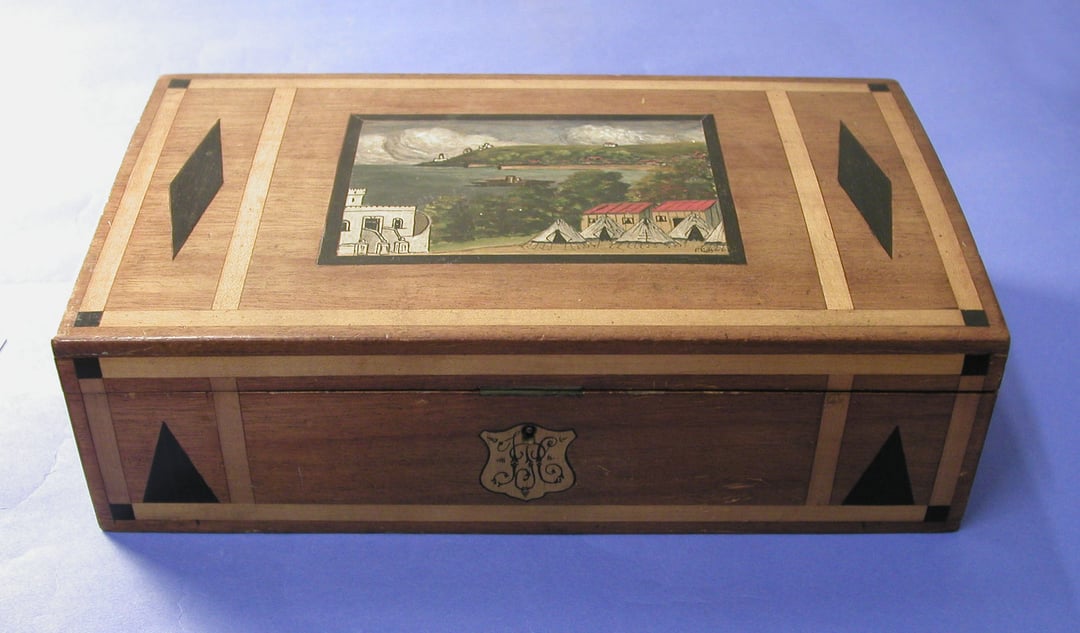
- - Box, souvenir (AM 2006.92.6-11). A souvenir box made by a German internee signing himself F.P.C. at the Douglas Aliens Detention Camp during the First World War. Fine handwork in bone, wood and straw is the best documented material category to come out of Manx internment, made by men with time and almost nothing else.
- - Box, souvenir (AM 2006.92.6-3). One of a set of souvenir boxes made by the internee F.P.C. at the Douglas Aliens Detention Camp in the First World War. The Douglas camp, in a former Cunningham holiday camp, opened before Knockaloe and was the island's first.
- - Box, souvenir (AM 2006.92.6-18). Another souvenir box by the internee F.P.C., Douglas Aliens Detention Camp, First World War. Craft work of this kind was sold, traded and sent home, and it is one of the few ways interned men entered the record in their own hand.
- - Box, souvenir (AM 2006.92.6-6). A carved souvenir box from the Douglas Aliens Detention Camp, made by a German civilian interned on the island during the First World War. The maker is known only by the initials F.P.C.
- - Eerste Wereldoorlog, propaganda, ansichtkaarten, prentbriefkaarten, SFA018000848. An orchestra of German prisoners at the Douglas camp, First World War, reproduced on a propaganda postcard. Organised music, theatre and teaching recur through the whole century of Manx internment, in the WWI camps and again in the WWII camps at Douglas and Onchan.
- - Box, souvenir (AM 2006.92.6-8). A souvenir box from the Douglas Aliens Detention Camp made by the internee F.P.C. during the First World War. Objects like these travelled: this one is now in the Auckland Museum collection.
- - Box, souvenir (AM 2006.92.6-7). Souvenir box carved by the German internee F.P.C. at Douglas during the First World War. Bone, wood and straw work of this kind is strongly attested in Manx museum collections.
- - Box, souvenir (AM 2006.92.6-12). A souvenir box made at the Douglas Aliens Detention Camp by the German internee F.P.C., First World War.
- - Box, souvenir (AM 2006.92.6-14). Another of the F.P.C. souvenir boxes from Douglas Aliens Detention Camp. The Douglas camp was set up in a requisitioned holiday camp and preceded Knockaloe, which opened in November 1914.
- - Box, souvenir (AM 2006.92.6-16). A souvenir box carved by the German internee F.P.C. at Douglas Aliens Detention Camp during the First World War, now in the Auckland Museum.
- - Waiting For Dinner in the Huts Art.IWMART17056. 'Waiting For Dinner in the Huts', painted inside a Manx internment camp in 1916, with bunks along the walls and clothing hung from hooks. Knockaloe was built of wooden huts, unlike the requisitioned boarding houses used in the Second World War.
- - Overnight Snowfall Melting Into Slush Art.IWMART17057. 'Overnight Snowfall Melting Into Slush', a camp yard between wooden huts, painted by an internee in 1917. Knockaloe held around 23,000 men, making it effectively one of the largest settlements in the Irish Sea.
- - View of a Pow Camp, Isle of Man, 1915-1919 Art.IWMART17053. A view down into a First World War prisoner camp on the island, painted by an internee between 1915 and 1919. WWI Knockaloe material is by far the better documented and more freely available seam of Manx internment imagery.
- - George Kenner and brother Benno washing salt herrings on the Isle of Man PoW Camp 10.9.1918. George Kenner and his brother Benno washing salt herrings at Knockaloe in 1918. Kenner was a German civilian interned for the duration, and the paintings and drawings he made inside the camp are among the fullest visual records of it that exist.
- - Storm and Rainbow, Symbol for Near End of War 1918 Art.IWMART17055. 'Storm and Rainbow, Symbol for Near End of War', painted in a Manx internment camp in 1918. The painter was one of the German civilians held at Knockaloe under Britain's enemy alien policy.
- - Last Supper Before Returning Feb. 1919 Art.IWMART17054. 'Last Supper Before Returning', February 1919, painted inside a Manx internment camp as men prepared to leave. Knockaloe operated until 1919, four months after the armistice.
- - Douglas - Central Promenade - Sunrise to the east. Central Promenade, Douglas (Doolish), at sunrise. Central Promenade Camp opened here in June 1940 and held over 2,000 internees by the end of that month, predominantly Italian; it closed after about ten months and became an RAF base.
- - Mooragh Park Lake Ramsey BW. Mooragh Park at Ramsey (Rhumsaa). Mooragh Camp opened on 27 May 1940 with a first intake of 823 internees and ran until September 1945. Like every Manx WWII camp it was made of requisitioned boarding houses enclosed in barbed wire rather than purpose-built compounds, and it held Nazi sympathisers and Jewish men together.
- - Arandora Star Part 4 of 4. Part four of a documentary series on the Arandora Star. The ship was carrying more than 1,600 men although designed for about 500; the sinking on 2 July 1940 changed British public opinion on internment and releases followed from later that year.
- - Detention of Second World War Prisoners of War and Great Britain's Enemy Aliens. Parks Canada on the detention of prisoners of war and British enemy aliens. Five ships were selected to move more than 6,000 internees and prisoners of war from Britain to Canada and Australia in 1940.
- - Arandora Star -- Ireland's Legacy. A documentary on the Arandora Star and its Irish legacy. The ship, carrying German, Austrian and Italian internees from Liverpool to Canada, was torpedoed by a German U-boat on 2 July 1940 about 100 miles northwest of Ireland; more than 800 died, around half or more of them Italian.
- - Barbed Wire - Publishers Disclaimer. The publisher's disclaimer from Hall Caine's 'The Woman of Knockaloe', later reissued as 'Barbed Wire'. Knockaloe Camp near Peel (Purt ny hInshey) opened in November 1914 and held around 23,000 internees with some 3,000 guards, on an island whose whole population was then about 50,000.
- - Hutchinson Square: Site of Hutchinson Internment Camp. The green on Hutchinson Square, Douglas, where the Hutchinson Camp university held its lectures on the lawn in good weather. A camp university was running within weeks of the camp opening in July 1940, drawing on interned scientists, lawyers, philosophers, writers and linguists.
- - The houses on th South side of Hutchinson Square, formerly a World War II internment camp. The south side of Hutchinson Square, Douglas, the site of Hutchinson Internment Camp in the Second World War. Kurt Schwitters was held here from July 1940 to November 1941 and made over 200 works in sixteen months, including more portraits than in any other period of his career.
- - T.T. week Red Arrows display. A Red Arrows display over Douglas during TT week, seen from Central Promenade. The same seafront terraces were sealed behind wire in 1940 as Central Promenade Camp, one of six named internment camps operating on the island at once.
- - Hutchinson Square green, the site of "University" lectures. Hutchinson Square green, Douglas, where the camp university lectured and internees played boules with knobs taken from bedsteads. Among those interned here was the prehistoric archaeologist Gerhard Bersu, a refugee from Nazism who excavated Manx archaeological sites while detained.
- - WW1 German Internment Camp - Libury Hall. A First World War German internment camp at Libury Hall in Hertfordshire. Knockaloe on the Isle of Man was the largest such camp in Britain, holding around 23,000 internees, and was central to the government's enemy alien policy.
- - Sending Letters Across the Isle of Man While Interned During WWII. An account of letters sent from internment on the island, recorded by the Yiddish Book Center. Correspondence was censored and rationed, and the surviving letters are a principal documentary source on daily life in the camps.
- - The Mooragh Internment Camp and the Midwood Family Home [Interview with Mary Midwood]. Mary Midwood recalls the Mooragh Camp and her family home at Ramsey. Manx families lived alongside the camps throughout, and at Rushen local residents and internees lived inside the same perimeter.
- - The Man with a Glass Nose - Visual Expression. A short piece on visual expression under confinement. At Hutchinson Camp in Douglas the Dada artist Kurt Schwitters produced over 200 works in sixteen months, including more portraits than in any other period of his career, and made sculpture from porridge.
- - World War 2 on the Isle of Man. A short account of the island in the Second World War. Six main civilian internment camps operated: Mooragh at Ramsey, Rushen at Port Erin and Port St Mary, Central Promenade and Hutchinson at Douglas, Onchan, and Peveril at Peel.
- - Friend or Foe? - The Exhibition. The Rushen Heritage Trust's 'Friend or Foe?' exhibition on the women's internment camp. Rushen opened on 29 May 1940 and was the only camp on the island holding women and children.
- - INTERNMENT ON THE ISLE OF MAN: HIS MAJESTY'S MOST LOYAL ENEMY ALIENS DOCUMENTARY. A documentary on wartime internment on the island. After the fall of France in 1940 Britain interned enemy aliens en masse, and a large proportion of those held on the island were Jewish refugees who had fled Nazi Germany and Austria.
- - Knockaloe Letters Project. Schoolchildren work on the Knockaloe Letters Project. Knockaloe Camp, at Knockaloe Farm in the parish of Patrick near Peel (Purt ny hInshey), opened in November 1914 and held around 23,000 internees with some 3,000 guards, on an island whose whole population was then about 50,000.
- - Husky Tones 'The Island Of Barbed Wire' Official Video. 'The Island of Barbed Wire', a song about internment on the island. The phrase describes both wars: Knockaloe held around 23,000 men from 1914 to 1919, and six civilian camps operated between 1940 and 1945.
- - 'Island Of Barbed Wire' A Short Film by Husky Tones. A short film built around the song 'Island of Barbed Wire'. At Rushen, uniquely, the wire enclosed two whole towns and Manx residents lived inside the perimeter alongside the interned women.
- - Peel & Knockaloe railway lines remembered. The Peel and Knockaloe railway lines remembered. A branch line was laid to serve Knockaloe Camp, which at around 23,000 internees was effectively one of the largest settlements on the Irish Sea while it operated from 1914 to 1919.
- - Friend or Foe? Remarkable story of Rushen camp. Manx Radio on 'Friend or Foe?', the Rushen Heritage Trust's research and book on the women's camp. Boarding house keepers at Port Erin and Port St Mary were paid a guinea a week for each internee billeted with them.
- - THE ANGELS WHO CARE. A short film on care and welfare in the island's internment story. Rushen, the women's camp opened on 29 May 1940 across Port Erin (Purt Chiarn) and Port St Mary (Purt le Moirrey), held over 4,000 women, about 300 of them pregnant.
- - WW2 Internment in the Isle of Man. Culture Vannin's account of Second World War internment on the island. Foreign nationals were graded A, B and C by tribunal, with category C assessed as friendly aliens, but after May 1940 those distinctions were largely overridden by blanket internment and many Jewish refugees had been wrongly categorised.
- - Remains of WWII Internment Camps (the Isle of Man in WW2). What remains of the Second World War internment camps on the island. Because the camps were requisitioned hotels and boarding houses rather than purpose-built compounds, most of the buildings are still standing and in ordinary use.
- - Medicine Behind Barbed Wire: Interned Medical Refugees on the Isle of Man.. A lecture on interned medical refugees held on the island. Hutchinson and Onchan camps held an unusual concentration of academics and professionals, and a camp university was running within weeks of Hutchinson opening in July 1940.
- - Beyond Barbed Wire Musicians in Mooragh Internment Camp, Ramsey, Isle of Man. Musicians in the Mooragh Camp at Ramsey, presented by the Association of Jewish Refugees. Professional musicians interned as enemy aliens gave concerts inside the wire, and Peter Gellhorn composed there in 1940.
- - Detail from boundary wall. A boundary wall at Knockaloe, built from the fabric of the internment camp itself. Knockaloe operated from November 1914 to 1919 and was the largest internment camp of the First World War; almost nothing of it survives above ground apart from reused stone like this.
- - Graves and headstones of Turkish Internees. Graves of Turkish internees held at Knockaloe Farm between 1915 and 1919. Britain's enemy alien policy swept up subjects of every state it was at war with, and the men who died in the camp were buried in the parish of Patrick, far from anywhere they had chosen to be.
- - 20753 Rifleman A E Joyce headstone. The headstone of Rifleman A. E. Joyce of the King's (Liverpool Regiment), who died on 28 February 1915 aged 49 and lies in Kirk Patrick churchyard. Knockaloe stood in this parish, and many of the soldiers buried here were guards rather than combatants.
- - Knockaloe Centre for WWI internment. The Knockaloe Centre for WW1 Internment, near Peel. It is run by the Patrick community as a not-for-profit charity with no government funding and volunteer staff, and holds artefacts, photographs and a 1:500 scale model of the camp.
- - Panorama of Knockaloe Farm - the internment camp. Knockaloe Farm, in the parish of Patrick near Peel, where the camp stood. Land here had been used for military training before it was built as a purpose-built internment camp in November 1914.
- - "I had a letter from Vaughan Williams...": Letters from the Mooragh Camp by Peter Gellhorn. Letters from Mooragh Camp by the composer Peter Gellhorn. Mooragh, at Ramsey (Rhumsaa), opened on 27 May 1940 with its first 823 internees, and held Nazi sympathisers and Jewish men in the same camp.
- - Women Internees on the Isle of Man. A lecture on the women interned on the island. Rushen was the only civilian camp on the island holding women and children, and the arrangement was unique: the wire was drawn around Port Erin and Port St Mary and the women were billeted with local families in their own boarding houses.
- - Music composed in Mooragh Internment Camp: Mooragh (1940) by Peter Gellhorn. 'Mooragh' (1940), music composed by Peter Gellhorn inside Mooragh Internment Camp at Ramsey. Gellhorn was one of many professional musicians and academics swept up by the blanket internment of May and June 1940.
- - Music composed in Mooragh Internment Camp: Cats by Peter Gellhorn. 'Cats', composed by Peter Gellhorn while interned at Mooragh Camp, Ramsey. Camps on the island were requisitioned boarding houses and hotels enclosed with barbed wire rather than purpose-built compounds, which is the visual signature of Manx wartime internment.
- - Peter Gellhorn & the Mooragh Internment Camp: An interview with Norbert Meyn. Norbert Meyn on the composer Peter Gellhorn and Mooragh Camp. Mooragh ran from May 1940 to September 1945 and held Jewish refugees and Nazi sympathisers together, a contradiction repeated across the island's camps.
- - World War II Internment in the Mooragh Camp, Isle of Man. Culture Vannin on the Mooragh Camp at Ramsey (Rhumsaa). Mooragh took its first 823 internees on 27 May 1940 and remained open until September 1945.
- - Beyond Barbed Wire, the Sea: A poem composed within Mooragh Internment Camp. 'Beyond Barbed Wire, the Sea', a poem written inside Mooragh Internment Camp. Camp newspapers, poetry, orchestras and lectures were produced across the island's camps; Hutchinson's paper 'The Camp' first appeared on 21 September 1940.
- - Music composed in Mooragh Internment Camp: Andante by Peter Gellhorn. 'Andante', composed by Peter Gellhorn in the Mooragh Internment Camp at Ramsey. Gellhorn went on to a long career in British music after his release.
- - Interned on the Isle of Man: Three Women Recall Their Experiences. Three women recall being interned on the island, recorded by the Association of Jewish Refugees testimony archive. Rushen held over 4,000 women, mostly German and Austrian refugees, at times making internees more than 80 per cent of the combined population of Port Erin and Port St Mary.
- - Second World War Internment in the UK - September 1939 to July 1940. A lecture covering internment in Britain from September 1939 to July 1940. Tribunals graded foreign nationals A, B and C, but after the fall of France the distinctions were overridden and refugees from Nazism were interned alongside its supporters.
- - Junction of Hutchinson Square and Waverley Terrace, Douglas. The corner of Hutchinson Square and Waverley Terrace in Douglas (Doolish). A 1941 sketch map by the interned architect Dr Bruno Ahrend records how the houses on this square were numbered and allocated as Hutchinson Camp, known as the artists' camp.
- - Kirk Patrick Holy Trinity church and graveyard. Holy Trinity church and graveyard at Kirk Patrick, with a considerable number of white Portland headstones. Many mark guards from the Knockaloe camp nearby, which operated in this parish from 1914 to 1919.
- - Arrandale apartments and hotel - the internees hospital - Hutchinson Square Internment Camp. The Arrandale on Hutchinson Square, requisitioned in the Second World War as the internment camp's hospital. Hutchinson opened in the second week of July 1940 with 415 men and held 1,205 by the end of that month.
- - Auschwitz Tree sign. A tree at Knockaloe grown from an acorn brought from Auschwitz, planted in recognition of internees around the world. The Second World War camps on the island held civilians, including Jewish refugees who had fled Nazi Germany and Austria and were then interned by Britain as enemy aliens.
- - 1, 2, 3, 4 and 5 Stanley View, Douglas. Numbers 1 to 5 Stanley View, Douglas, part of the Hutchinson Square camp. Internees mixed brick dust with the oil from sardine tins to make paint, and the camp's cultural department was run by Klaus Hinrichsen, who later became the principal historian of the art made there.
- - The alleyway between Hutchinson Square and Drury Terrace. 1940.
- - 6 and 7 Stanley Terrace, Douglas. Numbers 6 and 7 Stanley Terrace, Douglas, still carrying the house numbers they were allocated as part of Hutchinson Camp. Commandant Major H. O. Daniel actively enabled the camp's cultural life, which is why the artists' camp produced what it did.
- - Artist Hugo "Puck" Dachinger Austrian TV Report December 1991. An Austrian television report on the artist Hugo 'Puck' Dachinger, interned in Britain during the Second World War. Internee artists worked with what they could find; at Hutchinson Camp in Douglas they mixed brick dust with the oil from sardine tins to make paint.
- - Money of the WWII Internment Camps on the Isle of Man. A talk on the money issued inside the island's wartime internment camps. Camp scrip was one of several parallel institutions the internees built, alongside a camp university, newspapers, orchestras and art exhibitions.
- - Time Tunnellers: Far from home: WW1 internment camps. An educational film on First World War internment camps. Knockaloe, near Peel, opened in November 1914 on land already used for military training and operated until 1919, holding around 23,000 internees with about 3,000 guards.
- - SOS Arandrora Star. A short account of the loss of the Arandora Star on 2 July 1940. Responsibility is genuinely divided: the sinking was a German act, while the overcrowding and the decision to deport were British.
- - Planet Zero - 152 - Mooragh Internment Camp. A long-form discussion of the Mooragh Internment Camp. The camps were formed by requisitioning boarding houses and hotels and running barbed wire around a block of streets, so the internees lived in seaside terraces rather than huts.
- - Countryside 29 August 2023. Manx Radio's Countryside programme, covering the island's land and rural life. Knockaloe Camp occupied a working farm in the parish of Patrick, and the site returned to agriculture after the camp closed in 1919.
- - MUSEUM 100 22 AUGUST 2023. Manx Radio marks the centenary of the Manx Museum. Manx National Heritage holds the island's internment collections, including the material record of Knockaloe and the Second World War camps.
- - Enemy Aliens. A history podcast episode on Britain's enemy alien policy. Mass internment was ordered from mid-May 1940 and accelerated after Italy entered the war on 11 June 1940, which swept in a large Italian civilian population resident in Britain.
- - IoM TV archive: Knockaloe internment camp exhibition: 14.8.2014. Isle of Man TV's archive report on a Knockaloe internment camp exhibition. The Knockaloe Centre for First World War Internment at Patrick is run by the local community as a volunteer-staffed charity receiving no government funding, and holds a 1:500 scale model of the camp.
- - IoM TV archive: Kurt Schwitters internment camp art exhibition: 18.10.2013. An archive report on an exhibition of Kurt Schwitters' internment art. Schwitters was held at Hutchinson Camp in Douglas from July 1940 to November 1941; the commandant, Major H. O. Daniel, actively enabled the camp's cultural life.
- - Remembering Peel’s WW2 Internment Camp. Culture Vannin remembers Peel's wartime camp. Peveril Camp at Peel reopened on 12 May 1941 as a high security camp for British and foreign fascists, holding around 550 Mosley supporters, while Hutchinson at Douglas held their victims.
- - Taxi Podcast Episode 114 - Pamela on Noel Chavasse, Liverpool Scottish & Isle of Man Internment. A conversation touching on internment on the island alongside Liverpool history. The camps were a British government policy carried out here because the island had empty boarding houses out of season and was easy to seal.
- - IoM TV archive: Friend or Foe?: internment exhibition: 27.7.2016. An archive report on the 'Friend or Foe?' internment exhibition of 2016. The Rushen Heritage Trust researches and publishes on the women's camp at Port Erin and Port St Mary.