Levitation
Things floating with no support. The levitating frog that won an Ig Nobel, pyrolytic graphite hovering over a chessboard of magnets, a rubber horse on a carbon plate, water and strawberries in a bore magnet, and the field strengths each one needs.
Part of Diamagnetism
15 moments in this segment.
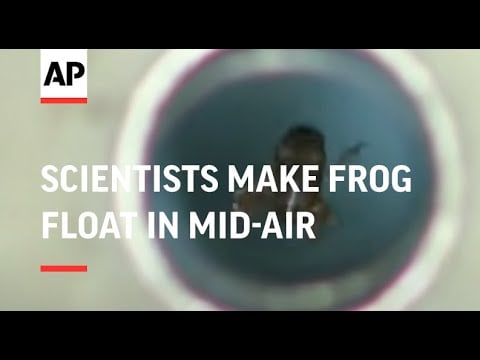
- - News footage: scientists make a frog float in mid-air. Associated Press coverage from 1997 of the Nijmegen experiment: a live frog held in the bore of a Bitter solenoid by the diamagnetism of the water in its own body. Contemporary news film of the moment the effect stopped being a laboratory curiosity and became famous.
- - A live frog levitating in a 16-tesla Bitter solenoid, Nijmegen. The famous photograph of a live frog floating inside the 32 mm vertical bore of a Bitter solenoid at about 16 tesla, at the High Field Magnet Laboratory in Nijmegen. Andre Geim and Michael Berry were levitating the water in the animal's own tissue - every ordinary substance is weakly diamagnetic, and a strong enough field gradient can hold it against gravity. The frog was unharmed, and it won Geim and Berry the 2000 Ig Nobel Prize in Physics.
- - Pyrolytic graphite levitating over a neodymium magnet array. A roughly 6 mm chip of pyrolytic graphite floating over four 5 mm neodymium cube magnets whose poles alternate in a checkerboard. Pyrolytic graphite is diamagnetic enough to hover over ordinary permanent magnets at room temperature, with no power and no cooling - the cheapest possible demonstration of Faraday's effect. Released into the public domain by its author.
- - Bismuth crystal, macro. A macro photograph of an iridescent hopper crystal of bismuth. Bismuth is the strongest diamagnet among ordinary metals, which is why Brugmans in 1778 and Faraday in 1845 both happened to be holding it when the effect showed itself. 2272x1704.
- - The levitating frog, ten seconds of it. Ten seconds of the frog turning slowly in the field. Nothing is holding it but the repulsion of ordinary water against a 16-tesla magnet.
- - Pyrolytic carbon levitation, high resolution. A high-resolution (2832x2128) photograph of a pyrolytic carbon plate suspended above a checkerboard magnet array, with the shadow gap clearly visible. The best-quality free image of a room-temperature diamagnetic levitation.
- - A rubber horse riding a levitating pyrolytic carbon plate. A toy rubber horse standing on a plate of pyrolytic carbon that is itself floating over a magnet checkerboard. It shows that the levitation carries real payload, and it is the kind of playful demonstration that runs in a direct line from Geim's frog. 2832x2128.
- - Diamagnetically stabilised levitation. A magnet held stably in mid-air between diamagnetic plates, the trick Werner Braunbek worked out in 1939 as the loophole in Earnshaw’s theorem, which had ruled stable magnetic levitation impossible since 1842.
- - Bismuth crystal, high-resolution macro. A very large (5184x3456) macro of a bismuth hopper crystal with the characteristic stepped spiral growth and oxide colours. The best-resolution free bismuth image found. Good for a full-bleed scene about the metal itself.
- - Pyrolytic graphite levitating on four magnets. A wafer of pyrolytic graphite resting on nothing above a square of neodymium magnets. Graphite is strongly enough diamagnetic to do at room temperature, on a desk, what the frog needed a 16-tesla superconducting magnet for.
- - Diamagnetic levitation demonstrated with pencil lead. Diamagnetic levitation shown with nothing but a few 3 mm neodymium magnets and a piece of ordinary pencil graphite. It is the most accessible version of the experiment and closes the loop from Faraday's heroic electromagnet to something anyone can do on a desk. 3092x1836.
- - Levitating highly oriented pyrolytic graphite (animated). An animation of a square of highly oriented pyrolytic graphite floating and drifting above a magnet array. Motion sells the effect in a way a still cannot: the plate can be nudged and it simply stays up. 480x360 GIF.
- - Pyrolytic graphite. A close look at pyrolytic graphite, the material that made diamagnetic levitation a thing you can own rather than a thing you visit a magnet laboratory to see.
- - Native bismuth in quartz. Skeletal crystals of native bismuth in quartz from the La Espuela de San Miguel mine, Cordoba, Spain, field of view 5 cm. This is bismuth as it occurs in the ground, rather than the lab-grown rainbow crystals. 6960x4640.
- - The strange magnetism of bismuth. Bismuth is the substance where the effect was first noticed, and the most strongly diamagnetic ordinary metal there is. A modern demonstration of exactly what Brugmans saw in 1778, a magnet pushing metal away instead of pulling it.