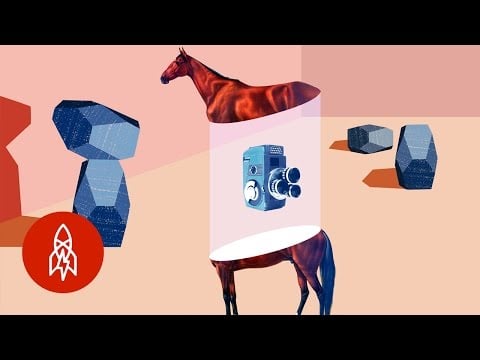
Motion Studies
Proving what the eye cannot catch. Muybridge's twenty-four tripwired cameras settling a bet about a galloping horse, the zoopraxiscope, Marey's chronophotographic gun, and Harold Edgerton's microsecond flash freezing a bullet through an apple and a drop of milk into a crown.
Part of Cameras
36 moments in this segment.
- - How One Horse Inspired the Invention of Movies. Muybridge & the Stanford horse bet (1872). In the years cinema was invented, the camera learned to capture not a moment but motion itself.
- - Eadweard Muybridge: Leland Stanford Jr.. Muybridge / Leland Stanford (1872). In the years cinema was invented, the camera learned to capture not a moment but motion itself.
- - Motion Capture Evolution: Muybridge to Marey | Shell Historical Film Archive. Muybridge to Marey (motion capture) (1878). In the years cinema was invented, the camera learned to capture not a moment but motion itself.
- - Muybridge's galloping horse (1878) (1878) (1 of 4). Muybridge's galloping horse (1878), an image made in 1878. In the years cinema was invented, the camera learned to capture not a moment but motion itself.
- - Muybridge's galloping horse (1878) (1878) (2 of 4). Muybridge's galloping horse (1878), an image made in 1878. In the years cinema was invented, the camera learned to capture not a moment but motion itself.
- - Muybridge's galloping horse (1878) (1878) (3 of 4). Muybridge's galloping horse (1878), an image made in 1878. In the years cinema was invented, the camera learned to capture not a moment but motion itself.
- - Muybridge's galloping horse (1878) (1878) (4 of 4). Muybridge's galloping horse (1878), an image made in 1878. In the years cinema was invented, the camera learned to capture not a moment but motion itself.
- - 1st Movie (Motion Picture) - Sallie Gardner at a Gallop (1878) Eadward Muybridge | Frame-by-Frame. Muybridge Horse in Motion 1878 (1878). In the years cinema was invented, the camera learned to capture not a moment but motion itself.
- - The Horse in Motion (Eadweard Muybridge) 1878. Muybridge The Horse in Motion (1878). Colour, instant prints and home movies brought the camera into everyday life, and one rode to the Moon.
- - Slices of Time: Eadweard Muybridge’s Cinematic Legacy. Eadweard Muybridge (1878). In the years cinema was invented, the camera learned to capture not a moment but motion itself.
- - 1878 - Sallie Gardner at a Gallop - Eadweard Muybridge. Muybridge, Sallie Gardner at a Gallop (1878). In the years cinema was invented, the camera learned to capture not a moment but motion itself.
- - "Sallie Gardner at a Gallop" or "The Horse in Motion" (Eadweard Muybridge, 1878). Muybridge, Sallie Gardner at a Gallop (1878). In the years cinema was invented, the camera learned to capture not a moment but motion itself.
- - Muybridge, The Attitudes of Animals in Motion. Eadweard Muybridge zoopraxiscope (1879). In the years cinema was invented, the camera learned to capture not a moment but motion itself.
- - The zoopraxiscope (1879) (1 of 4). The zoopraxiscope, the camera itself, 1879. In the years cinema was invented, the camera learned to capture not a moment but motion itself.
- - The zoopraxiscope (1879) (4 of 4). The zoopraxiscope, the camera itself, 1879. In the years cinema was invented, the camera learned to capture not a moment but motion itself.
- - Etienne-Jules Marey - Sport in the Darkroom (EN). Etienne-Jules Marey (1882). In the years cinema was invented, the camera learned to capture not a moment but motion itself.
- - Marey's chronophotography (1882) (2 of 4). Marey's chronophotography, an image made in 1882. In the years cinema was invented, the camera learned to capture not a moment but motion itself.
- - Marey's chronophotography (1882) (3 of 4). Marey's chronophotography, an image made in 1882. In the years cinema was invented, the camera learned to capture not a moment but motion itself.
- - Marey's chronophotography (1882) (4 of 4). Marey's chronophotography, an image made in 1882. In the years cinema was invented, the camera learned to capture not a moment but motion itself.
- - Marey's chronophotography (1882) (1 of 4). Marey's chronophotography, an image made in 1882. In the years cinema was invented, the camera learned to capture not a moment but motion itself.
- - Eadweard Muybridge: Studies in Motion. Eadweard Muybridge (1887). In the years cinema was invented, the camera learned to capture not a moment but motion itself.
- - Muybridge's motion studies (1887) (3 of 4). Muybridge's motion studies, an image made in 1887. In the years cinema was invented, the camera learned to capture not a moment but motion itself.
- - Muybridge's motion studies (1887) (4 of 4). Muybridge's motion studies, an image made in 1887. In the years cinema was invented, the camera learned to capture not a moment but motion itself.
- - Muybridge's motion studies (1887) (1 of 4). Muybridge's motion studies, an image made in 1887. In the years cinema was invented, the camera learned to capture not a moment but motion itself.
- - Muybridge's motion studies (1887) (2 of 4). Muybridge's motion studies, an image made in 1887. In the years cinema was invented, the camera learned to capture not a moment but motion itself.
- - 1891-95; 1900 - Chronophotographs by Étienne-Jules Marey (HA series) - Marey, Georges Demenÿ, Comte. Marey Chronophotography (1891). In the years cinema was invented, the camera learned to capture not a moment but motion itself.
- - Edgerton's high-speed photos (1957) (4 of 4). Edgerton's high-speed photos, an image made in 1957. Colour, instant prints and home movies brought the camera into everyday life, and one rode to the Moon.
- - Edgerton's high-speed photos (1957) (2 of 4). Edgerton's high-speed photos, an image made in 1957. Colour, instant prints and home movies brought the camera into everyday life, and one rode to the Moon.
- - Edgerton's high-speed photos (1957) (1 of 4). Edgerton's high-speed photos, an image made in 1957. Colour, instant prints and home movies brought the camera into everyday life, and one rode to the Moon.
- - Edgerton's high-speed photos (1957) (3 of 4). Edgerton's high-speed photos, an image made in 1957. Colour, instant prints and home movies brought the camera into everyday life, and one rode to the Moon.
- - Edgerton and His Incredible Seeing Machines (1985 documentary). Doc Edgerton high-speed photography (1985). Colour, instant prints and home movies brought the camera into everyday life, and one rode to the Moon.
- - The zoopraxiscope (1879) (2 of 4). The zoopraxiscope, the camera itself, 1879. In the years cinema was invented, the camera learned to capture not a moment but motion itself. The subject dates from 1879; this photograph was taken in 2013.
- - The zoopraxiscope (1879) (3 of 4). The zoopraxiscope, the camera itself, 1879. In the years cinema was invented, the camera learned to capture not a moment but motion itself. The subject dates from 1879; this photograph was taken in 2013.
- - Milk Drop: Behind Harold 'Doc' Edgerton's Photo & High-Speed Photography. Doc Edgerton high-speed photography (1957). Colour, instant prints and home movies brought the camera into everyday life, and one rode to the Moon.
- - Charles Wyckoff and the Rapatronic Camera. Edgerton/Wyckoff rapatronic camera (1952). Colour, instant prints and home movies brought the camera into everyday life, and one rode to the Moon.
- - The High Speed Photography of Prof Harold (Doc) Edgerton 1903-1990. Doc Edgerton high-speed photography (1940). Colour, instant prints and home movies brought the camera into everyday life, and one rode to the Moon.