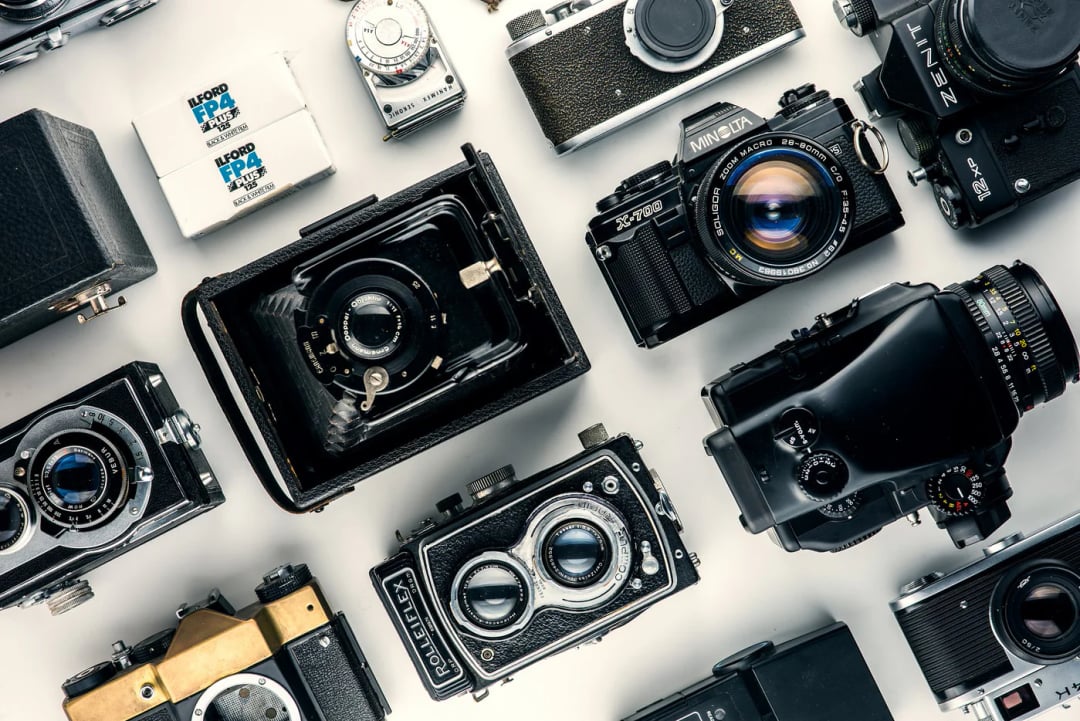
Cameras
Two hundred years of the camera, and the footage it gave us. From Niépce's eight-hour window in 1826 and Muybridge's galloping horse to the Lumière train, the moon-landing broadcast, the camcorder, the first digital frame, and the film studio everyone now carries in a pocket. The devices that captured the world, shown beside what they captured.
A chronological documentary of 729 moments spanning 1700–2026 on Loreline.
Curated by Olivier · last updated 2026-08-22
Eras
- Photographic Processes, How a picture was fixed before film. The camera obscura, Niépce's heliograph and Daguerre's mirror-polished plate, Talbot's paper negative, wet collodion carried into the field in a portable darkroom, tintypes made while you waited, and the stereoscope that put two slightly different views into one apparent solid.
- Motion Studies, Proving what the eye cannot catch. Muybridge's twenty-four tripwired cameras settling a bet about a galloping horse, the zoopraxiscope, Marey's chronophotographic gun, and Harold Edgerton's microsecond flash freezing a bullet through an apple and a drop of milk into a crown.
- Early Cinema, The first decade of moving pictures. Edison's Kinetoscope and the tar-paper Black Maria, the Lumières' cinématographe and the workers leaving the factory, Méliès painting a rocket into the moon's eye, the magic lantern that preceded all of it, and the actualities audiences watched simply because they moved.
- Kodak, George Eastman's bet that anyone could take a picture. The 1888 Kodak sold loaded and returned to the factory for developing, the one-dollar Brownie that put a camera in a child's hands, the Instamatic cartridge, Super 8, and the yellow box that meant film for a century.
- Leica & 35mm, The camera you could carry. Oskar Barnack's Leica built around cine film, the 35mm frame that became the standard, the Rolleiflex held at the waist, the Nikon F and the system camera, the machines that made candid photography physically possible.
- Colour Film, Getting the world's colours onto a plate. Prokudin-Gorsky's three exposures through three filters across the Russian Empire, the Lumières' Autochrome and its potato-starch grains, Kinemacolor, Technicolor's three-strip beam splitter, and Kodachrome, which held its colour for seventy years.
- Polaroid, A picture in sixty seconds. Edwin Land's daughter asking why she had to wait, the peel-apart print, the SX-70 folding to the size of a wallet, the whirr and the developing square, and the chemistry that made a darkroom unnecessary.
- Home Movies, Ordinary life, shot by the people living it. 8mm and 16mm reels, the Bolex, birthdays and holidays and back gardens, the projector and the bedsheet screen, and the accidental historical record that home footage turned out to be.
- Photojournalism, The camera as witness. Brady's teams photographing the American Civil War dead, the Speed Graphic and the press pack, the Hindenburg burning on newsreel, D-Day shot by combat cameramen, Iwo Jima, and the images that changed what the public would accept.
- Television Cameras, Live pictures down a wire. Farnsworth and Zworykin, the iconoscope and the image orthicon, the RCA TK studio cameras, the BBC's outside broadcasts, and the machines that made an event visible everywhere at the moment it happened.
- Videotape, Recording the picture instead of transmitting it. Ampex's quadruplex and the end of the kinescope, U-matic, the Betamax and VHS war, MiniDV, and the tape formats that decided what got kept.
- Camcorders, The camera that recorded onto tape in your hand. The Portapak that put video in the hands of artists and activists, the Betamovie, the Handycam, Video8 and Hi8, Nam June Paik, and the moment amateur footage started ending up on the news.
- Space Cameras, Cameras sent where people mostly cannot go. The V-2 films at the edge of the atmosphere, the Hasselblads carried to the Moon, Earthrise, Mariner and Viking and the Voyagers, and the first photographs taken of another planet's surface.
- Digital Cameras, The end of film. Steve Sasson's 1975 Kodak prototype recording to cassette, the CCD, Sony's Mavica, the QuickTake, the JPEG, the DSLR that professionals finally accepted, and mirrorless cameras removing the last moving part.
- Cinema Cameras, What films are shot on now. ARRI's Alexa, the RED, Blackmagic putting cinema sensors within reach, the underwater rigs Cousteau's crews built, and the digital bodies that pushed celluloid out of the industry that invented it.
- Phone Cameras, A camera in every pocket. The first camera phones, the iPhone, the Pixel and the Galaxy, computational photography stacking dozens of frames into one, the selfie, Instagram, and the fact that most photographs ever taken were taken this way.
- GoPro, The camera you strap to something. Nick Woodman's surf housing, the HERO line, helmet and board and dashboard mounts, Red Bull Stratos, 360 rigs and Insta360, and point-of-view footage as its own genre.
- Drones, The camera that flies itself. DJI's Phantom, Mavic and Avata, FPV racing rigs, the aerial shot that used to need a helicopter, and the regulation that arrived once everyone had one.
- Surveillance Cameras, Cameras that watch without a photographer. CCTV, the Trojan Room coffee webcam, the doorbell camera, police body cams, automatic number-plate readers, and the argument about who is holding the footage.
…and 729 more moments. Full text archive: /loreline-text/cameras.md